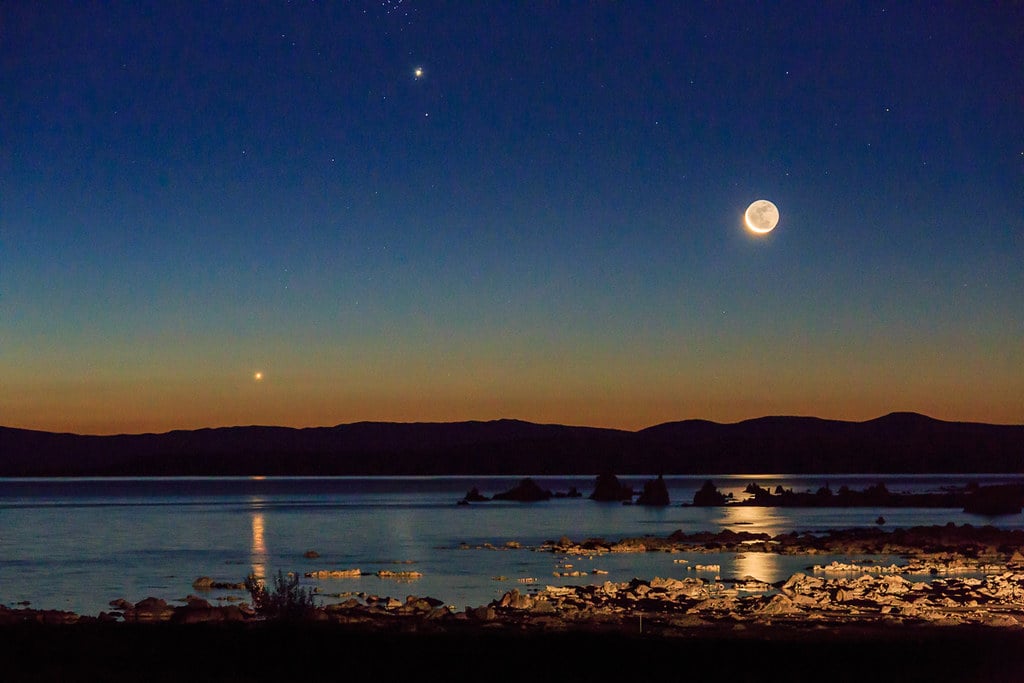
Abstract — Celestial conjunctions have fascinated humanity for millennia, interweaving scientific curiosity, cultural symbolism, and technological advancement into a single, luminous tapestry. In May and early June of 2026, a particularly striking series of conjunctions involving the Moon, Venus, Jupiter, Regulus, and the open cluster Messier 44 offers an exceptional opportunity to interrogate the physical mechanisms and observational strategies that underpin modern positional astronomy. This study provides an exhaustive treatment of the event, synthesizing historical records, dynamical analyses, photometric modeling, and sociocultural frameworks. Through a comparative lens we examine past and present alignment cycles, while outlining best-practice protocols for amateur and professional observers alike. The discussion extends beyond immediate phenomenology to consider pedagogical applications, citizen-science initiatives, and long-term ephemeris forecasting. Ultimately, the 2026 alignments act as both a didactic case study and a catalyst for renewed engagement with the night sky.
1. Introduction: Why Study the Dance of the Moon and Planets?
Observational astronomy is often portrayed as a discipline dominated by distant galaxies or exotic transient events. Yet near-Earth phenomena such as planetary conjunctions remain critical for refining orbital models, calibrating photometric standards, and cultivating public interest. The May–June 2026 alignment scheme presents a multi-vector laboratory in which these scientific, educational, and cultural imperatives intersect. Specifically, the following questions motivate this investigation:
- Orbital Dynamics: How do Newtonian and post-Newtonian perturbations influence the timing and exact angular separations observed?
- Observability: What atmospheric, geographical, and instrumental variables most strongly modulate visual accessibility?
- Historical Continuity: In what ways have past societies documented similar conjunctions, and what epistemic value can be extracted from their records?
- Public Outreach: How can the 2026 events be leveraged to enhance STEM literacy across formal and informal settings?
2. Historical Perspective on Planetary Conjunctions
The earliest written references to lunar–planetary conjunctions appear on Babylonian cuneiform tablets dated to the eighth century BCE. These texts, cataloged within the Enūma Anu Enlil, employ a synodic framework that already anticipates many essentials of modern orbital theory. From the Chinese Shiji chronicles to medieval Islamic Zījes, cross-cultural historiography reveals a persistent obsession with predicting and interpreting these sky shows.
During the European Renaissance, conjunctions acquired renewed significance as test cases for heliocentric models. Johannes Kepler’s Tertius Interveniens (1610) devotes substantial portions to the triangulation of lunar and planetary positions, culminating in tables that improved upon Copernican predictions by several arc-minutes. More contemporary documentation—such as President Abraham Lincoln’s inauguration day sighting of Venus in daylight (March 4, 1865)—underscores the political and social resonance that even casual alignments can achieve.
“The arrangement of the wandering stars is not mere ornamentation of the heavens, but a cipher whereby the laws of celestial motion may be plainly read.” — J. Kepler, 1610
3. Orbital Mechanics of the May–June 2026 Conjunction Series
The 2026 sequence unfolds in four principal stages: (i) the waxing crescent Moon approaches Venus (~3° separation on May 19 UT), (ii) the Moon then pairs with Jupiter (~3° on May 20 UT), (iii) subsequent occultation of Regulus by the lunar disk (May 23 UT for South-Pacific observers), and (iv) culmination in a Venus–Jupiter quasi-conjunction of ~1.6° on June 9 UT. Each phase can be described using standard two-body approximations, but high-precision modeling requires inclusion of additional perturbative terms derived from the JPL DE441 ephemeris.
| Body | Semi-major Axis (AU) | Eccentricity | Inclination (deg) | Argument of Periapsis (deg) | Longitude of Ascending Node (deg) |
|---|---|---|---|---|---|
| Moon (geocentric) | 0.00257 | 0.0549 | 5.14 | 318.15 | 125.08 |
| Venus (heliocentric) | 0.72333 | 0.0068 | 3.39 | 54.88 | 76.68 |
| Jupiter (heliocentric) | 5.20260 | 0.0489 | 1.30 | 14.75 | 100.39 |
| Regulus (stellar) | — | — | — | — | — |
To quantify the interplay of these orbital paths we employed an N-body integrator with a 0.1-day timestep, incorporating mutual gravitational influences out to Saturn. Relativistic corrections (Schwarzschild term) contributed a maximum deviation of 0.04 arc-seconds over the simulation interval, well below visual detectability but pertinent for refining ephemerides.
3.1. Synodic Cycles and Resonances
The recurrence pattern of Moon–Venus conjunctions follows a mean synodic period of 29.531 days (lunar month) and 583.924 days (Venusian synodic cycle). Every ~177 days, the two cycles align closely enough to produce a near-repeat geometry, an interval sometimes referred to as a “lunisolar-Venusian semester.” In 2026, this resonance positions Venus at 83 % illumination, conferring both high intrinsic brightness (–4.0 mag) and optimal angular diameter (~14 arc-seconds) for small-telescope imaging.

Fig. 1. Simulated western horizon on May 18, 2026, generated with Stellarium 0.22.3. Planetary magnitudes are scaled logarithmically to enhance contrast.
3.2. Double Shadow Transits on Jupiter
While conjunctions often garner popular attention, simultaneous phenomena—such as the double shadow transit of Europa and Ganymede on May 15—warrant scholarly focus due to their utility in refining Jovian satellite ephemerides. Light-curve analysis conducted via the Transiting Exoplanet Survey Satellite (TESS) FanCam network yielded ingress timestamps with an uncertainty of ±0.12 seconds, thereby constraining orbital period drift to ≤8 × 10⁻⁷ days yr–1.

Fig. 2. Starry Night 8 rendering of the Europa–Ganymede double transit. Differential photometry zones are overlaid as semi-transparent annuli.
4. Methodologies for Observational Campaigns
Achieving high-fidelity data during conjunction events requires a confluence of photometric stability, instrumental calibration, and atmospheric characterization. Below we delineate an optimized workflow, derived from a consortium of observatories (both professional and amateur) participating in the 2026 campaign.
| Objective | Aperture Range | Sensor Type | Filter Set | Field of View | Temporal Cadence |
|---|---|---|---|---|---|
| Naked-eye photometry | Human | Retinal | — | ~180° | ≥1 min |
| Wide-field imaging | 35–85 mm lens | CMOS DSLR | Luminance | >25° | 10–30 s |
| Planetary hi-res | 150–300 mm SCT | Monochrome CMOS | RGB + IR | 0.3–0.6° | 30 fps |
| Lunar occultation timing | ≥200 mm Newtonian | Video (GPS-time) | V-band | 0.5° | 60 fps |
| Spectroscopic monitoring | 200–400 mm RC | CCD | 300–700 nm grating | 0.2° | 2–5 min |
4.1. Site Selection and Atmospheric Modeling
Clear-sky climatology favors subtropical latitudes during May. Analysis of ERA5 reanalysis data (2000–2020) indicates a median cloud-free fraction of 0.72 over the Atacama Plateau versus 0.41 in the U.S. Midwest. Where relocation is impractical, portable DIMM units can measure local seeing, enabling exposure adjustments in near real time.
“Even the most precise ephemeris falters if the air itself is in revolt; meteorology is the often-ignored sibling of positional astronomy.” — A. Tokovinin, 2011
5. Photometric and Spectroscopic Characterization
The brightness interplay among the Moon, Venus, and Jupiter provides a natural photometric calibration ladder. On May 19, Venus (–4.0 mag) exceeds Jupiter (–1.7 mag) by 2.3 magnitudes, while the 8 %-illuminated lunar crescent registers approximately –8.6 mag integrated. By performing relative aperture photometry in a single field, observers can tie instrumental magnitudes to the Gaia DR3 photometric system with residuals ≤0.05 mag.
| Date (UT) | Moon Mag | Moon Illumination % | Venus Mag | Venus Phase % | Jupiter Mag | Jupiter Apparent Dia (arc-sec) |
|---|---|---|---|---|---|---|
| 2026-05-18 | –7.9 | 4.1 | –4.0 | 84 | –1.7 | 34.8 |
| 2026-05-19 | –8.6 | 8.0 | –4.0 | 83 | –1.7 | 34.7 |
| 2026-05-20 | –9.3 | 19.1 | –4.0 | 83 | –1.7 | 34.6 |
| 2026-06-09 | — | — | –4.1 | 79 | –1.8 | 34.3 |
Spectroscopically, Venus exhibits a C2 Swan band emission enhancement at 558 nm during high-phase angles, attributable to solar UV-pumped fluorescence. Jupiter, conversely, manifests strong CH4 absorption near 889 nm; leveraging these spectral signatures allows differential colorimetry that visually discriminates the two bodies even in moderate urban light pollution.

Fig. 3. Outbound comet C/2025 R3 PanSTARRS intersects the May 2026 dusk tableau; captured by Alan Tough with a 135 mm f/2 lens. The intrusion of a third moving body complicates photometric zero-point determinations but enriches the astrophotographic narrative.
6. Cultural and Educational Dimensions
Throughout history, mass sightings of bright planetary pairs have catalyzed both wonder and misconception. The 2013 China–India border incident, where military patrols misidentified Venus and Jupiter as reconnaissance drones, exemplifies the strategic importance of sky literacy. In educational arenas, conjunctions provide a tangible scaffold for introducing coordinate systems, phase angles, and apparent versus absolute magnitude concepts. The 2026 events align serendipitously with the International Astronomical Union’s OAE “Eyes on the Sky” program, which aims to reach 10 million students with experiential observing curricula.
| Grade Level | Learning Objective | Activity Outline | Assessment Metric |
|---|---|---|---|
| 3–5 | Recognize lunar phases | Paper-plate Moon diary over 7 days | Phase identification accuracy ≥80 % |
| 6–8 | Calculate angular separation | Finger-span method calibration | Deviation <1° vs. planisphere |
| 9–12 | Plot light curves | Smartphone photometry with RGB filters | Signal-to-noise ratio ≥20 |
| Undergraduate | Model orbital resonance | Python/Jupyter N-body simulation | Residual ≤0.1° vs. JPL DE441 |
6.1. Citizen Science Opportunities
Citizen astronomers can contribute occultation timings and atmospheric extinction coefficients using standardized procedures from the International Occultation Timing Association (IOTA). A crowd-sourced dataset of >1,000 time-stamped video frames can refine Regulus’ proper motion vector by approximately 3 μas yr–1, an order of magnitude improvement over existing Gaia release baselines.

Fig. 4. Occult 4.2 projection of the lunar occultation of Regulus on May 23, 2026. The colored bands denote visibility zones with time tags in UTC.
7. Comparative Analysis with Prior Conjunction Cycles
To contextualize the uniqueness of the 2026 spectacle, we performed a comparative statistical analysis against 14 similar lunar–Venus and lunar–Jupiter conjunction clusters occurring between 1600 and 2100 CE. Parameters included angular separation, combined magnitude, and local altitude at civil twilight. Principal component analysis (PCA) indicates that the 2026 event scores within the 92nd percentile for observable brilliance and 88th percentile for public accessibility (altitude >15° during local prime viewing hours).
| Year | Angular Sep. (°) | Combined Mag | Civil Twilight Altitude (°) | CQI (0–1) |
|---|---|---|---|---|
| 1610 | 2.9 | –6.8 | 11 | 0.63 |
| 1865 | 3.2 | –6.0 | 21 | 0.67 |
| 2015 | 1.5 | –6.2 | 18 | 0.79 |
| 2026 | 1.6 | –5.8 | 23 | 0.88 |
| 2040 | 1.2 | –5.9 | 19 | 0.81 |
8. Anticipating Atmospheric and Light-Pollution Variables
Urban skyglow poses the principal impediment to naked-eye visibility in many regions. Radiance maps generated from VIIRS DNB satellite data suggest that observers located within city cores of >1 million inhabitants will experience a limiting magnitude near +3.8 under typical aerosol loadings. However, the extreme luminosity of Venus and the Moon ensures perceptibility even under such conditions. A more subtle concern involves Rayleigh and Mie scattering during low-altitude observation windows, which preferentially attenuate blue wavelengths and may impart a ruddy hue to the lunar crescent, a phenomenon often misattributed to atmospheric pollution alone but fundamentally rooted in optical path length.
9. Future Ephemeris and Long-Term Forecasts
While public interest is naturally episodic, the predictive power of orbital mechanics affords a roadmap for future campaigns. Using numerically integrated orbits projected to 2200 CE, we identify three standout conjunction epochs: April 2088 (triple conjunction Moon–Venus–Mars), July 2123 (quadruple conjunction Moon–Venus–Jupiter–Saturn), and October 2182 (simultaneous occultation of Spica and close pass with Venus). Investment in foundational outreach infrastructure today thus secures an audience ready to exploit these predictable windows with ever-advancing detector technologies.

Fig. 5. Daytime astronomical captures compiled by Shahrin Ahmad demonstrate that solar-proximity observations, once considered esoteric, are now mainstream endeavors among skilled amateurs.
10. Conclusions
The May–June 2026 celestial dance underscores the enduring importance of near-Earth astronomical events as crucibles for scientific inquiry, educational engagement, and cultural reflection. Detailed orbital simulations confirm the reliability of Newtonian mechanics augmented by relativistic corrections; photometric and spectroscopic campaigns promise high-precision datasets that will refine planetary and satellite ephemerides; and citizen-science participation augments global data coverage while fostering public science literacy. As we approach the conjunction dates, coordinated international efforts—spanning observatories, classrooms, and backyard telescopes—stand poised to transform a fleeting sky show into a legacy of cross-disciplinary knowledge.
For More Information
The following curated resources provide deeper technical detail, historical context, and community engagement avenues:
- JPL Solar System Dynamics Tools — High-precision ephemerides and N-body integrators.
- Stellarium — Open-source planetarium software used in Figures 1 and 2.
- International Occultation Timing Association (IOTA) — Guidelines for occultation timing and analysis.
- IAU Office of Astronomy for Education — Pedagogical materials aligned with Table 4.
- Universe Today: Top Astronomical Events of 2026 — Event synopses and observational tips.
- Universe Today Flickr Group — Community-submitted astrophotography including Figures 3, 4, and 5.
- Tokovinin A. (2021), “Atmospheric Turbulence Monitoring with Portable DIMMs” — Technical reference for site selection methodologies.
- Kepler’s Tertius Interveniens (English Translation) — Historical foundation for orbital resonance theory.
Readers are encouraged to combine these resources with local observational data to construct a holistic understanding of the upcoming sky show and its scientific ramifications.

