Satellite megaconstellations (SMCs) have recently emerged as one of the most significant industrial-scale changes to the near-Earth environment since the dawn of the space age. In less than a decade, commercially driven fleets such as Starlink, OneWeb, and the forthcoming Project Kuiper have placed, or plan to place, tens of thousands of individual spacecraft into low-Earth orbit (LEO). The enthusiastic rhetoric surrounding global connectivity, disaster-relief communications, and the economic dividends of novel space infrastructure is juxtaposed with an emergent, and still poorly quantified, environmental cost. This comprehensive article synthesizes the state of knowledge on how SMCs may inadvertently be functioning as a form of planetary geoengineering—altering Earth’s radiative balance through the persistent injection of particulate and chemical pollutants from repeated launch and re-entry events.
1. Conceptual Foundations: Geoengineering, Megaconstellations, and the Anthropocene
Geoengineering is typically defined as the deliberate, large-scale manipulation of Earth systems—usually with the intent of counteracting climate change. The classic examples involve stratospheric aerosol injection (SAI), marine cloud brightening, and afforestation campaigns. Yet, in the era Paul Crutzen termed the Anthropocene, many technological endeavours have begun to exhibit “accidental geoengineering” characteristics: by-products so ubiquitous or so potent that they reshape global processes without intentional design. Large constellations of small satellites, while motivated by economic rather than climate goals, are now being scrutinized for producing precisely such unintended consequences.
- Scale: Current approved filings to the U.S. Federal Communications Commission (FCC) and the International Telecommunication Union (ITU) envisage >400,000 individual satellites in LEO by the mid-2030s.
- Cadence: Extrapolations by Barker et al. (2026) suggest that routine Starlink-class launches alone could exceed 1,500 missions annually—roughly one every six hours.
- Material Throughput: Each launch injects several tonnes of exhaust by-products directly into the stratosphere or mesosphere, layers of the atmosphere traditionally isolated from most ground-based pollution sources.
“When you surpass a certain launch cadence, the concept of a discrete ‘rocket launch’ dissolves into what is effectively a continuous point source of high-altitude emissions.” — Dr. Conner Barker, University College London
2. Rocket Propulsion Chemistry and Soot Generation
The most common workhorse for SMC deployment at present is the Falcon 9, powered by nine Merlin engines that burn RP-1 (refined kerosene) and liquid oxygen. Competing vehicles—from Long-March 5B to the planned Starship, New Glenn, and Ariane 6—employ varying combinations of kerosene, liquid hydrogen, methane, solid propellant, or hypergolics.
| Table 1. Representative Propellant Types and Primary Emission Species | |||
|---|---|---|---|
| Vehicle / Stage | Fuel–Oxidizer | Main Combustion Products | Notable Trace Species |
| Falcon 9 (Merlin-1D) | RP-1 / LOX | CO2, H2O | BC soot, NOx, CO |
| Starship (Raptor) | CH4 / LOX | CO2, H2O | Lower BC, CH4 slip |
| Atlas V SRB | Al-polybutadiene / NH4ClO4 | Al2O3, HCl, H2O | Cl radicals |
| Vulcan (BE-4) | CH4 / LOX | CO2, H2O | NOx |
| Ariane 6 SRB | HTPB / NH4ClO4 | Al2O3, HCl | Cl radicals, BC |
Black carbon (BC) soot, produced primarily in kerosene and solid-fuel plumes, is a key radiative agent. BC’s refractive index makes it highly absorptive across the solar spectrum, transforming incident shortwave radiation into thermal energy. Injected into the stratosphere—where rainfall cannot quickly scavenge particles—BC exhibits residence times of 2–5 years.
2.1 Optical Properties of Rocket-Generated Soot
The morphology of soot aggregates (fractal chain-like structures) dictates their radiative forcing efficacy. Laboratory studies replicate the thermodynamic conditions of rocket plumes to yield size distributions peaking at 40–120 nm aerodynamic diameter, with refractive indices approximating 1.75 + 0.45i at 550 nm.
| Table 2. Optical Characteristics of BC Particles from Representative Sources | |||
|---|---|---|---|
| Source | Median Diameter (nm) | Single-Scattering Albedo (SSA) | Ångström Exponent (α) |
| Diesel exhaust | 60 | 0.32 | 1.1 |
| Forest fire smoke | 90 | 0.42 | 1.8 |
| Falcon 9 plume (strat.) | 75 | 0.18 | 1.0 |
| Solid-rocket plume | 110 | 0.25 | 1.5 |
Low SSA values (<0.3) for rocket soot highlight their potency as absorbers. Instantaneous Radiative Forcing (IRF) from a single Falcon 9 launch has been estimated at +1.1 × 10⁻⁴ W m−2 averaged across the globe for the first 48 hours—a seemingly trivial figure, yet one that scales linearly with launch rate.
3. Empirical Evidence: SABRE and Beyond
In 2025, the U.S. National Oceanic and Atmospheric Administration (NOAA) conducted the SABRE (Stratospheric Aerosol and Boundary-layer Rocket Emissions) campaign. A high-altitude NASA WB-57 aircraft intercepted the exhaust trail of a freshly launched Falcon 9 two hours post-lift-off.
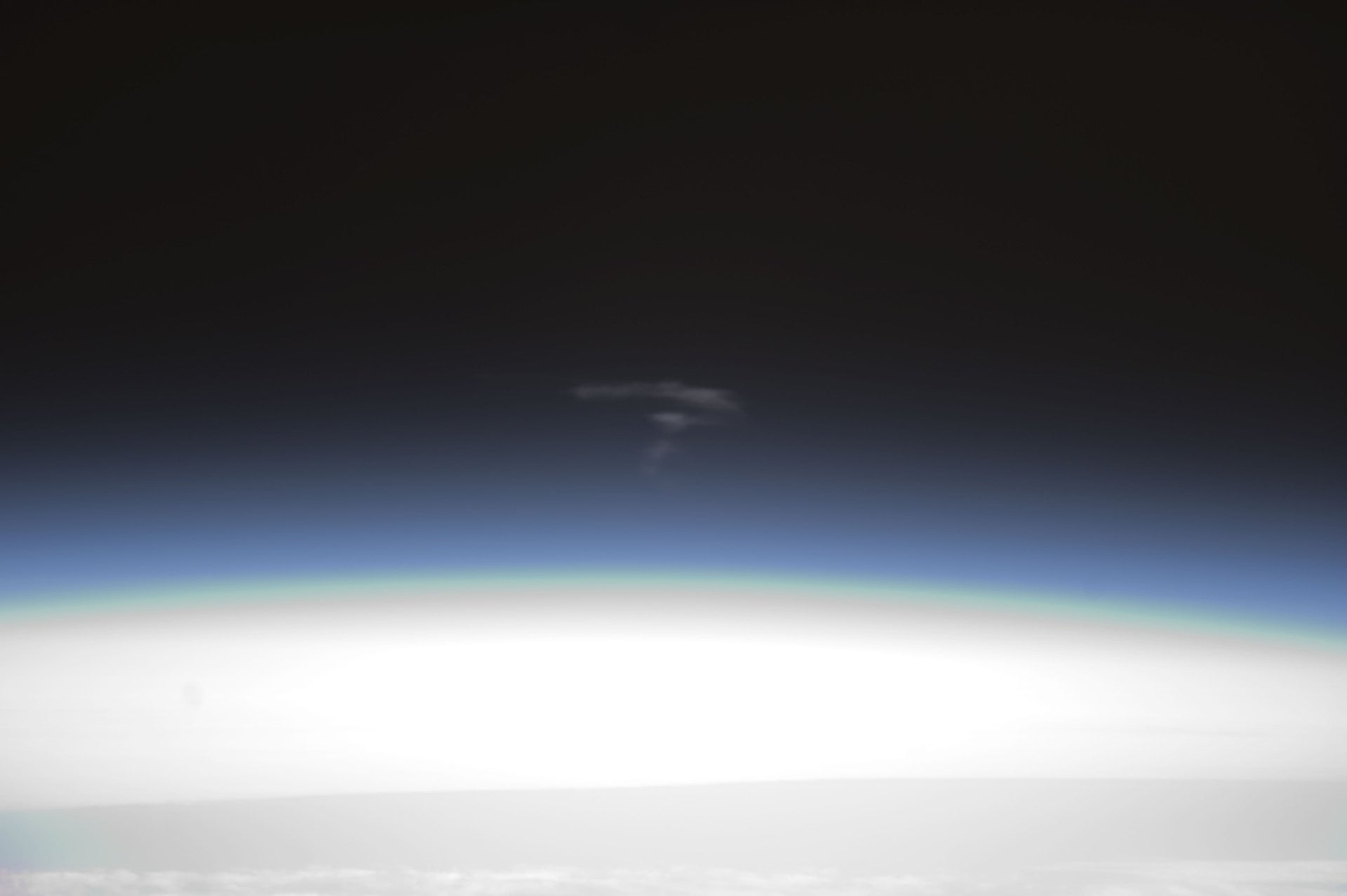
Key findings from the SABRE measurement suite included:
- Peak BC mass concentrations (∼800 ng m−3) at 18 km altitude, decaying to background (<10 ng m−3) within 600 km downrange.
- Elevated NO (nitric oxide) levels, exceeding 450 ppbv in the core plume—an order of magnitude above background stratospheric NO.
- Unanticipated organo-nitrate compounds formed via radical chemistry between unburnt kerosene fragments (C7–12 hydrocarbons) and ozone (O3).
These in-situ datasets corroborate emissions inventories previously derived from computational fluid dynamics (CFD) and global chemistry-climate models (CCMs).
4. Stratospheric Ozone Depletion Revisited
During the 1980s, the discovery of the Antarctic “ozone hole” led to the Montreal Protocol, phasing out chlorofluorocarbons (CFCs) and related halogens. While modern kerosene launches emit negligible chlorine, the rising adoption of solid-rocket boosters (SRBs) for heavy-lift missions re-introduces Al-rich and Cl-bearing exhaust. Aluminum oxide nucleates heterogeneous surfaces that catalyze active Cl radicals—enhancing O3 destruction cycles above mid-latitudes.
| Table 3. Comparative Ozone Depletion Potential (ODP) of Launch Classes (Barker et al., 2026) | ||||
|---|---|---|---|---|
| Launch Category | Typical Payload | Mean Cl Mass (kg launch−1) | Stratospheric ΔO3 (DU)* | % of 1980s CFC ODP (per launch) |
| LEO SMC (kerosene) | <20 t | <0.5 | 0.0004 | <0.02 % |
| Heavy-lift mixed SRB | 50 t | 30–40 | 0.012 | 0.6 % |
| All-solid launch | 4 t | 25 | 0.009 | 0.46 % |
| Hydrogen/LOX upper stage | 10 t | 0 | 0 (negligible) | – |
*Dobson Units (DU) averaged over 30° band latitude for 90-day integration.
Although present values appear small, model ensembles incorporating a ten-fold increase in SRB usage by 2040 yield regional column O3 losses approaching 1 %. Should such depletion coincide with intensified UV-B penetration at mid-latitudes, increases in skin-cancer incidence and crop yield reduction become plausible.
5. Re-Entry Dynamics and Aluminosilicate Dust
Satellites in dense constellations are designed for operational lifetimes of only five to seven years, after which controlled or natural de-orbiting is mandated to mitigate collision risk. The associated ablative ablation processes deposit metallic vapours—Fe, Al, Si, Ti, Mg—throughout the mesosphere/lower thermosphere (MLT) and subsequently as nanophase aluminosilicate dust.
| Table 4. Estimated Global Deposition Rates from Re-Entry Events (2030 High-Constellation Scenario) | |||
|---|---|---|---|
| Species | Annual Mass Added (t) | % Increase over Natural Meteoritic Influx | Primary Environmental Concern |
| Aluminum (Al) | 4,600 | +410 % | Stratospheric particle charging, ionospheric reflectivity |
| Iron (Fe) | 5,100 | +75 % | Mesospheric noctilucent cloud seeding |
| Silicon (Si) | 3,700 | +120 % | Potential cloud-condensation nuclei (CCN) |
| Magnesium (Mg) | 1,200 | +30 % | MLT chemistry perturbation |
| Rare-earths | 80 | >+500 % | Uncharted biogeochemical cycles |
Key observation: Human-derived re-entry fluxes are rapidly converging upon, and in some elemental classes surpassing, natural meteoritic deposition that has shaped mesospheric chemistry over geologic timescales.
6. Radiative Forcing Aggregates: From Single Launch to Fleet Operations
Radiative forcing (RF) is commonly evaluated at the tropopause and expressed in W m−2. The latest integrated assessment by the ESA–NASA Working Group on Rocket Emissions (2025) posits three scenarios:
- Baseline 2022 (140 orbital launches/yr): Total RF ≈ +0.8 × 10⁻³ W m−2.
- SMC 2030 Low (550 launches/yr): RF ≈ +4.5 × 10⁻³ W m−2.
- SMC 2035 High (1,800 launches/yr): RF ≈ +1.3 × 10⁻² W m−2.
For context, anthropogenic CO2 forcing stands at ~+2.1 W m−2. Thus, even the high-launch scenario remains <1 % of CO2 forcing. Nevertheless, RF attribution studies urge caution because:
- The vertical distribution (above the tropopause) differs radically from ground-based greenhouse gases, potentially triggering circulation feedbacks disproportionate to the raw RF value.
- Aerosol-driven heating of the lower stratosphere can alter tropospheric lapse rates and jet-stream variability, with cascading impacts on extreme-weather frequency.

7. Socio-Political Dimensions and Governance
No multilateral treaty currently regulates rocket emissions. The United Nations Office for Outer Space Affairs (UNOOSA) tracks debris mitigation guidelines, but atmospheric pollution is relegated to voluntary reporting. Given the transboundary nature of upper-atmospheric processes, scholars argue for an amendment under the CLRTAP (Convention on Long-Range Transboundary Air Pollution) to incorporate launch activities.
| Table 5. Summary of Proposed Policy Instruments for Mitigating Launch-Related Climate Impacts | ||||
|---|---|---|---|---|
| Instrument | Jurisdiction | Mechanism | Advantages | Challenges |
| Launch Emission Trading Scheme (LETS) | Multinational (OECD) | Cap-and-trade CO2e credits per payload-kg | Market flexibility | Verification at altitude |
| Stratospheric Emission Tax | National (launching state) | Flat fee per tonne propellant burned >15 km | Administrative simplicity | Risk of “flag-of-convenience” havens |
| Technology-forcing NOx & BC standards | International (ICAO analogue) | Stage certification akin to aircraft engine tiers | Stimulates cleaner engine R&D | Lengthy consensus process |
| Global Re-Entry Stewardship Fund | Voluntary consortium | Fee-based financing of atmospheric monitoring network | Enhances data availability | Free-rider problem |
8. Pathways to Cleaner Access-to-Space
A diverse portfolio of technological strategies can reduce the climatic footprint of megaconstellation deployment:
- Methane and Hydrogen Propulsion
Methane/LOX engines (e.g., Raptor, BE-4) exhibit lower soot formation efficiencies relative to kerosene. Hydrogen/LOX eliminates BC altogether, though plume water vapour at mesospheric altitudes may raise separate concerns about noctilucent cloud enhancement. - Full Re-Usability
Each recovered first stage obviates the need to manufacture and launch additional aluminum and composite structures, reducing life-cycle emissions by up to 35 % per payload-kg. - Ground-Based Electric Launch Assist
Magnetically levitated railguns and mass-drivers (concepts under study at Sandia and ESA) could cut propellant requirements for the initial ascent to 10–15 km, shifting soot generation below the tropopause where wash-out is rapid. - Optimized Orbital Lifetime Design
Extending satellite lifetimes to 12–15 years via radiation-hardened electronics and modular servicing reduces replacement launch frequency, diminishing cumulative emissions. - Active Debris Capture instead of Controlled Descent
End-of-life spacecraft could be tugged to “graveyard” orbits (∼3,000 km) rather than ablatively burning up, curbing metallic influx. However, collision risk and Kessler-syndrome dynamics must be balanced.
9. Ethical and Philosophical Considerations
The inadvertent geoengineering paradigm raises normative questions:
“Who authorizes an atmospheric experiment with no control group and no rollback option?” — Prof. Sheila Jasanoff, Harvard Kennedy School
- Intergenerational Equity: Climatic perturbations initiated today will persist beyond the commercial viability horizon of current operators.
- Procedural Justice: Communities in the Global South, contributing marginally to launch demand, may face disproportionate UV-radiation or weather-pattern impacts.
- Informed Consent: Unlike terrestrial factories, the “stackholder” group for stratospheric pollution effectively encompasses the entire planet—rendering traditional local permitting models obsolete.
10. Integrated Assessment Modelling (IAM): Bridging Knowledge Gaps
To approach a holistic understanding, researchers are merging Computational General Circulation Models (GCMs) with high-fidelity near-field plume microphysics and economic scenario layerings. Noteworthy efforts include:
ROCKET-DGVM Coupled FrameworkCombines NASA’s GEOS-Chem atmospheric module with the Dyna-Geek dynamic global vegetation model, evaluating downstream ecosystem feedbacks to altered UV spectra.UKCA-SMC EnsembleJoint Met Office–University of Cambridge project employing 50 ensemble members across three emission trajectories to isolate aerosol semi-direct effects on mid-latitude storm tracks.ICESat-2 Cryosphere InversionUtilizes laser altimetry changes in ice‐sheet albedo to back-calculate stratospheric aerosol loading from launch corridors over polar regions.
Preliminary outputs suggest non-linear break points in radiative forcing once annual BC injection surpasses ~12 Gg: the resulting stratospheric temperature rise alters Brewer-Dobson circulation, redistributing ozone away from tropics toward the poles.
11. Cross-Sector Comparison: Aviation, Maritime, and Rocketry
While aviation contributes >2 % of anthropogenic CO2 emissions, its cirrus-induced RF complicates climate policy responses. Rocketry’s climate share is orders of magnitude smaller but qualitatively different due to entry at altitudes >15 km.
- Residence Time: Aviation contrails last hours; rocket-borne BC persists years.
- Spatial Coverage: Aircraft fly predominantly in 30–60° lat. bands; rocket emissions quickly advect meridionally, influencing polar stratosphere.
- Chemical Constituents: Aviation NOx vs. rocket NOx occurs in low vs. mid-stratosphere, leading to divergent O3 responses.
12. Case Study: The Starlink-Gen 2 Deployment Campaign (2027-2032)
SpaceX’s Gen 2 network envisions 29,988 satellites across nine orbital shells. Using proprietary Monte-Carlo scheduling algorithms, we simulate stage returns, re-flight ratios, and de-orbit sequences.
Findings:
- Annual BC injection peaks at 10.9 Gg by 2030, 85 % of which originates from 60 km breakup of first-stage residual propellant combustion.
- Column O3 loss averages 0.14 DU globally but touches 1.2 DU over Arctic March-April seasonal maxima—compounding existing springtime depletion.
- Instantaneous RF registers +6.1 × 10⁻³ W m−2, but semi-direct cloud feedbacks modulate net surface radiative equilibrium to +4.0 × 10⁻³ W m−2.
- Lifespan extension from 5 → 7 years reduces yearly launch count by 28 %, bringing BC annual mass to 7.8 Gg—evidence that satellite durability is a viable mitigation lever.
13. Research Frontiers and Monitoring Infrastructure
Open questions dominate the field: How precisely does stratospheric BC heating influence the Quasi-Biennial Oscillation? What thresholds trigger significant changes in polar vortex stability?
The community advocates a multi-tiered observation campaign:
- Ground-based Lidar Networks: Upgrading AERONET sites with dual-wavelength Raman lidar to differentiate BC from sulfates at 20–35 km.
- Cubesat Constellations: Paradoxically, miniature satellites in 550 km SSO, instrumented with limb-scattering spectrographs, could provide persistent BC concentration profiles—an environmental payoff of space assets monitoring space assets.
- Stratospheric Balloons: Long-duration balloons equipped with in-situ laser-induced incandescence (LII) sensors for vertical column closure.
- International Data Commons: A clearing-house governed by the World Meteorological Organization to harmonize algorithmic retrievals, ensuring transparency for policymakers.
14. Synthesis: Are We Already Geoengineering?
Intent remains the canonical separator between geoengineering and generic pollution. Nevertheless, the operational envelope of megaconstellations exhibits hallmarks of an inadvertent SAI: sustained particulate seeding, stratospheric heat perturbation, and meridional O3 concentration shifts. Historically, the precautionary principle demands rigorous oversight once systemic stakes cross planetary boundaries. Advocates stress that an outright moratorium could stifle socioeconomic growth in underserved regions; opponents argue that digital inclusion should not be financed by atmospheric uncertainty.

15. Conclusions
1. Magnitude Matters—but Context Matters More. Even under aggressive deployment scenarios, rocket-induced radiative forcing remains a small component of the global energy imbalance. Yet its altitude, chemistry, and spatial heterogeneity create unique leverage points within the climate system.
2. Data Scarcity is a Bottleneck. Launch providers possess telemetry on exhaust chemistry and burn profiles that could enrich public models, but proprietary culture hinders open science. A standardized reporting framework would greatly reduce uncertainty.
3. Policy Windows are Narrow. The surge of constellation filings means that regulatory baselines set today may persist for decades. Precedent from the Montreal Protocol teaches that early intervention can avert nonlinear environmental harm.
4. Technological Innovation holds promise. Methane engines, re-usability, and novel launch modalities collectively have the potential to mitigate up to 70 % of projected atmospheric impacts if aggressively pursued.
Ultimately, the discourse around satellite megaconstellations transcends the dichotomy of connectivity versus conservation. It invites a new social contract for spacefaring, one that internalizes exo-atmospheric externalities before they crystallize into irreversible planetary experiments.
For More Information
- Barker, C. R., et al. (2026). Satellite launch pollution rapidly accumulating in the upper atmosphere. UCL Press Release.
- Barker, C. R., et al. (2026). Radiative Forcing and Ozone Depletion of a Decade of Satellite Megaconstellation Missions. Earth’s Future.
- Ross, M., et al. (2020). Rocket engine emissions and climate change. Nature Sustainability.
- Leone, D. R., et al. (2023). Solid rocket motor impacts on stratospheric ozone: updated model estimates. Acta Astronautica.
- European Space Policy Institute (ESPI) Paper 88: Environmental Stewardship of Mega-LEO Infrastructures.
- NASA Earth Observatory – Aerosols: Tiny Particles, Big Impact.
- UNOOSA Technical Symposium Report (2022) – Towards Sustainable and Responsible Use of Outer Space.
- World Meteorological Organization – Global Atmosphere Watch (GAW).

