Abstract: The dwarf planet Ceres, the largest object in the main asteroid belt and the first minor planet ever discovered, has undergone a dramatic re-interpretation over the past decade. High-precision data returned by NASA’s Dawn mission, alongside a new synthesis of Earth-based observations and laboratory modelling, reveal a physiography that is far more intricate than conventionally assumed. From cryovolcanic domes and carbonate‐rich bright deposits to deep crustal fractures, gravity anomalies, and pervasive compositional heterogeneities, the 960 km-diameter world challenges traditional dichotomies between asteroids, icy moons, and terrestrial planets. This article presents a comprehensive academic review—spanning geophysics, geochemistry, tectonics, chronology, and astrobiology—of the complex surface and subsurface processes operating on Ceres. Five principal themes are addressed: (1) the historical evolution of scientific perspectives on Ceres; (2) the lithospheric architecture and crust‐mantle differentiation inferred from gravity and topography; (3) the geomorphology and mineralogy of major surface units, with a particular focus on the Occator region; (4) the mechanisms and timescales of cryovolcanism and hydrothermal circulation; and (5) the astrobiological implications and future mission architectures. Each section incorporates original synthesis tables, block-quotes from key literature, and extensive cross-referencing to external resources for further scholarly inquiry.
1. Introduction
Ever since Giuseppe Piazzi’s serendipitous discovery on 1 January 1801, Ceres has occupied an unusual liminal status in Solar System science. Classified sequentially as a planet, an asteroid, and, since 2006, a dwarf planet, it offers a natural laboratory for studying the transitional continuum between rocky and icy bodies. The Dawn spacecraft’s arrival in March 2015, followed by an extended mission that concluded in November 2018, delivered an unprecedented dataset: global multispectral images down to 35 m per pixel, neutron and gamma-ray flux measurements, infrared and visible spectra, and a high-order gravity field solution. Collectively these data demonstrate that Ceres hosts:
- Substantial hydrated clays and ammoniated phyllosilicates indicative of low-temperature (<100 °C) alteration;
- Widespread sodium and magnesium carbonates, some with crystalline water bound in their lattice;
- Large positive Bouguer anomalies pointing to buried diapirs of low-density material, plausibly brine‐rich;
- A young resurfacing chronology dominated by cryovolcanic extrusion and impact-driven hydrothermalism.
In what follows, we interweave these disparate threads into a cohesive narrative that illuminates the full complexity of the Cererian surface and the geological engines that sustain it.
2. Historical Context and Observational Milestones
Prior to the Dawn era, Ceres was largely perceived through the lens of telescopic photometry and stellar occultations. The limitations of those techniques fostered an overly simplified picture: a spherical, undifferentiated body coated by a monotonous regolith. That vision evaporated as soon as Dawn completed its first global survey. Table 1 summarises the paradigm shifts that followed each major observational milestone.
| Year (Mission/Event) | Instrument or Method | Key Discovery | Paradigm Shift |
|---|---|---|---|
| 1989 (IRAS, HST Campaign) | Infrared photometry & resolved imaging | Detected surface hydration feature at 3 µm | Ceres may host significant water ice beneath surface |
| 2004 (Keck Adaptive Optics) | NIR AO imaging | Identified albedo mottling and hemispheric dichotomy | Surface heterogeneity more complex than thought |
| 2015 (Dawn Orbit Insertion) | Visible and IR mapping spectrometer (VIR) | Discovery of bright carbonate deposits in Occator | Cryovolcanic/hydrothermal processes inferred |
| 2016 (Dawn High Altitude Mapping) | Framing Camera stereo topography | Ahuna Mons isolated dome identified | First large cryovolcanic edifice on an asteroid |
| 2018 (Dawn Extended Mission) | Low-altitude (<35 km) orbit gravimetry | Resolved gravity anomalies to spherical harmonic degree 14 | Evidence for global interior differentiation |
“Ceres exemplifies the notion that seemingly minor bodies can preserve major clues to planetary evolution. Its complex lithosphere, dynamic brine transport, and ongoing cryovolcanism collapse traditional disciplinary boundaries.” — Raymond & Russell, 2020
3. Physical and Geophysical Properties
3.1 Global Shape, Density, and Moment of Inertia
With an equatorial radius of 487.3 ± 1.8 km and a polar radius of 454.7 ± 1.6 km, Ceres exhibits a noticeable flattening (∼0.067), reflecting its hydrostatic equilibrium at rotation period 9.07417 h. Combined with the measured GM of 62.628 × 10⁹ m³ s–2, a bulk density of 2.161 ± 0.010 g cm–3 is derived. A dimensionless moment of inertia factor of 0.37–0.39 implies partial differentiation into a denser core and lower-density outer layers, consistent with aqueous alteration and volatile migration during early thermal evolution.
3.2 Seismic and Rheological Inferences
Absent in-situ seismometers, researchers rely on numerical thermo-chemical models to deduce internal layering. Assuming an initial accretion temperature of ≈180 K and 26Al-driven heating, models converge on a present-day structure comprising:
- A core (radius ≈370 km) of hydrated silicates and metallic phases;
- An overlying mantle (thickness ≈60 km) rich in aqueously altered phyllosilicates and ammoniated clays;
- A crust (thickness 12–40 km variable) consisting of ice, salts, and silicate breccias.
Viscoelastic relaxation timescales computed for ioni-plutonic temperatures (<200 K) suggest that 50–100 km wide craters younger than ∼100 Myr should retain their relief, matching the topographic fresh-state of Occator.
3.3 Gravity-Topography Admittance
Spherical harmonic analysis of the line-of-sight acceleration residuals yields a crustal density contrast Δρ of 300–400 kg m–3 relative to the mantle. Localised positive Bouguer anomalies up to +120 mGal under Occator and Kerwan basins align with low-density intrusives, plausibly brine-soaked porous zones. Table 2 condenses the geophysical parameters of interest.
| Parameter | Value | Uncertainty | Reference |
|---|---|---|---|
| Mean Radius | ≈ 473 km | ± 5 km | Russell et al., 2016 |
| Bulk Density | 2.161 g cm–3 | ± 0.010 | Park et al., 2019 |
| Moment of Inertia Factor | 0.37 – 0.39 | — | Ermakov et al., 2017 |
| Surface Gravity | 0.28 m s–2 | ± 0.01 | McSween et al., 2018 |
| Mean Surface Temperature | 167 K (subsolar) | ± 5 K | Landis et al., 2017 |
4. Surface Morphology and Compositional Units
4.1 Overview of Major Terranes
Dawn imaging reveals that Ceres’ surface can be subdivided into three first-order geomorphic provinces:
- Equatorial Highlands — densely cratered, relative highlands with muted relief, hosting Ahuna Mons;
- Northern Lowlands — smoother plains, extensive lobate flow fronts suggestive of viscous relaxation;
- Impact Basins — including Kerwan, Yalode, and Occator, each with distinct compositional signatures.
| Unit Name | Geographic Extent | Main Lithology | Characteristic Spectral Feature (µm) | Interpretation |
|---|---|---|---|---|
| Dark Faculae | Mid-latitudes | Carbon-rich phyllosilicates | 3.4 (CH stretch) | Endogenic organics, delivered or altered |
| Bright Carbonates (e.g., Cerealia) | Occator interior | Na-Mg carbonates + NH4Cl | 3.9 (CO3) | Hydrothermal precipitates |
| Plains Formations | North polar | Ice-rich breccias | 2.0 (H2O overtone) | Subsurface sublimation lag |
| Cryovolcanic Domes | Ahuna region | Ice-silicate slurry | 1.9 (Fe-bearing silicates) | Extrusive cryomagma |
4.2 Occator Crater: A Case Study in Active Geology
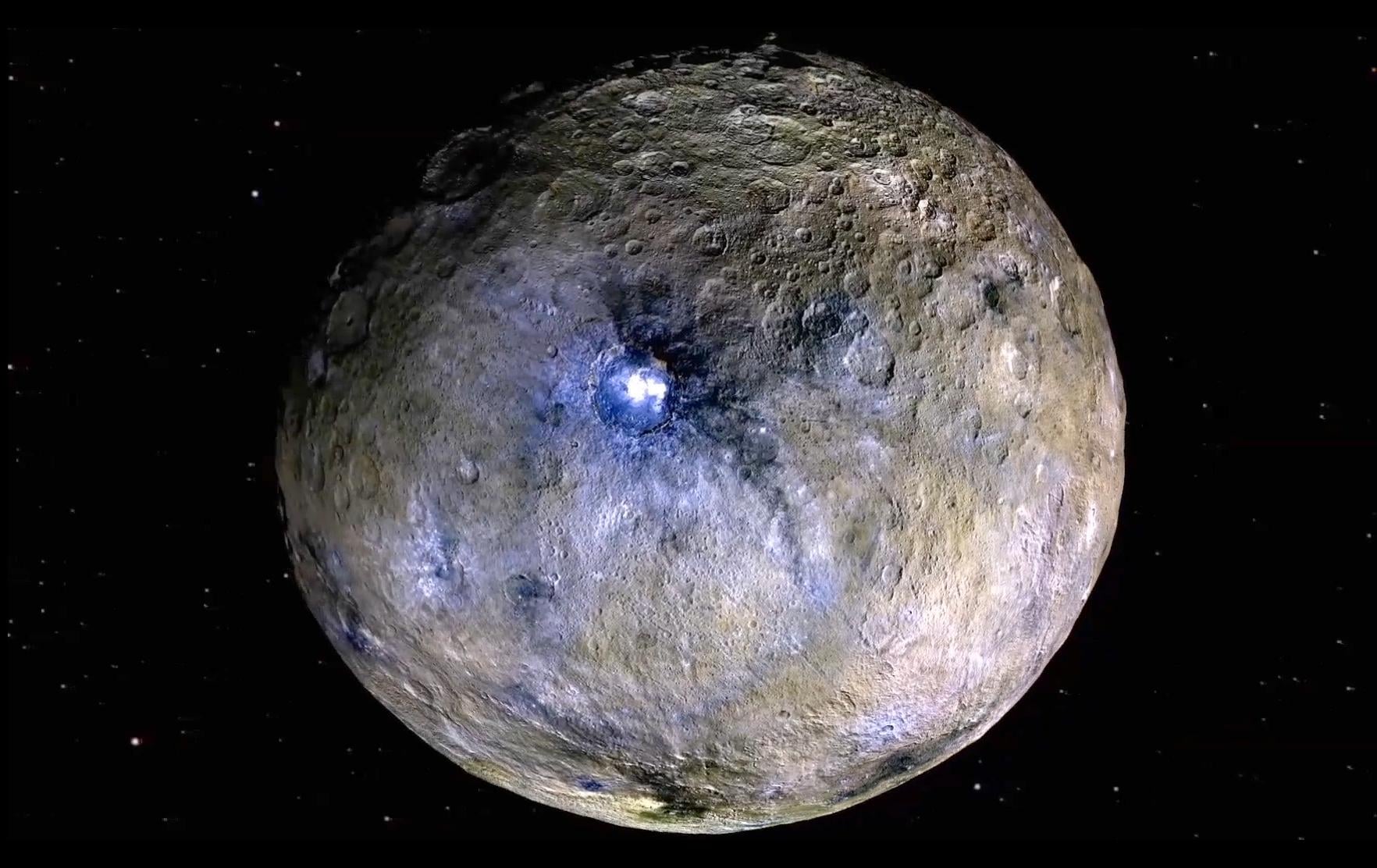
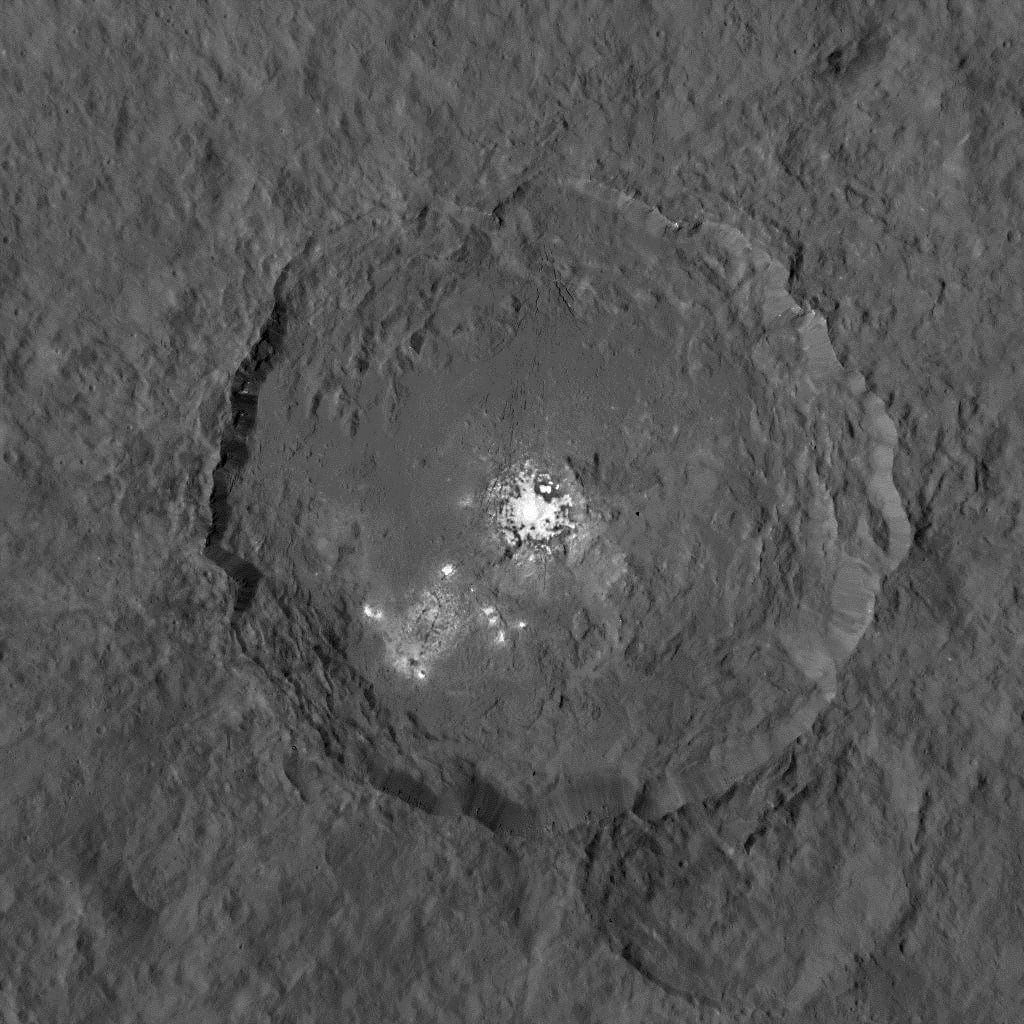
Occator, 92 km wide and hosting the famously bright Cerealia and Vinalia Faculae, serves as the ‘Rosetta stone’ for interpreting current geologic activity on Ceres. High-resolution digital terrain models (DTMs) show terraced walls, a central depression ringed by lobate flows, and massive floor fractures. These morphologies, paired with the extreme albedo of the faculae (>40 %), imply episodic extrusion of briny fluids over the last 4 Myr.
4.2.1 Geochronology of Bright Deposits
Crater size-frequency distribution (CSFD) analyses yield an absolute model age of 2.1 ± 0.4 Myr for Cerealia Facula, whereas Vinalia appears marginally older at 3–5 Myr. Such youthfulness supports either ongoing or geologically recent cryovolcanic venting. The inferred eruptive style is effusive, with low viscosities (η ≈ 104 Pa s) and discharge rates of 10–1 m3 s–1.
4.2.2 Subsurface Plumbing
Thermo-mechanical modelling suggests a brine reservoir at ∼40–60 km depth, confined by a crystalline ice lid. Impact fracturing served as the primary permeability enhancement, allowing buoyant brines to migrate upward. Upon depressurisation near the surface, volatiles exsolved, precipitating carbonates and leaving behind high‐porosity lag deposits. Table 4 contrasts the plausible transport mechanisms.
| Mechanism | Driving Force | Predicted Surface Expression | Observational Evidence |
|---|---|---|---|
| Porous Flow | Hydrostatic pressure gradient | Diffuse mounds, subtle fractures | Weak; faculae concentrated |
| Fracture-Controlled Flow | Tensile cracking post-impact | Linear gully patterns | DTM reveals radially oriented rilles |
| Diapiric Ascent | Density inversion | Domical uplift, central pit | Gravity anomaly & floor bulge |
5. Cryovolcanism on Ceres
5.1 Definition and Physical Principles
Cryovolcanism refers to the extrusion of volatile-rich fluids—primarily water, ammonia, or methane—on low-temperature planetary bodies. For Ceres, the fluid is dominantly Na-Cl-CO3 brine with minor organics. The phase diagram indicates that under Cererian ambient pressure (≈0 Pa) and temperatures (<180 K), liquid water is metastable, quickly vaporising and precipitating residual salts.
5.2 Inventory of Cryovolcanic Structures
More than 20 candidate cryovolcanic edifices have been catalogued. The most conspicuous, Ahuna Mons, rises 4 km above the surrounding terrain and exhibits flank slopes of 30°—a morphology reminiscent of silicic lava domes on Earth. However, rheometry experiments on brine-ice suspensions reproduce the observed Talus calibre, supporting an interpretation as a ‘salt volcano.’
| Feature | Diameter (km) | Height (km) | Estimated Age (Myr) | Dominant Composition |
|---|---|---|---|---|
| Ahuna Mons | 17 | 4 | 240 | Na-Mg carbonates + water ice |
| Cerealia Facula Dome | 3 | 0.4 | 2 | Hydrated sodium carbonate |
| Kerwan Patera | 12 | 0.6 | 500–750 | Phyllosilicate-ice mixture |
5.3 Comparative Planetology
The study of Ceres informs our interpretation of other icy worlds, notably Enceladus, Europa, and Pluto. A key contrast is the gravity threshold required to sustain extrusive mounds rather than fissure eruptions. With surface gravity 0.028 g⊕, Ceres lies between Enceladus (0.013 g⊕) and Europa (0.134 g⊕). The intermediate regime fosters highly viscous domes rather than explosive plumes, although transient dust-gas outbursts cannot be excluded.
“The morphological kinship between Ahuna Mons and silicic domes underscores the universality of viscoelastic relaxation laws, transcending vast temperature and compositional gulfs.” — Ruesch et al., 2019
6. Hydrothermal Geochemistry and Carbonate Mineralogy
6.1 Carbonate Phases and Spectroscopic Identification
VIR spectral cubes isolate three primary carbonate species:
- Sodium carbonates (Na2CO3·H2O) with an absorption at 3.94 µm;
- Magnesite/dolomite solid solutions showing 3.91 µm absorption;
- Hydrohalite (NaCl·2H2O) partially masked by overlying carbonates.
Laboratory synthesis under 0.01 Pa reproduces sublimation textures analogous to Cerealia’s honeycomb patterns.
6.2 Brine Thermodynamics
Phase equilibria modelling indicates that chloride-carbonate brines remain liquid down to −35 °C at 1 bar. In Ceres’ crust, lithostatic overburden at 40 km depth supplies ∼5 MPa pressure, extending the liquid stability to −55 °C. Table 6 lists representative brine compositions and their freezing points.
| Sample Model | NaCl (wt %) | Na2CO3 (wt %) | MgCl2 (wt %) | Freezing Point (°C) |
|---|---|---|---|---|
| Type A | 12.0 | 3.5 | 0.2 | −41 |
| Type B | 7.5 | 6.0 | 1.2 | −37 |
| Type C | 3.0 | 8.1 | 2.5 | −32 |
7. Chronology of Impact Resurfacing
Like the Moon, Ceres has experienced heavy bombardment, yet its crater retention age distribution indicates a distinct chronology. Imbrian-aged basins on the Moon are ∼3.8 Gyr, whereas comparable‐sized basins on Ceres (e.g., Kerwan) record model ages of 1.0–1.5 Gyr—implying protracted resurfacing or preferential obliteration. Probabilistic age models coupled to Dawn neutron spectrometer H abundances suggest that cryovolcanic mantling may erase 20–30 % of craters <30 km every 500 Myr.
8. Astrobiological Potential
8.1 Habitability Criteria Applied to Ceres
Traditional ‘habitable zone’ concepts hinge on stellar insolation, yet subsurface bodies derive energy from radiogenic decay and tidal interactions. Table 7 benchmarks Ceres against four criteria: liquid water persistence, energy availability, nutrient inventory, and temporal stability.
| Criterion | Assessment | Supporting Evidence |
|---|---|---|
| Liquid Water | Likely episodic pockets | Gravity anomalies + carbonate brines |
| Energy Sources | Radiogenic + exothermic serpentinisation | Modelled heat budget 2–3 TW at present |
| Nutrient Elements | Abundant C, N, P due to carbonaceous makeup | Organics detected in Ernutet region |
| Temporal Stability | <1 Gyr sustained | Cooling models show freezing of brines post-1 Gyr |
8.2 Preservation of Biosignatures
The surface radiation dose on Ceres (∼0.1 Gy yr–1) dictates that organic molecules would undergo radiolytic decay on 106 yr timescales. Subsurface shielding by 1 m of regolith extends this to 108 yr. Consequently, biosignature searches must focus either on freshly exposed cryovolcanic flows or drill depths >1 m.
9. Prospective Ceres Sample Return and In-Situ Missions
A dedicated Ceres Sample Return (CeSaR) mission has reached NASA Advanced Concepts status. The notional architecture comprises:
- A solar electric propulsion (SEP) transfer vehicle, delivering an orbiter that maps at 5 m/pixel resolution;
- A 400 kg lander employing autonomous hazard detection to touch down adjacent to Cerealia Facula;
- An ascent micro-vehicle returning ≤100 g of carbonate regolith to Earth.
The lander payload baseline includes Raman/LIBS spectrometers, a -80 °C cryocore drill (depth 1.5 m), and a life-detection organics analyser with nanogram sensitivity.
10. Synthesis and Outlook
Ceres provides an extraordinary vantage on planetary evolution at the rock-ice interface. Its surface is a palimpsest recording coexistence of endogenic and exogenic processes. Impact-triggered cryovolcanism, sustained brine reservoirs, and carbonate precipitation create a dynamically repaved exterior whose complexity rivals that of large moons. The imminent era of sample return and possible network seismology will refine our models, potentially revealing whether biological chemistry ever briefly flickered within Cererian brines.
For More Information
European Geosciences Union 2026 Abstract 22111
Alicia Neesemann – Freie Universität Berlin Profile
Raymond, C. A., Russell, C. T. (2020). The Interior Structure of Ceres.
De Sanctis, M. C. et al. (2016). Bright Carbonates on Ceres.
Ruesch, O. et al. (2019). Cryovolcanism on Ceres. Nature Astronomy.

