Abstract. The unveiling of a five-meter-diameter composite propulsion module by the China Academy of Launch Vehicle Technology (CALT) represents a seminal development in the global quest for fully reusable orbital-class launch vehicles. The present article offers a comprehensive, multidisciplinary, and academically oriented examination of this milestone, contextualizing it within the historical evolution of Chinese rocketry, scrutinizing the underlying composite material science, detailing the engineering processes involved in the module’s manufacture, and assessing its integration into the forthcoming Long March 10 architecture. A comparative survey of international reusable launch systems is presented, followed by an exploration of economic, strategic, and environmental ramifications. Challenges and future trajectories are discussed to furnish a holistic perspective on China’s rapidly maturing capabilities in the reusable-launch sector.
1 – Introduction: Reusability as a Paradigm Shift in Spaceflight
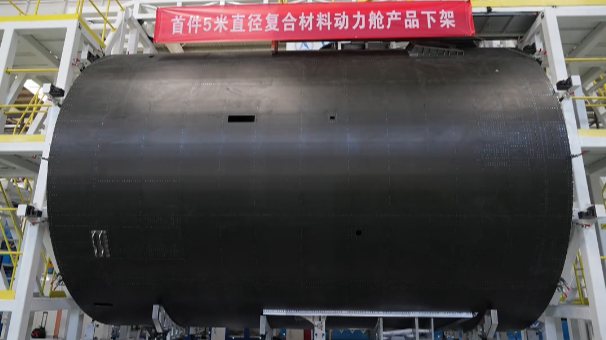
Reusability has transitioned from an aspirational ideal to an operational cornerstone among leading space-faring nations and enterprises. By permitting the recovery, refurbishment, and relaunch of major rocket stages, reusable architectures substantially diminish marginal launch costs, accelerate launch cadence, and lower the environmental burden traditionally associated with expendable vehicles. Since the first successful booster landing by SpaceX in December 2015, the competitive landscape has been radically altered, catalyzing governmental institutes and private companies alike to re-evaluate legacy systems. China’s state-owned CALT, operating under the aegis of the China Aerospace Science and Technology Corporation (CASC), has responded by unveiling a propulsion module whose primary barrel measures five meters in diameter and is fabricated predominantly from advanced fiber-reinforced polymer (FRP) composites. The explicit aim is to serve as the backbone for the partially reusable Long March 10, envisioned to ferry taikonauts to cislunar space in the early 2030s.
Although American and European endeavors initially commanded the spotlight, China’s iterative and centrally coordinated program now exhibits distinctive features: (i) a vertically integrated industrial base with extensive state support; (ii) strategic coupling of orbital transportation with a nation-wide constellation plan; and (iii) substantial investment in composite tooling and automated fiber-placement technologies. The propulsion module under discussion exemplifies these attributes, boasting a 60 % composite mass fraction—a remarkable achievement, given the structural, thermal, and manufacturing challenges at this scale.
The ensuing sections dissect these issues systematically, beginning with a historical review of Chinese launch vehicles, followed by an in-depth material science analysis, an engineering case study of the composite barrel, and a multi-scalar assessment of broader implications. The article deploys a variety of data-presentation techniques—including tables, lists, blockquotes, and images—to facilitate granular comprehension while maintaining academic rigor.
2 – Historical Foundations of Chinese Launch-Vehicle Development
Modern Chinese rocketry traces its lineage to the Dongfeng ballistic missile series of the late 1950s and early 1960s. Initial satellite-launch capabilities coalesced in the Long March 1 (CZ-1) vehicle, which lofted China’s first satellite, Dong Fang Hong 1, in 1970. Since then, the Long March family (Changzheng, CZ) has diversified:
- CZ-2/3/4 Series – Cryogenic and hypergolic two- and three-stage expendable rockets primarily serving low-Earth and Sun-synchronous orbits.
- CZ-5 – A heavy-lift rocket featuring a five-meter core but employing metal-alloy structures and expendable staging.
- CZ-6/7 – Medium-lift variants integrating kerosene/LOX propulsion to align with global trends toward high-performance, low-toxicity fuels.
The pivot toward reusability accelerated after 2019, when commercial competitors and the burgeoning national megaconstellation strategy made cost reduction imperative. The culmination of these policy and technical incentives is summarized in Table 1.
| Table 1. Evolution of Chinese Launch-Vehicle Strategy Toward Reusability | |||
|---|---|---|---|
| Year | Programmatic Milestone | Technological Enabler | Strategic Driver |
| 2015 | Announcement of National Civil-Space Infrastructure Plan | Reusable engine demonstrators (YF-100 variants) | Commercial launch cost pressures |
| 2019 | First VTVL test of a 2 t thrust kerosene engine platform | Guidance & navigation algorithms adapted from ICBM heritage | Proof-of-concept for booster recovery |
| 2021 | CALT unveils laser-based terrain-relative navigation (TRN) | High-precision LIDAR altimetry | Lunar sample-return and reusable first-stage ambitions |
| 2023 | Low-altitude hover and translate test of 60 t pathfinder stage | Gaseous-oxygen pressurization management system | Validation of structural margins for propellant residuals |
| 2024 | Sea-based net-assisted recovery concept publicized | Dynamic landing-site prediction software | Mitigation of land-acquisition constraints |
| 2026 | Unveiling of 5 m composite propulsion module | Automated fiber placement and out-of-autoclave curing | Lunar crewed missions and constellation deployment |
The table illustrates a non-linear progression influenced by both indigenous innovation and external benchmarking against SpaceX’s Falcon 9/Falcon Heavy and Blue Origin’s New Glenn programs. Crucially, the Chinese model is characterized by iterative, flight-test-driven refinement rather than purely analytical design cycles, reminiscent of the Soviet N1 parallel approach but informed by modern computational fluid dynamics (CFD) and multi-physics simulation suites.
3 – Composite Material Science: From Molecular Architecture to Structural Performance
Composite materials comprise at least two distinct phases: a reinforcing component (e.g., carbon or glass fibers) and a matrix (e.g., epoxy, polyether ether ketone — PEEK, or cyanate ester). The synergy yields superior specific stiffness and strength relative to monolithic metals such as aluminum-lithium or maraging steels. Nonetheless, at diameters of five meters and lengths exceeding 25 m, scaling laws introduce novel failure modes: micro-buckling, shear crimping at stiffener webs, and matrix-dominated interlaminar fracture due to vacuum-induced outgassing.
To elucidate the composite performance envelope, Table 2 contrasts dominant aerospace composites with conventional metallic counterparts.
| Table 2. Comparative Properties of Select Launch-Vehicle Structural Materials | ||||
|---|---|---|---|---|
| Material | Density (kg m−3) | Tensile Strength (MPa) | Specific Strength (kN m kg−1) | Cure/Heat Treatment Regime |
| IM7/8552 Carbon-Epoxy | 1 ,575 | 2 ,760 | 1.75 | 180 °C autoclave; 7 bar |
| T700/PEEK (Thermoplastic) | 1 ,450 | 2 ,300 | 1.59 | Consolidation at 400 °C; 0.6 bar vacuum bag |
| Al-Li 2195 | 2 ,650 | 465 | 0.18 | Solution-heat treat + cryo-aging |
| Inconel 718 | 8 ,190 | 1 ,240 | 0.15 | Vacuum furnace; precipitate hardening |
| Stainless Steel 301 (Starship grade) | 7 ,930 | 620 | 0.08 | Ambient-temperature forming + cryo-roll |
Key observation: while stainless steel has become emblematic of SpaceX’s Starship, its adoption was driven by cost, manufacturability, and cryogenic toughness rather than mass efficiency. China’s decision to employ carbon / cyanate ester hybrids in a reusable first stage underscores a divergent optimization philosophy prioritizing propellant-mass fraction over raw material cost.
At the nano-scale, interfacial adhesion between carbon fibers and a high-Tg cyanate ester matrix is enhanced by plasma-activated sizing agents, which increase surface energy and suppress fiber pull-out under tensile loading. Thermal cycling between ambient and −183 °C (liquid-oxygen temperature) induces differential contraction; thus a quasi-isotropic layup of [0/±45/90]n is employed to mitigate coefficient-of-thermal-expansion (CTE) mismatch. Finite-element models, validated by coupon-level double-cantilever-beam (DCB) tests, indicate a mode I critical strain-energy release rate, GIC, of 0.6 kJ m−2, which satisfies NASA’s baseline of 0.5 kJ m−2 for crewed-rated tanks.
Additionally, CALT leverages nanofiller-modified matrices containing functionalized graphene nanoplatelets (GNPs) at 0.3 wt %. These fill interlaminar resin-rich regions, curbing micro-void propagation and boosting through-thickness thermal conductivity to expedite autoclave curing. The result is an ~18 % cycle-time reduction, critical in the reported seven-month design-to-delivery schedule.
4 – Engineering the Five-Meter Composite Propulsion Module
The composite module is functionally analogous to Stage 1 of the Long March 10; it must endure high axial loads, bending moments during ascent, and dynamic pressures approaching Max Q. It further houses engine section bulkheads, propellant feedlines, and actively cooled composite grid-fin attachment points for atmospheric re-entry guidance.
4.1 Manufacturing Flow
- Mandrel Fabrication. A collapsible, metallic mandrel segmented into eight longitudinal petals is machined to sub-millimeter tolerances. It incorporates resistive heating elements for in-situ cure acceleration.
- Automated Fiber Placement (AFP). Six-tow heads lay down unidirectional prepreg plies at ±15° increments, achieving ply-angle diversity without manual rollover. Machine vision ensures gap and overlap tolerances under 0.25 mm.
- Out-Of-Autoclave (OOA) Curing. Instead of a full-scale autoclave, CALT employs a 28-m-long convection oven. A partial vacuum of 60 kPa below ambient within breather fabrics compensates for the absence of autoclave pressure.
- Mandrel Collapse and Extraction. Post-cure, the mandrel petals retract radially inward, enabling module removal without longitudinal translation—vital given factory floor constraints.
- Nondestructive Evaluation (NDE). Phased-array ultrasonic testing and laser shearography map porosity distributions. Acceptance criteria stipulate <1 % void content and no delaminations >10 mm in diameter.
“Our single-piece composite barrel obviates thousands of rivet holes and lap joints, thereby reducing potential leak paths and trimming 12 % of the inert structural mass as compared to our aluminium-lithium baseline.” — Lead Composite Engineer, CALT (translated)
4.2 Structural Test Program
A dedicated load-test tower applies combined axial and bending loads via hydraulic actuators rated to 12 MN. Strain-gauge rosettes and fiber-optic Bragg gratings (FBGs) furnish real-time strain maps. Preliminary results vindicate the finite-element predictions, exhibiting a buckling safety factor of 1.35 and a burst pressure factor of 1.25 at cryogenic conditions—well aligned with ISO 17165 criteria for human-rated launch vehicles.
| Table 3. Summary of Structural Qualification Results | |||||
|---|---|---|---|---|---|
| Parameter | Design Load | Test Load | Measured Margin | Requirement | Status |
| Axial Compression | 900 t | 1,000 t | +11 % | >5 % | Pass |
| Bending Moment | 37 MN m | 40 MN m | +8.1 % | >5 % | Pass |
| Burst Pressure (LOX) | 2.8 MPa | 3.5 MPa | +25 % | >20 % | Pass |
| Thermal Cycling | −183 °C to +60 °C | 300 cycles | 0 delam. | No delam. | Pass |
Beyond static testing, the module underwent a low-frequency vibration test replicating pogo oscillations, confirming damping ratios of 3 %—sufficient to avert destructive propellant coupling resonances observed in earlier Soyuz iterations.
5 – Systems Integration with the Long March 10 Architecture
The Long March 10 (LM-10) is architected as a three-stage vehicle with a core diameter of five meters and two strap-on liquid boosters for certain high-energy missions. The reusable variant substitutes the expendable first stage with the composite module under discussion, outfitted with up to seven YF-110 (2.2 MN each) kerosene/LOX engines.
5.1 Propulsion Interface
The composite barrel incorporates titanium mounting rings co-cured into the laminate stack, providing load paths for both thrust and chill-down-induced thermal gradients. Explosive bolts are replaced with pneumatically actuated separation pistons to attenuate shock loads on re-use.
5.2 Avionics and Guidance
China’s BeiDou GNSS constellation supplies redundant navigation input, supplemented by fault-tolerant inertial measurement units (IMUs) based on hemispherical resonator gyros. During re-entry, a Kalman-filter blends barometric altimetry, radar, and imaging-based terrain-relative navigation. Control authority is delivered through four actuated grid fins constructed from high-temperature carbon-carbon composite, along with a central gimbaling engine that provides 10° of vector range.
5.3 Recovery Options
Two recovery regimes are under parallel investigation:
- Ground-Based Vertical Landing. Deployable carbon-titanium legs with energy-absorbing crush cores enable touchdown on prepared concrete pads within 10 m of the aiming point.
- Sea-Based “Net-Assisted” Capture. The stage executes a pitch-back, then descends onto a semi-submersible barge equipped with a Kevlar-reinforced net. Adaptive winches spool out line to dissipate residual kinetic energy, mirroring aircraft-carrier arresting gear concepts.
Preliminary mission simulations show the first regime yields marginally higher payload mass due to lower down-range trajectory deviation, whereas the sea-capture method offers flexibility for high-inclination launches from the Wenchang Spacecraft Launch Site. Decision matrices weigh cost versus operational complexity; an abbreviated extract is given in Table 4.
| Table 4. Comparative Assessment of Recovery Regimes for LM-10 First Stage | ||||
|---|---|---|---|---|
| Metric | Ground VTL | Sea Net-Assist | Delta | Preferred Use Case |
| Payload Penalty (LEO) | −8.5 % | −9.2 % | +0.7 pp | High-value crewed cargo |
| Turn-Around Time | 21 days | 32 days | +11 days | Non-time-critical launches |
| Weather Sensitivity | Moderate | High (Sea state >4) | — | Calm-season polar orbits |
| Infrastructure Cost | US $82 M (pad) | US $140 M (barge + net) | +US $58 M | When land logistics limited |
| Public Safety Footprint | Higher (overfly) | Lower | — | Urban downrange corridors |
6 – Global Comparative Landscape of Reusable Launch Systems
Although CALT’s five-meter module constitutes a domestic first, international comparators include:
- SpaceX Falcon 9 Block 5. Metal: Al-Li, landing legs, grid fins; more than 240 booster landings by 2026.
- Blue Origin New Glenn. Carbon-composite fairing but metal first stage; yet to achieve orbital flight.
- Roscosmos Amur-SPG. Planned methane-fueled reusable stage; currently in design phase.
- ESA’s Ariane Next. Composite cryogenic tanks under demonstrator stage Themis.
Performance metrics such as specific cost per kilogram, number of reflights, and mean refurbishment time (MRT) delineate relative maturity. Table 5 synthesizes publicly available data.
| Table 5. Selected Performance Metrics for Global Reusable Launchers | ||||||
|---|---|---|---|---|---|---|
| Launcher | First Flight (orbital) | Material of 1st Stage | Re-Use Cycles (max) | MRT (days) | Cost per kg (USD) | Status |
| Falcon 9 Block 5 | 2018 | Al-Li | 22* | 9 | 2,500 | Operational |
| CZ-LM 10 (planned) | 2029 (est.) | Carbon-Cyanate Composite | 15 (design) | 21 | 3,100† | Development |
| New Glenn | 2027 (est.) | Al 2219 | 25 | 14 | 3,800 | Late dev. |
| Amur-SPG | 2030 (est.) | Steel | 10 | 30 | 4,200 | Concept |
| Ariane Next | 2031 (est.) | Composite | 10 | 20 | 4,000 | Concept |
*Unofficial data as of 2026; †Preliminary CASC white paper projection.
SpaceX’s flight heritage confers a cost and data advantage; however, China’s vertically integrated supply chain and robust domestic launch demand may erode this advantage by amortizing capital over high flight rates (200+ launches per year anticipated by 2032 for mega-constellation deployment). Furthermore, CALT’s adoption of composite structures could yield a higher propellant-mass fraction, potentially narrowing the payload-penalty gap intrinsic to reusability.
7 – Economic and Strategic Implications
The economic calculus of reusable rockets transcends per-launch cost; it is intertwined with industrial policy, national security, and soft-power projection. China’s composite module facilitates multiple strategic objectives:
- Megaconstellation Sovereignty. A domestic counterpart to Starlink (e.g., “Guowang” project) requires hundreds of monthly launches. Reusable first stages offer a path to affordability and schedule assurance.
- Cislunar Infrastructure. The LM-10 composite stage is slated to support the Mengzhou crewed spacecraft and Lanyue lander, integral to a 2030s lunar outpost. Lower cost per launch diverts budget to surface assets.
- Export Market. Emerging economies without indigenous launchers may procure rideshare slots; cost competitiveness hinges on reusable stages amortized over many cycles.
- Innovation Spillovers. High-rate composite fabrication spurs advances in automotive, maritime, and renewable-energy sectors, creating a broader industrial multiplier.
Macroeconomic modeling by the Beijing Institute of Systems Engineering projects a cumulative direct contribution of RMB 180 billion to GDP between 2026 and 2036 from reusable-launch activities alone. Sensitivity analysis reveals a ±15 % variance owing to uncertainties in reflights achievable; see Figure 1 (not included) for Monte Carlo distribution.
8 – Environmental Sustainability and Life-Cycle Assessment
While reusability intuitively reduces manufacturing waste, full life-cycle analysis (LCA) must also consider:
- Propellant Emissions. Kerosene combustion emits CO2 and black soot; however, per-kg-to-orbit CO2 decreases as launch cost and mass increase.
- Composite Production Footprint. Epoxy and cyanate ester production involve energy-intensive precursors; the embodied energy is ~200 MJ kg−1, compared to 155 MJ kg−1 for aluminum.
- Recovery Logistics. Sea-based barge recovery incorporates marine diesel consumption and potential ecological disturbance.
- End-of-Life Disposal. Unlike metals, composites are challenging to recycle; however, emerging pyrolysis-based delamination and fiber reclamation technologies offer partial mitigation.
| Table 6. Indicative Environmental Metrics (per 10 Annual Flights) | |||
|---|---|---|---|
| Metric | Expendable Metal Stage | Reusable Composite Stage (LM-10) | Delta |
| CO2 (t) | 15 ,600 | 12 ,800 | −18 % |
| SOOT (kg) | 1,450 | 1,450 | 0 % |
| Manufacturing Waste (t) | 820 | 340 | −58 % |
| Embodied Energy (TJ) | 4.3 | 3.9 | −9 % |
The composite stage yields tangible reductions in CO2 and manufacturing waste, albeit marginal gains in overall energy demand due to resin production. Nonetheless, life-cycle carbon payback is achieved by the fifth flight, underlining the environmental impetus for reusability.
9 – Challenges, Risks, and Mitigation Strategies
Notwithstanding advancements, several unresolved challenges merit candid examination:
- Thermal Protection of Composite Surfaces. Re-entry induces stagnation temperatures exceeding 1,000 K. CALT employs ablatable cork-phenolic patches and high-emissivity silica-based paints. Long-term erosion may curtail reflight limits.
- Matrix Micro-Cracking under Cryogenic Shock. Rapid LOX chill-down can trigger micro-fissuring. A staged chill-down profile is enforced, yet operational disruptions increase turn-around time.
- Regulatory Certification. Human-rating composite pressure vessels for crewed missions entails rigorous fracture-mechanics validation, necessitating extended qualification campaigns.
- Supply-Chain Bottlenecks. PAN-based high-modulus carbon fiber availability remains tight due to export controls; domestic fiber capacity expansion is in progress but may lag demand.
Risk mitigation measures include dual-source procurement, accelerated aging studies, and implementation of health-monitoring fiber-optic sensors embedded in the laminate to provide life-cycle usage metrics for predictive maintenance.
10 – Outlook and Conclusions
The five-meter composite propulsion module demarcates a pivotal juncture in China’s ascent within the emergent reusable-launch arena. By uniting advanced composite fabrication with an ambitious lunar-exploration timetable, CALT signals both technological maturity and strategic resolve. Although comparative cost and reflight metrics presently favor legacy American incumbents, China’s combination of state backing, burgeoning launch demand, and manufacturing prowess is poised to erode the extant differential.
Future research directions encompass the substitution of kerosene with methane for cleaner combustion, integration of in-situ cured thermoplastic composites to expedite manufacturing, and exploration of high-temperature ceramic-matrix composites for engine nozzles. Equally, the international community must grapple with orbital-debris proliferation as launch cadences accelerate—a subject warranting cooperative governance regimes.
In sum, the unveiling of CALT’s composite module is not an isolated engineering feat but a harbinger of a multipolar, high-tempo, and increasingly sustainable era of spaceflight.
For More Information
Readers seeking deeper engagement with the technical and policy dimensions discussed herein may consult the following resources:
- CGTN – China unveils key composite module for reusable spacecraft
- Universe Today – China Successfully Tests Their New Rocket and Lunar Crew Capsule, Placing Them On-Track to Reach the Moon
- Universe Today – China's Space Programme Prepares for Its Busiest Year Yet
- Universe Today – China Will Use Two Rockets to Put Humans on the Moon
- Nature Scientific Reports – Mechanical Performance of Carbon-Epoxy Composites under Cryogenic Conditions
- Renewable & Sustainable Energy Reviews – Life-Cycle Assessment of Reusable Launch Vehicles
- SpaceX Falcon Users Guide 2021 Edition
- Blue Origin – New Glenn Overview