Cold Weather Alloy Opens New Possibilities for Space Technology
By Mark Thompson - July 20, 2025

A team of scientists from multiple Japanese institutions has developed a groundbreaking material that could revolutionize space technology. This new smart metal alloy, primarily composed of copper, retains its unique shape memory capabilities even at extremely low temperatures, up to -200°C.
The Mechanics of Shape Memory Alloys
Shape memory alloys (SMAs) have unique properties that allow them to return to a predefined shape when heated after being deformed. This characteristic is what classifies them as "smart materials." When under thermal stress, SMAs can be twisted, bent, or otherwise modified at lower temperatures, only to revert to their original configurations upon heating.
| Temperature (°C) | Property |
|---|---|
| -200 | New copper-aluminum-manganese alloy effective |
| -100 | Partial functionality in some alloys |
| -20 | Common alloys lose effectiveness |
Challenges of Extremely Cold Environments
Spacecraft are regularly subjected to temperatures that plummet well below -100°C, demanding materials that can function reliably under such conditions. Traditional SMAs, especially those formed from nickel and titanium, encounter significant challenges in functional applications beyond -20°C, limiting their usability for spacecraft design.
Implications for Spacecraft Design
This revolutionary copper-based alloy developed by the research team could be critical in the advancement of spacecraft technologies:
- Reliability: The new alloy could lead to more dependable moving parts in satellites and spacecraft.
- Weight Reduction: Utilizing this alloy could simplify mechanisms and reduce the overall weight of spacecraft systems.
- Enhanced Functionality: New applications could include actuators in thermal control systems for space telescopes.
Prototype Development and Testing
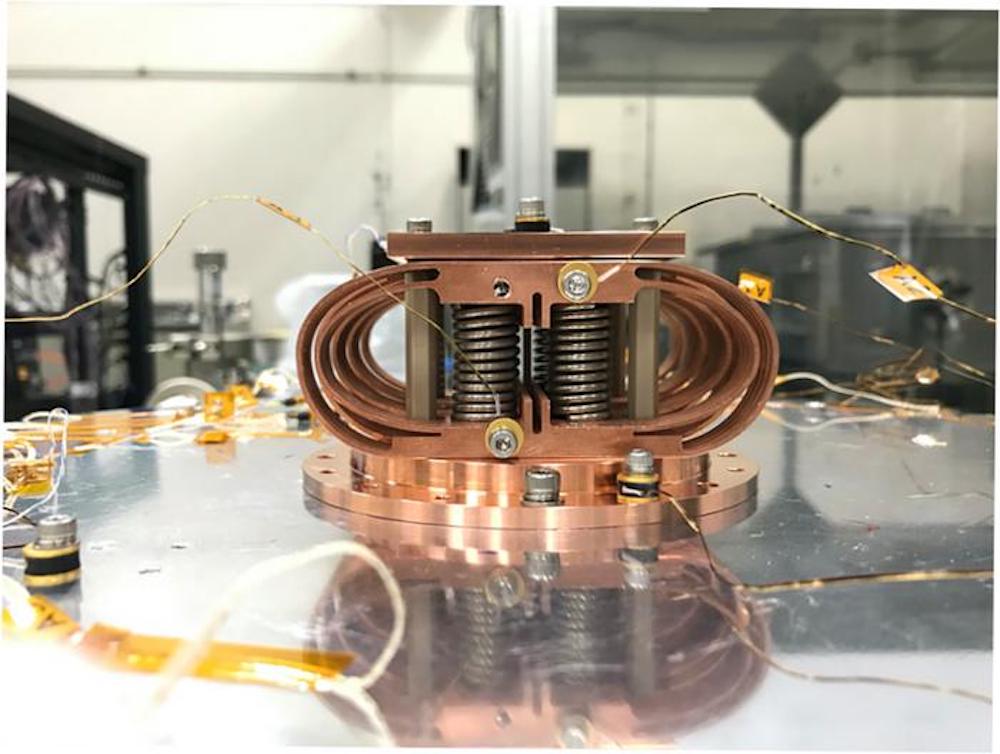
The prototype mechanical heat switch designed by the researchers leverages the shape memory properties of their alloy. It successfully demonstrated the ability to switch between contact and non-contact states at temperatures as low as -170°C. This culminates in precise temperature regulation critical for instruments in varied thermal environments.
"We were very happy when we saw that it worked at -170°C. Other shape memory alloys simply can't do this." - Toshihiro Omori, Tohoku University
Future Prospects and Applications
The implications of this discovery are vast, with the potential for future research aiming to expand the properties of this novel alloy. Researchers suggest numerous applications for this material, including:
| Application | Description |
|---|---|
| Space Telescopes | Adaptable thermal control systems reliant on reliable movement |
| Satellites | Improved structural integrity and reduced weight |
| Environmental Monitoring | Instruments capable of functioning in extreme cold locations |
Conclusion
As we explore the possibilities and challenges of extending human presence into the Solar System and beyond, materials like the new copper-aluminum-manganese alloy will provide the structural and mechanical reliability essential for future missions. As noted by the research team, the versatility and reliability of such materials are paramount for overcoming the inherent challenges faced in space environments.
For More Information
- New Cryogenic Shape Memory Alloy Designed for Outer Space
- Japan Aerospace Exploration Agency (JAXA)
- Tohoku University Discoveries
About the Author
Mark Thompson is a science broadcaster and author known for making science accessible through numerous media appearances.
Related Articles
- Seeing the Exact Moment When New Planets Started Forming
- Exploring the Depths of Space: The Next Frontier
© 2025 Universe Today | Ad-Free Content Supported by Patrons | RSS Feed
This work is licensed under a Creative Commons Attribution 4.0 International License.