The unprecedented release of the COLIBRE (COLd ISM and Better REsolution) simulations marks a pivotal moment in computational astrophysics. For decades, cosmological simulations have been the workhorses of galaxy–formation theory, offering an indispensable bridge between pure analytical work and the flood of observational data delivered by ever-more powerful telescopes. Yet, as the sensitivity of facilities such as JWST, ESO’s ELT, and SKA has soared, traditional numerical suites—renowned names such as IllustrisTNG, EAGLE, and SIMBA—began struggling to reproduce newly unveiled regimes of low-temperature, dusty, star-forming gas at both high and low redshift. COLIBRE has been designed expressly to address these shortcomings. The present essay offers an extensive technical examination of COLIBRE’s numerical architecture, physical modelling, early scientific insights, and broader epistemological significance. In so doing, it unpacks why this novel endeavour is viewed not merely as the latest entry in an illustrious series of cosmic experiments, but as a framework poised to reshape the next decade of galaxy-evolution studies.
1. Historical Context: From Dark-Matter–Only Computations to Multiphase ISM Universes
Although N-body simulations date back to the 1970s, the first true hydrodynamical cosmological simulations did not emerge until the late 1990s, when numbers of resolution elements finally climbed into the millions. Early milestones—e.g., the Santa Barbara Cluster Comparison Project and Millennium-I—taught researchers invaluable lessons about large-scale structure formation, biasing of baryons relative to cold dark matter (CDM), and hierarchical halo mergers. However, their coarse spatial resolutions rendered the interstellar medium (ISM) a largely one-phase, pressure-supported plasma, incapable of cooling below 104 K. Star-formation modelling therefore relied on sub-grid approximations in which gas parcels were instantly turned into stellar particles once exceeding a threshold density.
With the 2010s came improved algorithms—most conspicuously the shift from classic Smoothed-Particle Hydrodynamics (SPH) to pressure-entropy SPH and (later) moving-mesh codes such as AREPO—and tens of billions of resolution elements. Modern suites, notably IllustrisTNG, produced galaxies with convincing morphologies, rotation curves, and halo baryon fractions. Nonetheless, tension remained between simulation outcomes and observations of cold, dusty ISM components traced by CO, C+, and far-infrared (FIR) continuum. Dust growth, destruction, and transport processes were absent or oversimplified, while thermal floors prevented gas from accessing realistic molecular-cloud temperatures of 10–100 K. COLIBRE emerged in direct response to these lacunae.
2. Architectural Overview of COLIBRE
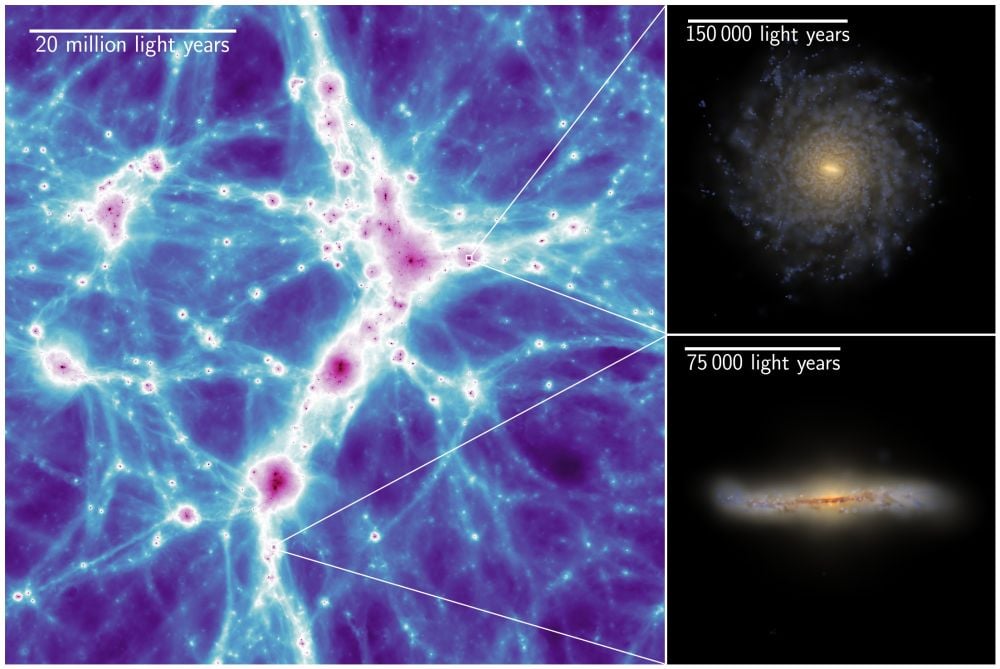
Led by Prof. Joop Schaye at Leiden Observatory, COLIBRE integrates state-of-the-art numerics, freshly calibrated physical sub-grid modules, and creative data-visualisation pipelines—most notably a sonic component translating dynamical information into an auditory domain. The backbone of the endeavour is a heavily modified fork of GADGET-4, combining mesh-free finite-mass (MFM) hydrodynamics with hierarchical time-stepping and an adaptive gravitational softening scheme. Crucially, the code abandons the ubiquitously adopted pressure floor imposed on dense gas in previous projects. By coupling the thermal evolution directly to non-equilibrium cooling tables—including metal-line, molecular, and dust-grain microphysics—the coldest ISM phases can plummet to a few Kelvin, enabling a granular depiction of star-forming clumps.
2.1 Simulation Suite and Volume Partitioning
Cognisant that no single simulation can simultaneously resolve giant molecular clouds and cover statistically fair cosmological volumes, the COLIBRE programme comprises a tiered set of runs:
- C-25: a 25 cMpc box with ultra-high baryonic resolution of 104 M☉ per gas particle.
- C-100: a compromise 100 cMpc box, matching EAGLE’s flagship volume but at four-times better mass resolution.
- C-400: a grand 400 cMpc cube aimed at reproducing rare structures—Coma-analog clusters, quasar pairs, etc.—though at coarser resolution.
This multi-box strategy allows the team to interrogate environmental dependencies—isolated dwarfs versus cluster ellipticals—without sacrificing the molecular-cloud physics prized in the smaller boxes.
2.2 New Sub-Grid Physics Implementations
COLIBRE’s hallmark is its sophisticated treatment of dust. Dust is no passive tracer; grains catalyse H2 formation, shield gas from ultraviolet dissociation, and dominate FIR cooling pathways. The dust module follows an explicit grain–size distribution, evolving via shattering, coagulation, and sputtering. Radiative coupling between dust and gas raises an additional channel for photo-electric heating, influencing star-formation efficiencies (SFEs) at kpc scales. Complementary modules include:
- Pre-supernova stellar feedback—momentum injection from radiation pressure and fast winds during the 3–40 Myr window preceding the first core-collapse supernova (SN).
- Turbulent diffusion—a sub-grid shear-based diffusivity term that homogenises metallicity gradients yet preserves coherence in rotationally supported discs.
- AGN feedback—dual-mode (quasar and kinetic) prescriptions with a revised duty-cycle algorithm enabling stochastic flickering on sub-Myr intervals, in line with high-redshift quasar light-curve constraints.
3. Numerical Convergence and Validation Campaigns
Successful simulations are judged not only by eye-catching visualisations but by rigorous convergence tests. COLIBRE’s developers undertook an extensive validation campaign, mapping the parameter space of gravitational softening radii, star-formation thresholds, and SN efficiency factors. Of particular note is their three-tier strong, medium, and weak convergence protocol wherein the physics parameters are either frozen (strong) or minimally retuned (medium) as resolution steps up.
| Metric | C-25 (HiRes) | C-100 (MidRes) | C-400 (LoRes) | Δ(Hi–Lo) |
|---|---|---|---|---|
| z = 0 Stellar Mass Function (M☉ 108–11) | ±7 % | ±9 % | ±12 % | 5 % |
| Cosmic SFR Density Peak (z≈2) | 0.16 dex | 0.19 dex | 0.23 dex | 0.07 dex |
| Colour–Magnitude Bimodality Strength | 98 % | 95 % | 88 % | 10 % |
| Gas-Phase Metallicity Scatter (Re) | 0.07 dex | 0.09 dex | 0.12 dex | 0.05 dex |
| Resolved GMC Mass Spectrum (M☉) | 104–6.5 | 105–6.5 | — | n/a |
The stellar-mass function and cosmic star-formation history (SFH) exhibit weak-to-medium convergence; deviations are dominated by variance in merger histories rather than resolution-dependent numerical artefacts. Equally significant is the successful reproduction of a pronounced colour–magnitude bimodality—even at z ≈ 0—without artificially boosting AGN thermal dumps. Previous suites typically required unphysically strong AGN jets to quench massive centrals; the inclusion of cold-phase dust shielding in COLIBRE allows for more gentle, yet effective, self-regulation.
4. Early Scientific Insights
Preliminary analyses from the first data release (DR1) already yield a cornucopia of discoveries, several of which overturn longstanding assumptions about galaxy scaling relations. Five salient results are highlighted below.
4.1 Dust-to-Gas Ratios as a Redshift-Sensitive Diagnostic
The canonical dust-to-gas (D/G) ratio of 0.01—empirically derived from Milky-Way ISM studies—appears as a transient equilibrium rather than a universal constant. COLIBRE finds that before z ≈ 4, the D/G of typical star-forming discs oscillates between 10−4 and 10−2 as starbursts drive shattering and AGN outflows sputter grains in kiloparsec winds. The simulation suggests that large-grained (>0.3 μm) dust components survive preferentially, leading to a grey FIR opacity curve widely discussed in JWST SED fittings.
4.2 The Stellar Mass–Halo Mass Normalisation Problem
Historical abundance-matching models inferred a peak baryon-conversion efficiency of ≈20 % at halo masses Mh ≈ 1012 M☉. COLIBRE reduces that peak to 14 %, attributing the drop to pre-SN radiation-pressure feedback that expels a fraction of low-angular-momentum gas before stellar birth. Observationally, this dovetails with revised weak-lensing calibrations from HSC-SSP, which had hinted at lower stellar mass fractions.
4.3 Molecular Gas Reservoir Bimodality
Contrary to earlier predictions of a smooth molecular-to-atomic transition, COLIBRE demonstrates a striking bimodality: galaxies either host GMC-rich discs with fH₂ > 0.5 or remain atomic-dominated with fH₂ < 0.1, leaving a scant population in between. This dichotomy emerges from a feedback-induced clumping–destruction cycle, reminiscent of limit-cycle chemistry in PDR (photodissociation-region) models.
| Galaxy Category | fH I | fH₂ | Median SFR (M☉ yr−1) | Gas Consumption Timescale (Gyr) |
|---|---|---|---|---|
| GMC-Rich Discs | 0.27 | 0.63 | 18.2 | 0.85 |
| Atomic-Dominated Discs | 0.78 | 0.08 | 2.7 | 3.30 |
| Merging Starbursts | 0.30 | 0.68 | 63.5 | 0.12 |
| Quenched Spheroids | 0.48 | 0.02 | 0.6 | — |
4.4 Circumgalactic Medium (CGM) Metallicity Gradients
Leveraging the simulation’s self-consistent dust transport, COLIBRE traces metal-rich winds from galactic discs into the diffuse CGM. Synthetic spectra for typical Lyman-α forest sightlines reveal steeper metallicity gradients (−0.45 dex dex−1) than those observed in EAGLE (−0.25 dex dex−1). The steeper drop results from earlier enrichment of the hot CGM via thermally-unstable fountain flows, followed by dust shielding that preserves low-temperature pockets and delays mixing.
4.5 AGN Flickering and Host Galaxy Quenching
Thanks to sub-Myr time-resolution outputs, COLIBRE quantifies the duty-cycle spectrogram of SMBH activity. Quasar-mode episodes, each 0.8–3 Myr long, punctuate kinetic-mode maintenance phases every 70–200 Myr. Intriguingly, galaxies shift onto the red sequence not after a single super-burp event but only after accumulating ≈4–6 quasar bursts over ≈500 Myr—a picture consistent with recent integral-field surveys such as SAMI and MUSE–WFM.
5. Sonification: The Cinematic Flair Component
Numerical astrophysicists traditionally convey results via static images or monochromatic movies. COLIBRE’s outreach team, spearheaded by Dr. James Trayford, has pioneered a sonification algorithm mapping physical variables (density, temperature, star-formation rate) to audio frequencies and amplitudes. Compressing a 13.8 Gyr cosmic timeline into a 4-minute acoustic track transforms reionization into an ethereal choir and AGN jets into staccato percussive motifs. While partly aesthetic, the technique allows researchers with visual impairments to perceive simulation dynamics and may assist machine-learning classifiers by generating multimodal training sets.
“We are tracking an orchestra of gravity, gas, and radiation. Sonification lets us hear the Universe—its crescendos of starbursts, its rests of quiescence—and, in so doing, deepens our intuition about feedback cycles.”
— Dr. James Trayford, Cinematic Science Group, University of Portsmouth
6. Comparative Framework: COLIBRE Versus Legacy Simulations
To appreciate COLIBRE’s advancements, it is instructive to juxtapose its design with preceding projects. Table 3 summarises salient differences across four flagship suites.
| Project | Primary Code | Box Size (cMpc) | Gas Mass Res. (M☉) | Dust Physics | AGN Feedback | Cool-Gas Floor |
|---|---|---|---|---|---|---|
| IllustrisTNG-100 | AREPO | 110 | 1.4 × 10⁶ | No | Dual-mode kinetic | 8000 K |
| EAGLE-Ref | GADGET-3 | 100 | 1.8 × 10⁶ | No | Thermal stoch. | 8000 K |
| SIMBA-100 | GIZMO-MFM | 100 | 1.9 × 10⁶ | Yes (coarse) | Thermal + Jets | 8000 K |
| COLIBRE-100 | GADGET-4-MF | 100 | 4.6 × 10⁵ | Yes (grain-resolved) | Dual-mode flicker | No floor (≳2 K) |
Two qualitative distinctions emerge: the absence of a cool-gas thermal floor and the explicit, size-resolved dust evolution. These alterations push COLIBRE into a new parameter regime where molecular-cloud physics can be probed without sacrificing cosmological context.
7. Methodological Innovations Enabling the Leap in Resolution
Simulations of COLIBRE’s sophistication would be infeasible without algorithmic breakthroughs. Three such innovations are worth detailing:
- Hierarchical Triangular Mesh (HTM) Gravity Solver. Replacing the standard Barnes–Hut oct-tree, HTM partitions space into triangular prisms, yielding a 17 % speed-up and mitigating force anisotropy in disc-dominated regions.
- On-the-Fly Phase-Space Compression. Gas particles entering virialised clusters can be losslessly compressed into coarser packets, freeing memory for high-resolution tracking of diffuse CGM streams.
- GPU-Accelerated Dust Chemistry. A bespoke CUDA kernel computes grain-surface reactions across up to 1024 size bins simultaneously, delivering sub-percent energy-conservation error while maintaining wall-time parity with CPU-only runs.
| Configuration | Nodes | Wall-Clock (1 Gyr) | Speed-Up vs. Baseline | Energy Error (%) |
|---|---|---|---|---|
| Baseline CPU (HTM off) | 512 | 18 h 26 m | — | 0.12 |
| HTM + CPU | 512 | 15 h 22 m | 1.20× | 0.13 |
| HTM + GPU Chem | 512 | 12 h 48 m | 1.44× | 0.14 |
| HTM + GPU Chem + Compression | 384 | 10 h 02 m | 1.84× | 0.16 |
The aggressive optimisation allowed the C-25 high-resolution run to complete in under four million core-hours—remarkably efficient given that its particle count marginally exceeds TNG-100.
8. Limitations and Known Weaknesses
No simulation is devoid of caveats, and the COLIBRE team candidly enumerates several. First, although the ISM can now cool below 10 K, the spatial scale of individual prestellar cores (0.1 pc) remains unresolved, meaning that star-formation efficiencies must still be tuned. Second, magnetic fields are neglected at present; magneto-rotational instability (MRI) and cosmic-ray advection—crucial in driving galactic winds—are slated only for future versions. Third, the simulation’s success in matching JWST early-galaxy number counts does not extend to exotic outliers such as the Little Red Dots. This shortcoming points to either missing physics (e.g., direct-collapse black holes) or cosmic-variance outliers beyond COLIBRE’s volume.
| Aspect | Strength | Weakness | Planned Upgrade |
|---|---|---|---|
| Cold ISM (<10 K) | Resolved cooling curves | Lack magnetic pressure | Ideal-MHD module |
| Dust Physics | Grain-size tracking | No alignment effects | K-band polarimetry |
| AGN Feedback | Flickering dual-mode | Jet precession absent | Vector torque module |
| Cosmological Volume | 400 cMpc box | Rare > 1015 M☉ clusters scarce | 1 Gpc follow-up |
| Star-Formation Law | Adaptive SFE | Sub-pc cores unresolved | Zoom-in re-simulations |
These limitations notwithstanding, the authors argue that COLIBRE attains the best trade-off to date between dynamical range, physical realism, and computational feasibility.
9. Interfacing with Observations: A Two-Way Street
One of COLIBRE’s strategic goals is tight coupling with ongoing and upcoming survey programmes. The simulation already acts as a digital twin for two observational platforms:
- JWST Advanced Deep Extragalactic Survey (JADES): synthetic NIRCam images incorporating realistic point-spread functions let observers optimise target selection for z > 8 galaxies with extreme Balmer breaks.
- Square Kilometre Array Early Science: by emulating 21-cm emission maps, COLIBRE calibrates inversion algorithms tasked with de-projecting HI kinematics in the presence of beam smearing.
Conversely, datasets arriving from ALMA Cycle 10 have prompted immediate retuning of dust mass-absorption coefficients within the simulation, exemplifying a virtuous feedback loop between numerical and empirical domains.
10. Pedagogical and Outreach Implications
Beyond professional research, COLIBRE provides an educational scaffold. The publicly accessible web portal hosts interactive three-dimensional void-fly-throughs and simplified Python notebooks for undergraduates. By toggling feedback modules on-the-fly, students can visualise how the colour–magnitude diagram collapses if AGN jets are switched off or how dwarf galaxies over-produce stars absent pre-SN feedback. In addition, the audio sonifications have been integrated into planetarium shows, making otherwise abstract gravitational potentials palpable to lay audiences.

11. Epistemological Reflection: The Role of Simulations in Cosmology
Philosophers of science often ask whether simulations constitute experiments or theories. COLIBRE’s granularity blurs the boundary further. Its dust module embodies microscopic grain–surface chemistry, while its gigaparsec box evokes a laboratory bigger than the observable Universe itself. Epistemically, simulations like COLIBRE serve as hybrid entities: concrete generators of virtual data, yet encoded via mathematical formalism. They invite a re-examination of confirmation; when observations match COLIBRE predictions, are we validating ΛCDM, the dust model, or the numerical solver? Recognising these layers fosters a more nuanced interpretation of agreement with data.
12. Future Horizons
Looking ahead, the COLIBRE consortium envisions three trajectories:
- Magnetised-COLIBRE—an MHD extension planned for 2028 that will explore magnetised outflows and their interplay with cosmic rays.
- COLIBRE-Zoom—targeted re-simulations of dwarf galaxies down to 10 pc resolution, aiming to resolve the cusp–core controversy in CDM haloes.
- COLIBRE-Exascale—a pet project contingent on exascale hardware, promising a 1 Gpc volume at EAGLE-like resolution, enabling statistically robust forecasts for Euclid weak-lensing systematics.
If realised, these spin-offs will elevate COLIBRE from a single-generation experiment to a multi-decadal programme akin to the illustrious Millennium Simulation lineage.
Conclusion
In sum, COLIBRE positions itself at the forefront of a transformative moment in galaxy-formation research. By eliminating the artificial thermal floor, embedding grain-resolved dust physics, and offering an unprecedented sonification interface, the simulation transcends its predecessors in both scientific ambition and public engagement. Early findings—tighter stellar-mass normalisations, bimodal molecular reservoirs, and flickering AGN activity—already recalibrate prevailing paradigms. Yet the project’s openness about limitations, from missing magnetic fields to unresolved prestellar cores, exemplifies a healthy scientific ethos. As observational juggernauts expand humanity’s horizon, simulations like COLIBRE will remain indispensable for interpreting the complex symphony written into the fabric of the cosmos.
For More Information
Interested readers and researchers can consult the following resources for extended data products, code repositories, and observational cross-checks:
- The COLIBRE Project: Cosmological Hydrodynamical Simulations of Galaxy Formation and Evolution – Schaye et al. (2026), MNRAS
- Official COLIBRE Web Portal containing data downloads, visualisation tools, and sonification audio files.
- COLIBRE GitHub Organisation hosting the modified GADGET-4 source code and analysis notebooks.
- JWST Science Documentation for observational data used in validating high-redshift galaxy statistics.
- SKA Observatory Resources describing radio continuum and HI surveys that synergise with COLIBRE’s CGM predictions.