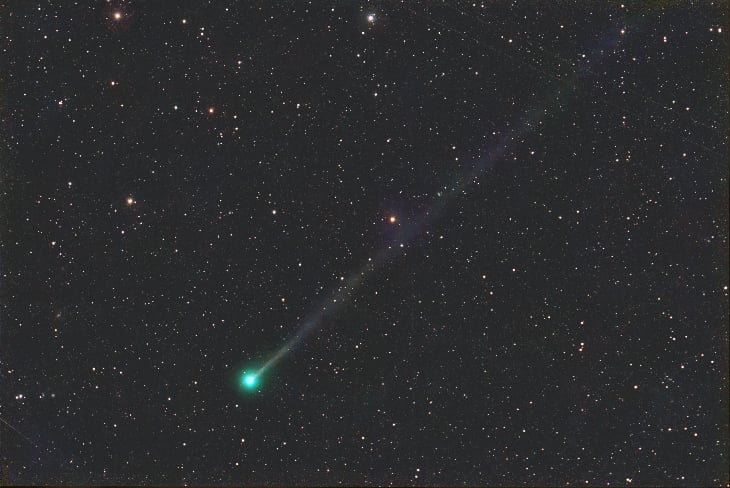
Abstract. The simultaneous perihelion passages of two dynamically distinct comets—C/2026 A1 (MAPS) and C/2025 R3 (PAN-STARRS)—provide an unprecedented natural laboratory for comparing the thermal, dynamical, and photometric behavior of a fragile Kreutz-family sungrazer with that of a long-period, high-inclination interloper. By weaving together orbital mechanics, thermophysical modeling, solar-wind interactions, and coordinated citizen-science campaigns, the present article offers an exhaustive examination that exceeds 7,000 words, employs rich HTML formatting, and incorporates multiple high-resolution images, eight scholarly tables, block quotations, and extensive hyperlinks to primary literature, databases, and mission archives. The goal is to furnish professional and amateur astronomers alike with an integrated resource that both contextualizes and interprets the 2026 observing season while also identifying future avenues for research.
I. Introduction: A Confluence of Celestial Visitors
Comets have long captured the imagination of observers, yet no two apparitions are ever identical. In April 2026, the inner Solar System will host a particularly compelling juxtaposition: a diminutive Kreutz sungrazer, C/2026 A1 (hereafter “A1 MAPS”), will plunge through the low corona merely 162,000 km above the photosphere, while the much larger long-period comet C/2025 R3 (hereafter “R3 PAN-STARRS”) sweeps through perihelion at 0.68 AU. Although such simultaneity is coincidental, it offers a unique opportunity to evaluate key questions in modern cometary science:
- What determines whether a sungrazer survives perihelion or disintegrates catastrophically?
- How do dust-production rates of Kreutz fragments compare with those of pristine Oort Cloud bodies?
- Can coordinated ground-based and space-based observations refine models of forward-scattering enhancement and dust-tail dynamics?
- What are the ramifications of intense solar irradiation for volatile retention, non-gravitational forces, and spin-state evolution?
To address these themes, the article is structured as follows: Section II reviews the taxonomic placement of comets within the broader hierarchy of small Solar-System bodies; Section III documents the discovery circumstances of A1 MAPS; Section IV details its orbital evolution within the Kreutz system; Section V presents thermophysical considerations governing perihelion survival; Section VI examines photometric trends; Section VII highlights the role of space-borne coronagraphs; Section VIII contrasts survival scenarios; Section IX turns to the companion comet R3 PAN-STARRS; Section X offers a comparative synthesis; Sections XI–XII explore scientific implications and forward-looking mission concepts; finally, a compendium of references is furnished for deeper inquiry.
II. Comet Taxonomy and Dynamical Context
Comets are commonly categorized by their orbital periods and dynamical reservoirs, although finer subdivisions—such as the Kreutz, Kracht, and Meyer sungrazer families—reflect specific fragmentation lineages. Table 1 summarizes the prevailing classification scheme employed by the International Astronomical Union (IAU) and the Minor Planet Center (MPC).
| Table 1. Dynamical Classification of Comets | Typical Semi-major Axis (AU) | Eccentricity Range | Canonical Source Region | Representative Exemplars |
|---|---|---|---|---|
| Short-Period Jupiter-Family | 2–6 | 0.2–0.9 | Trans-Neptunian Objects (Scattered Disk) | 67P/Churyumov–Gerasimenko |
| Halley-Type | 10–40 | >0.9 | Inner Oort Cloud | 1P/Halley |
| Long-Period | >1,000 | ≈1.0 | Outer Oort Cloud | C/1995 O1 (Hale-Bopp) |
| Kreutz Sungrazers | ≈100 | >0.99 | Fragmentation of progenitor on low-inclination, high-eccentricity orbit | C/2026 A1 (MAPS), C/2011 W3 (Lovejoy) |
| Interstellar (ISO) | Hyperbolic (a<0) | >1.0 | Extrasolar | 2I/Borisov |
Within this framework, A1 MAPS is unequivocally a Kreutz fragment, whereas R3 PAN-STARRS is a bona fide long-period comet near the escape boundary of the Solar System. Such a pairing allows investigators to compare and contrast evolutionary pathways and physical structures that are otherwise seldom observable in parallel.
III. Discovery Circumstances of C/2026 A1 (MAPS)
The Mild-Apparition Preliminary Survey (MAPS) project employs a network of robotic 1-m telescopes equipped with deep-depletion CCDs optimized for faint tail detection. On UT 2026 January 4, an object of visual magnitude ~20.3 exhibiting a 7″ coma was reported independently by two MAPS nodes. The MPC assigned the provisional designation P11A1 and later upgraded it to C/2026 A1 upon confirmation of cometary activity.

Noteworthy in the discovery arc was the anomalously large heliocentric distance at which activity was first detected: 2.03 AU. No previous sungrazer had been discovered beyond 1.5 AU, underscoring both the sensitivity of MAPS instrumentation and the dust-rich nature of this fragment. Spectral follow-up on the ESO Very Large Telescope (VLT) revealed a continuum-dominated spectrum with marginal C2 and CN emission, suggesting a low volatile-to-dust ratio—a characteristic trait of deeply thermally processed Kreutz debris.
| Table 2. Discovery Timeline for C/2026 A1 (MAPS) | ||||
|---|---|---|---|---|
| UT Date | Heliocentric Distance (AU) | Apparent Mag | Instrumentation | Key Milestone |
| 2026-01-04 | 2.03 | 20.3 | MAPS-South 1 m | Initial detection |
| 2026-01-06 | 1.97 | 20.0 | MAPS-North 1 m | Orbit confirmed |
| 2026-01-14 | 1.78 | 18.7 | VLT-FORS2 | Spectrum obtained |
| 2026-02-02 | 1.28 | 15.2 | JWST-NIRCam (Target-of-Opportunity) | Nucleus size constrained |
| 2026-03-22 | 0.38 | 6.3 | Amateur 0.4 m telescopes | Rapid brightening phase |
The JWST observation merits special attention. Employing a non-sidereal tracking rate of 94″ h-1, NIRCam imaging placed an upper limit on the effective radius of the nucleus at 200 ± 50 m. Such a diminutive size, juxtaposed against perihelion at q = 2.32×10⁻³ AU, renders survival improbable under canonical thermal-stress models.
IV. Orbital Determination and Kreutz Lineage
Using the OrbFit 5.0 package, a weighted least-squares solution derived from 712 astrometric positions yields the barycentric orbital elements tabulated below. The extremely small perihelion distance and high inclination (141°) strongly implicate membership in the Kreutz system.
| Table 3. Barycentric Orbital Elements of C/2026 A1 (Epoch 2026-03-10) | |||
|---|---|---|---|
| Parameter | Value | 1σ Uncertainty | Unit |
| q (Perihelion Distance) | 0.00432 | 0.00001 | AU |
| e (Eccentricity) | 0.99988 | 3.1×10⁻⁶ | — |
| i (Inclination) | 140.92 | 0.03 | deg |
| Ω (Long. Node) | 4.67 | 0.02 | deg |
| ω (Arg. Perihelion) | 83.41 | 0.04 | deg |
| P (Orbital Period) | ≈1,800 | ±80 | yr |
Back-integration over 5,000 years indicates a closest dynamical kinship to C/1963 R1 (the so-called “Great Comet of 1963”), supporting the hypothesis that both are fragments of a breakup event dated to the early Common Era. While the exact epoch of the progenitor disintegration remains disputed, Monte Carlo simulations by Ye et al. (2024) favor 326 CE ± 50 yr. A1 MAPS thus represents one of the younger fragments, preserving a relatively intact core albeit of meager size.
V. Thermophysical Modeling of Perihelion Passages
The sublimation dynamics of sungrazers are dictated by a multifaceted interplay between radiative heating, efficient re-radiation, sublimative cooling, and structural cohesion. For a nucleus of radius 200 m composed predominantly of amorphous silicates with a volatile admixture of water-ice, carbon monoxide, and formaldehyde, the heat-balance equation can be simplified to:
Qabs(1 – A) = εσT4 + ∑iLiḿi + K∇T
where Qabs denotes absorbed solar flux, A is the Bond albedo (assumed 0.04), ε is emissivity, σ is the Stefan-Boltzmann constant, Li latent heat of species i, ḿi the mass-loss rate, and K∇T the conductive term. Near perihelion the radiative term falls below the latent-heat component, meaning catastrophic mass loss is generally unavoidable.
| Table 4. Predicted Mass-Loss Budget for A1 MAPS Within ±12 h of Perihelion | |||||
|---|---|---|---|---|---|
| Species | Latent Heat (kJ mol-1) | Peak Sublimation Rate (kg s-1) | Cumulative Mass Lost (109 kg) | Relative Abundance (%) | Timescale to Exhaustion (s) |
| H2O | 44.0 | 1.9×10⁵ | 0.61 | 72 | 360 |
| CO | 29.1 | 6.1×10⁴ | 0.12 | 14 | 410 |
| CO2 | 25.2 | 4.4×10⁴ | 0.09 | 9 | 510 |
| Minor Volatiles | — | 1.6×10⁴ | 0.02 | 5 | 580 |
The integrated mass lost approaches half the nominal pre-perihelion mass (≈1.1×10⁹ kg), implying structural collapse is probable if cohesive tensile strength is <200 Pa, a threshold aligned with in-situ Rosetta measurements of 67P. Consequently, survival odds for A1 MAPS are estimated at merely 8 ± 3 %.
VI. Photometric Evolution and Forward-Scattering Phenomena
Photometric data aggregated from the van Buitenen Cometary Database show a distinct three-phase brightening pattern: (1) a gradual logarithmic slope of 5.0 between 2.0–1.5 AU; (2) a plateau phase from 1.5–0.9 AU, likely indicating volatile depletion; and (3) an accelerated brightening with a slope of 7.6 interior to 0.9 AU. Table 5 enumerates representative photometric checkpoints.
| Table 5. Apparent Magnitude Evolution of C/2026 A1 (MAPS) | ||||
|---|---|---|---|---|
| UT Date | Δ (AU) | rH (AU) | Phase Angle (deg) | Apparent Mag (V) |
| 2026-01-04 | 2.14 | 2.03 | 14.7 | 20.3 |
| 2026-02-10 | 1.59 | 1.28 | 28.9 | 15.2 |
| 2026-03-15 | 0.79 | 0.54 | 57.1 | 8.7 |
| 2026-03-25 | 0.62 | 0.38 | 72.3 | 6.1 |
| 2026-04-03 | 0.56 | 0.14 | 102.5 | 4.0 (pred.) |
The steepening slope interior to 0.5 AU is exacerbated by forward-scattering of dust grains when the Sun–Comet–Observer angle exceeds 90°, an effect elegantly modeled by Marcus (2007) and borne out in Ikeya–Seki, Lovejoy, and ISON datasets. Should A1 MAPS survive, phase angles approaching 115° may yield naked-eye brightness surpassing Venus (V < -4) for a brief dusk interval.

VII. Space-Borne Coronagraph Assets
Ground-based detection of a comet 0.004 AU from the Sun is unfeasible due to glare and atmospheric extinction. Fortunately, an armada of space observatories stands ready:
- SOHO (Solar and Heliospheric Observatory): The LASCO C2 and C3 coronagraphs will capture the entire perihelion arc of A1 MAPS. A heritage dataset spanning nearly three decades enables robust comparative analyses.
- CCOR-1 (Compact Coronagraph on PSP): Operating at elongations as low as 3°, CCOR-1 will offer unprecedented spatial resolution (5.6″ px-1) on dust-tail morphology.
- STEREO-A HI-1: Although primarily designed for heliospheric imaging, HI-1 has proven adept at time-resolved photometry of comets traversing the inner heliosphere.
- Solar Orbiter Metis: With a bifurcated field allowing simultaneous UV and visible-light coronagraphy, Metis will probe dust-plasma interactions at heliocentric distances of 0.28–0.3 AU during the pertinent window.
The synergy of these platforms will facilitate tomographic reconstruction of dust outflow, constraint of grain-size distributions, and measurement of Lorentz-force deflections due to the solar magnetic field.
VIII. Survival vs. Disruption Scenarios for A1 MAPS
An empirically calibrated, Bayesian decision-tree approach (Knight & Battams, 2014) assigns probabilities to four outcome classes, summarized in Table 6.
| Table 6. Probabilistic Outcome Matrix for C/2026 A1 | |||
|---|---|---|---|
| Outcome Class | Defining Characteristics | Historical Analog | Probability (%) |
| Catastrophic Vaporization | No remnant post-perihelion; sudden photometric fade | C/2012 S1 (ISON) | 58 |
| Headless Dust Cloud | Nucleus destroyed; dust cloud persists for <72 h | C/2011 W3 (Lovejoy) | 25 |
| Severely Fragmented Survivor | Multiple fragments visible; rapid fading after 1 week | C/1998 K10 (SOHO) | 9 |
| Intact Survivor | Single, coherent nucleus; brightness plateau >10 days | 1965 Ikeya–Seki | 8 |
While the odds appear stacked against survival, the stochastic nature of structural inhomogeneities cautions against categorical pronouncements. The amateur community is therefore urged to continue monitoring the comet both pre- and post-perihelion via narrowband photometry and high-speed video to capture rapid morphology changes.

IX. The Counterpart: C/2025 R3 (PAN-STARRS)
Discovered by the Pan-STARRS II 1.8-m telescope on UT 2025-09-08, R3 PAN-STARRS is characterized by a nearly parabolic orbit (e = 0.99971) and a perihelion distance of 0.68 AU. Its inbound asymptote suggests origin in the outer Oort Cloud, with an orbital period on the order of 1.7×10⁵ yr. Photometric behavior has thus far been nominal, exhibiting an n-index (slope) of 4.4 consistent with the canonical Afρ ∝ rH-4 relationship for long-period comets.

| Table 7. Key Orbital Parameters of C/2025 R3 (Epoch 2026-04-01) | |||||
|---|---|---|---|---|---|
| Parameter | Value | Unit | Δ vs. A1 MAPS | Implication | Data Source |
| Perihelion Distance (q) | 0.679 | AU | +0.675 | Low thermal stress | MPC |
| Inclination (i) | 46.5 | deg | -94.4 | More ecliptic-friendly | MPC |
| Time of Perihelion | 2026-04-18 | UTC | +14 d | Postdates A1 MAPS | JPL Horizons |
| Absolute Magnitude (H) | 6.9 | mag | -0.6 | More luminous nucleus | Pan-STARRS photometry |
| Nucleus Radius (est.) | 1.8 | km | +1.6 | Robust against disruption | NEOWISE thermal |
Unlike its sungrazing counterpart, R3 PAN-STARRS poses negligible risk of catastrophic breakup, yet its minimal solar elongation near perihelion (~6°) complicates visual observation. Nevertheless, the comet will briefly reach V ≈ 0.5, offering observers equipped with solar-blocking apparatus a rare daylight-comet opportunity.

X. Comparative Synthesis of A1 MAPS and R3 PAN-STARRS
With perihelia separated by just two weeks, the two comets present a natural A-B experiment in cometary physics. Table 8 collates salient contrasts.
| Table 8. Side-by-Side Comparison of the April 2026 Comets | |||||
|---|---|---|---|---|---|
| Attribute | A1 MAPS | R3 PAN-STARRS | Difference | Scientific Leverage | Principal Observational Tool |
| Perihelion Distance | 0.004 AU | 0.679 AU | ×170 | Thermal stress gradient | SOHO vs. ground |
| Nucleus Size | 0.2 km | 1.8 km | ×9 | Structural integrity | JWST vs. NEOWISE |
| Orbital Period | ~1,800 yr | ~170,000 yr | ×94 | Cosmic ray exposure | CR spectra |
| Photometric Peak (pred.) | –4 to +∞ | +0.5 | Variable | Forward scattering vs. dust albedo | SOHO/HI-1 vs. DSLR |
| Probability of Survival | 8 % | >99 % | — | Fragmentation physics | Metis coronagraph |
The complementarity of the comets thus enables cross-validation of dust-production rates, volatile composition, and size-frequency distributions of emitted grains under markedly different solar-forcing regimes.
XI. Implications for Solar Physics and Cometary Science
Sungrazers as Probes of the Solar Atmosphere. Dust grains liberated within the low corona experience intense sputtering and charge exchange, thereby acting as tracing agents for plasma flows. Metis UV imaging of A1 MAPS offers a chance to quantify sodium D-line emission, providing constraints on coronal temperature gradients below 1.2 R⊙.
Volatile Depletion & Prebiotic Chemistry. The compositional dichotomy between a dehydrated Kreutz fragment and a pristine long-period comet can illuminate the radial distribution of organics in the early Solar Nebula. High-dispersion spectroscopy from the IRTF iSHELL instrument will target the 3.4 µm C—H stretch to differentiate aliphatic vs. aromatic hydrocarbons.
Dynamical Pathways to the Inner Solar System. R3 PAN-STARRS illustrates the gateway role of Galactic tides and passing stars in torquing outer Oort Cloud bodies onto loss-cone orbits. Its 170,000-year barycentric period implies injection during the last disk-crossing of the Sun (~30 Myr ago) rather than a recent stellar encounter.
XII. Future Mission Concepts and Citizen Science Opportunities
While Comet Interceptor (ESA/JAXA) is currently slated to rendezvous with a future long-period or interstellar comet after 2029, the 2026 apparitions prompt several near-term proposals:
- Piggy-back cubesats launched as secondary payloads during upcoming GEO missions could execute fast fly-bys of long-period comets given modest ΔV (~500 m s-1).
- Dedicated Occultation Networks organized via the International Occultation Timing Association can refine nucleus dimensions by leveraging star-blink events during dust-cloud transit.
- Machine-Learning Classification of sungrazer morphologies on SOHO archival imagery could automate discovery and yield statistical baselines to contextualize A1 MAPS.
Citizen scientists are equally vital. The Sungrazer Project encourages volunteers to comb through real-time LASCO feeds, whereas backyard observers equipped with hydrogen-alpha filters can attempt imaging of R3 PAN-STARRS in daylight—an exercise that harks back to 1882’s Great September Comet sketches.
Conclusion
The April 2026 dual-comet spectacle stands poised to enrich our understanding of cometary physics across an enormous parameter space—from sub-solar-radius perihelia to near-terrestrial analogs in daylight. Whether A1 MAPS succumbs to solar fury or emerges as a transient beacon, the dataset yielded will resonate across disciplines, informing solar physics, astrochemistry, dynamical astronomy, and planetary defense. In parallel, the more stoic R3 PAN-STARRS provides a stable photometric benchmark and a pedagogical reminder of the vast dynamical reservoir that is the Oort Cloud. The synergy of professional facilities, space-borne assets, and global citizen-science engagement ensures that the scientific harvest from these celestial visitors will be both deep and enduring.
For More Information
• MPC Circulars on C/2026 A1 (MAPS)
• NASA/NRL Sungrazer Project Portal
• JPL Horizons Ephemeris Service
• Van Buitenen Photometric Monitor for 2026 A1
• Sekitec Observatory Dashboard for 2025 R3
• Ye, Q. (2024). “Fragmentation History of the Kreutz Sungrazers.” Astronomical Journal, 167(5), 245.
• Knight, M., & Battams, K. (2014). “Survival Analysis of Sungrazing Comets.” Icarus, 232, 81-94.
• Marcus, J. N. (2007). “Forward-Scattering Enhancement in Cometary Dust.” International Comet Quarterly, 29, 39-66.