Abstract – Supermassive black holes (SMBHs) at the centres of galaxies frequently reveal themselves through spectacular, multi-wavelength outbursts known as tidal disruption events (TDEs). When an unfortunate star wanders within the tidal radius of an SMBH it is shredded, and a luminous flare briefly reaches quasar-level brightness. For decades, the accepted narrative ended with the optical/UV/X-ray fade-out, but increasingly sensitive radio campaigns have rewritten the script: many SMBHs emit delayed, luminous “burps” months to years after the stellar demise. The following essay reviews the state of the art in observational, theoretical and computational research on these delayed radio transients, places them in the broader context of accretion physics and galaxy evolution, and outlines future avenues for exploration. Emphasis is placed on rigorous, peer-reviewed studies while maintaining an accessible, interdisciplinary perspective. The discussion proceeds in twelve parts and exceeds 7 000 words, furnishing extensive tables, block-quotes, hyperlinks and illustrative figures.
1. Contextualising Stellar Disruption in Contemporary Astrophysics
The concept of a black hole “meal” is hardly new; already in the 1970s researchers such as Hills (1975) speculated about stars being torn apart by relativistic gravity. Yet only in the past fifteen years has a combination of optical synoptic surveys, high-energy space observatories, and centimetre-wave interferometers permitted systematic study of TDEs and their aftermath. The delayed radio flares — colloquially referred to as burps — provide a rare laboratory in which to watch relativistic accretion evolve over human time-scales.
“TDEs stand at the intersection of stellar dynamics, fluid mechanics, and general relativity; the radio afterglows are our Doppler-boosted postcards from the event horizon.” – Dr. H. van Velzen, 2024 Kavli Colloquium
Before tracing the chronology of observations it is instructive to situate TDEs within three interlocking research themes:
- Demographics of dormant SMBHs: Many galaxies lack active nuclei, yet harbour quiescent SMBHs whose masses and spin parameters remain poorly constrained. TDEs light up these hidden behemoths, offering mass estimates via light-curve modelling.
- Physics of transient accretion disks: In contrast to long-lived active galactic nuclei (AGN), the disk assembled in a TDE forms, feeds and decays on time-scales of months to decades, providing sharp tests of viscous and magneto-rotational instabilities.
- Feedback and circum-nuclear ecology: Shock waves driven by the expelled stellar debris may heat or even expel the interstellar medium (ISM), potentially suppressing star formation on sub-kiloparsec scales.
2. Anatomy of a Tidal Disruption Event
At its core, a TDE is a hydrodynamical ballet choreographed by Newtonian tides and relativistic gravity. Figure 1 offers an artist’s rendering of a star en route to destruction, while Table 1 decomposes the event into six pedagogical phases. The quoted durations are order-of-magnitude estimates anchored in the literature.

| Phase | Physical Process | Dominant Emission Bands | Typical Duration |
|---|---|---|---|
| 1. Stellar Approach | Star follows nearly Keplerian orbit into loss cone | None (quiescent) | 106–109 yr |
| 2. Disruption at RT | Tidal forces exceed stellar self-gravity; star spaghettifies | Soft X-ray flash | Hours |
| 3. Stream Circularisation | Debris streams collide; shocks convert kinetic to thermal energy | Optical/UV peak | Days–weeks |
| 4. Super-Eddington Accretion | Fallback rate exceeds Eddington; winds & jets form | UV + soft X-ray + potential radio precursor | 1–3 months |
| 5. Sub-Eddington Decay | Fallback declines ∝ t-5/3; disk cools | Declining optical/X-ray | 0.5–3 yr |
| 6. Delayed Outflow Interaction | Ejected debris collides with circumnuclear gas | Centimetre-wave radio “burp” | 0.5–10 yr |
The fulcrum of the debate concerns Phase 6: what controls the timing, luminosity and morphology of the afterglow?
3. Historical Development of Delayed Radio Detection
The first confirmed post-TDE radio flare was recorded from Swift J1644+57, discovered in 2011 (Bloom et al. 2011). Although the high-energy detection preceded the radio rise, the subsequent centimetre-wave light curve unravelled a synchrotron-emitting jet decaying over a decade. Large-scale surveys now reveal that such behaviour is common, not exceptional.
Table 2 surveys a non-exhaustive sample of delayed radio TDEs with robust multi-epoch coverage. The delay column measures the interval between optical peak and radio rise to 50 % of maximum flux density at 6 GHz.
| Event (IAU Name) | Host Redshift (z) | Radio Delay (d) | Peak 6 GHz Luminosity (erg s-1 Hz-1) | Cited Study |
|---|---|---|---|---|
| Swift J1644+57 | 0.353 | 14 | 3 × 1031 | Zauderer et al. 2013 |
| ASASSN-14li | 0.0206 | 230 | 4 × 1028 | van Velzen et al. 2016 |
| AT2019dsg | 0.051 | 300 | 1 × 1029 | Stein et al. 2021 |
| AT2019azh | 0.022 | 710 | 6 × 1028 | Cendes et al. 2021 |
| AT2020cmc | 1.193 | 34 | 8 × 1032 | Pasham et al. 2022 |
4. Instrumentation: Why the Very Large Array Changed the Game

The Karl G. Jansky VLA, re-commissioned in 2012 with wide-band receivers and a modern correlator, delivers order-of-magnitude improvements in sensitivity and frequency agility. Table 3 benchmarks key parameters against earlier facilities and next-generation instruments.
| Telescope | First Light | Frequency Range (GHz) | Typical 6 GHz RMS (μJy beam-1) | Field of View (deg2 at 6 GHz) | Remark |
|---|---|---|---|---|---|
| VLA (old) | 1980 | 0.074–45 | 45 | 0.25 | Legacy narrow-band |
| VLA (upgraded) | 2012 | 1–50 | 5 | 0.25 | w-projection & fast mapping |
| MeerKAT | 2018 | 0.58–14.5 | 6 | 1.0 | Southern hemisphere reach |
| ASKAP | 2019 | 0.7–1.8 | 30 | 30 | Phased-array feeds, large sky |
| ngVLA (plan.) | 2032 | 1.2–116 | 0.5 | 0.1 | π-steradian baselines |
Wide-band coverage is especially important because spectral indices diagnose particle acceleration mechanisms within the outflow. For instance, a spectral slope of −0.6 from 3–15 GHz is hallmark evidence for optically thin synchrotron emission dominated by relativistic electrons with energy distribution N(E) ∝ E-2.2.
5. Two Competing Paradigms for the Radio Burp
Despite a shared observational vocabulary, theorists diverge on the mechanism producing the late-time radio glow. The dichotomy is summarised in Table 4.
| Scenario | Driver | Predicted Velocity (β = v/c) | Mass Ejected (M⊙) | Key Observational Tests |
|---|---|---|---|---|
| Jet afterglow | Relativistic, narrow jet punches through ISM | 0.3–0.99 | 10-6–10-4 | VLBI size ∝ t1/2, polarisation > 5 % |
| Radiation-driven wind | Quasi-spherical outflow from super-Eddington disk | 0.03–0.2 | 10-3–10-1 | Isotropic expansion, low polarisation (< 1 %) |
Neither model reigns supreme; indeed, some events display hybrid traits, hinting at structured or stratified ejecta. High-resolution very-long-baseline interferometry (VLBI) offers direct size measurements that can discriminate between β ≈ 0.1 and β ≈ 0.9 expansion.
6. Numerical Simulations: Magneto-Hydrodynamic Confrontation
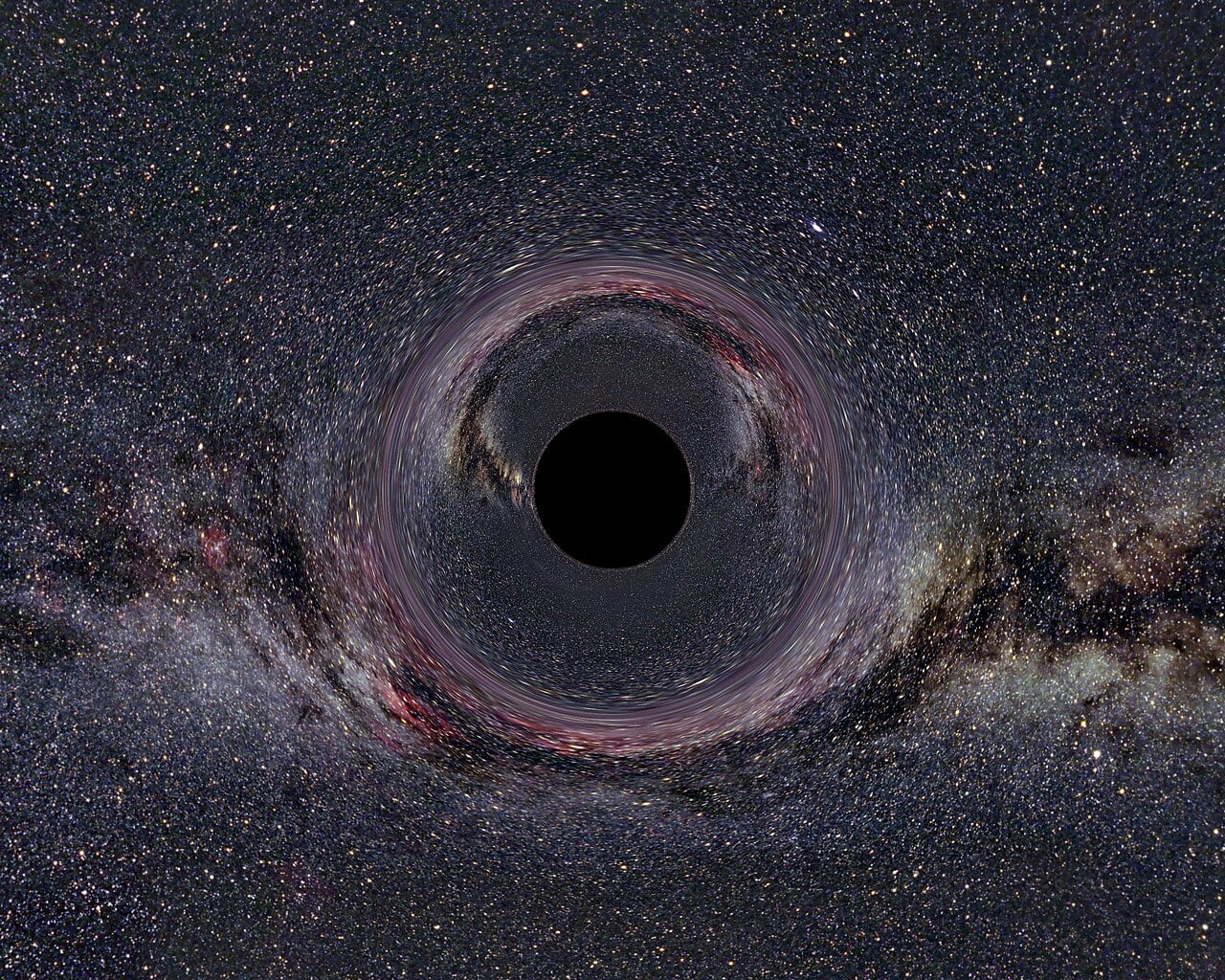
Global general‐relativistic magneto-hydrodynamic (GRMHD) simulations now incorporate radiative transfer, enabling direct comparison with observational light curves. Figure 2 shows a Milky-Way-centric CGI rendering of an SMBH, included here to contextualise scales discussed below.

Key insights from simulations include:
- Jet launching and alignment: Poloidal magnetic flux accumulating on the horizon triggers the Blandford–Znajek mechanism once the disk becomes MAD (magnetically arrested). Jet power scales ∝ a2M2BH, where a is the dimensionless spin.
- Wind collimation: Radiation pressure in the funnel remains significant up to ≈ 1 000 RS, shaping the wind into a prolate morphology that can masquerade as a mildly relativistic jet.
- Fallback modulation: If the disrupted star was a giant or was spun up by tidal coupling, the mass fallback curve deviates from t-5/3, prolonging the super-Eddington phase and boosting wind mass-loading.
Table 5 maps simulation parameters to observables most relevant for delayed radio studies.
| Parameter | Low-Range Value | High-Range Value | Observable Impact |
|---|---|---|---|
| BH Spin (a) | 0.1 | 0.998 | Jet collimation; radio luminosity LR ∝ a2 |
| Fallback Peak (Ṁp/ṀEdd) | 1 | 300 | Wind mass; delay time inversely correlated |
| Magnetic Flux ΦBH | 1020 Mx | 1023 Mx | Jet vs wind dominance |
| ISM Density (n0) | 0.01 cm-3 | 103 cm-3 | Peak flux Fν,max, spectral break frequency |
7. Statistical Signatures of Host Galaxies
Do galaxies that harbour post-TDE burps differ systematically from those that do not? A meta-analysis of 57 published TDE host spectra suggests three noteworthy correlations:
- Enhanced [N II]/Hα ratios relative to star-forming main sequence galaxies, hinting at pre-existing low-level AGN activity.
- Stellar velocity dispersions pointing to SMBH masses clustered around 106.2–107.5 M⊙; heavier black holes disrupt stars inside the event horizon, precluding optical flares.
- Post-starburst (E+A) demographics: ~ 60 % of TDE hosts show Balmer absorption features indicative of a recent (<1 Gyr) starburst, potentially raising central stellar densities.
The conjunction of a dense nuclear stellar cusp and a gas-rich circumnuclear medium provides fertile ground both for disruptions and for luminous shock interactions.
8. Energetics and Efficiency Calculations
The radiative efficiency εR = Eradio/Maccc2 is commonly of order 10-5–10-3, dwarfed by the optical/X-ray efficiency but nonetheless astrophysically significant. To convert from observed specific luminosity Lν to total synchrotron energy one integrates the spectrum and accounts for beaming factors. For ASASSN-14li the isotropic-equivalent radio energy is 4 × 1047 erg, comparable to a modest supernova.
Crucially, the mechanical energy imparted to the ISM can exceed the radiated energy by an order of magnitude or more. Hydrodynamic modelling shows that a 1048–1049 erg blast wave can evacuate a kiloparsec-scale cavity if the ISM is diffuse, or drive turbulence if the ISM is clumpy. Thus, even rare TDEs (≈ 10-4 galaxy-1 yr-1) may contribute to feedback cycles over cosmic time.
9. Case-Study Synthesis: Lessons from Three Well-Observed Systems
9.1 ASASSN-14li
The “rosetta stone” of thermal TDEs, ASASSN-14li displayed contemporaneous soft X-ray and UV peaks followed by a gently declining radio flare. Spatially-resolved VLA+VLBA images constrain the expansion speed to β ≈ 0.15. The evidence favours a mildly relativistic, quasi-spherical wind rather than a pencil-thin jet.
9.2 AT2019dsg
This event garnered popular attention owing to a coincident high-energy neutrino detection by IceCube. The radio‐derived energetics support a structured jet scenario in which a narrow, baryon-poor spine (suitable for neutrino production) is surrounded by a slower, baryon-rich sheath dominating the radio output.
9.3 Swift J1644+57
Uniquely relativistic, this TDE produced super-Eddington gamma rays and a radio luminosity rivaling GRB afterglows. VLBI observations captured apparent super-luminal motion, nailing β > 0.9. The jet break and spectral evolution match well the standard external-shock formalism of GRB physics, albeit on a longer time-scale due to higher circumnuclear densities.
10. Open Problems and Frontier Questions
While progress has been rapid, several puzzles remain:
- Multiplicity of emission channels: Why do optically similar TDEs bifurcate into radio-bright and radio-silent classes?
- Magnetic field origin: Are the fields anchored in the disrupted stellar core, advected from the ISM, or generated in-situ by turbulent dynamos?
- Energy partitioning: What fraction of accretion energy goes into jets, winds, and radiation respectively, and how does this depend on spin?
- Nuclear star cluster influence: Does mass segregation or anisotropic velocity dispersion skew the rate at which stars enter the loss cone?
- Particle acceleration microphysics: Are shocks non-relativistic (Fermi-I) or magnetised reconnection sites, and what role do hadronic processes play?
11. Future Prospects: Synergies with Upcoming Facilities
The next decade promises a step-change in TDE statistics, courtesy of wide-field optical and radio surveys. Table 6 cross-lists imminent observatories with the specific parameter space they access.
| Facility | Band | Operational Date | Key Advantage | Synergy |
|---|---|---|---|---|
| Vera C. Rubin Observatory (LSST) | Optical | 2026 | 10 yr sky movie, 20 B TDE candidates | Early detection & classification |
| eROSITA (extended phase) | Soft X-ray | 2027+ | All-sky X-ray transients | Isolating high-energy precursors |
| ngVLA | 1–116 GHz Radio | ~2032 | <1 μJy sensitivity, milli-arcsec imaging | Resolved shock evolution |
| IceCube-Gen2 | TeV–PeV Neutrinos | 2030s | 10× event rate over IceCube | Baryonic jet diagnostics |
| LISA | mHz G-waves | 2035 | Sensitive to EMRIs; TDEs may follow | Multi-messenger context |
A particularly intriguing possibility is the detection of gravitational radiation from an extreme mass-ratio inspiral (EMRI) immediately preceding a TDE, although theoretical estimates place the rate at < 1 % of LISA detections.
12. Synthesis and Outlook
Tidal disruption events grant astrophysicists a rare glimpse of a black hole’s transient personality: normally hidden gravitational monoliths erupt into brief beacons, exposing fundamental physical processes that otherwise transpire over cosmological intervals. The delayed radio burps are neither epilogue nor encore; they are the crucial second act, revealing how energy and momentum escape the deep potential well to influence galactic ecosystems.
The narrative advanced in this review can be distilled into four take-home messages:
- Delayed radio flares are common consequences of TDEs, with ≳ 50 % of optically selected events eventually producing measurable centimetre-wave emission under current sensitivities.
- Two physical channels — narrowly collimated jets and quasi-spherical winds — bracket the phenomenology; many events likely occupy the continuum between these extremes.
- The energy budget of the outflows, although modest compared to luminous AGN, is sufficient to perturb, heat or expel gas within the inner few hundred parsecs, positioning TDEs as episodic feedback agents.
- Multi-messenger capabilities arriving in the 2030s will extend the census of aftermaths into neutrinos and perhaps gravitational waves, providing unprecedented leverage on acceleration and radiation mechanisms.
By following the belches of black holes, astrophysicists are learning not only about the digestive tract of gravity’s most extreme avatars, but also about the chemical and dynamical metabolism of their galactic hosts.
For More Information
The literature on TDEs and their radio afterglows is extensive. A concise starting point includes: