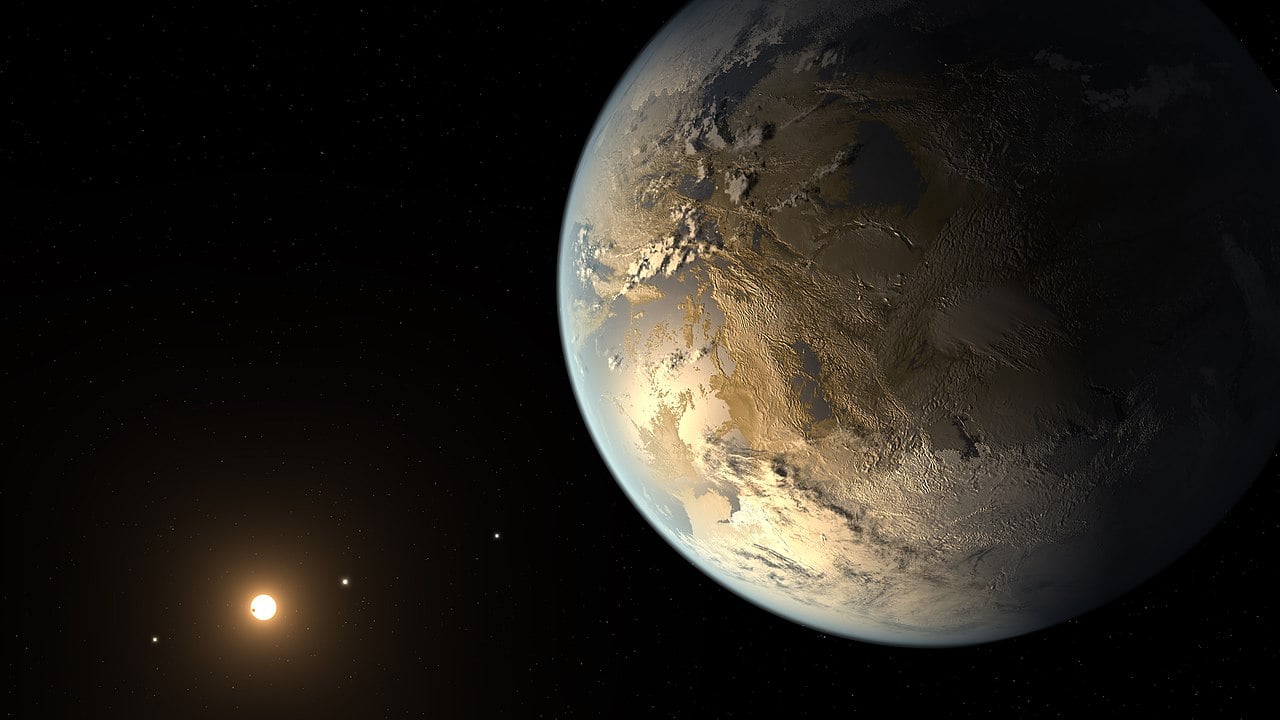
Astronomers have found a fascinating new world that challenges our understanding of planetary systems. Using NASA's Transiting Exoplanet Survey Satellite (TESS), an international team of researchers has discovered TOI-2431 b, an Earth-sized planet orbiting a nearby star just 117 light-years away. What makes this discovery extraordinary isn't just the planet's size; it’s how incredibly fast it races around its star.

TOI-2431 b completes a full orbit around its host star in just 5.4 hours, making it one of the shortest "years" ever recorded for any known planet. To put this in perspective, while Earth takes 365 days to orbit the Sun, this distant world experiences more than 1,600 "years" in the same timeframe. The planet sits extremely close to its star too, only about 0.0063 AU away, which is roughly 933,000 kilometers.
This proximity comes with extreme consequences. The planet's surface temperature reaches approximately 2,000 Kelvin (about 1,727°C), hot enough to melt most rocks and metals. Scientists believe the planet's surface is likely molten, creating a landscape of liquid rock and metal.
Despite being classified as Earth-sized, TOI-2431 b is quite different from our home planet. With a radius about 1.53 times larger than Earth and a mass 6.2 times greater, this world is significantly denser than Earth. Its density of 9.4 grams per cubic centimeter suggests it's made of much heavier materials, possibly containing a large iron core or other dense metals.

The intense gravitational forces from its nearby star have likely changed the planet's shape. The team estimates that TOI-2431 b is tidally deformed, with its shortest axis being about 9 percent shorter than its longest axis, giving it a somewhat flattened appearance rather than a perfect sphere, like the Earth but somewhat more extreme.
Perhaps most intriguingly, this planet won't be around forever. The researchers calculated that TOI-2431 b has a tidal decay timescale of about 31 million years, the shortest known among similar ultra-short period planets. This means the planet is gradually spiraling into its star and will eventually be consumed, though the planet’s eventual demise won't happen for many millions of years.
The discovery team, led by Kaya Han Taş of the University of Amsterdam, confirmed the planet using multiple observation methods, including TESS data, ground-based telescopes, and specialized spectrographs. Scientists noted that TOI-2431 b would be an excellent target for the James Webb Space Telescope to study further, potentially revealing details about its surface composition and whether it retains any atmosphere despite the extreme conditions.
This discovery adds to our growing catalog of extreme worlds and helps scientists understand how planetary systems form and evolve under different conditions, expanding our knowledge of the incredible diversity of planets in our galaxy.
Source: New Earth-sized exoplanet orbiting nearby star detected
Introduction to Exoplanetary Research
The field of exoplanet research has burgeoned in recent decades, thanks to advancements in telescope technology and dedicated missions such as TESS and Kepler. This growth has facilitated discoveries that significantly enhance our understanding of the universe and potentially the origins of life beyond Earth.
Exoplanets, which are planets outside of our solar system, can vary widely in size, composition, and orbital characteristics. Many of these worlds challenge existing theories in planetary formation and evolution. The discovery of unusual planets like TOI-2431 b opens new avenues of inquiry around their atmospheres, surface conditions, and potential habitability.
The Role of TESS in Exoplanet Discovery
The Transiting Exoplanet Survey Satellite (TESS) is a NASA mission launched in April 2018 aimed at identifying exoplanets by monitoring the brightness of stars. TESS uses the transit method, where minute changes in star brightness indicate the potential presence of a planet crossing in front of it. Here are some significant aspects of TESS:
- Wide Field of View: TESS surveys the entire sky over a two-year period, allowing it to monitor numerous stars simultaneously.
- Candidate Detection: It has the capacity to detect planets as small as Earth that transit around stars as bright as those of our Solar System.
- Follow-Up Studies: The data obtained by TESS is used by astronomers to coordinate follow-up observations, including those by ground-based telescopes and the Hubble and James Webb space telescopes.
The Significance of TOI-2431 b
TOI-2431 b stands out for several reasons:
- Short Orbital Period: Its extraordinary rapid orbit allows scientists to study environmental conditions that were previously difficult to ascertain, providing insight into thermal characteristics of close-in exoplanets.
- Densely Packed Composition: With a mass significantly higher than Earth’s, its internal structure offers clues on how planets can evolve under increased gravitational stress.
- Tidally Locked Phenomenon: Close proximity to its star likely means the planet is tidally locked, leading to extreme differences in temperature and atmospheric phenomena.
Comparative Analysis of Exoplanets
The universe showcases a plethora of exoplanets with varying characteristics. Below is a table briefly comparing TOI-2431 b with other notable exoplanets:
| Exoplanet | Distance (light-years) | Orbital Period (hours) | Mass (Earth masses) | Radius (Earth radii) |
|---|---|---|---|---|
| TOI-2431 b | 117 | 5.4 | 6.2 | 1.53 |
| HD 189733 b | 64 | 7.7 | 1.15 | 1.14 |
| Kepler-22 b | 600 | 290 | 2.4 | 2.4 |
| HD 97658 b | 40 | 9.5 | 1.6 | 1.8 |
| Trappist-1 e | 40 | 6.1 | 0.92 | 0.92 |
Understanding Planetary Characteristics
Examining the characteristics of exoplanets helps scientists derive theories about planetary formation and the dynamics of their atmospheres. For instance, TOI-2431 b's extreme conditions present opportunities to study:
- Surface Conditions: The high temperature is of interest for understanding volcanic activity and surface material composition.
- Atmospheric Dynamics: Investigating the potential for an atmosphere on such a hot planet, despite the scalding environment.
- Orbital Mechanics: How close proximity to a star affects a planet's orbital decay and resultant lifespan.
Future Research Directions
The growing catalogue of extreme exoplanets is paving the way for numerous lines of inquiry. Key future research directions include:
- Atmospheric Studies: Utilizing advanced telescopes to analyze the composition of exoplanet atmospheres may lead to discoveries about their potential habitability.
- Comparative Planetology: Detailed comparisons between Earth-like planets and extreme worlds like TOI-2431 b will deepen our understanding of planet formation.
- Dynamic Simulation Models: Conducting simulations to model the environmental conditions on such extreme exoplanets can inform predictions of their long-term stability.
Conclusion
TOI-2431 b enriches our understanding of planetary systems and serves as a reminder of the diverse and unique worlds that exist beyond our Solar System. Each new discovery not only adds to our catalog of known exoplanets but also prompts new questions regarding the conditions necessary for life and the future evolution of these celestial bodies.
For More Information
For further reading on exoplanets and the discoveries made by TESS, please visit:
If you would like to learn more about the potential for life on exoplanets, consider reading additional literature on habitability zones and planetary atmospheres.