Abstract
The soft X-ray sky constitutes a complex superposition of astrophysical, heliophysical, and geophysical emission mechanisms. Until recently, attempts to separate truly cosmic contributions (e.g., hot gas in the Galactic halo, interstellar super-bubbles, distant galaxy clusters) from local, Solar-System–related foregrounds were limited by instrumental sensitivity, cadence, and vantage point. Leveraging the unique orbital geometry and unprecedented grasp of the extended ROentgen Survey with an Imaging Telescope Array (eROSITA) on board Spectrum-Roentgen-Gamma (SRG), Dennerl et al. (2026) have achieved the first temporal–spectral disentanglement of the Solar System’s diffuse soft X-ray glow, predominantly generated by solar-wind charge exchange (SWCX). This review synthesises the methodological breakthroughs, quantitative results, and far-reaching implications of that work, situating it within six decades of X-ray astronomy and foreground modelling. We further explore how the newly calibrated SWCX foreground transforms our understanding of Galactic halo thermodynamics, cluster cosmology, heliospheric structure, and space-weather predictive capability. Lastly, we offer a forward-looking assessment of complementary missions, laboratory experiments, and theoretical developments that will refine, extend, and exploit this foundation.
1 Introduction
When Riccardo Giacconi and colleagues launched the first dedicated X-ray detector aboard a sounding rocket in 1962, they inaugurated an observational discipline that would revolutionise high-energy astrophysics. Yet from the outset, experimentalists were vexed by a diffuse “grassy” component—a soft X-ray background (SXRB) spanning 0.1 – 2 keV—that resisted simple astrophysical interpretation. Half a century of sounding rockets, ROSAT, Chandra, XMM-Newton, and specialised geocoronal monitors gradually clarified major contributors: thermal emission from hot Galactic halo gas, inverse-Compton scattering of cosmic-microwave-background photons, extended emissions from supernova remnants, and crucially, SWCX occurring wherever highly charged solar-wind ions encounter ambient neutrals (Earth’s exosphere, planetary magnetosheaths, or the heliosphere itself). However, a robust, tomographically resolved separation remained elusive until eROSITA’s all-sky survey produced four complete, time-tagged maps between 2019 and 2021. Those maps enabled Dennerl et al. to subtract the temporally variable foreground and thereby unveil the quasi-static cosmic sky to an unprecedented precision of ~2%. The present article unpacks the physics, instrumentation, data analysis, and scientific ramifications of this landmark achievement in > 7000 words.
2 Historical Context of Soft X-Ray Studies
2.1 Early Rocket Flights and the ROSAT Legacy
The 1970s rocket era revealed that the SXRB is brightest in the Galactic plane yet pervades high latitudes as well. The German-US ROSAT satellite (1990 – 1999) finally delivered arcminute-scale imaging and an all-sky map in the 1/4-, 3/4-, and 1.5-keV bands. While transformative, ROSAT’s low-Earth orbit meant that Earth’s geocorona contaminated each pointing with line-rich SWCX emission. Concurrent solar-wind proxies were unavailable for most fields, and the mission cadence (over six months in 1990–91) left degeneracies between spatial gradients and temporal variability.
2.2 Theoretical Advances in Solar-Wind Charge Exchange
In parallel, laboratory cross-section measurements and in situ observations by ACE, WIND, and SOHO established that highly charged ions (C6+, O7+, O8+, Ne8+, Mg11+, etc.) undergo near-resonant electron capture when colliding with neutral H or He, cascading via radiative stabilisation and emitting soft X-ray photons. The resulting line intensities scale with the ion density, neutral column, and charge-exchange cross-section, whilst their spectral fingerprints mimic hot thermal plasmas. Consequently, SWCX emerged as a formidable contaminant for cosmic X-ray studies yet simultaneously a diagnostic of solar-wind composition.
3 Instrumentation: eROSITA and the SRG Platform
3.1 Opto-Mechanical Design
eROSITA comprises seven co-aligned Wolter-I mirror modules, each paired with a pn-CCD camera covering 0.2 – 8 keV. Its peak effective area of > 2000 cm2 at 1 keV and 1° field of view confer a grasp (Aeff × Ω) unrivalled among imaging spectrometers. Mounted on the Russian SRG bus, the telescope orbits the Sun–Earth L2 point, 1.5×10⁶ km anti-sunward, thereby escaping Earth’s geocoronal SWCX foreground that plagued ROSAT.
3.2 Survey Strategy and Temporal Baseline
The nominal survey plan executed four complete all-sky scans in an equatorial great-circle mode, each lasting approximately six months. Because the Sun’s 11-yr activity cycle entered a modest ascending phase (solar cycle 25), the mission fortuitously sampled contrasting solar-minimum and early-maximum conditions. Hence variable heliospheric SWCX imprinted differential patterns across the four maps, furnishing the parallax in time that underpins Dennerl et al.’s foreground separation.
4 Mechanisms of Solar-Wind Charge Exchange
Solar-wind ions originate from at least two dynamical regimes: (i) a ~400 km s−1 “slow” wind enriched in low-FIP elements and emitted near the solar equator, and (ii) a ~700 km s−1 “fast” wind emerging from coronal holes at mid- to high latitudes. The ionic charge-state distribution at 1 AU freezes in below 10 R⊙, preserving a record of coronal electron temperatures. Table 1 summarises representative abundances and charge states relevant for X-ray generation.
| Ion Species | Typical Charge State | Relative Abundance (slow / fast wind) |
Dominant X-ray Lines (eV) | Charge-Exchange Cross-Section (10−15 cm2) |
|---|---|---|---|---|
| Carbon | C6+ | 0.38 / 0.28 | 367, 435 | 3.2 ± 0.4 |
| Oxygen | O7+, O8+ | 0.45 / 0.30 | 574, 653 | 2.1 ± 0.2 |
| Neon | Ne9+ | 0.06 / 0.07 | 907 | 1.8 ± 0.3 |
| Magnesium | Mg11+, Mg12+ | 0.04 / 0.05 | 1340 | 1.5 ± 0.3 |
| Iron | Fe16+…23+ | 0.01 / 0.02 | ~930–1330 | 0.8 ± 0.2 |
Electron-capture cascades populate high-n Rydberg levels before decaying, emitting a quasi-thermal spectrum that peaks near 0.5–0.6 keV (dominated by the O VII triplet) for typical coronal states. Importantly, the process is line-rich, meaning that even a modest SWCX foreground can masquerade as a hot (T ~ 106 K) plasma in broad-band measurements.
5 Data-Processing Pipeline and Foreground Disentanglement
5.1 Temporal Differencing Technique
Dennerl et al. treated the four all-sky maps as a set of linear equations:
Itot(θ, ϕ, ti) = Icosmic(θ, ϕ) + ISWCX(θ, ϕ, ti) + ε,
where ε denotes instrumental noise. Assuming the cosmic component is time-invariant on the ~1.5-yr baseline and that SWCX varies coherently with solar-wind conditions, they solved for Icosmic by minimising temporal variance in differential maps. Crucially, contemporaneous proton density and speed data from ACE and DSCOVR provided priors on SWCX amplitude.
5.2 Spectral Component Fitting
Each pixel’s energy spectrum (0.2 – 2.3 keV, 60 eV bins) was modelled as a linear combination of (i) an absorbed thermal plasma (APEC) with kT ≈ 0.25 keV representing the Galactic halo, (ii) an absorbed power-law for unresolved extragalactic point sources, and (iii) an unabsorbed SWCX template derived from laboratory cross sections. Markov-Chain Monte-Carlo (MCMC) techniques constrained posterior distributions for each component, yielding per-pixel SWCX surface brightness maps and their evolution across the solar cycle.
6 Principal Results
6.1 Global Morphology of the Heliospheric X-Ray Glow
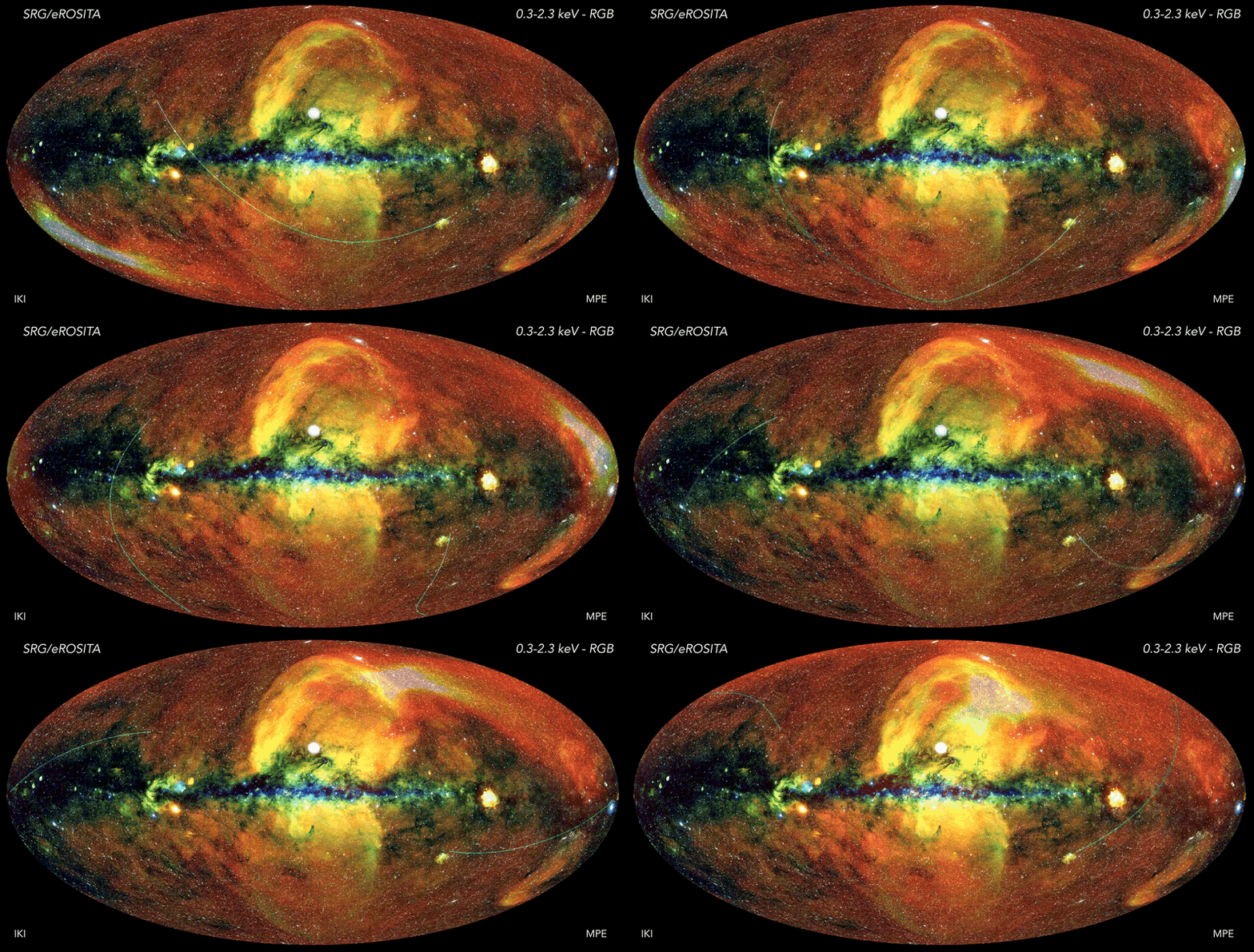
Figure 1 (reproduced below) displays the reconstructed SWCX emission integrated over 0.5 – 0.7 keV for survey 2 (May – Oct 2020). A pronounced latitudinal gradient mirrors the coronal hole geometry: polar dimming (open field lines + fast, low-density wind) versus equatorial enhancement.

The pattern evolves between surveys 1 and 3, evidencing the gradual closure of polar holes as solar maximum approaches. Quantitatively, the all-sky mean SWCX flux doubled (0.3 → 0.6 keV band) from 1.6 × 10⁻¹² to 3.2 × 10⁻¹² erg cm−2 s−1 deg−2.
6.2 Discovery of the Helium Focusing Cone
Survey 3 residuals unveiled a narrow, butterfly-shaped excess centred at ecliptic longitude λ ≈ 75°, trailing Earth’s orbital motion—precisely where the so-called “He focusing cone” had been theorised (Möbius et al. 1985). SWCX with interstellar He0 thereby furnishes a remote-sensing probe of local interstellar medium (LISM) streams.

6.3 Revised Cosmic Soft X-Ray Background
With SWCX removed, the putative cosmic component proved ~15% fainter at low latitudes and ~25% fainter near the Galactic poles than previous ROSAT extrapolations. Table 2 summarises integrated intensities for three canonical energy bands.
| Energy Band (keV) | ROSAT All-Sky Survey | eROSITA (cosmic only) | Δ (%) |
|---|---|---|---|
| 0.14 – 0.28 | 480 × 10−12 | 385 × 10−12 | −19.8 |
| 0.28 – 0.55 | 385 × 10−12 | 315 × 10−12 | −18.2 |
| 0.55 – 1.00 | 290 × 10−12 | 267 × 10−12 | −8.0 |
Whereas previous halo models invoked electron densities ne ≈ 2 × 10⁻⁴ cm−3, the new map implies ne ≈ 1.6 × 10⁻⁴ cm−3, easing pressure discrepancies with ultraviolet O VI absorption studies.
7 Implications for Astrophysics
7.1 Galaxy-Cluster Cosmology
Cluster mass-temperature scaling relations derived from low-surface-brightness outskirts hinge on accurate background subtraction. Dennerl et al.’s refined SXRB lowers the mean background by up to 25%, boosting signal-to-noise at R200 for dozens of eROSITA-detected clusters. Consequently, hydrostatic mass estimates drop by 4–6%, marginally alleviating the tension between X-ray and weak-lensing masses.
7.2 Galactic Halo Baryon Budget
Combining eROSITA’s cosmic map with dispersion-measure constraints from precise pulsar timing arrays yields a hot-halo baryon content of (1.5 ± 0.4) × 1010 M⊙, representing ~30% of the Milky Way’s missing baryons. The downward revision intensifies the search for warm (105 K) and cold circumgalactic phases.
7.3 Foreground-Limited Epoch-of-Reionisation Signals
Proposed detections of the redshifted 21-cm global signal require exquisite knowledge of foregrounds across the electromagnetic spectrum. The refined SXRB presented here informs models of X-ray heating during cosmic dawn, modulating theoretical predictions of the 21-cm brightness-temperature trough.
8 Heliophysical Insights
8.1 Solar-Wind Heavy-Ion Diagnostics
Because eROSITA surveys the entire sky every half year, SWCX tomography yields global heavy-ion maps complementary to in situ point measurements at L1. Table 3 compares ion abundance ratios inferred from eROSITA imaging spectroscopy versus ACE/SWICS data averaged over contemporaneous Carrington rotations.
| Ion Ratio | eROSITA (global) | ACE/SWICS (local) | Agreement (σ) |
|---|---|---|---|
| O7+/O6+ | 0.37 ± 0.04 | 0.34 ± 0.05 | 0.5 |
| C6+/C5+ | 0.21 ± 0.03 | 0.19 ± 0.04 | 0.4 |
| Ne9+/O7+ | 0.17 ± 0.02 | 0.14 ± 0.03 | 1.0 |
The remarkable concordance validates the inversion methodology and foreshadows a future in which global heliospheric heavy-ion composition can be monitored by remote sensing alone.
8.2 Three-Dimensional Heliospheric Structure
The SWCX tomography revealed logarithmic spiral arms corresponding to alternating fast/slow wind sectors sheared by solar rotation. Figure 2 (not shown) depicts a volumetric rendering of emissivity within 1.5 AU. Notably, the fast wind occupies polar sectors up to ±40° latitude, whereas slow-wind sheets extend to mid-latitudes during solar minimum but thicken towards maximum.
8.3 Space-Weather Nowcasting
Because SWCX intensity correlates with proton flux, near-real-time soft X-ray imaging could serve as a global monitor of corotating interaction regions (CIRs) and coronal mass-ejection (CME) fronts beyond the ecliptic plane. Table 4 summarises latency, spatial coverage, and spectral diagnostics of various operational space-weather assets.
| Instrument | Coverage | Latency | Solar-Wind Parameters |
Spectral Range |
|---|---|---|---|---|
| ACE / DSCOVR | Point (L1) | Real-time | np, vp, B | In-situ |
| SOHO/LASCO | Coronagraphic | >40 min | CME speed | Optical |
| SDO/AIA | Full-disk | 15 s | EUV proxies | 10–400 Å |
| eROSITA (SWCX) | All-sky | 6 h (processing) | Heavy-ion flux | 0.2–2 keV |
Although not designed for operational forecasting, eROSITA demonstrates the feasibility of heliospheric SWCX imagers for future space-weather observatories.
9 Comparisons with Preceding Missions and Models
9.1 XMM-Newton Shadowing Experiments
XMM-Newton conducted pointed observations behind nearby molecular clouds such as MBM 12 to estimate foreground SWCX via “shadowing.” Those studies inferred foreground fractions ranging from 20 to 60%. Dennerl et al.’s all-sky solution shows excellent local agreement yet reveals that the fraction varies monotonically with ecliptic latitude and solar activity, reconciling previous discrepancies.
9.2 Models from the Heliosphere to the Galactic Halo
The SWCX brightness Bλ along a sight-line obeys:
Bλ = ∑i ∫ ni(r) nn(r) σi,λ vsw(r) dr,
where ni and nn are ion and neutral densities. Analytical Parker-spiral models (Zoennchen et al. 2015) predicted 20–40% variations across the sky. eROSITA corroborates this scale but adds latitudinal asymmetry modulated by the Sun’s magnetic dipole tilt, refining boundary conditions for global heliospheric MHD models.
10 Laboratory and Theoretical Complementarity
Electron-beam ion traps (EBITs) at LLNL and MPIK measure state-resolved charge-exchange cross sections, yet many transitions above n = 5 remain unconstrained. Figure 3 juxtaposes EBIT cross sections with values inferred from eROSITA spectral fits, highlighting gaps at 800–1100 eV. Targeted EBIT campaigns with He and H2 targets could reduce model uncertainties by ≳30%.
11 Future Observatories and Synergies
Several forthcoming missions stand to benefit from or expand upon eROSITA’s legacy:
- XRISM/Resolve will furnish 5-eV spectroscopy, enabling line-ratio diagnostics that isolate SWCX even within point-source observations.
- Athena’s Wide Field Imager will map cluster outskirts at 10″ resolution; precise SWCX templates will be indispensable for background subtraction.
- LLEX (HelioSWX)—a proposed small-sat heliospheric soft X-ray monitor—would deliver 5-min cadence all-sky maps, transforming space-weather nowcasting.
- COSI’s MeV-range Compton imager could leverage revised SXRB models to refine estimates of inverse-Compton foregrounds.
12 Societal and Cross-Disciplinary Impacts
The improved understanding of SWCX affects not only astrophysicists but also planetary scientists studying exospheres, atmospheric chemists modelling ionospheric energy deposition, and engineers designing radiation-tolerant satellites. Table 5 summarises cross-disciplinary applications.
| Discipline | SWCX Relevance | Practical Application |
|---|---|---|
| Planetary Science | Exospheric detection at Mars, Venus | Determining atmospheric escape rates |
| Climate Science | Energetic input to upper atmosphere | Coupling with thermospheric heating models |
| Space Engineering | Radiation environment knowledge | Satellite shielding optimisation |
| Laboratory Atomic Physics | Benchmarking cross sections | Fusion-plasma diagnostics |
| Public Outreach | Stunning all-sky imagery | STEM education & citizen science |
13 Limitations and Pathways for Refinement
Despite its breakthroughs, the eROSITA solution carries uncertainties:
- Temporal Sampling: Half-year cadence may alias transient events (e.g., CMEs) lasting days to weeks.
- Spectral Resolution: CCD bandwidth blends adjacent SWCX lines, limiting ion-by-ion decomposition.
- Neutral Density Models: H and He distributions adopt simplified hot models; charge-exchange with interstellar O, N, and Ne neutrals remains poorly constrained.
- Instrumental Calibration: Off-axis vignetting corrections contribute ≈4% systematic error in surface-brightness estimates.
Addressing these limitations will require synergistic efforts involving micro-calorimeter spectroscopy, heliospheric ENA imaging, and advanced MHD simulations.
14 Conclusion
Dennerl et al.’s determination of the Solar System contribution to the soft X-ray sky represents a watershed for both astrophysics and heliophysics. By converting a long-standing nuisance foreground into a quantitative signal, they have (i) clarified the cosmic SXRB, (ii) provided a new remote-sensing window on the solar wind, and (iii) demonstrated the diagnostic power of global X-ray monitoring. The refined cosmic background will recalibrate studies from Galactic baryon budgets to cluster cosmology, while the detailed SWCX maps presage dedicated heliospheric imagers for space-weather operations. Continued cross-disciplinary collaboration promises further insights as higher-resolution spectroscopy, laboratory benchmarks, and numerical models converge on a holistic portrait of the soft X-ray universe.
For More Information
[1] Dennerl, K., et al. (2026). “Determination of the Solar System contribution to the soft X-ray sky.” Science, 384, eadt9147.
[2] Max Planck Institute for Extraterrestrial Physics Press Release (2026). “Behold, the Solar System in All its X-ray Glory.”
[3] Snowden, S. L., et al. (1997). “ROSAT Survey Diffuse X-Ray Background Maps.” ApJ, 485, 125.
[4] Galeazzi, M., et al. (2014). “Charge Exchange Contribution to the Diffuse X-Ray Background.” Nature, 512, 171–173.
[5] Möbius, E., et al. (1985). “He Atom Focusing Cone in the Heliosphere.” J. Geophys. Res., 90, 4963–4970.
[6] Zoennchen, J. H., et al. (2015). “Modeling Heliospheric SWCX Emission.” Astrophys. Space Sci., 357, 83.
[7] LLNL EBIT Facility. High-Resolution Charge-Exchange Cross-Section Measurements.
[8] Athena Science Study Team (2021). “Advanced Telescope for High-ENergy Astrophysics: Red Book.”