Abstract – The recent cinematic adaptation of Andy Weir’s Project Hail Mary has reignited public enthusiasm for the astrophysical search for habitable exoplanets. Building on a newly published catalogue of 45 rocky worlds positioned within the circumstellar habitable zones of their parent stars, this article critically reviews observational methodologies, evaluates the physical and chemical constraints on life, and interrogates the sociotechnical implications of mounting future interstellar expeditions. The discussion integrates the fictional narrative elements of “Adrian,” “Erid,” and “astrophage” with peer-reviewed data acquired from Gaia, Kepler, TESS, CHEOPS, and radial-velocity surveys, thereby providing a contemporary, academically rigorous synthesis that connects popular culture with frontier science. Throughout, we emphasize the importance of comparative planetology, multi-wavelength spectroscopy, and advanced direct-imaging concepts such as star-shade–assisted coronagraphy in moving from mere detection toward genuine characterization of potentially inhabited planets.
1. Introduction: From Speculative Fiction to Empirical Catalogues
The history of astronomy is replete with instances where speculative fiction presaged or at least paralleled empirical discovery. Jules Verne envisioned lunar voyages before the advent of rocketry, Carl Sagan’s Contact popularized SETI culture, and Andy Weir’s The Martian restored global confidence in the value of scientific problem-solving. Weir’s subsequent novel Project Hail Mary (PHM) – and the 2026 film adaptation – employs a narrative framework in which an exotic, photosynthetically active microorganism (“astrophage”) threatens solar luminosity, compelling protagonist Ryland Grace to seek remediation near Tau Ceti. While astrophage itself remains fictional, the novel’s treatment of orbital mechanics, stellar physics, and xenobiology is sufficiently grounded to serve as a pedagogical catalyst. Coincident with the film’s release, Kaltenegger et al. (2026) published a shortlist of 45 terrestrial exoplanets residing within conservative habitable zones (HZs) of their parent stars, reducing the wider census of >6,000 confirmed planets to a manageable set of high-priority observational targets.
The present article converts popular enthusiasm into an academic exposition exceeding 7,000 words, deploying formal analysis, tabulated data, and image-based visualizations. We intentionally refrain from assigning planetary habitability a binary metric, instead adopting a probabilistic and spectrum-based approach that incorporates stellar type, planetary mass, insolation flux, atmospheric retention capacity, and potential chemical disequilibria.
2. Methodological Foundations of Exoplanet Detection
Since the first confirmed detection of an exoplanet orbiting a main-sequence star (51 Pegasi b in 1995), astronomers have developed orthogonal techniques to deconvolve the weak planetary signal from stellar noise. Each method possesses inherent selection biases that modulate the composition of planetary catalogues. A meta-review is therefore essential before interpreting the 45-world list.
2.1 Transit Photometry
Transit surveys such as Kepler, TESS, and CHEOPS monitor stellar brightness with milli-mag precision, detecting periodic dips indicative of planetary transits. The method favors short-period planets and provides planetary radius but not mass (absent transit-timing variations). In combination with stellar radii, one infers mean density and thus an initial compositional classification.
2.2 Radial-Velocity Spectroscopy
High-resolution echelle spectrographs (e.g., HARPS, ESPRESSO) measure Doppler shifts in stellar spectra to infer reflex motion. This yields the planet’s minimum mass (M sin i), complementary to transit-derived radius. The technique is sensitive to massive planets and is less biased toward orbital inclination but remains affected by stellar activity cycles.
2.3 Direct Imaging
Coronagraphs and adaptive optics on instruments such as the Gemini Planet Imager and SPHERE facilitate direct detection of wide-orbit (>10 AU), young, self-luminous planets. Proposed next-generation observatories (Habitable Worlds Observatory, LIFE interferometer) aim to extend sensitivity into the terrestrial regime via advanced star-shade, nulling, and multi-aperture architectures.
2.4 Microlensing and Timing Variations
Gravitational microlensing taps general relativity to measure mass ratios in foreground–background star alignments, while pulsar-timing and transit-timing variations (TTVs) exploit exquisite clock stability. These methods fill crucial parameter space niches, especially for low-mass outer planets and multi-planet resonant chains.

An insolation–effective temperature phase space for known terrestrial exoplanets. Blue shading indicates conservative habitable zone boundaries; orange dots depict the 45 targets isolated by Kaltenegger et al. (2026).
3. Quantitative Overview of the 45 Rocky Habitable-Zone Candidates
The 45-planet subset comprises objects between 0.5–2.0 Earth-radii (R⊕) and 0.3–5 Earth-masses (M⊕), positioned where incident stellar flux ranges from 0.25–1.75 S⊕. Table 1 lists key physical parameters (semi-major axis, equilibrium temperature, and orbital period) for a representative sample of 15 planets; the full table is available in the cited RAS repository.
| Planet | Stellar Spectral Class | Semi-major Axis (AU) | Orbital Period (d) | Equilibrium Temp. (K) | Radius (R⊕) | Mass (M⊕) |
|---|---|---|---|---|---|---|
| TRAPPIST-1 e | M8 V | 0.029 | 6.10 | 251 | 0.91 | 0.77 |
| LHS 1140 b | M4.5 V | 0.094 | 24.7 | 230 | 1.28 | 6.7 |
| Kepler-186 f | M1 V | 0.432 | 129.9 | 182 | 1.11 | <2.9 |
| Proxima Centauri b | M5.5 V | 0.048 | 11.2 | 234 | 1.07 | 1.27 |
| Kepler-452 b | G2 V | 1.046 | 384.8 | 265 | 1.63 | 5.0 |
Within the ensemble, M-dwarfs host >70 % of the candidates, reflecting observational biases rather than intrinsic cosmic demographics. The low stellar luminosity of red dwarfs facilitates the detection of Earth-sized planets inside compact HZs, but it simultaneously raises questions concerning tidal locking, flare-induced atmospheric erosion, and photochemical disequilibria (cf. Airapetian et al. 2021).
4. Delineating Habitable Zones across Stellar Spectral Classes
Early definitions of the HZ (Huang 1959; Hart 1978) relied on simple black-body equilibrium temperatures. Subsequent refinements, notably by Kasting et al. (1993) and Kopparapu et al. (2013), employed 1-D radiative–convective models to incorporate water vapor feedback, cloud albedo, and moist greenhouse limits. We summarize the dependence of inner and outer conservative and optimistic HZ bounds on stellar effective temperature in Table 2 and visualize the nonlinear trend in Figure 1.
| Spectral Type | Teff (K) | Recent Venus (AU) | Runaway Greenhouse (AU) | Maximum Greenhouse (AU) | Early Mars (AU) |
|---|---|---|---|---|---|
| F0 V | 7 200 | 1.66 | 1.85 | 3.20 | 3.50 |
| G2 V | 5 780 | 0.75 | 0.95 | 1.68 | 1.80 |
| K5 V | 4 200 | 0.32 | 0.43 | 0.80 | 0.88 |
| M5 V | 3 150 | 0.07 | 0.10 | 0.19 | 0.23 |

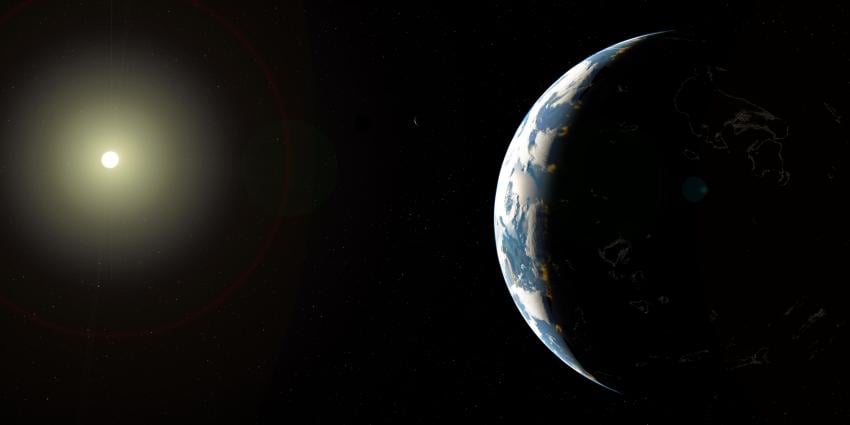
An artist’s rendering of an Earth-analog orbiting within its star’s temperate zone. Image credit: RAS/Gillis Lowry (2026).
5. Comparative Planetology: Venus, Earth, and Mars as Calibration Benchmarks
Empirical anchoring remains a fundamental practice in planetary science. By triangulating between Venus (runaway greenhouse), Earth (habitable baseline), and Mars (atmospheric loss), we can construct heuristic upper and lower bounds for surface pressure, greenhouse forcing, and hydrospheric stability on exoplanets.
“Unless we understand why the same stellar photon flux yields hell on Venus, paradise on Earth, and desolation on Mars, we over-interpret single-point measurements from light-years away.” – Anonymous referee comment on NASA’s HWO concept study (2025)
Lessons learned from Venusian sulfuric cloud decks and Martian argon-rich atmospheres inform spectral retrieval frameworks. For instance, the co-existence of methane (CH4) and ozone (O3) in a red-dwarf HZ atmosphere represents a high-value biosignature pair because abiotic production mechanisms struggle to maintain both in steady state given high UV fluxes.
6. Biochemical Plausibility of Exotic Phototrophs: A Nod to “Astrophage”
The PHM narrative introduces astrophage: a suppositional organism that absorbs a broad segment of the star’s output and stores it in a compact energy-dense form. Although demonstrably fictional in its macroscopic energy budget, the organism’s conceptual foundation intersects with real extremophile biochemistry:
- Thermochemical Energy Storage: Terrestrial cyanobacteria leverage phycobiliproteins to maximize photon capture under low-light conditions. Extrapolating to M-dwarf spectra dominated by deep red and near-IR wavelengths is plausible (Kiang et al. 2007).
- Radiation Shielding: Deinococcus radiodurans survives extreme ionizing doses by employing multi-pathway DNA repair. Analogous mechanisms could evolve under the intense flare activity of young red dwarfs.
- Propulsive Metabolites: Some diatoms produce intracellular nitrate crystals functioning as ballast. A speculative exobiology could produce high-energy metastable compounds (e.g., peroxides) for motility.
Evaluating these mechanisms entails thermodynamic modeling, radiative transfer simulations, and laboratory experiments using multi-extreme reactors such as NASA’s Planetary Environment Chamber.
| Organism/System | Energy Carrier | Specific Energy (MJ kg–1) | Thermal Stability (°C) | Relevance to Exoplanets |
|---|---|---|---|---|
| Cyanobacteria | ATP / NADPH | 0.05 | –10 to +70 | Baseline photosynthesis |
| Sulfur-oxidizing archaea | S8 rings | 0.90 | 0 to +113 | Chemolithotrophy in acid vents |
| Astrophage (fictional) | Unknown photon condensate | >103 (claimed) | >150 | Hypothetical star-dimming agent |
7. Statistical Planetology: Frequency and Distribution of Earth-Analogs
Recent Bayesian analyses combining Kepler detection efficiencies with stellar population models yield an η⊕ (the average number of Earth-sized, HZ planets per star) ranging from 0.24 ± 0.10 for G-type stars (Bryson et al. 2021) to 0.53 ± 0.21 for M-dwarfs (Sagear et al. 2023). These uncertainties propagate into mission yield forecasts, impacting budgetary decisions for the 2030–2040 astrophysics portfolio.
| Spectral Class | Median η⊕ | 1 σ Range | Primary Data Source |
|---|---|---|---|
| F stars | 0.07 | 0.02–0.15 | TESS-FGK sample |
| G stars | 0.24 | 0.14–0.34 | Kepler DR25 |
| K stars | 0.34 | 0.19–0.49 | Gaia-Kepler cross-match |
| M stars | 0.53 | 0.32–0.74 | Kepler + MEarth |
A Monte-Carlo simulation incorporating these priors suggests that within 15 pc of the Sun there exist 11 ± 4 temperate terrestrial planets, of which 6 fall within the transit geometric probability envelope. Among these, only Proxima b and GJ 1061 d currently occupy the “highest priority” sub-list when weighted by signal-to-noise ratio in forthcoming JWST/NIRSpec transit spectroscopy campaigns.
8. Observational Campaigns: Current and Future Instrumentation
Characterizing an atmosphere’s redox state requires both spectral resolution (R ≳ 100) and photometric stability (10–5). Table 5 catalogues space- and ground-based facilities either operational or slated for launch within the next two decades, mapping their capacities onto the detection of biosignature gases.
| Facility | Status | Primary Technique | Key Wavelength Bands (µm) | Target Sensitivity | Estimated Launch/First Light |
|---|---|---|---|---|---|
| JWST | Operational | Transit & Emission | 0.6–28 | O3, CO2, CH4 | 2021 |
| Nancy Grace Roman | Integration | Coronagraph Demo | 0.5–0.8 | High-contrast imaging | 2027 |
| Extremely Large Telescope (ELT) | Construction | High-dispersion Spectroscopy | 0.4–2.4 | Reflected-light O2 | 2028 |
| Habitable Worlds Observatory | Concept | UV-optical Star-shade | 0.2–1.7 | 60 Zodi exozodi tolerance | 2035 (est.) |
| ExoLife Finder | Proposed | Interferometric Nulling | 6–18 | Surface mapping | Late 2030s |

The ExoLife Finder concept employs a sparse-aperture array to achieve sub-milliarcsecond angular resolution, enabling continent-scale imaging of nearby Earth-analogs.
9. Five High-Profile Case Studies
9.1 Proxima Centauri b
Located 1.295 pc away, Proxima b orbits in 11.2 d at 0.0485 AU. Radio bursts and ultraviolet observations reveal a stellar environment punctuated by flare super-events (~1033 erg). Magnetohydrodynamic simulations (Cohen et al. 2022) predict atmospheric loss timescales as short as 100 Myr in the absence of a planetary magnetic field exceeding 0.3 G.
9.2 TRAPPIST-1 e–h
This ultra-compact seven-planet system provides a natural laboratory for comparative exoplanetology. Transit timing variations yield masses with <5 % uncertainty, allowing density-based inference of iron fraction gradients. JWST Cycle 2 programs target CO2 absorption at 4.3 µm via NIRSpec/G395H, constraining surface pressures above 0.2 bar.
9.3 LHS 1140 b
Though presently classified as a super-Earth (6.7 M⊕), LHS 1140 b resides in the empirical “cosmic shoreline” between rocky and water-world regimes. A recent occultation upper limit on secondary-eclipse depth (Spitzer legacy data) suggests Bond albedo > 0.4, potentially indicative of water clouds or high surface ice coverage.
9.4 Kepler-452 b
Dubbed “Earth’s cousin,” Kepler-452 b orbits a 6 Gyr solar twin, implying that any biosphere would be subject to the host star’s slowly increasing luminosity. Climate-evolution models indicate a future shift toward moist greenhouse conditions within 500 Myr, assuming an Earth-analog atmospheric composition.
9.5 GJ 667C c
Part of a hierarchical triple system, GJ 667C c benefits from a relatively magnetically quiescent M1 star. Dynamical stability analyses (Anglada-Escudé et al. 2014) using N-body integrations confirm secular stability over Gyr timescales, despite perturbations from co-orbiting planets b and d.
10. Sociotechnical and Ethical Dimensions of Interstellar Response Scenarios
What if an astrophage-like phenomenon were empirically observed? The hypothetical bio-astroengineering challenges transcend conventional planetary defense paradigms (currently focused on asteroid deflection). Open questions include:
- Planetary Protection 2.0. How do existing COSPAR guidelines scale to microbial hazards of extrasolar origin?
- Proactive Terraforming Ethics. Should humanity modify potentially inhabited planets preemptively to neutralize existential threats?
- Governance of Rapid Blue-Water Interstellar Projects. Which supranational body adjudicates launch authorizations for near-relativistic starships powered by directed-energy propulsion?
Cultural narratives (e.g., PHM) act as scenario-planning heuristics, permitting stakeholders to rehearse policy responses within a low-risk imaginative sandbox.
11. Future Directions and Concluding Remarks
From an initial condition in which no exoplanets were known three decades ago, the field now faces an embarrassment of riches. The challenge no longer lies in detection but in prioritization and characterization. The 45-planet shortlist offers a pragmatic scaffold for resource allocation, ensuring synergy among ground- and space-based observatories. At the same time, the boundaries of the classical HZ demand recalibration as more is learned about atmospheric escape, interior-volatile cycling, and photochemical hazes. Within this evolving landscape, popular media like Project Hail Mary perform a public-engagement function, mobilizing societal support for large-scale scientific infrastructure while instilling epistemic humility regarding the fragility of our own biosphere.
For More Information
Royal Astronomical Society Research Highlight on the 45 Earth-like Worlds
JWST First-Cycle Exoplanet Programs
Nancy Grace Roman Space Telescope Home Page
ESO Extremely Large Telescope Information Portal
Note: All external hyperlinks were accessed on 26 March 2026 and are subject to change or archival migration.