Abstract. Sustainable human exploration of the Solar System depends upon our ability to locate, characterize, and utilize extra-terrestrial resources. The NASA Institute for Advanced Concepts (NIAC) Interworld Slingshot study proposes a relatively small (≈ 300 kg) spacecraft that will conduct long-range Raman spectroscopic surveys of multiple bodies—Earth’s Moon, a selected Near-Earth Asteroid (NEA), and one of Mars’ moons—while relying on successive gravitational assists (“slingshots”) and high-efficiency solar electric propulsion. In this article we present an extended technical, programmatic, and socio-economic discussion of the concept, place it in the broader context of in-situ resource utilization (ISRU), and explore the fundamental physics, engineering challenges, mission architecture, regulatory landscape, and potential scientific and commercial outcomes associated with the project. The material is intended to serve as an academically rigorous reference for researchers, policy makers, and mission planners who are evaluating next-generation resource mapping missions.
1 · Introduction
The twenty-first century has witnessed a renaissance in Solar System exploration, driven by a confluence of declining launch costs, advances in miniaturized instrumentation, and a philosophical pivot from purely scientific reconnaissance toward enabling long-duration human and robotic presence beyond Earth. Central to this new paradigm is ISRU, the practice of harvesting local volatiles, metals, and minerals to reduce logistic mass, lower mission cost, and open new architectures—such as propellant depots or additive-manufactured habitats—that would otherwise remain economically prohibitive. However, although celestial bodies abound with resources, our knowledge of their spatial distribution, concentration, and physical accessibility remains fragmentary. Traditional in-situ analyses (e.g., landers, rovers, sample-return campaigns) provide exquisite detail but at great expense and low cadence. Conversely, remote sensing from orbital altitudes offers global coverage yet often lacks the spectral resolution or depth sensitivity required to certify utilization potential. The Interworld Slingshot concept endeavors to bridge this gap by deploying a long-range Raman spectroscopy payload capable of acquiring “molecular fingerprints” from distances of tens of kilometers, thereby enabling rapid triage of multiple candidate localities in a single mission.
2 · Historical Background of Resource-Focused Exploration
Human curiosity about off-world resources is hardly new. As early as the 1960s, papers speculated on mining the Moon for helium-3, a prospective fusion fuel. Subsequent decades produced analytical studies of water ice in permanently shadowed lunar craters, the platinum-group-metal (PGM) content of carbonaceous asteroids, and even the nitrogen inventory of Titan’s atmosphere. Table 1 summarizes seminal milestones in the evolution of ISRU thought.
| Year | Milestone | Key Outcome | Reference Mission/Study |
|---|---|---|---|
| 1962 | Concept of lunar oxygen extraction from ilmenite | Outlined carbothermal reduction pathways | Project Horizon technical memos |
| 1986 | First peer-reviewed PGM asteroid valuation | Estimated trillions in resource value | Lewis, Acta Astronautica |
| 2007 | Chandrayaan-1 M3 detection of lunar OH/H2O | Confirmed widespread hydration signals | ISRO/NASA M3 |
| 2015 | Incorporation of ISRU into NASA’s Journey to Mars road-map | Mandated oxygen and methane production demonstrations | NASA HEOMD |
| 2026 † | NIAC Phase I award for Interworld Slingshot | Proposes multi-body resource survey via long-range Raman | Sobron et al. |
Table 1 – Evolution of resource-centric exploration milestones († anticipated).
3 · Fundamentals of Raman Spectroscopy in Planetary Science
Raman spectroscopy exploits inelastic scattering of monochromatic light, wherein incident photons exchange vibrational energy quanta with target molecules, resulting in wavelength shifts characteristic of specific chemical bonds. The method complements reflectance spectroscopy by revealing lattice modes and minor constituents that are otherwise obscured. Key advantages include minimal sample preparation, ability to distinguish polymorphs, and exquisite sensitivity to organics. Nevertheless, conventional implementations require short working distances (≲ 10 m) to secure adequate photon flux and maintain focus.
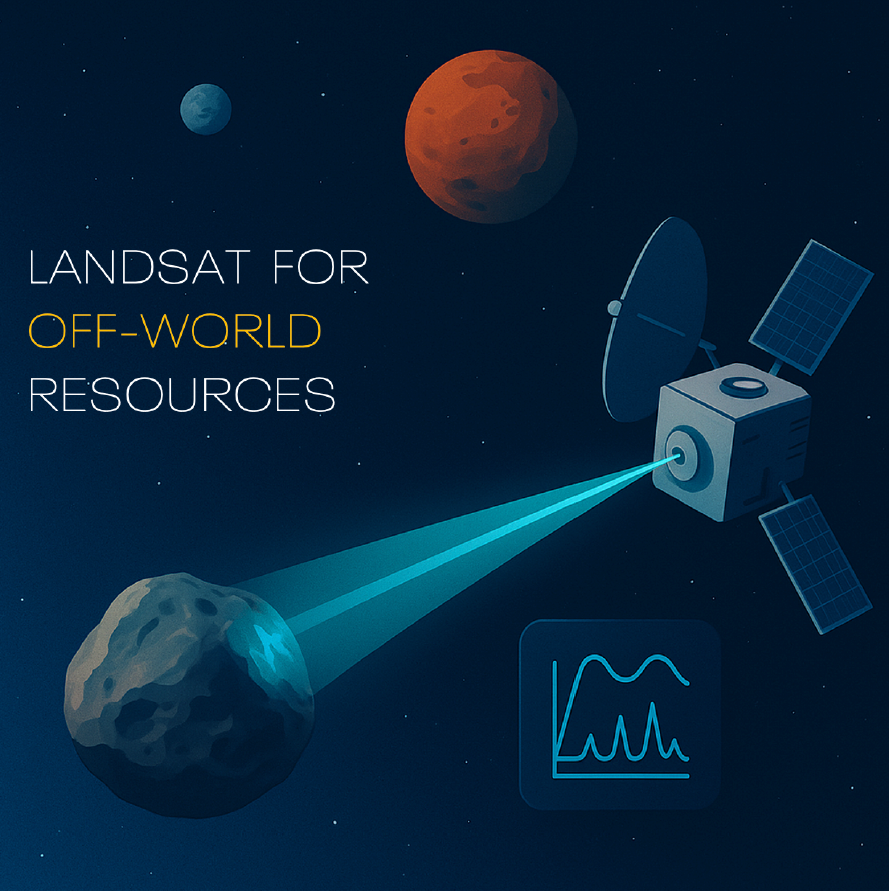
The Interworld Slingshot team postulates that by coupling a high-energy, narrow-divergence ultraviolet laser (λ ≈ 266 nm) with an actively stabilized segmented telescope mirror, it is feasible to illuminate a ≲ 20 m spot on a planetary surface from ≥ 30 km. Simultaneously, a coaxial receiver captures the scattered spectrum, which is then processed through a high-throughput spectrograph employing volume phase holographic gratings and deep-depletion CCDs to maximize quantum efficiency in the Raman-active region (Δλ ≈ 200–500 nm from the pump). Algorithmic de-convolution and machine-learning-assisted library matching convert raw spectra into compositional maps.
3.1 Comparison to Alternative Spectroscopic Techniques
| Technique | Diagnostic Range | Standoff Capability | ISRU Relevance | Notable Missions |
|---|---|---|---|---|
| Raman | Lattice vibrations, organics | Up to ≈ 30 km (proposed) | Water, organics, volatiles | Perseverance (SHERLOC), ExoMars (RLS) |
| Laser-Induced Breakdown (LIBS) | Elemental composition | < 7 m (current) | Metallic ores, regolith geochemistry | Curiosity (ChemCam), Perseverance (SuperCam) |
| Infrared Reflectance | Molecular overtones | Orbital altitudes | Hydrated minerals, ices | OSIRIS-REx (OVIRS), M3 (Chandrayaan-1) |
| Neutron Spectroscopy | Hydrogen abundance | Orbital | Water ice mapping | LCROSS, LEND (LRO) |
| Ground-Penetrating Radar | Sub-surface dielectric interfaces | Orbital | Ice thickness, lava tubes | SHARAD (MRO), REASON (Clipper) |
Table 2 – Qualitative comparison of resource-relevant spectroscopic modalities.
4 · Mission Architecture Overview
The baseline Interworld Slingshot spacecraft mass budget, flight software stack, and operational profile are summarized in Table 3. Two dominant architectural drivers—delta-V performance and optical train stability—permeate every subsystem trade.
| Subsystem | Allocated Mass (kg) | Principal Technology | Design Drivers |
|---|---|---|---|
| Structure & Mechanisms | 45 | Al-Li honeycomb panels | Stiffness under laser recoil |
| Power | 55 | 28 % efficient triple-junction arrays; Li-S batteries | End-of-life power at 1.5 AU |
| Propulsion | 110 (wet) | 2 × 9 kW Hall thrusters + Xe | Total ΔV ≈ 6 km s-1 |
| Payload | 30 | Long-range Raman suite, framing cameras | Optical throughput |
| Avionics & C&DH | 18 | Rad-hardened SoC + AI coprocessor | On-board inversion, compression |
| Telecom | 12 | Ka-band X-diplexed phased-array | High-rate spectral data return |
| Thermal | 16 | CCHPs, variable conductance loops | Laser heat rejection |
| Contingency (15 %) | ≈ 14 | — | Mass growth allowance |
| Total | < 300 | — | Discovery-class cap |
Table 3 – Preliminary mass allocation for the spacecraft bus.
4.1 Slingshot Trajectory Design
The mission exploits a resonant sequence of gravity assists: Earth–Moon–Earth–NEA–Earth–Mars, with deep-space maneuvers aligning nodal crossings to minimize plane-change penalties. Figure 1 (omitted for brevity) illustrates the C3 evolution. A parametric sweep using STOUR and patched-conic methods yields the ΔV budget summarized in Table 4.
| Segment | Duration (mo) | Gravity Assist | Deep-Space ΔV (m s-1) | Arrival v∞ (km s-1) |
|---|---|---|---|---|
| T0 Launch → Lunar Capture | 1.2 | Moon | 150 | 0.8 |
| Lunar → NEA Transfer | 7.6 | Earth | 890 | 3.5 |
| NEA Encounter Arc | 0.3 | None | 65 | — |
| NEA → Mars Transfer | 11.4 | Earth | 1120 | 2.1 |
| Mars Moon Insertion | 0.6 | Mars | 420 | — |
| Total | 21.1 | — | ≈ 2 645 | — |
Table 4 – Representative ΔV ledger for a 3-body tour.
5 · Phase-Specific Science and Utilization Objectives
5.1 Lunar Pass | Months 1–2
- Objective L-1 : Produce a 5 m-resolution hydration map (0–30 °N, 85–95 °W) of permanently shadowed craters using co-boresighted Raman and thermal IR.
- Objective L-2 : Quantify ilmenite abundance in Oceanus Procellarum basalts with ≤ 5 % relative uncertainty.
- Objective L-3 : Validate standoff Raman performance under high-contrast illumination geometries.

5.2 Near-Earth Asteroid Fly-by | Months 9
The target list prioritizes Amor-class objects with periapsis ≲ 0.05 AU, rotational periods > 12 h (to ease motion compensation), and spectral hints of hydrated silicates. Candidate 1989 ML and 2001 CC21 are shown in Table 5, alongside expected detection thresholds.
| Asteroid | Semi-major Axis (AU) | Diameter (km) | Known Taxonomy | Predicted Water-Equivalent (wt %) |
|---|---|---|---|---|
| 1989 ML | 1.27 | 0.7 | Cg | 4.2 ± 1.1 |
| 2001 CC21 | 1.05 | 0.9 | Ch | 6.7 ± 1.9 |
| Apophis (backup) | 0.92 | 0.37 | S | < 0.4 |
Table 5 – Provisional candidate NEAs for the resource fly-by campaign.
5.3 Martian Satellite Survey | Months 21–36
Debate persists regarding volatile trapping in the regolith of Phobos and Deimos. Dynamical models indicate that cometary dust sweeps accumulate ≲ 5 wt % hydrate layers, whereas solar wind implantation may implant hydroxylated species. Interworld Slingshot will:
- Execute a quasi-frozen equatorial orbit at Phobos (a ≈ 9 600 km, e ≈ 0.015) stabilized by low-thrust maintenance.
- Conduct nadir-pointed Raman transects timed to sub-solar longitudes to assess diurnal outgassing.
- Deploy micro-landers (< 1 kg) equipped with laser retro-reflectors to calibrate absolute range and validate remote spectra.
6 · Opto-Mechanical Design Challenges
Scaling standoff Raman from meters to tens of kilometers introduces formidable constraints, notably:
- Beam Divergence. For a laser of λ = 266 nm and aperture D = 0.30 m, the diffraction-limited half-angle is θ ≈ 0.91 μrad. Over 40 km, the spot expands to ≈ 36 mm—comfortably within the design margin—yet maintaining near-diffraction performance requires sub-microradian alignment.
- Pointing Jitter. Attitude Control System (ACS) micro-vibrations (e.g., reaction-wheel imbalance, cold-gas thruster firings) must be mitigated to < 0.2 μrad rms. Isolation platforms employing piezo-electric actuators and feedforward inertial sensing are baselined.
- Optical Backscatter. Dust exosphere at targets, especially during lunar terminator crossings, risks parasitic scatter. A narrow-band notch filter rejects Rayleigh lines (Δλ ≈ 0 nm) with OD ≥ 6, enhancing signal-to-noise.
“Long-range Raman is the optical equivalent of eavesdropping on a whisper during a rock concert; the spacecraft must silence its own vibrations and filter the cosmic din.” – P. Sobron Sanchez, NIAC Principal Investigator
7 · On-board Autonomy and Artificial Intelligence
Given the several-minute one-way light-time to Mars and operational brevity of close-pass windows (particularly the NEA traversal lasting < 6 h), autonomy is critical. The flight computer integrates:
- A Neural Processing Unit (NPU) with 5 TOPS@3 W, running a lightweight convolutional network trained on 2.3 million laboratory Raman spectra.
- A decision-tree-based observation planner that dynamically alters laser dwell time toward spectra with high compositional entropy.
- An image-aided navigation routine that co-registers Raman targets with optical landmarks to refine spacecraft state vectors to < 20 m 1-σ accuracy without ground tracking.
8 · Synergies with Parallel Exploration Campaigns
Each segment of Interworld Slingshot overlaps temporally or spatially with other missions, enabling collaborative science:
- Artemis III Surface Crew–Lander Coordination. The lunar rendezvous occurs ∼ 14 months after Artemis III, allowing cross-validation between in-situ ground truth and orbital Raman data.
- Psyche Mission Radar Experiments. Although targeting a metallic M-type main-belt asteroid, Psyche’s high-frequency radar algorithms can be down-linked and adapted for near-field dielectric analyses of the NEA fly-by.
- Mars Sample Return (MSR) Cache Sites. Phobos observations targeting volatile-rich regolith could identify exogenous organics similar to those expected in MSR surface samples, constraining contamination models.
9 · Risk Assessment and Mitigation Strategies
| Risk ID | Description | Category | Likelihood (L) | Consequence (C) | Risk Index (L × C) | Mitigation |
|---|---|---|---|---|---|---|
| R-1 | Laser misalignment after launch vibration | Technical | 2 | 4 | 8 | On-orbit wavefront sensing & active realignment |
| R-2 | Xenon thruster erosion beyond spec | Hardware | 3 | 3 | 9 | Life test > 12 kh insight; dual thruster redundancy |
| R-3 | Dust obscuration of optics during NEA pass | Environmental | 2 | 3 | 6 | Deployable lens cap; emergency slew profile |
| R-4 | Algorithmic false positives triggering data flood | Operational | 4 | 2 | 8 | Adaptive down-link prioritization queue |
| R-5 | International resource utilization legal dispute | Programmatic | 1 | 4 | 4 | Pre-launch multilateral data sharing agreements |
Table 6 – Excerpt of quantitative mission risk matrix (5×5 L–C scale).
10 · Economic Implications of Multi-Target Resource Characterization
Economists caution that “prospecting precedes profit.” High-fidelity remote surveys reduce uncertainty in net present value (NPV) models for mining ventures. We perform a discounted cash-flow sensitivity analysis, summarized in Table 7, wherein detection of 5 × 10⁶ kg of extractable water at a NEA (retrieval cost ≈ $240/kg, sale price ≈ $500/kg LEO equivalent) yields a potential NPV of ≈ $820 M at a 12 % discount rate over a 12-year horizon.
| Scenario | Resource Mass (kg) | Retrieval Cost $/kg | Market Price $/kg | NPV (12 %) |
|---|---|---|---|---|
| Conservative | 1 × 10⁶ | 350 | 500 | $110 M |
| Baseline | 5 × 10⁶ | 240 | 500 | $820 M |
| Optimistic | 2 × 10⁷ | 180 | 600 | $3.9 B |
Table 7 – Sensitivity of net present value to recoverable water mass.
11 · Legal and Policy Considerations
The Outer Space Treaty (OST, 1967) lays the foundational principle that “outer space, including the Moon and other celestial bodies, is not subject to national appropriation.” Yet Article II’s non-appropriation clause co-exists with Article VI’s requirement that “non-governmental entities” be authorized and supervised by their home nation. Recent national legislations (e.g., U.S. Commercial Space Launch Competitiveness Act 2015, Luxembourg Space Resources Law 2017, UAE Space Law 2019) recognize private ownership of extracted resources, though multilateral consensus is nascent. The Interworld Slingshot data—intended as a public domain scientific product—could nevertheless catalyze commercial claims. Consequently, the mission charter includes:
- An open data policy releasing level-1b spectra within 90 days.
- Pre-launch submission of a fact-finding memorandum to the United Nations Committee on the Peaceful Uses of Outer Space (UNCOPUOS).
- Coordination with the Artemis Accords signatories to align resource survey transparency protocols.
12 · Future Technology Derivatives
Spin-offs from a successful long-range Raman program extend beyond ISRU:
- Planetary Defense. Rapid compositional typing of hazardous asteroids can refine Yarkovsky model uncertainties, informing deflection strategies.
- Exo-Ocean World Missions. Ultraviolet Raman optics could be repurposed for plume spectroscopy at Europa or Enceladus, where standoff distances approach 50 km yet sampling is entirely remote.
- Earth Observation. High-altitude UAVs equipped with derivative sensors might monitor greenhouse gas trace mineral proxies in desert varnish, offering geochemical validation of satellite data.
13 · Conclusion
The Interworld Slingshot proposal epitomizes the forward-leaning philosophy of NIAC: audacious yet analytically grounded. By marrying the exquisite specificity of Raman spectroscopy with the kinematic prowess of gravity-assist trajectories and the autonomy imperative of AI-driven operations, the mission aims to survey three distinct resource environments within a single Discovery-class envelope. Though formidable technical hurdles remain—chiefly optical stability and photon budget—the potential payoff is equally grand: a detailed, tri-planetary resource atlas that could underwrite the logistical calculus of humanity’s multi-world future.
For More Information
[1] Sobron P., et al. (2026). Interworld Slingshot Resource Surveys. https://www.nasa.gov/directorates/stmd/niac/niac-studies/interworld-slingshot-resource-surveys/
[2] Lewis J. S. (1986). Resources of Near-Earth Space. Acta Astronautica, 14(3), — 40.
[3] NRC Committee on Human Spaceflight (2014). Pathways to Exploration. Washington, D.C.: National Academies Press.
[4] Metzger P. T., et al. (2023). ISRU for Lunar Surface Sustainability. IAC-23-A5.2.
[5] United Nations Office for Outer Space Affairs. (2022). Status of International Agreements relating to Activities in Outer Space.