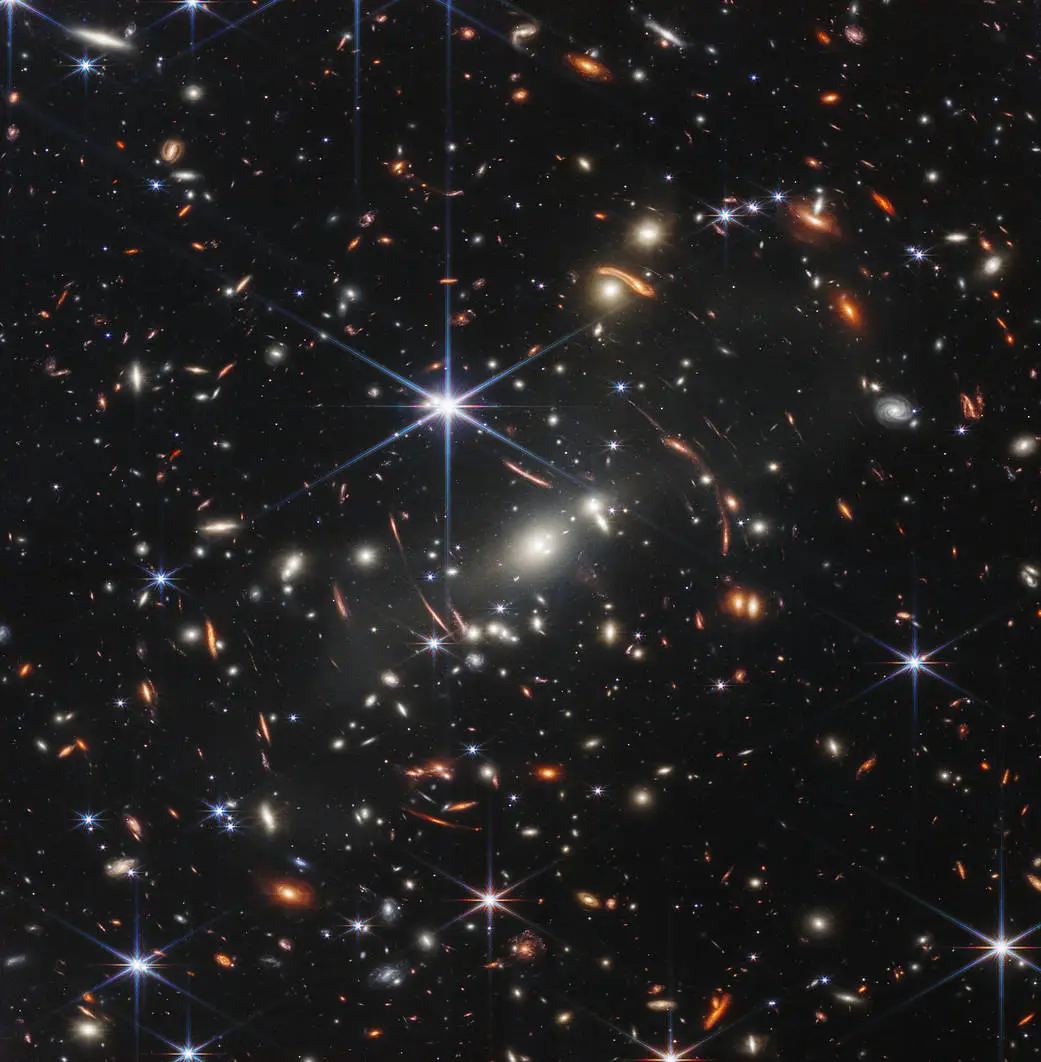
Black holes played a critical role in the formation of the early universe. However, astronomers have been debating for a long time just how critical, as the information we had about early black holes, which exist at high red-shifts, was relatively limited. A new paper from a group of researchers led by Sophia Geris at the University of Cambridge combined several spectra from the James Webb Space Telescope (JWST) to add some context to the formation of black holes early in the universe, and found that there are plenty of smaller ones lurking around, lending credence to the idea that black holes of all sizes contributed to the formation of our modern universe.
The Role of JWST in Astronomical Discoveries
JWST has been operating for a few years now, yielding several data releases for its various instruments. The particular dataset used for the analysis in this study is part of the third data release from the JWST Advanced Deep Extragalactic Survey (JADES). This release included 4000 additional, never-before-seen spectra, featuring 2375 objects in its dataset that have defined redshifts, indicating scientists know how far away they are in space and time.
The Study's Methodology
This particular study analyzed 600 galaxies that were very distant and removed those with known Active Galactic Nuclei (AGNs), which are active black holes consuming gas and dust at the center of galaxies. Most of the identified AGNs were notably bright. As the intention of this paper was to discover faint AGNs that would otherwise be overlooked in a conventional survey, those bright sources needed to be excluded.
Once the known bright AGNs were filtered out, the researchers stacked a series of images captured using different spectra to enhance the visibility of any faint AGNs still present in the dataset. The authors further organized the galaxies based on certain criteria, such as their brightness and the number of stars they contained.
Fraser explains how black holes can shine, despite being "black".
| Step | Description |
|---|---|
| 1. Data Collection | Gathered spectra from JADES - 4000 additional spectra. |
| 2. AGN Removal | Excluded known bright AGNs from analysis. |
| 3. Image Stacking | Stacked images using various spectra to enhance faint AGNs. |
| 4. AGN Search | Identified broad Hα light signal indicating black hole activity. |
Finding Faint AGNs
After stacking the spectra together and obtaining a list of AGNs that were bright enough to be noticeable, the researchers focused on a specific type of light known as broad Hα. This light signals that a black hole is actively consuming material, though it can also originate from other events such as supernovae or galactic winds.
By eliminating these possibilities, the researchers isolated a series of faint AGNs located at the centers of many galaxies at high red-shift, which were previously believed to have no active black holes. Notably, many of these black holes are significantly smaller than those typically associated with early universe black holes. Their masses only amount to about 1,000,000 times that of our Sun, and they are much less active compared to previously identified AGNs found at similar redshifts.
Implications for Understanding Galaxy Formation
This finding solves a previous conundrum regarding the sizes of black holes in the early universe. Notably, larger AGNs identified in prior studies seemed disproportionately large for their respective galaxies. However, the black holes isolated in this research conform more closely to the accepted size parameters for their host galaxies. This result suggests a paradigm shift away from a "black-hole first" scenario in galaxy evolution towards a model where galaxies can form first, and the black hole at its center can grow to a detectable size at a later stage.
Fraser discusses how quickly black holes can form.
Future of JWST Research
The studies conducted using the JWST represent exactly what the telescope was designed for—exploring the early universe for pathways to galaxy formation and uncovering the massive structures that have shaped the evolution of the universe. As it stands, JWST is only beginning its research journey, with numerous data releases expected in the future. These releases are likely to provide even greater insight into this early population of low-mass black holes, which have been definitively confirmed for the first time.
Related Resources
Further reading on this exciting area of astronomical research includes:
- S. Geris et al - JADES reveals a large population of low mass black holes at high redshift
- How Did Black Holes Grow So Quickly? The Jets
- Early Black Holes Were Bigger Than We Thought
- Webb Could Detect if Supermassive Black Holes Formed Directly
Conclusion
The discovery of a prolific population of low-mass black holes in the early universe through the use of JWST has important implications for our understanding of cosmic evolution. These findings contribute to a more nuanced picture of galaxy formation and the role black holes play within it, reaffirming the significance of black holes of all sizes in shaping the structure of our universe.
For More Information
Find additional resources related to the research and theories discussed in this article:
- NASA's James Webb Space Telescope
- Nature - The early universe as observed by JWST
- Science Magazine - JWST's Discovery
By enhancing our understanding of low-mass black holes and their formation, ongoing research has the potential to bridge gaps in our cosmic history, shedding light on the mechanisms that governed the evolution of the universe itself.