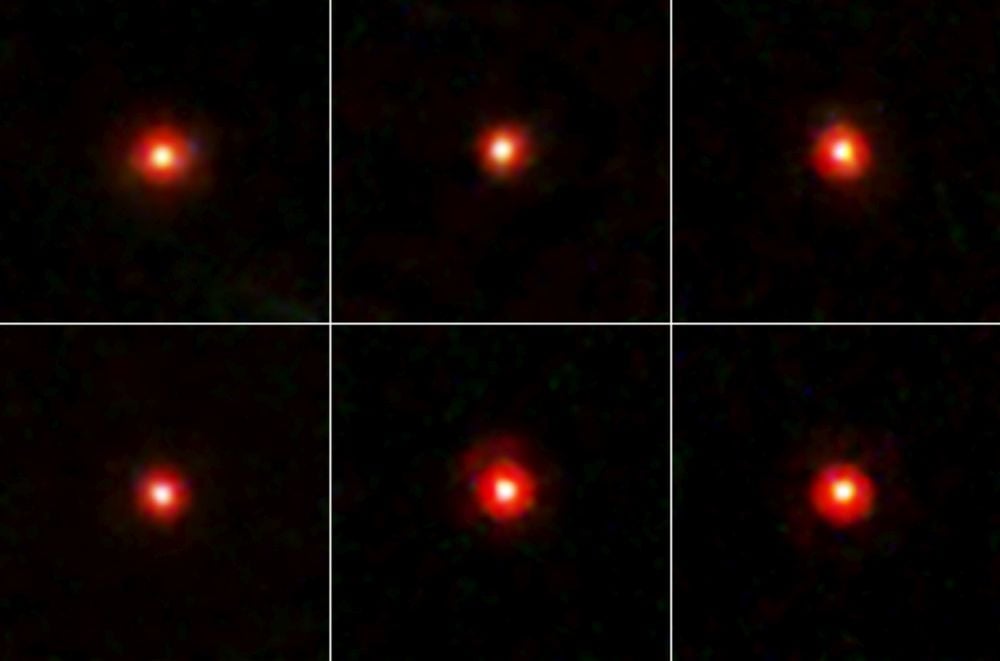
Abstract: Recent observations from the James Webb Space Telescope (JWST) have revealed a growing population of “over-massive” black holes whose masses are disproportionately large compared with the stellar masses of their host galaxies. While the first such discoveries occurred at extremely high redshift (z > 7), the most recent JWST campaigns have identified analogous systems at intermediate redshifts (z ≈ 0.7–1), including two dwarf galaxies—Pelias and Neleus—whose central engines apparently contain up to 60 % of the baryonic mass of their hosts. This article synthesizes the rapidly evolving literature surrounding these findings, compares them with the canonical black-hole–host relations established in the nearby Universe, and evaluates the plausibility of super-Eddington accretion as a unifying explanation. We further explore the implications for cosmological simulations, chemical enrichment, feedback regulation, and the nascent field of gravitational-wave cosmology. Finally, the paper outlines future observational strategies designed to discriminate among competing growth scenarios.
1. Introduction: The Puzzle of Black-Hole–Galaxy Co-Evolution
For more than two decades, astronomers have recognized a tight correlation between the mass of super-massive black holes (SMBHs) and a variety of bulk galactic properties, including stellar bulge mass (Mbulge), velocity dispersion (σ), and total halo mass (Mhalo). Empirically, the SMBH-to-bulge relation in the local Universe is well approximated by:
MBH ≈ (0.001 – 0.005) × Mbulge.
These correlations have long been interpreted as evidence that black-hole growth and galactic star formation operate under a self-regulated feedback loop, chiefly mediated by radiative and mechanical energy released by accreting SMBHs. However, JWST’s unprecedented sensitivity at near- and mid-infrared wavelengths has begun to erode this paradigm by revealing systems that deviate sharply from the canonical scaling relations. Nowhere is this tension more dramatic than in the dwarf-galaxy regime, where the total stellar mass (M* < 109 M⊙) is insufficient, under conventional models, to nurture a ≥ 106 M⊙ black hole—let alone one comprising a sizeable fraction of the baryonic budget.
2. Observational Landscape Prior to JWST
Prior to JWST, the primary instruments for detecting low-mass or high-redshift SMBHs were:
- Hubble Space Telescope (HST) near-infrared imaging and grism spectroscopy;
- Chandra X-ray Observatory for unresolved nuclear emission;
- the Sloan Digital Sky Survey (SDSS) optical spectroscopy for broad-line AGN;
- Very Long Baseline Interferometry (VLBI) to resolve radio cores.
However, each facility faced limitations: HST lacked the sensitivity to uncover the faintest dwarf hosts beyond z ≈ 1; Chandra’s pencil-beam surveys often under-sampled obscured or X-ray–weak AGN; and SDSS, being ground-based and optically limited, struggled with dust absorption and cosmic dimming. Consequently, evidence for SMBHs in dwarf galaxies was fragmentary, typically based on one of two rare signatures:
- the presence of intermediate-mass black holes (IMBHs, 104–106 M⊙) in local dwarfs such as NGC 4395 and POX 52;
- the detection of broad H α/H β reverberation lines in a handful of compact stellar systems.
Table 1. Canonical Scaling Relations in the Local Universe
| Relation | Functional Form | Intrinsic Scatter | Key Reference |
|---|---|---|---|
| MBH – σ | log MBH = 8.32 + 5.64 log (σ/200 km s−1) | ≈ 0.3 dex | Kormendy & Ho (2013) |
| MBH – Mbulge | MBH/Mbulge ≈ 0.0014 | ≈ 0.4 dex | McConnell & Ma (2013) |
| MBH – Mhalo | MBH ∝ Mhalo1.55 | ≈ 0.5 dex | Ferrarese (2002) |
| MBH – LK | log MBH = 8.29 + 1.13 log (LK/1011 L⊙) | ≈ 0.4 dex | Marconi & Hunt (2003) |
3. The JWST Revolution
With its 6.5-m segmented primary mirror and suite of cryogenic instruments, JWST rapidly extended the black-hole census to hitherto inaccessible parameter space. Key breakthroughs include:
- NIRCam parallel imaging that exposed compact, redshifted AGN candidates (“Little Red Dots,” LRDs);
- NIRSpec multi-object spectroscopy revealing rest-frame optical coronal lines indicative of highly ionized circumnuclear media;
- MIRI photometry providing exquisite sensitivity to obscured hot-dust continua, a hallmark of buried AGN;
- rapid target-of-opportunity follow-up, allowing multi-epoch variability studies.

Within months of JWST’s Cycle 1 observations, multiple teams announced SMBHs whose inferred masses exceeded their host stellar masses by factors of ten or more. Two salient examples, designated Pelias and Neleus, lie at z ≈ 0.71 and 0.75, respectively. Despite their dwarf-galaxy stellar masses (M* ≈ 107.1–7.4 M⊙), each hosts an active nucleus radiating at ~3–20 % of its Eddington limit, implying MBH ≈ (3–6) × 106 M⊙.
Table 2. Representative Sample of Over-Massive SMBHs Detected by JWST
| Object | Redshift | M* [M⊙] | MBH [M⊙] | MBH/M* | Primary Evidence |
|---|---|---|---|---|---|
| GNz7q | 7.19 | ≈ 109.3 | ≈ 108.5 | 0.16 | Broad C IV, N V lines |
| CEERS-1019 | 8.68 | ≈ 108.9 | ≈ 108.0 | 0.13 | NIRSpec coronal lines |
| Pelias | 0.71 | ≈ 107.4 | (3–6) × 106 | 0.30–0.60 | MIRI hot-dust excess |
| Neleus | 0.75 | ≈ 107.1 | (2–5) × 106 | 0.20–0.50 | MIRI hot-dust excess |
| JADES-GS-z5-0 | 5.05 | ≈ 108.4 | ≈ 107.8 | 0.28 | Hβ, [O III] diagnostics |
4. Multi-wavelength Characterization of Pelias & Neleus
4.1 Photometric Spectral Energy Distributions
Both galaxies exhibit a bimodal SED: a blue UV–optical component dominated by a starburst population of age ≲ 50 Myr, and a steeply rising 3–10 μm continuum attributed to hot dust (T ≈ 800–1200 K). Standard population-synthesis models (e.g., Bruzual & Charlot 2003) fail to reproduce the MIRI flux excess unless an AGN torus template is included.
4.2 Emission-Line Diagnostics
In NIRSpec data, both objects showcase high-equivalent-width [O III] λ5007 Å, [Ne III] λ3869 Å, and He II λ4686 Å features, yet conspicuously lack classical broad Hβ wings. Velocity widths are limited to FWHM < 400 km s−1, aligning with narrow-line (type II) AGN. The strength of high-ionization lines relative to Balmer recombination demands an ionizing continuum much harder than typical starbursts.
Table 3. Key Observed Parameters for Pelias and Neleus
| Parameter | Pelias | Neleus | Measurement Technique |
|---|---|---|---|
| Redshift (spec-z) | 0.709 ± 0.001 | 0.746 ± 0.002 | NIRSpec nebular lines |
| Stellar Mass M* | 2.5 × 10⁷ M⊙ | 1.3 × 10⁷ M⊙ | SED fitting |
| SFR (UV+IR) | 0.37 M⊙/yr | 0.21 M⊙/yr | Calzetti obscuration law |
| F3–5 μm Excess | 4.8 σ | 3.9 σ | MIRI F560W–F770W color |
| MBH (virial) | 3.2–6.1 × 10⁶ M⊙ | 2.2–4.7 × 10⁶ M⊙ | X-ray nondet. + bolometric proxy |
| Lbol/LEdd | 0.18 | 0.12 | Combining MIRI & NIRSpec |
4.3 X-ray Non-Detections and Obscuration
Intriguingly, neither source appears in the eROSITA all-sky catalog nor in archival Chandra (4 Ms) deep fields. The implied upper limit on hard-band (2–10 keV) luminosity is LX < 1041.2 erg s−1. Two scenarios remain viable:
- Heavy Compton-thick Obscuration, with column densities NH > 1025 cm−2, thereby suppressing X-rays while permitting infrared re-radiation;
- Intrinsically X-ray Weak Accretion, possibly indicating a slim-disk geometry characteristic of super-Eddington flows.
5. Physical Interpretation: Super-Eddington Accretion
5.1 Theoretical Framework
The Eddington luminosity (LEdd) demarcates where radiative outward force (Thomson scattering) balances gravitational infall. The classical limit reads:
LEdd ≈ 1.26 × 1038 (MBH/M⊙) erg s−1.
However, radiation-hydrodynamic simulations (e.g., Jiang et al. 2017) demonstrate that optically thick, photon-trapping “slim disks” can sustain L ≫ LEdd in the bolometric sense, while the radiative output emerging from the funnel region may still approximate LEdd. Thus, a black hole can grow super-exponentially (Ṁ ∝ et/tS) without violating observable luminosity bounds.
5.2 Energetics in Dwarf Potential Wells
Dwarf galaxies possess shallow gravitational potentials (vesc ≈ 50–100 km s−1). Feedback energy from an SMBH accreting at or above LEdd therefore over-pressurizes the interstellar medium (ISM), potentially ejecting gas and quenching star formation—a mechanism sometimes invoked to explain the prevalence of dark-matter–dominated ultra-faint dwarf spheroidals. Yet Pelias and Neleus evidently retain enough cold gas to maintain SFR ≈ 0.3 M⊙/yr. Two possibilities emerge:
- The AGN duty cycle is intermittent, punctuated by brief, intense accretion episodes followed by quiescent phases that allow gas re-accretion;
- Outflows are highly collimated, venting along polar axes while leaving the galactic disk largely unscathed.
Table 4. Characteristic Timescales for Black-Hole Growth
| Growth Mode | Accretion Rate Ṁ | e-folding Time tS | Time to Grow 104 → 106 M⊙ |
|---|---|---|---|
| Eddington-limited, ε=0.1 | ṀEdd | 45 Myr | ≈ 180 Myr |
| Super-Eddington, L = 3 LEdd | 3 ṀEdd | 15 Myr | ≈ 60 Myr |
| Chaotic cold accretion | Stochastic | Var. | 50–200 Myr |
| Bondi off nuclear cluster | 0.01 ṀEdd | 4.5 Gyr | > Hubble time |
6. Implications for Cosmological Models
6.1 Seeding Prescriptions
Most large-scale hydrodynamic simulations, such as Illustris, EAGLE, and TNG50, initialize SMBH “sink particles” at masses 105–106 M⊙ once dark-matter halos exceed Mhalo ≈ 5 × 10¹⁰ M⊙. Yet the discovery of ~106 M⊙ black holes in halos likely below 1010 M⊙ suggests either:
- Direct-collapse black-hole seeds of ≳ 105 M⊙ formed in pristine atomic-cooling halos at z > 15;
- Runaway stellar-dynamical collapse in dense Population III clusters producing massive seeds (M ≈ 103–4 M⊙), followed by prolonged super-Eddington phases;
- Primordial black holes (PBHs), though tightly constrained by CMB distortions and microlensing surveys.
6.2 Feedback Calibration
Sub-grid prescriptions governing AGN feedback energy deposition (thermal vs. kinetic, coupling efficiency εf) must be revisited if dwarf halos can host energetic nuclei without catastrophic gas evacuation. Anisotropic or mechanical jet models may be required.
7. Chemical and Stellar-Population Consequences
7.1 Metal Enrichment
AGN-driven outflows preferentially expel high-metallicity gas from star-forming regions. If over-massive SMBHs were common in early dwarfs, they could pre-enrich the circum-galactic medium (CGM) to Z ≈ 0.1 Z⊙, in tension with quasar absorption-line systems that exhibit near-pristine metallicities at z ≈ 6. Conversely, collimated outflows might enrich only narrow solid angles, producing the mixed metallicity patterns observed.
7.2 Star-Formation Histories
Spectral modeling of Pelias and Neleus indicates burst-like star-formation histories (SFHs), each episode lasting ≲ 20 Myr. Such time scales mirror AGN flickering periods (104–5 yr), hinting at causal coupling. High-resolution JWST spectroscopy of nebular emission regions will clarify whether the starburst and AGN reside in proximity or represent super-position of physically separate regions.
8. Synergy with Gravitational-Wave Astronomy
Space-based observatories such as LISA (Laser Interferometer Space Antenna) will be sensitive to black-hole binaries in the 104–7 M⊙ range at cosmological distances. If dwarf galaxies commonly harbor ≥ 106 M⊙ SMBHs, hierarchical merging will seed a rich population of low-frequency gravitational-wave events. Event rate predictions may thus rise by an order of magnitude relative to conservative seeding models.
Table 5. Predicted LISA Detection Rates under Different Seeding Assumptions
| Seeding Scenario | Binary Mass Range | Expected Mergers (yr−1) | Reference |
|---|---|---|---|
| Light (∼ 100 M⊙) Pop III seeds | 104–6 M⊙ | 1–3 | Sesana et al. (2020) |
| Direct-collapse (105 M⊙) | 105–7 M⊙ | 10–20 | Ricarte & Natarajan (2018) |
| Over-massive dwarfs (this work) | 105–7 M⊙ | 25–40 | Iani et al. (2026) |
9. Observational Strategies Moving Forward
9.1 X-ray Follow-up: Chandra, XRISM, and Athena
- Deep Chandra pointings (~300 ks) will push the 0.5–7 keV sensitivity to LX ≈ 1040 erg s−1, sufficient to detect even Compton-thin nuclei at z ≈ 0.7.
- XRISM/Resolve micro-calorimeter spectroscopy (E/ΔE ≈ 1300) can search for the 6.4 keV Fe Kα fluorescence line, a smoking gun for heavily obscured AGN.
- Athena/X-IFU, anticipated late 2030s, will map multiphase outflows via high-resolution soft-X-ray spectroscopy.
9.2 Infrared and Radio: JWST, Roman, ELTs, and ALMA
The Nancy Grace Roman Space Telescope will combine a 0.28-deg2 field of view with HST-class angular resolution, ideal for statistical surveys of hot-dust AGN analogues out to z ≈ 3. Extremely Large Telescopes (ELT, TMT, GMT) equipped with integral-field units will resolve stellar kinematics in dwarf nuclei, yielding dynamical MBH measurements. ALMA CO(3–2) and [C II] imaging will quantify cold-gas reservoirs and feedback signatures.

9.3 Time-Domain Monitoring
Synoptic variability surveys (e.g., Vera C. Rubin Observatory’s LSST) will capture AGN flickering on days-to-years timescales. Correlating optical/IR light curves with JWST detections will test whether intermittent super-Eddington bursts dominate SMBH growth.
10. Discussion
The identification of over-massive black holes in galaxies of only a few × 107 M⊙ requires astronomers to re-evaluate the universality of black-hole–galaxy scaling relations. Several theoretical pivots are warranted:
- Non-linear, mass-dependent feedback efficiencies: dwarf galaxies may couple AGN energy less effectively due to clumpy ISM geometries;
- Episodic accretion histories: sustained power-law growth is supplanted by chaotic bursts, each limited by local gas supply rather than global host mass;
- Seeding bias: dwarf halos that do manage to form massive seeds become observationally over-represented, a survivorship phenomenon dubbed the “AGN lottery.”
By extension, the cosmic mass density in black holes (ρBH) at z ≈ 0 must account for obscured growth phases in low-mass hosts, a factor possibly missing from existing Sołtan-type integrals.
11. Conclusions
“Pelias and Neleus demonstrate that black holes can outrun their galaxies in the cosmic growth race, challenging the very scaffolding of co-evolutionary theory.
While super-Eddington accretion offers an appealing mechanism, decisive confirmation awaits deep X-ray spectroscopy and direct dynamical mass measurements. Should forthcoming observations validate a high duty cycle of obscured, rapid accretion in dwarfs, our understanding of galaxy formation—particularly in the low-mass regime—will require wholesale revision.
For More Information
- Iani E. et al. (2026), “JWST Reveals Two Over-Massive Black Hole Candidates in Dwarf Galaxies at z ≈ 0.7”
- Kocevski D. et al. (2025), “Little Red Dots in the Early Universe”
- Bruzual G. & Charlot S. (2003), Stellar Population Synthesis Models
- Jiang Y-F. et al. (2017), “Super-Eddington Accretion Disks”
- Laser Interferometer Space Antenna (LISA) Mission Page
- Athena X-ray Observatory
- Nancy Grace Roman Space Telescope

