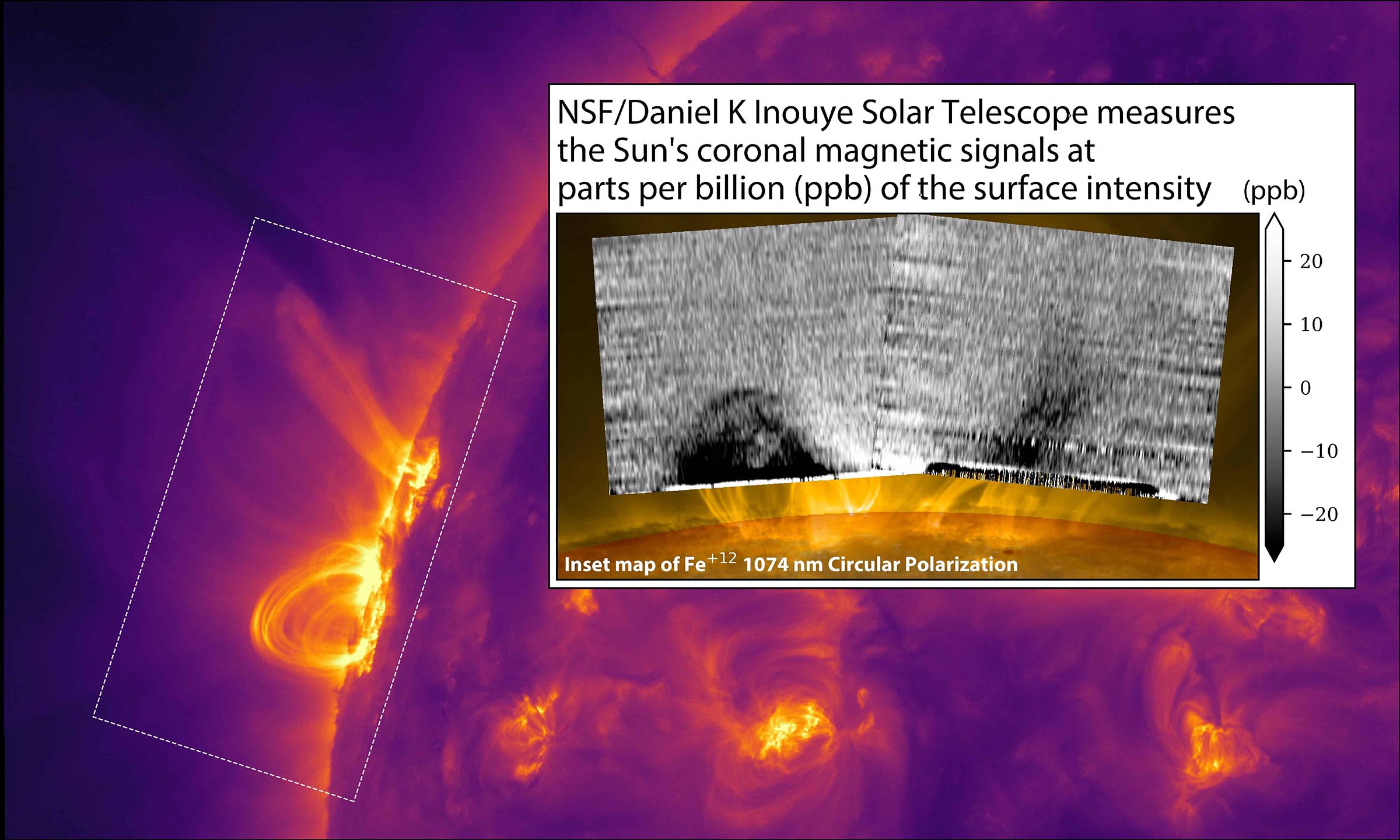
Scientists using the Daniel K. Inouye Solar Telescope (DKIST) in Hawai'i have uncovered an important mechanism occurring on the Sun's surface that they believe contributes to the heating of the solar corona. This process, known as a Kelvin-Helmholtz Instability (KHI), sheds light on previously hidden dynamics of the Sun's magnetic field, particularly a phenomenon referred to as flux braiding.
Introduction
The Sun's corona, the outer atmosphere of the Sun, exhibits complex magnetic structures and behaviors. Recent research has found that the processes occurring in this region are critical for understanding solar dynamics and their effects on the solar system, particularly regarding space weather events.
The Kelvin-Helmholtz Instability
The Kelvin-Helmholtz Instability is a fluid instability that occurs when there is a velocity shear in a continuous fluid or across the interface between two different fluids. This instability is manifested in the solar atmosphere, particularly in the form of swirling plasma structures that can lead to turbulence, heating, and energy transfer within the corona. The KHI has often been observed in astrophysical phenomena and is thought to play a crucial role in the dynamics of solar eruptions.
Mechanism
- The instability occurs at fluid interfaces where velocity differences are present.
- The process involves the generation of vortices that can lead to significant energy transfer, impacting solar heating.
- Additionally, the interaction of these vortices with the magnetic fields can lead to various magnetic phenomena, including reconnection events.
Flux Braiding
The research indicates that KHI may be a root cause of magnetic flux braiding observed in the solar corona. This phenomenon is characterized by magnetic field lines intertwining, forming braided structures that can result in increased magnetic energy storage. These braids can lead to magnetic reconnection, contributing to the heating processes in the corona.
Findings
| Observation | Result |
|---|---|
| Kelvin-Helmholtz Instability Presence | Detected swirling plasma structures in the corona. |
| Flux Braiding Analysis | Indicated braided magnetic structures leading to solar heating. |
| Magnetic Field Mapping | Revealed detailed maps of the coronal magnetic field using the Zeeman Effect. |
Methodology
This study was carried out using data collected from the Daniel K. Inouye Solar Telescope, which is recognized as the world's most powerful solar telescope. Utilizing its advanced imaging capabilities, scientists employed the Zeeman Effect to measure the magnetic field strength in the solar corona. This technique involves analyzing the polarization of light emitted from the sun to infer magnetic properties.
Conclusion
This recent discovery is pivotal as it not only provides insights into the mechanics behind solar heating but also offers explanations for similar activities observed in other stars. Understanding the role of Kelvin-Helmholtz Instabilities in solar dynamics may enhance prediction models for space weather, safeguarding technology that is increasingly reliant on solar activity forecasts.
Limitations
- The exact mechanisms of KHI in solar phenomena are still under investigation.
- Research findings may vary based on observational data quality and methodologies.
References
- AURA Astronomy. (2024). Groundbreaking Achievement: NSF Daniel K. Inouye Solar Telescope Produces its First Magnetic Field Maps of the Sun’s Corona.
- Zeeman Effect. (n.d.). More information on the Zeeman Effect.
Image
Please refer to the relevant publications for images related to the Kelvin-Helmholtz Instability and solar magnetic field observations.