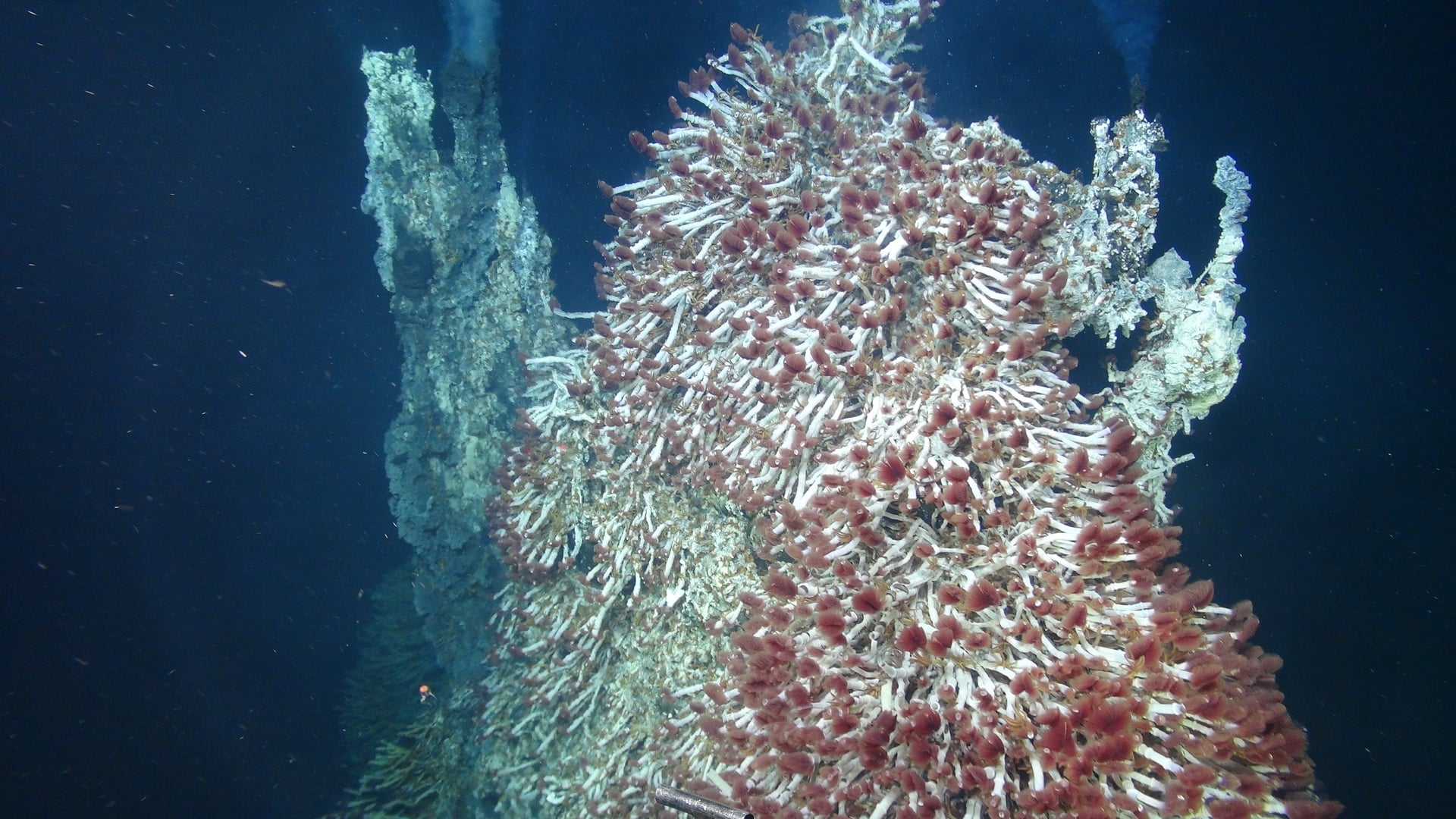
If life is to be found elsewhere in our Solar System, astrobiologists believe it is likely to be simple (microbial) in nature. While most of our astrobiology efforts are currently focused on Mars, multiple missions will be sent to the outer Solar System in the coming years to search for possible signs of life inside Jupiter's icy moon Europa. For decades, scientists have theorized that life could exist beneath the moon's surface around hydrothermal vents located at the core-mantle boundary. Searching for possible evidence of this life is the purpose of the ESA's JUpiter ICy moons Explorer (JUICE) and NASA's Europa Clipper mission, which are currently en route to the Jupiter system.
Based on fossilized bacteria found around deep-sea vents, hydrothermal activity is believed to have played a key role in the emergence of life roughly 4 billion years ago. NASA recently awarded $621,000 to James Holden, a microbiology researcher in the School of Earth and Sustainability at the University of Massachusetts Amherst. Per the award, Holden will conduct a three-year study on microbes that live around volcanic fissures on the ocean floor. This study aims to help scientists predict what microbial life inside Europa could look like in anticipation of what missions like JUICE and the Europa Clipper could find.
Scientists got their first hints of a possible liquid ocean beneath Europa's icy exterior when the Voyager 1 and 2 probes passed through the system in 1979. Since then, observations by multiple robotic missions and the Hubble Space Telescope confirmed the presence of plume activity on the moon's surface. Similar to Saturn's moon Enceladus and other "Ocean Worlds" in the Solar System, these plumes are the result of "cryovolcanism," a geological process where volatiles (like water, methane, and ammonia) erupt from the surface of a body rather than molten rock.
Holden has been studying deep-sea volcanoes since 1988. With NASA's support, he established a lab simulating the lightless and oxygen-less conditions typically found around deep-sea vents. It is here that extremophiles can obtain the energy and nutrients they need from the hot gases and minerals flowing from these vents. As Holden explained in a UMass Amherst press release:
To get our microbes from them, we use submarines—sometimes human-occupied, sometimes robotic—to dive a mile below the surface and bring the samples ashore and back into my lab at UMass Amherst. Because Europa's conditions might be similar to the conditions these microbes come from, we think that Europan life, if it exists, should look something like our own hydrothermal microbes.
However, Europa's interior ocean will likely be different from Earth's in many ways, owing to the moon's different chemistry, size, and gravity (roughly 13.5% of Earth's). This essentially means that while life inside Europa will have some things in common with extremophiles here on Earth, they will not be exactly the same. On Earth, the type of extremophiles that Holden and other microbiologists study break down hydrogen to get their energy using special enzymes called hydrogenases. These enzymes come in many types that work in different ways and may have different functions in different kinds of cells. As a result, organisms that rely on different sets of hydrogenases may not resemble each other or function in the same way.
In addition, the iron, sulfur, and carbon released by Earth's hydrothermal vents are known to bond with hydrogen to generate energy. But scientists are unsure how those processes work biologically since the amounts of hydrogen involved vary.
We have long had a basic interest in knowing if there is life beyond our planet and how that life would function. It's exciting to think that the answer to the secret might be here on our own planet. So, we need to figure out the different chemical processes that Europan microbial life might be using in order to create energy. Different chemistries could create very different kinds of microbes. Our research will be to determine how the different chemical processes contribute to an organism's physiology.
Significance of Hydrothermal Vents
Hydrothermal vents present a unique environment for studying extremophiles and can potentially serve as analogs for extraterrestrial life. The key findings about these ecosystems are summarized in the table below:
| Characteristic | Details |
|---|---|
| Temperature | Extremophiles thrive at temperatures sometimes exceeding 400°C (752°F). |
| Pressure | Vents exist at depths often exceeding 4,000 meters (13,123 feet), creating immense pressure environments. |
| Energy Source | Organisms derive energy from chemical reactions, mainly between hydrogen and various mineral compounds. |
| Biological Diversity | These ecosystems host a variety of life forms, including tube worms, clams, and bacteria. |
Microbial Life in Extreme Environments
Extremophiles around hydrothermal vents provide critical insights into the survival strategies of life in extreme conditions. The study of these organisms helps us understand how life may adapt to environments on other celestial bodies.
Types of Extremophiles
- Thermophiles: Thrive at very high temperatures.
- Psychrophiles: Prefer extremely cold environments.
- Halophiles: Flourish in high-salinity conditions.
- Acidophiles: Adapted to acidic environments.
The Implications for the Search for Extraterrestrial Life
The findings and ongoing research of microbes around deep-sea hydrothermal vents not only help in understanding life on Earth but also serve as a model for the search for life on other planets, particularly Europa.
Potential Habitats on Europa
Researchers hypothesize that beneath Europa’s icy crust, there could be conditions similar to those found in Earth's oceans around hydrothermal vents. The characteristics of these potential habitats are summarized in the following table:
| Feature | Possible Condition on Europa |
|---|---|
| Water | Presence of a subsurface ocean under the ice crust. |
| Energy Sources | Potential heat from hydrothermal activity on the ocean floor. |
| Chemical Nutrients | Minerals and gases that could support life. |
Methodologies for Future Exploration
To explore these subsurface environments, scientists plan to use various methodologies, including robotic spacecraft and potential landers or probes designed to penetrate the icy crust of Europa. The following table summarizes current and future missions aimed at investigating Europa:
| Mission | Agency | Goal |
|---|---|---|
| JUICE (JUpiter ICy moons Explorer) | European Space Agency (ESA) | To study Europa and its potential habitability. |
| Europa Clipper | NASA | To conduct detailed reconnaissance of Europa's ice shell and subsurface ocean. |
| Europa Lander (conceptual) | NASA | To land on Europa and search for signs of life directly. |
Conclusion
The search for life beyond Earth remains one of humanity's most profound quests. By studying extremophiles in our own oceans, scientists like James Holden lay the groundwork for understanding how similar life forms might exist in the extreme environments of Europa. As we prepare for upcoming missions to Jupiter's icy moon, knowledge of life's resilience in hostile conditions on Earth will guide our exploration of the cosmos.
Further Reading
For those interested in delving deeper into this fascinating topic, here are some useful links:
- University of Massachusetts Amherst Press Release on Research
- Search for Alien Life Begins in the Ocean
- NASA's Europa Mission Page

Matthew Williams
Matt Williams is a space journalist, science communicator, and author with several published titles and studies. His work is featured in The Ross 248 Project and Interstellar Travel. He also hosts the podcast series Stories from Space at ITSP Magazine.
© 2025 Universe Today
A space and astronomy news site
Support our ad-free content
Become a PatronContact Us Privacy Policy
This work is licensed under a Creative Commons Attribution 4.0 International License.