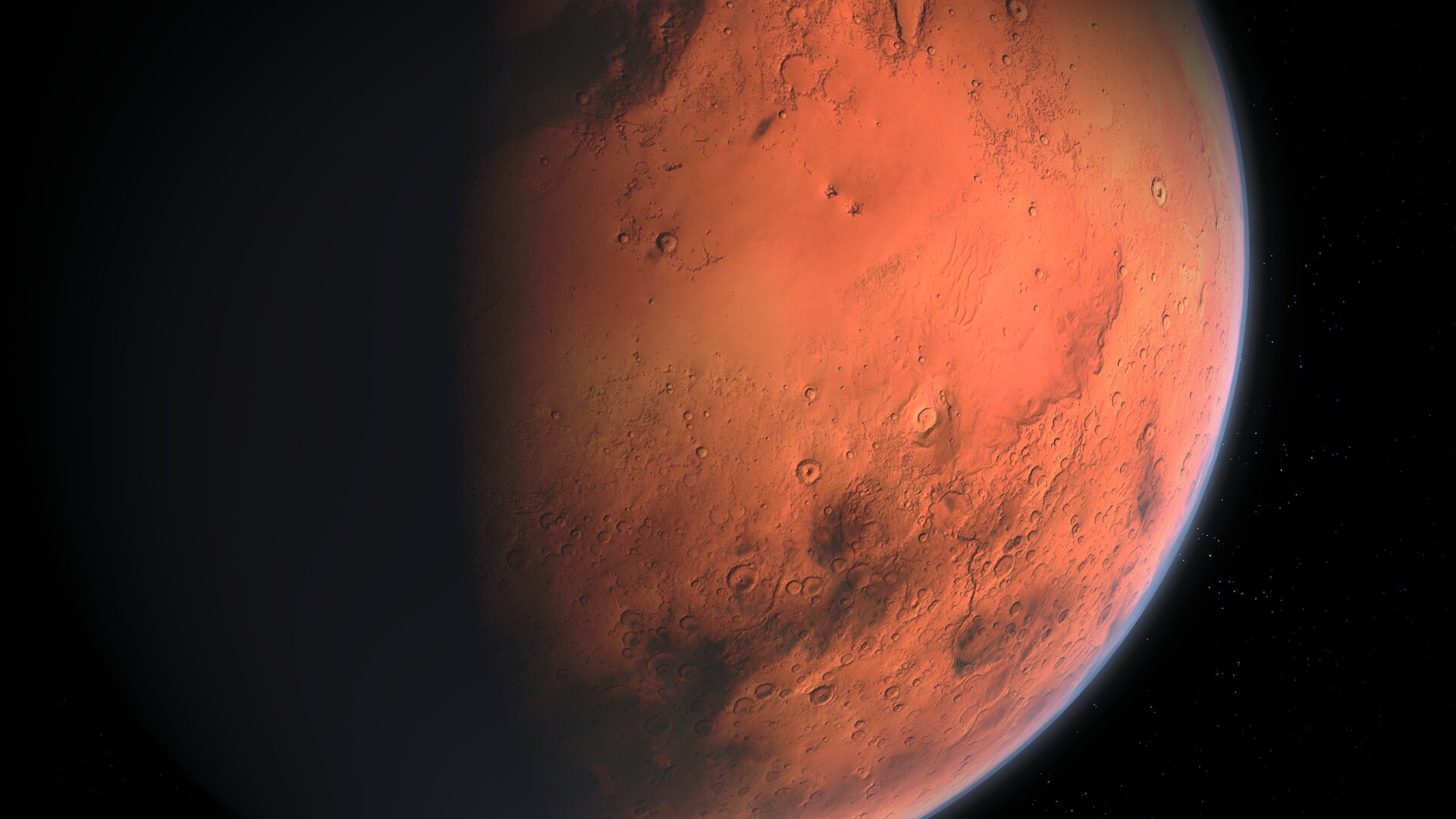
Scientists find evidence of vast hidden magma systems inside Mars
Researchers from the University of Oxford have uncovered evidence that Mars once hosted enormous, Earth-like magmatic systems deep beneath its surface—despite the planet lacking the plate tectonics long thought necessary for this kind of geological complexity.
The findings, published in Nature Astronomy, reveal new possibilities for how rocky planets become habitable.
Mars is often described as a "stagnant lid" planet: Unlike Earth, its surface is not broken into moving tectonic plates. Because plate tectonics drives volcanism, recycling and continent-building on Earth, many scientists assumed Mars lacked the conditions needed to produce similarly complex crust. However, this new study challenges that view, suggesting that Mars could have produced highly evolved crust through intense internal recycling.
The study was based on data recorded by NASA's InSight mission to investigate seismic waves from meteoroid impacts and marsquakes—the Martian equivalent of earthquakes.
Researchers from Oxford's Departments of Earth Sciences and Statistics used the recordings to investigate a mysterious boundary about 24 kilometers (15 miles) beneath the Martian surface. Previous studies had recognized the boundary, but no one knew what it represented.

A buried boundary comes into focus
To test the idea that the boundary marked a transition between two different rock types, the Oxford team compared hundreds of possible rock compositions with the seismic data using thermodynamic modeling and statistical techniques.
They found that only “ultramafic” (rich in iron and magnesium, but low in silica) rocks consistently matched the physical properties beneath the 24-km boundary. The properties above this boundary, meanwhile, were better matched to “mafic” (containing a higher proportion of silica) rocks.
The researchers believe that this buried layer likely formed where molten rock pooled deep underground and gradually separated into different materials. This would leave behind a thick residue of dense crystals at the base of the crust, while lighter, more evolved melts rose upward. On Earth, similar processes occur beneath volcanic arcs and are linked to the formation of continents.
Lead author Dr. Tobermory Mackay-Champion (Department of Earth Sciences, University of Oxford, at the time of the study, now University of Bristol) said, "We've traditionally assumed that volcanism on Mars was relatively simple compared to that on Earth. But this discovery suggests Mars could sustain large, long-lived systems where molten rock evolved and reprocessed itself throughout the entire crust. It raises exciting possibilities for how common such systems might be on rocky planets beyond our solar system.”
Beyond isolated Martian volcanoes
The study suggests this layer may extend sideways for hundreds or even thousands of kilometers around Mars' northern hemisphere, indicating that the red planet once hosted enormous, interconnected magmatic systems rather than simple, isolated volcanoes. This phenomenon—known as “transcrustal magmatism”—was previously thought to be unique to Earth.
These geological processes are closely linked to how planets develop atmospheres, oceans, and potentially habitable environments. For instance, on Earth, geological recycling helps regulate climate and supports long-term cycling of water and other volatile elements.
Scientists have often assumed plate tectonics were essential for creating these conditions. But the new findings suggest planets may not need Earth-style tectonics to build complex crusts and sustain the conditions that support life.
Co-author Professor Jon Wade (Department of Earth Sciences, University of Oxford) said, "One of the big questions in planetary science is whether Earth is unique. If Mars could develop this kind of complex crust without plate tectonics, then maybe the conditions needed for habitability could emerge on more planets than we realized, including those that were previously dismissed based on size or their apparent lack of tectonic activity.”
The work builds on seismic observations from NASA's InSight mission, which placed the first seismometer on Mars in 2018 and revealed the planet's interior in unprecedented detail.
Publication details
Seismic evidence for a melt-depleted lower crust and transcrustal magmatism on Mars, Nature Astronomy (2026). DOI: 10.1038/s41550-026-02907-5
Key concepts
magma volcanic rocks Lithosphere Volcanoes
Provided by University of Oxford
Sadie Harley
BSc Life Sciences & Ecology. Microbiology lab background with pharmaceutical news experience in oil, gas, and renewable industries. Full profile →
Robert Egan
Bachelor's in mathematical biology, Master's in creative writing. Well-traveled with unique perspectives on science and language. Full profile →