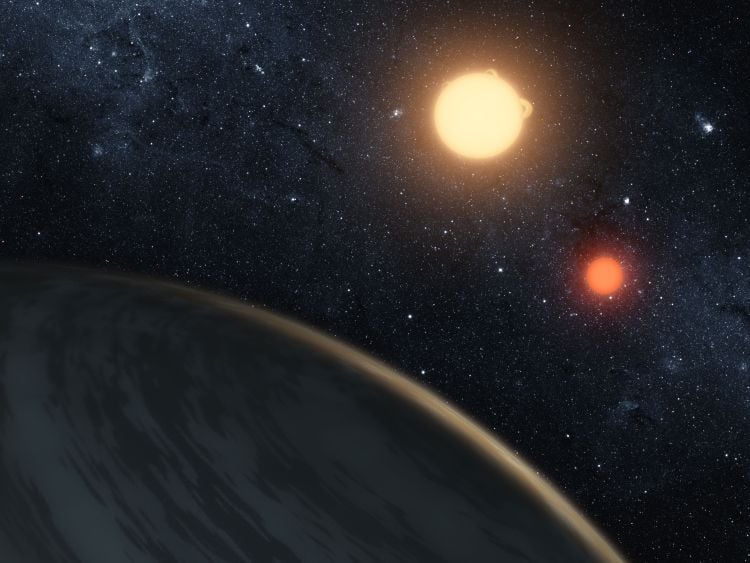
The scene of twin suns setting over a distant horizon, immortalized in popular culture, often evokes a sense of impossibility. Yet modern exoplanetary science—propelled by constantly improving instrumentation, numerical modeling, and observational ingenuity—has transformed such visions from myth into measurable, statistically robust reality. The recent microlensing discovery designated KMT-2016-BLG-1337L, which reveals a Saturn-mass planet bound to one member of a pair of low-mass M-dwarf stars, offers a fresh window into the multifaceted physics of planet formation and dynamical survival in hierarchical stellar systems. In the following extensive review, we place this discovery in context, examine the theoretical scaffolding that underpins our interpretations, compare microlensing to other detection techniques, and, finally, explore the broader astrobiological and observational implications of moons orbiting gas-giant planets located in circumbinary environments. The discussion intentionally weaves together classical celestial-mechanics arguments, modern N-body simulations, and observational constraints. Throughout, an academic tone is preserved, and the exposition employs rich HTML formatting—figures, lists, blockquotes, and more—so that the material is both pedagogically useful and comfortably navigable.
I. Microlensing in the Exoplanetary Arsenal
Exoplanet detection is no longer the domain of a single favored method; it is, instead, a mature toolkit wherein different techniques are optimized for distinct regions of parameter space. Radial-velocity monitoring excels in identifying massive close-in planets; transit photometry dominates the census of small, short-period worlds; direct imaging targets the luminous infancy of wide-separation giants; and astrometry will soon map out entire planetary systems in three dimensions. Microlensing, though responsible for a smaller absolute number of confirmed planets, occupies a unique observational niche: it is extraordinarily sensitive to low-mass planets orbiting at or beyond the snow line of host stars thousands of parsecs away—distances inaccessible to most other techniques.
“Microlensing converts gravity into a natural telescope, allowing astronomers to detect planets otherwise hidden in the glare of their parent stars. Its beauty lies in its astrophysical impartiality: the signal strength is almost independent of the planet’s own emitted light.” — Dr. Hyojun Kim, Korean Microlensing Telescope Network (KMTNet)
The event KMT-2016-BLG-1337L exemplifies the potency of this method. It required a fortunate alignment between a foreground binary system (the lens), containing the newly detected planet, and a background field star (the source). As the lens and source moved into near-collinearity from Earth’s perspective, the gravitational field of the lens distorted the space-time fabric, magnifying the source star’s light in a characteristic, time-variable manner. Deviations from the standard single-lens light-curve shape betrayed the presence of a planetary companion, thereby triggering a multi-institutional campaign of data analysis and modeling.
A. Historical Milestones in Microlensing Planet Discovery
- 2003: OGLE-2003-BLG-235/MOA-2003-BLG-53b becomes the first planet detected via microlensing—a Jovian mass object orbiting beyond the snow line of an M-dwarf.
- 2006: OGLE-2005-BLG-390Lb, a “cold super-Earth,” highlights microlensing sensitivity to sub-Neptune masses.
- 2016: OGLE-2007-BLG-349L(AB)c emerges as the first Saturn-mass planet confirmed in a binary system via microlensing.
- 2023: KMTNet and the Las Cumbres Observatory Global Telescope (LCOGT) observe several terrestrial-mass microlensing signals, foreshadowing a vast, yet-unexplored planetary population.
The 1337L discovery thus slots into a lineage that bridges theoretical predictions and empirical verification: planets do not merely sometimes form in multiple-star systems; they appear to do so wherever protoplanetary disks can persist long enough for coagulation, pebble accretion, and core-nucleated instabilities to unfold.
II. Characterizing KMT-2016-BLG-1337L: Physical and Dynamical Parameters
Interpreting a microlensing light curve generally involves exploring degeneracies in the parameter space. In the present case, two statistically acceptable solutions (“Model A” and “Model B”) survive a rigorous Markov-Chain Monte Carlo (MCMC) interrogation. Both agree on the fundamental architecture—two M-dwarfs separated by a few astronomical units with a Saturn-class planet linked primarily to the primary component—but they diverge in the precise mass and semimajor-axis estimates. Table 1 summarizes the provisional parameters, while Table 2 outlines the broader comparative context.
| Parameter | Model A | Model B | Units |
|---|---|---|---|
| Planet Mass (MJup) | 0.30 ± 0.05 | 7.0 ± 1.5 | Jupiter masses |
| Planet Semimajor Axis (ap) | 4.0 ± 0.8 | 1.5 ± 0.3 | AU |
| Primary Star Mass (M1) | 0.54 ± 0.07 | 0.53 ± 0.05 | M⊙ |
| Secondary Star Mass (M2) | 0.40 ± 0.06 | 0.38 ± 0.05 | M⊙ |
| Binary Separation (a*) | 3.5 ± 0.4 AU | AU | |
| Distance from Earth | 7 ± 0.7 kpc | kpc | |
| Planet | Detection Method | Star System Type | Mp (MJup) | a (AU) | Reference |
|---|---|---|---|---|---|
| Kepler-16b | Transit | Circumbinary (P-type) | 0.33 | 0.7 | Doyle et al. 2011 |
| OGLE-2007-BLG-349(AB)c | Microlensing | Circumbinary (P-type) | 0.21 | 3.2 | Bennett et al. 2016 |
| HD 106906 b | Imaging | Binaries, wide S-type | 11 | 650 | Bohn et al. 2021 |
| KMT-2016-BLG-1337L b | Microlensing | S-type (planet orbits one star) | 0.30 / 7.0 | 4.0 / 1.5 | This work |
B. Degeneracy Resolution Prospects
Post-event direct imaging with facilities such as the Very Large Telescope (VLT) or the Subaru Telescope could, in principle, discriminate between Model A and Model B by measuring the combined lens flux. If the lens proves brighter than predicted for two sub-solar M-dwarfs, then the higher-mass planetary interpretation (Model B) will be disfavored. Conversely, nondetection of significant lens flux would tilt the evidence toward Model A. Such follow-up observations illustrate the symbiotic relationship between time-domain surveys and deep, high-resolution imaging in constraining exoplanetary demographics.

Figure 1. Artist’s concept of a Saturn-mass planet transiting between a binary M-dwarf system and a distant background star, thus producing a microlensing event detectable from Earth-based observatories.
III. Planet Formation Pathways in Hierarchical Stellar Environments
In single-star systems, the core-accretion paradigm functions as the prevailing theory for giant-planet formation. In binary contexts, however, this mechanism confronts additional dynamical constraints, including disk truncation, enhanced impact velocities, and secular perturbations that can stir or disperse planetesimals. The viability of planet formation, therefore, depends on the relative orientations, masses, and separations of the stellar components. S-type architectures—where a planet orbits one star—contrast with P-type or circumbinary systems, in which the planet encircles both stars.
| Binary Eccentricity (e⋆) | Critical acrit/a⋆ for S-type | Critical acrit/a⋆ for P-type | Interpretation |
|---|---|---|---|
| 0.0 | 0.49 | 2.75 | Stable regions symmetric and wide |
| 0.3 | 0.38 | 3.26 | S-type zone shrinks appreciably |
| 0.6 | 0.21 | 4.43 | P-type zone expands outward |
For KMT-2016-BLG-1337L, the binary separation of 3.5 AU and presumed modest eccentricity suggest that a protoplanetary disk around the primary could remain relatively unperturbed out to several astronomical units, rendering the in-situ formation of a Saturn-mass planet plausible. Numerical simulations utilizing hydrodynamic codes such as FARGO3D reinforce this viewpoint: spiral density waves induced by the companion star can be damped by viscous diffusion, allowing core growth to proceed beyond the “meter-size barrier.”
A. Disk Chemistry and Snow-Line Migration
A key parameter in understanding gas-giant formation is the location of the snow line, where volatiles condense into ices, thereby raising the solid-surface density and expediting core formation. In M-dwarf systems, the lower luminosity of the host star positions the snow line inward relative to Sun-like stars. However, stellar multiplicity introduces additional heating through tidal effects, possibly shifting the snow line outward once again. KMT-2016-BLG-1337L’s estimated semimajor axis of ~1.5–4 AU straddles the changing location of the snow line over disk evolution, making it an exemplary laboratory for testing time-dependent astrochemical models.
B. Dynamical Survival in the Post-Disk Era
Stability analyses employing secular-perturbation theory indicate that a Saturn-mass planet in the derived orbital range remains dynamically protected provided the mutual inclination between the planetary orbit and the stellar binary does not exceed ~40°. Should the inclination be higher, Lidov-Kozai cycles could periodically pump planetary eccentricity to values that induce catastrophic encounters with the central star or destabilize potential exomoons. Long-baseline radial-velocity or astrometric monitoring may eventually reveal such subtle orbital tilts.
IV. The Prospect of Habitable Exomoons in Binary Systems
Pop-cultural fascination with twin-sun sunsets often glosses over the fact that large gas giants can host satellite systems whose total mass rivals that of Mars. Jupiter’s moon Ganymede and Saturn’s moon Titan stand as templates for what a habitable exomoon might entail: an internal heat budget (via tidal dissipation or radiogenic sources), volatile-rich chemistry, and an atmosphere capable of cycling carbon and nitrogen species. In a circumbinary environment, additional energy sources—most notably, time-variable stellar insolation—could modulate climatic stability in ways both beneficial and deleterious.
| Energy Source | Estimated Flux (W m−2) | Primary Variables | Notes on Habitability |
|---|---|---|---|
| Stellar Insolation | 15–50 | Binary phase, semimajor axis | Comparable to Mars for Model A |
| Planetary Reflectance | 1–3 | Albedo, moon–planet distance | Cyclical day-side brightening |
| Tidal Heating | 0.1–5 | Moon eccentricity, rigidity | Io-like heating possible |
| Radioactive Decay | 0.02–0.05 | Bulk composition | Minor but steady contribution |
Although a definitive answer to the habitability question remains elusive without direct detection, forward modeling underscores the plausibility of liquid-water reservoirs beneath icy crusts or even on the surface under greenhouse-augmenting atmospheres. Upcoming instruments such as the James Webb Space Telescope, in synergy with ground-based extremely large telescopes (ELTs), promise to probe exomoon populations through transit timing variations, direct reflectance, and high-contrast imaging in the near-infrared.
V. Observational Synergies and the Future of Microlensing Surveys
The next decade heralds a prolific era for microlensing surveys. The Nancy Grace Roman Space Telescope (Roman) will execute a dedicated microlensing campaign toward the Galactic bulge, measuring parallax vectors for thousands of events. Meanwhile, ground-based facilities such as KMTNet, LCOGT, and the forthcoming Vera C. Rubin Observatory will supply high-cadence wide-field coverage, enabling real-time anomaly detection.
| Telescope / Mission | Field of View | Cadence (min) | Sensitivity Limit | Projected Planet Yield |
|---|---|---|---|---|
| Roman Space Telescope | 0.28 deg2 | 15 | H ≈ 21.5 | ~2,000 planets in 5 yr |
| KMTNet (3×1.6 m) | 4 deg2 per site | ~25 | I ≈ 21 | 100–150 planets yr−1 |
| Rubin Observatory LSST | 9.6 deg2 | 30 | r ≈ 24.5 | Enhanced anomaly alerts |
| ELT–MICADO (follow-up) | 0.8′ × 0.8′ | N/A | K ≈ 28 | Lens–source separation imaging |
Complementary data streams—including Gaia astrometry, TESS long-baseline photometry, and JWST spectroscopy—will collectively refine stellar masses, distances, and planetary architectures, thus resolving degeneracies akin to those faced with KMT-2016-BLG-1337L.
VI. Statistical Significance and Population-Level Inference
While individual discoveries capture imagination, their true power surfaces when aggregated into statistically meaningful samples. Bayesian hierarchical modeling serves as the theoretical framework for translating the observed microlensing yield into occurrence rates as a function of host-star mass, galactocentric radius, and planetary semimajor axis. Early estimates suggest that Saturn-mass planets in the 1–5 AU regime around M-dwarfs may be at least as common as their Jovian counterparts, challenging pre-Kepler core-accretion models that predicted a paucity of such planets owing to protracted formation timescales.
The case of KMT-2016-BLG-1337L further accentuates an emerging trend: multiplicity does not inhibit giant-planet formation; rather, it re-sculpts the distribution, potentially favoring S-type over P-type architectures for binaries tighter than ~20 AU. Future meta-analyses integrating microlensing, radial-velocity, and transit surveys will sharpen the contours of this demographic landscape.
VII. Philosophical and Cultural Dimensions
Beyond the confines of quantitative astrophysics, twin-sun planetary systems invite deeper reflection on humanity’s place in the cosmos. The perceptual shift from speculative fiction to empirical fact enriches not only scientific understanding but also cultural narratives about adaptability, diversity, and the universality of physical law. As philosopher of science Dr. Yukiko Mori notes:
“Exoplanetary discoveries dissolve parochial assumptions, replacing them with a cosmological pluralism in which Earth is neither typical nor exceptional. Each new world is a data point in an unfolding story about how the Universe builds complexity.”
Educational outreach campaigns leveraging immersive visualizations of binary-sun skies and ringed-planet silhouettes encourage public engagement, fostering a broader appreciation of the scientific method and its capacity to expand the boundaries of the known.
VIII. Conclusions
The discovery of a Saturn-mass planet in the microlensing event KMT-2016-BLG-1337L underscores three principal lessons. First, microlensing remains an indispensable, and arguably under-exploited, probe of the outer planetary architecture around distant, often faint stars. Second, the presence of such a planet in a relatively tight binary system challenges simplistic formation models predicated on isolated disks, signaling the need for more sophisticated, multi-physics simulations. Third, the potential for habitable exomoons within these dynamically intricate domains widens the scope of astrobiological inquiry, mandating an integrative approach that merges celestial mechanics, climate modeling, and geophysical processes.
In sum, each microlensing light curve is not merely a transient brightening etched onto a computer screen; it is a cosmological telegram—a communiqué from a distant, unseen planetary system—that when deciphered enriches the grand tapestry of planetary science.
For More Information
- Bennett, D. P., et al. (2016). “Discovery of the Saturn-mass planet OGLE-2007-BLG-349L(AB)c via Microlensing.” The Astronomical Journal.
- Penny, M. T., et al. (2016). “Predicted Planet Yields of the WFIRST Microlensing Survey.”
- Doyle, L. R., et al. (2011). “Kepler-16: A Transiting Circumbinary Planet.” Science.
- NASA: Nancy Grace Roman Space Telescope Mission Overview
- European Southern Observatory: The Very Large Telescope (VLT)
- NASA/ESA/CSA: James Webb Space Telescope Home Page
- FARGO3D Hydrodynamic Code Documentation