In a remarkable discovery that expands our understanding of the outer Solar System, astronomers using the Subaru Telescope have identified a new object located beyond Pluto's orbit. This celestial body, designated as 2023 KQ14, has been classified as a "sednoid," a rare classification given that only three others have been discovered previously. The implications of this find are profound, particularly in the context of the ongoing debate regarding the existence of a hypothetical Planet Nine that may influence the orbits of other distant objects.
Understanding Sednoids
Sednoids are a group of trans-Neptunian objects (TNOs) defined by their highly eccentric orbits that take them further away from the Sun compared to most TNOs. These orbits are characterized by high eccentricity, which means their distance from the Sun varies drastically throughout their orbital cycles. Typically, sednoids have their perihelion (the point in their orbit closest to the Sun) much further out than that of other TNOs. The category derives its name from the dwarf planet Sedna, which was the first member of this group to be discovered.
The discovery of 2023 KQ14 adds a new chapter to our understanding of the dynamics in this distant realm of our Solar System. As noted, its path takes it from 72 astronomical units (AU) away from the Sun to nearly 438 AU, resulting in an orbital period extending close to 4,000 years.
The Discovery Process
The identification of Ammonite (the nickname for 2023 KQ14) was made during multiple observational campaigns throughout 2023. The Subaru Telescope initially detected its existence during longer-term monitoring efforts in March, May, and August of that year. However, the faint nature of this object necessitated confirmatory observations, which were successfully performed using the Canada-France-Hawaii Telescope in July 2024.
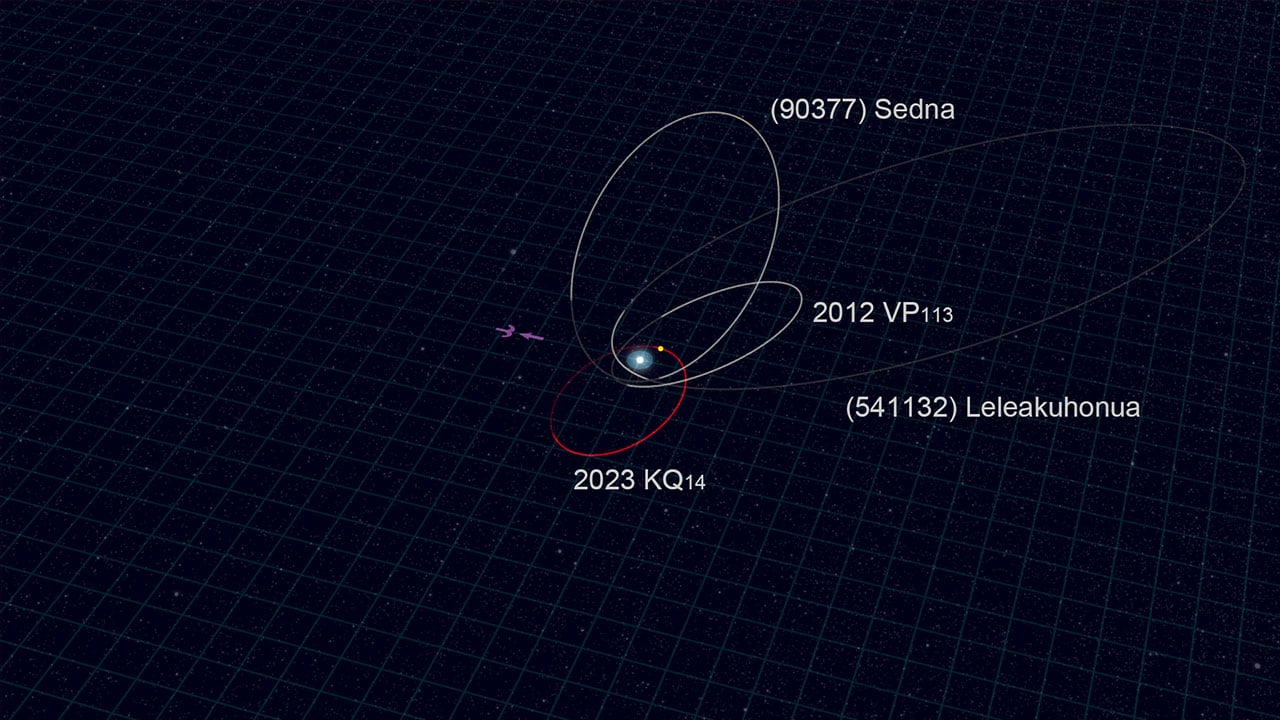
According to a paper published in Nature Astronomy, the discovery was significant not only because of the rarity of sednoid objects but also due to its implications for understanding our Solar System's architecture.
"Understanding the orbital evolution and physical properties of these unique, distant objects is crucial for comprehending the full history of the Solar System." - Dr. Fumi Yoshida, co-author.
Theoretical Implications
One of the central theories within planetary astronomy centers on the concept of Planet Nine, a hypothesized object that some researchers believe could explain the gravitational influences observed in the orbits of distant Solar System bodies. The discovery of 2023 KQ14 is particularly intriguing because its unique orbital path does not align with the expected clustering of sednoids, adding complexity to ongoing discussions about Planet Nine's potential gravitational impacts.
Observed Differences
| Sednoid | Perihelion (AU) | Semi-major Axis (AU) | Discovery Year |
|---|---|---|---|
| Sedna | 76 | 500 | 2003 |
| 2012 VP113 | 80 | 400 | 2014 |
| 2015 TG387 | 70 | 250 | 2018 |
| 2023 KQ14 | 72 | 438 | 2025 |
The Gap in the Distribution of Objects
The researchers note a significant gap in the perihelion distances of distant Solar System objects, within which the orbit of Ammonite is positioned. This gap, referred to as the q-gap, has been a point of contention in understanding the distribution and migration of TNOs and sednoids. The researchers argue that Ammonite’s orbit fills this gap, demonstrating a distinct difference from the other known sednoids.
This observation challenges previous assumptions about the gravitational influences acting on these distant bodies. As Dr. Yukun Huang mentioned regarding the implications of Ammonite's findings, the desynchronization between its orbit and those of previously known sednoids suggests that the traditional hypothesis attributing their orbits to Planet Nine may require reevaluation.
Orbital Simulations and Historical Context
The study employed advanced orbital simulations to trace the evolutionary pathways of Ammonite and the other sednoids. According to the simulations conducted by the FOSSIL (Formation of the Outer Solar System: An Icy Legacy) team, Ammonite has maintained a stable orbit for approximately 4.5 billion years. This timeline coincides with the early history of the Solar System, allowing astronomers to glean insights into its formation and subsequent development.

The simulation results suggested that while the paths of the other known sednoids were similar around 4.2 billion years ago, they have diverged significantly due to influences that remain to be fully elucidated. This divergence poses important questions regarding past interactions in the early Solar System, such as encounters with rogue celestial bodies or gravitational perturbations from nearby stars.
Future Observations
Further research and observations are essential to enhance our understanding of the dynamics governing distant Solar System objects. The ongoing work of NASA's Vera Rubin Observatory, which is set to focus on transient events and will soon initiate its Legacy Survey of Space and Time (LSST), may yield new findings about celestial objects like Ammonite.
This initiative aims to survey the night sky in unprecedented detail, providing opportunities to discover new trans-Neptunian objects. The graphical data generated could further clarify existing hypotheses about the origins and influences of distant Solar System bodies.
Conclusion: A Window into Our Solar System’s History
The discovery of 2023 KQ14 presents a valuable opportunity to explore complex questions regarding the early Solar System and the evolution of its distant objects. As researchers continue to analyze its characteristics and implications, it will offer insights into the confirmed and potential arrangements of celestial bodies, providing an enriched understanding of planetary formation and orbital dynamics.
In conclusion, the work surrounding the FOSSIL project illustrates a grander narrative about the mysteries lying in the outer reaches of our Solar System and reaffirms the importance of continued exploration, observation, and analysis in the ever-expanding field of astronomy.
References and Further Reading
[1] Chen, Y.-T., et al. (2025). Discovery and dynamics of a Sedna-like object with a perihelion of 66 au. Nature Astronomy.
[2] University of Tokyo. (2025). Press Release: Discovery of a New Sednoid.
[3] Verne et al. (2025). The Legacy Survey of Space and Time: Exploring the Night Sky.
[4] Brodwin, M. et al. (2023). FOSSIL: The Formation of the Outer Solar System. Lunar and Planetary Institute.
[5] Wikipedia Contributors. (n.d.). Planet Nine. Wikipedia, The Free Encyclopedia.