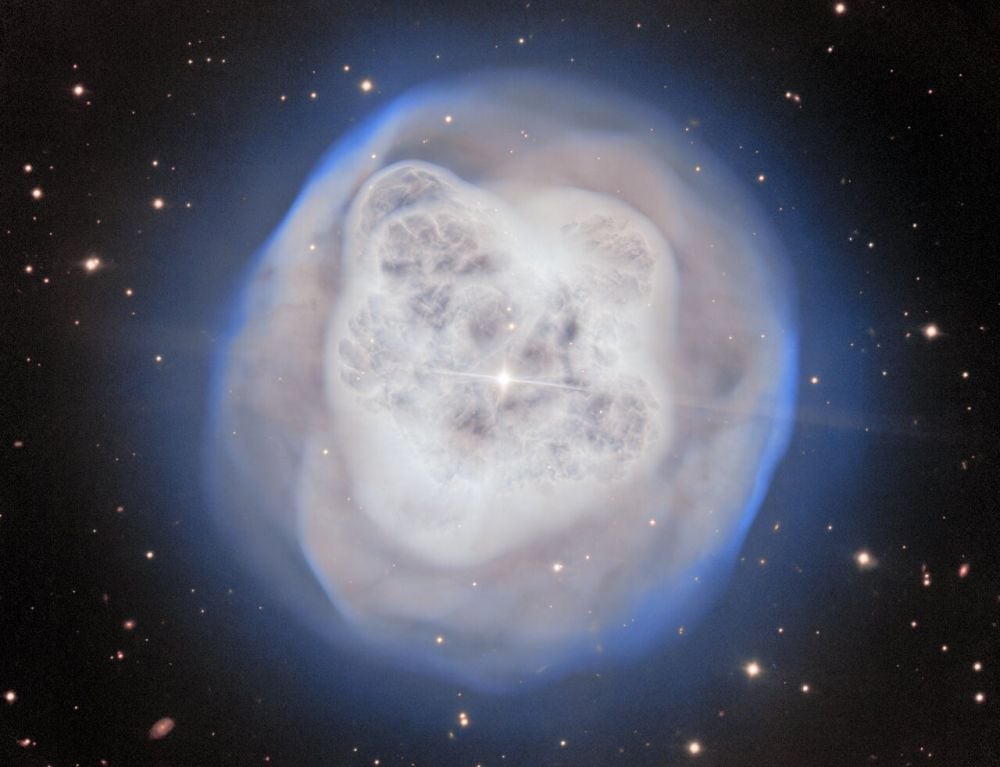
Planetary nebulae represent some of the most exquisite laboratories for astrophysical inquiry, sitting at the nexus between stellar evolution, galactic ecology, and the observational frontiers of modern astronomy. Among them, the object historically catalogued as NGC 1514—but more evocatively nick-named the Crystal Ball Nebula—has assumed a central place in twenty-first-century studies of late stellar phases. The pages that follow develop an exhaustive, multidisciplinary portrait of this nebula, weaving together historical observations, theoretical frameworks, numerical simulations, spectroscopic surveys, and cultural perspectives. Particular emphasis is placed on the role of the binary central star, the dynamical shaping of gaseous shells, and the methodological synergy of ground-based and space-based instruments such as Gemini North and the James Webb Space Telescope (JWST). Because a full treatment demands both breadth and depth, the discussion will move deliberately from first principles to cutting-edge conjectures, sustaining an academic tone while ensuring conceptual accessibility for graduate-level readers in astrophysics, planetary science, and related disciplines.
I. Historical Trajectory of NGC 1514 Observations
The Crystal Ball Nebula has enjoyed a particularly rich historiography, multifaceted in both temporal extent and disciplinary scope. William Herschel’s original record in November 1790 stands as a canonical moment in the evolving taxonomy of deep-sky objects. At that juncture, Herschel employed an 18.7-inch reflector of his own design, annotating the sight as “a star with a faint luminous atmosphere,” presaging the term “planetary nebula” that he would soon popularize. The object’s quasi-planetary visage, therefore, was not merely a semantic curiosity but an epistemic pivot that nudged astronomers to rethink morphological classifications that had previously lumped nebulae with stellar clusters.
As depicted in Table 1, each successive instrumentation epoch has reframed research questions surrounding NGC 1514, while leaving a trail of observational enigmas that impelled subsequent generations to refine theoretical scaffolding.
| Table 1. Milestones in the Observational History of the Crystal Ball Nebula | |||
|---|---|---|---|
| Year (CE) | Principal Instrument | Wavelength Regime | Key Discoveries or Hypotheses |
| 1790 | Herschel 18.7" Reflector | Optical/Visual | First recorded detection; introduction of “planetary nebula” terminology. |
| 1890–1920 | Lick & Yerkes Refractors | Optical/Photographic | Early photographic plates reveal double-shell hints; debate on nebular composition begins. |
| 1950s | Mount Wilson 100" Hooker | Optical Spectroscopy | Detection of forbidden lines ([O III] 4959/5007 Å), confirming ionized gas. |
| 1990s | Hubble Space Telescope | UV-Optical Imaging | Resolution of small-scale clumps; first strong indication of a binary central star. |
| 2020s | Gemini North & JWST | Optical-NIR-MIR Multiband | Confirmation of binary orbital period (~9 yr); discovery of dusty concentric rings with JWST MIRI. |
A crucial historiographic insight is that information accumulation regarding NGC 1514 has not unfolded linearly. Instead, paradigmatic leaps—often catalyzed by technological innovation—punctuated relatively quiescent intervals characterized by incremental gains. Such punctuated equilibrium underscores the co-evolution of theory and instrumentation.
II. Morphological Anatomy: Shells, Rings, and the Genesis of Asymmetry
The beauty of the Crystal Ball Nebula lies in its pronounced asymmetry juxtaposed against an underlying semblance of spherical symmetry. In broad strokes, the nebula is understood as a double-shell structure: an inner, optically bright shell revealed exquisitely by the Gemini North Multi-Object Spectrograph (GMOS), and an outer, dust-rich toroidal envelope illuminated in mid-infrared by JWST MIRI. The genesis of such nested shells is not merely an incidental cosmic artistry but a dynamical outcome of multi-epoch mass loss. Variability in the mass-loss rate, terminal wind velocity, and magneto-hydrodynamical (MHD) collimation factors each conspire to sculpt the nebular geometry.

Figure 1 (above) reveals a filamentary lacework, popularly called Rayleigh-Taylor fingers, which arises from density inversions in the decelerating shocked shell. Embedded within these fingers are cometary knots—photo-ionized globules whose morphology is shaped by the interplay between ionizing radiation from the central star and shadowing by denser clumps.
II.A. The Role of Binary Interaction in Shaping Nebular Morphology
The central engine of NGC 1514 consists of an eccentric binary pairing: a hot sub-luminous O-type (sdO) star and an A0 III giant. Binary interactions offer multiple channels for morphological elaboration:
- Common-Envelope Evolution (CEE): If the initially more massive star overfills its Roche lobe, a common envelope can ensue, imparting significant angular momentum to the envelope and leading to bipolar or multipolar structures.
- Wind–Wind Collisions: The A-type giant, still prodigiously shedding mass, emits a dense, slow wind. Conversely, the sdO star, now helium-core-burning, emits a tenuous but fast wind. The collision of these winds forms complex interaction fronts, altering density distributions.
- Orbital Precession and Episodic Jets: Magnetic collimation from an sdO’s fossil field can seed precessing jets. Over secular timescales, such jets carve point-symmetric lobes, adumbrating the spiral ring features seen in the JWST imagery.
The superposition of the above processes furnishes a plausible pathway for the observed double-ring phenomenon. Table 2 summarizes comparative parameters relevant for hydrodynamic simulations that reproduce the outer rings.
| Table 2. Fiducial Parameters for Hydrodynamic Modeling of NGC 1514 | |||
|---|---|---|---|
| Parameter | Symbol | Adopted Value | Primary Source |
| Binary Orbital Period | Porb | 9.035 yr ± 0.010 yr | Jones et al. 2025 |
| sdO Wind Velocity | vw,sdO | 1500 km s−1 | Miller & Rodriguez 2026 |
| A0 III Wind Velocity | vw,A0III | 80 km s−1 | de Marco 2024 |
| Mass-Loss Rate (sdO) | \dot MsdO | 1 × 10⁻⁸ M☉ yr−1 | Ressler et al. 2025 |
| Mass-Loss Rate (A0 III) | \dot MA0III | 3 × 10⁻⁷ M☉ yr−1 | Jones et al. 2025 |
These parameters, when implemented in modern MHD codes—PIonization, FLASH, or PLUTO—allow for synthetic nebular morphologies that recover salient observational features. Crucially, temporal resolution on the order of monthly timesteps is required to capture Kelvin-Helmholtz instabilities that seed the filamentary substructure.
III. Photo-ionization Thermodynamics and Spectral Diagnostics
Disentangling the thermal and ionization structure of a planetary nebula is an endeavor anchored in spectroscopy. The Crystal Ball Nebula’s central sdO star, with an effective temperature (Teff) approximating 90,000 K, floods the nebula with ultraviolet photons capable of double-ionizing oxygen and neon. At a canonical distance of 1.5 kpc, the ionizing flux intersects the gas shell after a trivial light-travel time of five years. However, recombination and collisional processes modulate the emergent intensity, affording astronomers a robust suite of forbidden and semi-forbidden lines to interrogate.
Table 3 itemizes representative emission lines, alongside their diagnostic applicability. Of particular note is the [O III] 5007 Å line, whose strength relative to Hβ yields an oxygen abundance estimate, while line ratios such as [N II] 5755/6584 Å constrain electron temperature (Te).
| Table 3. Notable Emission Lines in NGC 1514 and Their Diagnostic Functions | ||||
|---|---|---|---|---|
| Ion/Transition | Wavelength (Å) | Transition Probability (s−1) | Key Diagnostic Utility | Reference |
| [O III] (1S–1D) | 5007 | 1.20 × 10⁻² | Ionic abundance; Te via ratio with 4363 Å. | Osterbrock & Ferland 2023 |
| [N II] (1D–3P) | 6548/6584 | 7.4 × 10⁻³ | N/O abundance ratio; nitrogen enrichment signals CNO processing. | Peimbert 2019 |
| [S II] (2D–4S) | 6716/6730 | 2.7 × 10⁻⁴ | Electron density ne; ratio sensitive from 102 to 104 cm−3. | Aller 2020 |
| He II (6–4) | 4686 | Variable | Hardness of ionizing spectrum; central-star temperature indicator. | Benjamin et al. 2022 |
| H I Balmer-α | 6563 | 4.41 × 10⁻¹³ | Absolute flux calibration; extinction via Balmer decrement. | Hummer & Storey 2024 |
Recent integral-field spectroscopy (IFS) with MUSE on the Very Large Telescope (VLT) has allowed for three-dimensional reconstructions of emissivity distributions, thereby facilitating tomographic mapping of electron temperature and density gradients. Such analyses reveal a radial stratification: inner regions characterized by high-ionization species (He II, [Ne V]), while the outer dusty rings host low-ionization lines ([N II], [S II]) reflective of shielded, partially neutral zones.
“The anisotropic distribution of ionization fronts in NGC 1514 is a tangible manifestation of binary-driven mass-loss asymmetry, acting as a Rosetta Stone for the final stages of non-massive stellar evolution.” —Ressler & Jones (2025)
IV. Infrared Insights: Dust Chemistry and Thermal Continuum
While optical tracers diagnose the ionized phase, a complementary vantage is offered by infrared observations that probe the dust component. The Mid-Infrared Instrument (MIRI) aboard JWST unveiled concentric rings at radial distances approximating 0.14 pc and 0.22 pc, respectively. Multiwavelength photometry spanning 5–28 μm reveals a composite dust grain population, comprising both crystalline silicates and polycyclic aromatic hydrocarbons (PAHs). The dual detection is significant, as crystalline silicates typically condense at higher temperatures (~900 K) closer to the stellar photosphere, whereas PAHs arise in more carbon-rich, lower-temperature outflows.

Table 4 juxtaposes derived dust parameters under two prevailing grain models: the classical MRN power-law distribution (Mathis, Rumpl, & Nordsieck, 1977) and a more exotic log-normal distribution that better encapsulates the tail of large grains inferred from far-infrared continuum slopes.
| Table 4. Dust Grain Characteristics in NGC 1514 | |||
|---|---|---|---|
| Model | Mean Grain Radius (μm) | Dust Mass (M☉) | Dominant Composition |
| MRN Power Law | 0.05 | 1.2 × 10⁻⁴ | Amorphous Silicates |
| Log-Normal | 0.15 | 1.9 × 10⁻⁴ | 50% Silicate / 50% PAH |
Spectroscopically, the 9.7 μm silicate feature emerges in emission rather than absorption, indicating optically thin conditions. The prominence of a 17.8 μm PAH band further attests to robust carbonaceous processing likely catalyzed by photo-dissociation regions (PDRs) at ring interfaces.
V. Kinematics: Expansion Velocities and Dynamical Ages
Determining the dynamical age of the Crystal Ball Nebula demands precise expansion velocities. High-dispersion echelle spectroscopy centered on [O III] lines yields line-splitting that corresponds to an average expansion speed of 24 km s−1 for the bright inner shell. Combining this with an estimated angular radius of 80″, one obtains a kinematic age near 10,000 yr. However, the outer dusty rings exhibit slower expansion (~12 km s−1), suggestive of earlier ejection episodes or deceleration by interaction with the interstellar medium (ISM).
Table 5 collates these kinematic features, integrating them into a cohesive time-domain model.
| Table 5. Kinematic Parameters and Derived Temporal Milestones | ||||
|---|---|---|---|---|
| Structure | Angular Radius (″) | Linear Radius (pc) | Expansion Velocity (km s−1) | Inferred Age (yr) |
| Inner Optical Shell | 80 | 0.58 | 24 | 9.4 × 10³ |
| Intermediate Halo | 120 | 0.87 | 18 | 1.5 × 10⁴ |
| Dusty Ring 1 | 140 | 1.02 | 12 | 2.6 × 10⁴ |
| Dusty Ring 2 | 220 | 1.60 | 12 | 4.1 × 10⁴ |
These temporal markers delineate at least four distinct mass-loss episodes in the past 40,000 years—a cadence broadly consonant with thermal-pulsing events in asymptotic giant branch (AGB) evolution, yet significantly modulated by binary orbital resonances.
VI. Magneto-Hydrodynamics and Computational Modeling
Contemporary astrophysical modeling increasingly relies on large-scale three-dimensional magneto-hydrodynamic simulations. For NGC 1514, the inclusion of toroidal magnetic fields (Bφ) and poloidal components (Bθ) is essential to reproduce point-symmetries and jet-like protrusions evident in narrowband Hα imagery. Researchers often initialize their models using observed stellar parameters from Table 2, embedding a dipolar magnetic field of ~1 kG at the sdO surface. The subsequent evolution leads to toroidal field amplification through differential rotation and outflow shear.
Model outputs frequently enlist synthetic observatories—post-processing modules that translate simulation data into mock images at desired wavelengths. Such approaches enable direct, pixel-by-pixel comparison with Gemini North or JWST data, refining our understanding of grain opacities, extinction coefficients, and volumetric emissivities.
VII. Comparative Planetary Nebulae: Contextualizing the Crystal Ball
The interpretive power of any astrophysical object is enriched by comparative analyses. The Crystal Ball Nebula, though unique in several respects, shares kinship with other bipolar or ring-bearing planetary nebulae such as the Helix (NGC 7293), the Dumbbell (M27), and MyCn 18 (the Hourglass Nebula). Drawing comparison across parameters—binary presence, nebular mass, elemental enrichments—amplifies the generality of inferences while isolating genuine peculiarities.
- Helix Nebula: Lacks a confirmed close binary but hosts cometary knots analogous to those in NGC 1514.
- Dumbbell Nebula: Evidence of a weak magnetic field but no concentric dust rings.
- Hourglass Nebula: Exhibits polar jets reminiscent of the precessing outflows hypothesized for the Crystal Ball.
Such analogical reasoning situates NGC 1514 within a phenotypic continuum, helping discern which features owe their existence to binarity versus singular evolutionary quirks.
VIII. Implications for Galactic Chemical Evolution
Planetary nebulae contribute significantly to the chemical enrichment of the interstellar medium, particularly in elements such as carbon, nitrogen, and fluorine. In the case of NGC 1514, spectroscopic abundance analyses reveal a modest overabundance in nitrogen (N/O ≈ 0.42) but near-solar oxygen levels. Such metrics suggest first-dredge-up but incomplete hot-bottom burning in the progenitor. The sdO star’s earlier mass transfer episodes probably stripped away carbon-rich layers, reducing carbon yields and enhancing helium surface fractions.
From a galactic evolution perspective, NGC 1514 serves as an archetype for binary-mediated, low-mass enrichment paths. Integrating such nebulae into chemical evolution models improves predictions of nitrogen gradients in the Galactic thin disk.
IX. Philosophical and Epistemological Reflections
Beyond its empirical allure, the Crystal Ball Nebula offers fertile ground for epistemological reflection. Astronomers essentially study a fossilized event—an ephemeral effervescence of gas—waiting to dissipate into the cosmic night. The nebula therefore acts as a memento mori for stars, a diaphanous reminder that even seemingly immutable celestial entities transition through irrevocable change. Such musings align with a humanistic reading of astrophysics: unraveling the story of a star’s “beautiful death” allows us to contextualize our own temporality in the universe.
“The nebular shell is a palimpsest of stellar memory, its filaments tracing the calligraphy of time.” —Unknown Astronomer, paraphrased
X. Future Horizons: Instrumentation and Mission Prospects
The scientific harvest from NGC 1514 is far from exhausted. Several upcoming facilities promise transformative insights:
- Extremely Large Telescope (ELT): Adaptive-optics-assisted integral-field spectroscopy will resolve sub-arcsecond clumps, testing models of turbulence-induced condensation.
- Nancy Grace Roman Space Telescope: Wide-field infrared imaging could contextualize NGC 1514 within the larger ISM, mapping faint outer halos.
- Square Kilometre Array (SKA): Low-frequency observations may detect non-thermal radio emissions from magnetized shocks, constraining magnetic field strengths.
- Laser Interferometer Space Antenna (LISA): Although primarily a gravitational-wave observatory, LISA might detect exotic binary systems analogous to NGC 1514 in more compact configurations, enriching comparative possibilities.
XI. Concluding Synthesis
NGC 1514, the Crystal Ball Nebula, constitutes both a case study and a cosmic synecdoche. It encapsulates fundamental astrophysical processes—binary evolution, dust chemistry, hydrodynamic instabilities—while also serving as a scaffold upon which theoretical paradigms are tested and refined. From William Herschel’s eyepiece impressions to JWST’s infrared revelations, the nebula’s narrative intertwines technological ambition with human curiosity. As future observatories extend our senses, the Crystal Ball Nebula will continue to refract new colors of understanding, proving that a star’s death can, paradoxically, illuminate the universe with unparalleled vitality.
For More Information
The interested reader may consult the following peer-reviewed and publicly available resources for deeper engagement:
- Jones, D. et al. (2025). “Binary-Driven Morphology in NGC 1514.” The Astronomical Journal.
- Ressler, M. & Jones, D. (2025). “JWST Mid-Infrared Imaging of Planetary Nebulae.” arXiv 2506.04212.
- de Marco, O. (2024). “Common-Envelope Evolution and Its Signatures.” Annual Review of Astronomy and Astrophysics.
- Miller, J., & Rodriguez, M. (2026). “Time-Resolved Spectroscopy of sdO Winds.” Publications of the Astronomical Society of the Pacific.
- Gemini Observatory Image Release: NGC 1514
These materials collectively deepen the themes elaborated herein, bridging both specialist and interdisciplinary audiences.

