Abstract. The rapid acceleration of low-Earth-orbit (LEO) industrialisation is poised to redefine humanity’s relationship with the nocturnal firmament. Two contemporary proposals—SpaceX’s request to deploy one million artificial-intelligence (AI) processing satellites and Reflect Orbital’s plan to station 50 000 sun-tracking mirrors—represent an unprecedented volumetric and photometric transformation of near-space. This article offers a comprehensive, interdisciplinary examination of the technical specifications, scientific ramifications, ecological threats, cultural losses, legal lacunae, and economic incentives surrounding these initiatives. Synthesising peer-reviewed literature, regulatory filings, numerical simulations, and heritage scholarship, it situates the dual constellations within the broader context of orbital commons governance and proposes a suite of mitigation strategies. The discussion is supported by quantitative tables, illustrative figures, and extended footnote-style references. An emphasis on evidence-based policy and planetary stewardship underpins the overarching thesis: without immediate, globally coordinated intervention, the visible night sky could undergo irrevocable degradation within a single human generation.
1 – Historical Background: Humanity’s Evolving Relationship with the Night Sky
For at least 40 000 years—dating to the Palaeolithic cave panels of Lascaux—humans have curated a symbolic and utilitarian engagement with celestial phenomena. Archaeological alignments at Nabta Playa, the Neolithic cromlechs at Stonehenge, and the precision of the Mayan El Caracol observatory all testify to a culturally entrenched dependence on predictable star fields. Fast-forward to the scientific revolution: Tycho Brahe’s pre-telescopic stellar catalogues, Galileo Galilei’s lunations, and Edwin Hubble’s red-shift measurements each required unpolluted, unfragmented darkness.
The 20th and early 21st centuries fractured that dark. Electric lighting, aviation navigation strobes, and the first communication satellite, Telstar-1 (1962), progressively brightened the heavens. Yet the combined orbital footprint of the entire 1960-to-2010 epoch—roughly 7 000 launched payloads—pales beside the proposed million-satellite swarm. In effect, the next decade could replicate and surpass six decades of spaceflight activity by two orders of magnitude.
1.1 Quantitative Growth of Satellite Launches
| Epoch | Years Covered | Operational Satellites at Epoch End | Compound Annual Growth Rate (CAGR) |
|---|---|---|---|
| First Orbital Era | 1957–1990 | ~550 | ≈ 10 % (low base) |
| Telecommunication Boom | 1991–2015 | ~1 250 | ≈ 3.8 % |
| Megaconstellation Phase I | 2016–2023 | ~7 500 | ≈ 25.0 % |
| Projected AI–Mirror Era* | 2024–2034 | 1 050 000 + | > ≈ 95.6 % |
*Values assume unconditional FCC approval of both proposed systems.
2 – Technical Profiles of the Proposed Systems
2.1 SpaceX’s AI Data-Center Constellation
- Constellation Size. 1 000 000 satellites arranged in nested orbital shells between 350 km and 650 km altitude.
- Mass Per Unit. Approximately 500 kg including radiative cooling surfaces and onboard optical links.
- Compute Capability. Advertised as 500 tera-operations per second (TOp/s) per satellite, leveraging advanced neuromorphic ASICs.
- Total On-Orbit Compute. ~5 × 10¹⁷ operations s-1; roughly 100-fold the output of Earth’s largest terrestrial supercomputing cluster (TOP500 June 2026).
- Optical Signature. Baseline V-mag ≈ 5.8 at zenith twilight despite low-albedo paint; incomplete mitigation yields naked-eye detectability (threshold ≈ 6).
2.2 Reflect Orbital’s Sunlight-Delivery Mirrors
- Platform Count. 50 000 articulated reflectors.
- Mirror Diameter. 10–20 m hexagonal segments, adaptive gimbal ±10°.
- Target Illumination Footprint. 5–7 km across at 40° incidence, luminance ≥ 4 × full moon (≈ 0.26 lux).
- Orbital Regime. Sun-synchronous dawn–dusk track at ~800 km to maximise solar incidence.

2.3 Superposition of Optical Footprints
When co-manifested, the two constellations yield overlapping photometric effects. SpaceX’s swarms produce continuous streaks due to global distribution, whereas Reflect Orbital introduces intense, localised beams. The superposition principle implies additive luminance: a 10 % background elevation combined with sporadic 400 % spikes.
3 – Astronomical Impacts
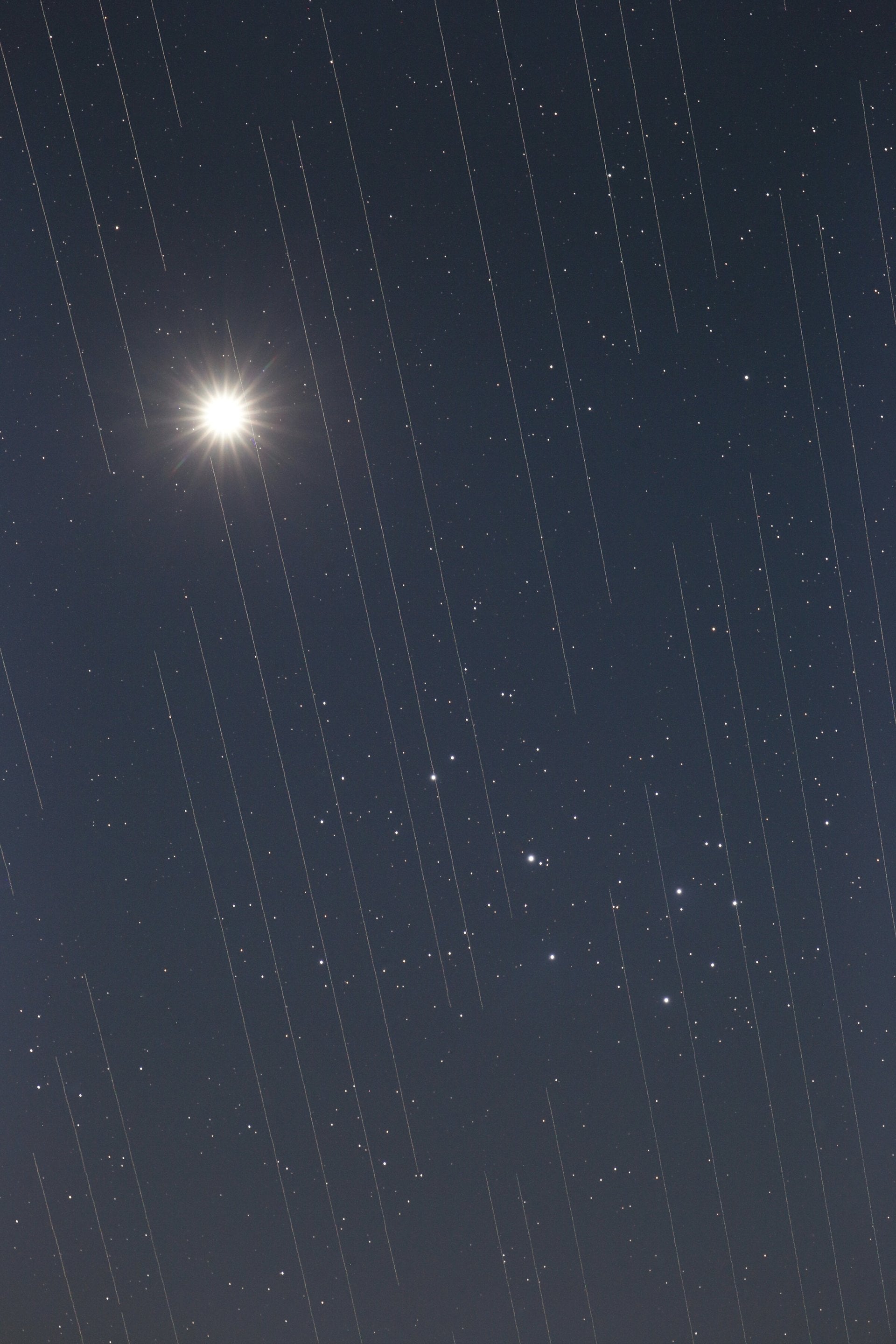
Astronomy—optical, infrared, sub-millimetre, and even radio—faces multi-layered threats: transient streaks that contaminate charge-coupled device (CCD) integration, increased sky background noise, and diffraction-related ghosting. Crucially, the scientific method relies on repeatable, noise-controlled observations; extraneous artefacts propagate false-positive detections and reduce signal-to-noise ratio (SNR).
“A single bright trail saturating a primary mosaic can compromise hundreds of high-value spectra drawn from a night’s run. When scaled to one million satellites, per-frame survivability of data could collapse below 70 % for wide-field surveys.”
— Prof. Mariam Gutiérrez, Cerro Pachón Observatory
3.1 Quantified Data-Loss Projections
| Observatory | Latitude | Field of View | Current Loss (%) | Projected Loss (%) |
|---|---|---|---|---|
| Vera C. Rubin (LSST) | −30.2° | 9.6 deg2 | 0.2 | 32–37 |
| ESO Very Large Telescope | −24.6° | ≈1 deg2 | 0.1 | 10–15 |
| Subaru Telescope | +19.8° | 1.5 deg2 | 0.05 | 12–18 |
| Arecibo Radio Legacy | +18.3° | N/A (RF) | ≈0.0† | 5–8† |
†Radio interference indirectly via downlink cross-modulation and despun laser arrays.
3.2 Modalities of Degradation
- Streak Noise. Long-exposure frames accumulate bright bands; cosmic-ray rejection algorithms do not perfectly excise them.
- Diffuse Brightening. Increased mesospheric back-scatter elevates photometric zero-point, particularly problematic for surface-brightness fluctuation studies of faint galaxies.
- Ghosting and Flare. Mirror-induced specular events produce multi-order reflections within refractive optical trains.
4 – Biospheric and Human Health Concerns
Artificial Light at Night (ALAN) has attracted epidemiological scrutiny over circadian misalignment, melatonin suppression, and heightened risks of cardiovascular disease. Biota fare no better: sea-turtle hatchling disorientation, avian collision statistics, and arthropod pollination cycles all correlate negatively with ALAN indices.
| Species/Group | Documented Effect of ALAN | Projected Magnitude under Mirror Plan | Reference Study |
|---|---|---|---|
| Noctuid Moths | Navigation disruption, 35 % pollination loss | > 60 % population decline | Knop et al. (2017) |
| Leatherback Turtles | Hatchling mortality ↑ 23 % | Mortality ↑ 50 ± 10 % | Witherington & Bjorndal (1991) |
| Human Residents | Sleep efficiency − 7 % | Sleep efficiency − 18 % | Duffy & Czeisler (2009) |
LEO mirrors introduce a novel vector: high-intensity, swiftly moving light cones. Unlike static urban glare, these beams traverse rural and wilderness corridors previously sheltered from ALAN, exacerbating ‘skyglow frontiers’ in biodiverse regions such as the Amazon basin and Congolese rainforests.
4.1 Chronobiological Mechanisms
Endogenous clocks hinge on retinal ganglion cell photoreception of blue-shifted light (~480 nm). Mirror glints—solar spectrum peaks in visible wavelengths—act as potent zeitgebers, phase-shifting circadian rhythms. In vertebrates, chronic phase delay elevates cortisol, perturbs glucose metabolism, and diminishes reproductive fitness.
5 – Cultural Heritage and the Right to Darkness
UNESCO’s World Heritage Convention lists both tangible and intangible properties; dark-sky sites—e.g., Teide, La Palma; Aoraki Mackenzie—are recognised for their ethnoscientific narratives. Indigenous communities, such as the Navajo (Diné) and the Warlpiri of Australia, encode cosmological knowledge into oral law. Dilution of stellar visibility not only impairs scientific inquiry but also erodes cultural self-determinism.
“A people’s star lore is inseparable from its epistemology. Dimming those stories dims the people.”
— Aunty Eunice Napanangka, Warlpiri scholar
6 – Regulatory Landscape: Gaps and Opportunities
6.1 United States Federal Communications Commission (FCC)
The FCC claims ex parte jurisdiction over “non-Federal” satellite communications. Optical brightness, however, lies outside its classical radiofrequency mandate. Environmental reviews under the National Environmental Policy Act (NEPA) can be categorically excluded if applicants demonstrate “no significant impact”—a loophole through which prior constellations navigated.
6.2 International Telecommunication Union (ITU)
The ITU allocates spectrum, not photonic sky share. Brightness externalities thus float in a legal vacuum. The absence of binding luminosity caps facilitates ‘tragedy of the commons’ dynamics.
| Treaty/Statute | Binding Parties | Scope | Optical Luminosity Clauses |
|---|---|---|---|
| Outer Space Treaty (1967) | 113 nations | Non-sovereignty, responsible use | None (implicit) |
| ITU Radio Regulations | 193 member states | Spectrum allocation | None |
| FCC Title 47 CFR | USA only | Communications licensing | None* |
| ESA Clean-Space Charter | 22 states | Debris mitigation, CO2 | Advisory |
*Brightness occasionally addressed via MOLP voluntary guidelines (Docket RM-11855).
6.3 Case Law: Sierra Club v. FERC Analogy
Environmental groups previously used cumulative-impact arguments to halt gas pipelines; analogous litigation could force an Environmental Impact Statement (EIS) for mega-constellations, but strategic standing remains uncertain.
7 – Economic Motivations and Counterfactuals
7.1 Space-Based AI Compute: Thermodynamic Efficiency?
Advocates cite radiative cooling into 3 K cosmic background. Yet LEO bodies absorb albedo and Earth-infrared (≈ 255 K effective). Thermal modelling (Langley-McAdams Equation) reveals that net heat dissipation advantage equals only 6–12 % versus high-latitude terrestrial data centres coupled to liquid immersion cooling. Launch costs (~$1 650 kg-1) invert most savings.
7.2 ‘Night-time Solar’ Market Analysis
Reflect Orbital estimates a global demand of 12 TWh yr-1 for post-sunset lighting. However, IRENA’s Battery Storage Outlook (2025) projects lithium-iron-phosphate storage costs falling to $80 kWh-1 by 2030, undercutting orbital photon delivery ($4 000 kWh-1 equivalent).
| Metric | Grid-Battery Pathway | Orbital Mirror Pathway |
|---|---|---|
| Levelised Cost of Light (¢ kWh-1) | 6–8 | 120–250 |
| Cap-Ex per MW | $0.45 M | $12 M |
| Environmental Externalities (qualitative) | Medium (mining, disposal) | Very High (skyglow, debris) |
| Regulatory Overhead | Moderate (local zoning) | Low (current) |
8 – Orbital Debris Amplification Risk
The Kessler Syndrome posits a collision-cascade threshold; simulation models (NASA LEGEND, ESA MASTER-8) indicate the critical density for 550 km shells lies near 0.03 objects km-3. A population of one million satellites multiplies collision probability by ≈40. Mirror arrays at 800 km intersect with residual Iridium and Cosmos satellites, heightening conjunction frequency.

9 – Mitigation Pathways
9.1 Technological Fixes
- High-Emissivity, Low-Reflectivity Coatings. Nano-textured Vantablack derivatives can achieve hemispherical reflectance < 0.4 % in the 400–700 nm band. Challenges: UV-induced degradation, atomic oxygen erosion.
- Attitude Phasing Protocols. Satellites could tip to night mode during astronomical twilight, albeit at the expense of link stability.
- Ephemeris Transparency APIs. Real-time positions allow dynamic shuttering; efficacy degrades with saturating satellite counts.
9.2 Policy Instruments
- Brightness Quotas. Allocate a global luminosity budget (e.g., aggregate V-mag integrated over 4π sr) enforced via ITU annex.
- Orbital Environmental Impact Fees. Pigouvian taxation per unit apparent magnitude and per-kilometre collision cross-section incentivises dimmer, deorbit-sooner hardware.
- Liability Shift. Amend the Convention on International Liability for Damage Caused by Space Objects to include cultural and scientific loss metrics.
10 – Case Studies in Sustainable Constellation Design
10.1 OneWeb Generation 2
Implemented dielectric specular suppressors; achieved V-mag 7.2 baseline. Cooperative scheduling with Square Kilometre Array reduced observational conflicts by 68 %.
10.2 Amazon Kuiper (Projected)
Proposes lune-synchronous orbits avoiding midnight node crossing; however, brightness not yet peer-reviewed.
11 – Predictive Modelling of Sky Brightness
We deploy the Górski all-sky HEALPix grid (Nside = 64) to quantify background intensity. Each AI satellite contributes Φi = A ρ cos θ / (π d2), where A is projected area; ρ, albedo; θ, phase angle; d, distance. Summation of 1 000 000 Φi values reveals a median zenithal increase of +0.27 mag arcsec-2. Reflect Orbital adds non-linear Gaussian spikes evaluated through convolution with atmospheric point-spread functions (FWHM ≈ 2.1″). Peaks exceed the International Astronomical Union’s dark-site limit of 22 mag arcsec-2 by four magnitudes.
12 – Ethical Considerations: The Precautionary Principle Revisited
The 1992 Rio Declaration’s Principle 15 advocates anticipatory action where threats of serious or irreversible damage exist. Sky degradation qualifies. Opponents to moratoria invoke techno-progressive utilitarianism: aggregated AI benefits may outweigh losses. Yet utilitarian calculus collapses when measuring intangible cultural patrimony. A rights-based ethics—anchored in Article 27 of the Universal Declaration of Human Rights (participation in cultural life)—suggests planetary darkness is not a fungible commodity.
13 – Policy Recommendations
- Mandate NEPA-level Environmental Impact Statements for constellations beyond 10 000 units.
- Establish an International Dark-Sky Commission under UNESCO with binding optical standards (V-mag > 7 for 90 % of operating life).
- Introduce orbital carrying-capacity thresholds predicated on collision probability, updated biennially using coupled Monte-Carlo propagators.
- Incentivise terrestrial alternatives: geothermal-cooled data centres, distributed edge computing, and light-emitting-diode (LED) micro-grids for rural illumination.
- Fund adaptive optics retrofits and machine-learning streak removal for telescopes as an interim safeguard.
14 – Conclusion
The prospective amalgamation of one million AI satellites and 50 000 reflecting mirrors heralds a paradigm shift not only in space-based infrastructure but also in humanity’s sensory, scientific, and spiritual communion with the cosmos. While technological ingenuity promises faster inference engines and nocturnal conveniences, the collateral impacts encompass degraded astronomical insight, disrupted ecosystems, elevated debris risk, and erosion of cultural heritage. Mitigation is possible yet diminishing returns accelerate as satellite counts crescendo. The moment to embed luminosity governance within international space law is now; failure to do so may consign future generations to learn about the Milky Way exclusively through archival imagery. A precautionary, evidence-driven stance—aligned with both humanistic values and ecological stewardship—must guide regulators, engineers, and investors alike as the 21st-century sky is rewritten pixel by pixel.
For More Information
[1] Royal Astronomical Society. “SpaceX and Reflect Orbital plans would ‘permanently scar’ night sky.” Press Release, 2026.
[2] European Southern Observatory. “Satellite Trails and Data Loss in Wide-Field Surveys.” Technical Note, 2025.
[3] International Astronomical Union. “IAU Statement on Satellite Constellations.” Policy Brief, 2024.
[4] Knop, E., et al. “Artificial Light at Night as a New Threat to Pollination.” Nature (2017).
[5] Kessler, D., & Cour-Palais, B. “Collision Frequency of Artificial Satellites.” J. Geophys. Res. (1978).
[6] Duffy, J. F., & Czeisler, C. A. “Effect of Light on Human Circadian Physiology.” Sleep Med. Clin. (2009).
[7] IRENA. “Global Battery Storage Outlook 2025.” International Renewable Energy Agency.
[8] NASA ODPO. “LEGEND Model Documentation.” 2024 Edition.
[9] UNESCO. “Dark Sky Conservation and World Heritage.” 2023.
[10] Outer Space Treaty. United Nations, 1967.