Introduction: From Surface Scoops to Subsurface Hopes
For more than half a century the search for life on Mars has been dominated by a paradigm that quite literally scratches the surface. From NASA’s Viking landers in the 1970s, which used robotic arms to scoop and bake a few cubic centimeters of regolith, to the Perseverance rover’s cutting-edge rock-core caching system in Jezero Crater, the Red Planet has been investigated principally at or just below the interface between atmosphere and lithosphere. Yet mounting evidence from orbital spectroscopy, in-situ geochemical assays, global climate simulations, and terrestrial analog research indicates that the Martian surface is—and has been for billions of years—a hostile environment for extant biology. Ionizing radiation, hyper-oxidizing perchlorate chemistry, large thermal gradients, desiccating conditions, and the lack of an appreciable magnetosphere combine to make the uppermost few meters of the crust inhospitable to cellular integrity and metabolic processes.
Against this backdrop of surface sterility, a growing coalition of planetary scientists, astrobiologists, and mission architects has converged on a new strategic doctrine: to maximize the probability of encountering living organisms or their biosignatures, one must venture underground. Subsurface niches can furnish shielding from radiation, physical isolation from oxidants, relatively stable temperatures, and potentially liquid water—especially in zones where residual geothermal heat is channeled upward along volcanic fractures. Critically, terrestrial microbiology demonstrates that both chemolithoautotrophic and thermophilic communities thrive in analogous refugia such as deep sea hydrothermal vents, basaltic lava tubes in Hawai‘i, and Icelandic subglacial volcanoes.
The Cerberus Fossae Region: Geological and Astrobiological Significance
Of all the targets proposed for subsurface exploration, few captivate scientific imagination like Cerberus Fossae—a labyrinthine system of tectonic fissures and volcanic vents that dissects the western margin of Elysium Planitia. This region, stretching roughly 1,300 km in length, is geologically youthful by Martian standards. Crater counting and stratigraphic analyses constrain significant eruptive episodes to as recently as 46,000 years ago, with several studies suggesting intermittent magmatic or seismic activity could persist today. Furthermore, the presence of the Cerberus Fossae Mantling Unit (CFmu)—an extensive pyroclastic blanket tens of meters thick—attests to volatile-rich explosive volcanism. Such volcanism is intimately linked to elevated heat flow and volatile exsolution, two pre-conditions for habitability and for the preservation of biosignatures in pyroclastic glass.
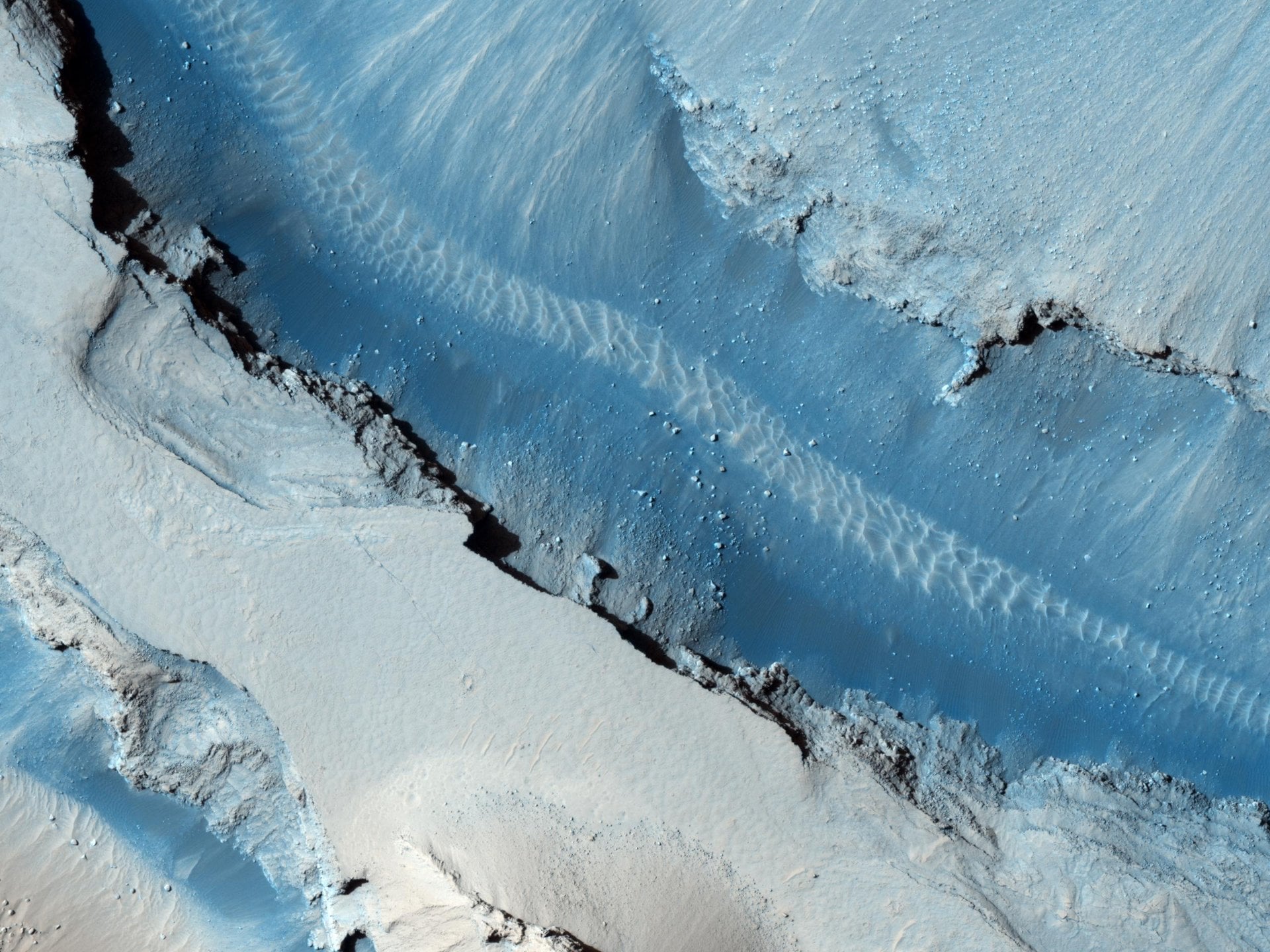
Yet the very features that render Cerberus Fossae scientifically alluring also thwart conventional rover access. Sheer pit walls, jagged ejecta ramparts, and unconsolidated ash deposits create mobility hazards that exceed the traction, articulation, and power margins of even the most advanced six-wheel rocker-bogie platforms. Fully realizing the astrobiological potential of these subsurface voids therefore demands a fundamentally different mobility architecture.
Enter ORPHEUS: A Vertical-Takeoff-and-Landing Hopper Concept
The ORPHEUS mission concept—formally titled “Out-Regolith Probe Hopper for Exploring Underworld Spaces” but more poetically invoking the mythic lyrist who charmed Cerberus—proposes to meet this challenge with a robotic vehicle capable of vertical takeoff and landing (VTOL) operations in the tenuous Martian atmosphere. Building on the triumph of NASA’s Ingenuity technology demonstrator, ORPHEUS couples contra-rotating rotor assemblies for lift with a compact reaction-control propulsion set for translational hops of up to 10 km per sortie. Crucially, it incorporates retractable landing spikes, autonomous vision navigation, and adaptive flight software hardened against variable wind shear within pit cavities.
“VTOL architectures expand the Martian reachable science terrain by at least an order of magnitude compared to traditional surface assets. ORPHEUS in particular will transform previously categorized ‘Regions of Interest—No Access’ into fully investigable laboratories.” ‑ Dr. Pascal Lee, SETI Institute, LPSC 57 Keynote
Mission Architecture Overview
ORPHEUS is envisaged as a primary hopper platform supported by a modest lander infrastructure that serves as power and communication relay. Once deployed, the hopper performs a multi-leg traverse from its touchdown ellipse near the CFmu to a series of increasingly hazardous waypoints culminating in Vent #5 atop Cerberus Tholus 1 (CT1). Each leg will leverage both powered flight and ballistic hops, permitting direct ingress into vertical skylights and controlled egress via autogyro descent.
| Mission Phase | Duration (sols) | Key Objectives |
|---|---|---|
| Cruise & EDL | 0–210 | Interplanetary transit; aeroshell entry; sky-crane landing. |
| Commissioning | 210–230 | Deploy hopper; system & comms checkouts. |
| Local Survey | 231–280 | Short-range (<1 km) flights; calibrate sensors; characterize CFmu. |
| Extended Traverse | 281–350 | Multi-kilometer hops across Zunil ejecta to Cerberus Archipelago. |
| Vent Reconnaissance | 351–400 | IDL approach; acquisition of high-res pit wall imagery; subsurface radar. |
| Biosignature Campaign | 401–420 | Deploy micro-samplers; in-situ biomolecular assays inside Vent #5. |
Scientific Payload: Synergistic Instrumentation for Life Detection and Geology
To achieve its dual mandate—interrogating both habitability parameters and volcanic evolution—ORPHEUS carries an integrated payload suite constrained to < 5 kg and < 15 W continuous power. Major subsystems are summarized below.
| Instrument | Mass (g) | Power (W) | Primary Data Products |
|---|---|---|---|
| OmniCam-360 | 520 | 3.2 | Panoramic RGB & multispectral imaging, stereo depth maps. |
| NIRIS (1–2.6 μm NIR spectrometer) | 610 | 2.7 | Mineral phase mapping; hydration signatures; organics detection. |
| GPR-Lite | 800 | 2.1 | Subsurface dielectric stratigraphy to 30 m depth. |
| BIO-DD (Biosignature Dipstick Detector) | 390 | 1.6 | Immunoassay fluorescence for amino acids, hopanoids, porphyrins. |
| ENV-Node Suite | 275 | 0.9 | Temperature, RH, trace gas (CH4, SO2) monitoring. |
Collectively, these instruments build a high-fidelity, spatially co-registered dataset enabling cross-disciplinary analysis. For example, GPR stratigraphic discontinuities can be correlated with NIRIS-derived mineralogical contacts, while BIO-DD fluorescence events are mapped against micro-topographic niches imaged by OmniCam.
VTOL Engineering: Aeromechanics and Propulsion Challenges
Flight in the Martian atmosphere—less than 1% the density of Earth’s at sea level—demands an aggressive lift-to-weight optimization strategy. ORPHEUS addresses this imperative through a carbon-fiber composite fuselage weighing < 1.2 kg and biplane rotor disks extending 1.6 m in diameter. Brushless direct-drive motors spin these rotors at up to 2,800 RPM, generating sufficient thrust for a 3.5 kg gross vehicle mass.
Horizontal translations are augmented by a cold-gas reaction control system fed by a 150-bar nitrogen tank. Although this architecture incurs a propellant mass penalty, it enables precise vectoring essential for landing within the 1–2 m diameter apertures of volcanic skylights. Computational fluid dynamic (CFD) modeling validates that plume impingement loads will not destabilize regolith surfaces or dislodge precariously supported basalt plates in the pit environment.
| Parameter | Value @ 0 m AGL | Value @ 50 m AGL | Operational Margin |
|---|---|---|---|
| Rotor Tip Mach Number | 0.55 | 0.48 | ≥ 0.40 required |
| Hover Power (W) | 98 | 91 | < 125 W limit |
| Translational Speed (m/s) | 17 | 14 | 10–20 m/s optimal |
| Max Wind Tolerance (m/s) | 11 | 9 | ≥ 8 m/s required |
Power is harvested via a deployable, high-efficiency GaAs solar blanket mounted atop the lander. The blanket recharges a 55 Wh Li-S battery housed within the hopper. Duty cycles anticipate one major flight every six sols, allowing adequate energy budget for science operations, data uplink, and thermal housekeeping.
Operational Considerations: Autonomy, Navigation, and Data Management
Low-latency teleoperation from Earth is infeasible given the 4–22-minute one-way light time; hence ORPHEUS depends on a multi-layered autonomy stack. Vision-based simultaneous localization and mapping (V-SLAM) computes real-time terrain meshes from OmniCam feeds, while inertial measurement units supply high-frequency attitude data. Novel software routines fuse these channels via an extended Kalman filter running on a radiation-tolerant FPGA, achieving < 10 cm positional uncertainty inside GNSS-denied pit interiors.
On the data side, each sortie generates ~2.6 Gb of raw imagery and spectrometry. Lossless compression, on-board triage, and prioritized packet scheduling ensure that the Ultra-High Frequency (UHF) relay link to Mars Reconnaissance Orbiter can downlink greatest-value content during 10-minute overpasses. A kerberized file authentication protocol guards against corruption during multiple relay hops.
The Search for Extant Life: Biosignatures, Detection Strategies, and Null Hypothesis Testing
Central to ORPHEUS is the interrogation of Vent #5 for evidence of ongoing microbial metabolism. Terrestrial analog studies at the Icelandic Fimmvörðuháls vents and the Dallol hydrothermal field underscore three tiers of biosignature hierarchy: (1) morphological (e.g., filamentous mineralized biofilms); (2) chemical (amino acid enantiomeric excess, lipid biomarkers); and (3) isotopic (fractionated δ34S or δ13C values). ORPHEUS’ payload is optimized for Tier 2 detection, with Tier 1 supported by high-resolution cross-lighting photography. Tier 3 remains beyond current miniaturization constraints but is earmarked for sample caching in synergy with prospective Mars Sample Return 2.0 architectures.
| Biosignature Type | Target Compound / Feature | Detection Threshold | Instrument Mode |
|---|---|---|---|
| Molecular Homochirality | L-amino acid predominance | 60% ee | BIO-DD Immuno-Chiral Assay |
| Complex Organics | Aromatic hydrocarbons, PAHs | 10 ppb | NIRIS Fluorescence-Excited Spectra |
| Pigmented Biofilms | Bacterioruberin derivatives | Surface coverage ≥ 5% | OmniCam Narrowband Filter |
| Exopolysaccharide Matrices | C-O absorption bands | Signal-to-Noise ≥ 3 | NIRIS Short-Wave Mode |
Importantly, each positive detection scenario is subjected to Bayesian model averaging to estimate posterior probabilities that favor a biological versus abiotic origin. Cross-instrument confirmation is mandated before declaring Level-2 confidence in life detection, in accordance with the NASA/ESA life-detection protocols.
Geophysical Insights: Volcanism, Tectonics, and Planetary Evolution
While astrobiology headlines may capture public imagination, the secondary geophysical dataset harvested by ORPHEUS promises to reshape theoretical frameworks for Martian interior dynamics. The morphology of Cerberus Fossae fractures indicates dike-induced extensional stresses, suggesting that mantle plume activity in the Elysium province persisted well into the Amazonian epoch. GPR stratigraphy can test hypotheses regarding cyclical intrusive episodes, while compositional heterogeneity observed by NIRIS can elucidate magma differentiation pathways.
Moreover, seismicity recorded by the InSight lander—only ~1,600 km away—has already implicated Cerberus Fossae as a modern marsquake epicenter. Joint inversion of ORPHEUS’ subsurface radar data and InSight’s seismic catalogs could yield unprecedented 3-D velocity models that constrain crustal porosity, volatile content, and effective elastic thickness.
Environmental Hazards and Risk Mitigation
Among the numerous engineering hazards ORPHEUS must negotiate, three dominate risk matrices: (1) pit micro-climate turbulence, (2) regolith adhesion onto optics and rotor blades, and (3) electrostatic discharge in high-dust atmospheres. For each, dedicated sensors and contingency protocols have been integrated.
| Hazard | Likelihood (Pre-Mitigation) | Impact | Mitigation Measures | Residual Risk |
|---|---|---|---|---|
| Wind Gusts in Pits | Medium | Catastrophic | CFD-based flight envelope; LIDAR gust sensing; abort climb. | Low |
| Dust Accumulation | High | Major | Lotus-leaf coating on optics; ultrasonic blade shake. | Medium-Low |
| Electrostatic Discharge | Low | Major | Embedded grounding straps; humidity bias probes. | Low |
| Battery Thermal Runaway | Low | Catastrophic | Phase-change heat sink; neg-temp-coef sensors. | Very Low |
In the unlikely event of a forced landing within a pit, ORPHEUS’ structural cage can absorb a 3-m drop without compromising payload integrity. A tertiary uplink via orbiting relay ensures last-data-packet survival, safeguarding irreplaceable science even in the face of mission loss.
Comparative Analysis: ORPHEUS Versus Alternate Subsurface Access Approaches
Multiple strategies for subsurface Martian exploration compete for resources and launch windows. These range from drilling platforms (ExoMars Rosalind Franklin’s 2-m drill) to penetrator probes (DASH – Dedicated Astrobiology Subsurface Hammer). Each methodology presents unique cost-benefit vectors. A comparative matrix is illustrative.
| Approach | Depth Access (m) | Area Coverage (km2) | Tech Readiness Level | Cost Estimate (FY26 $M) |
|---|---|---|---|---|
| Wheeled Rover + Drill | 2 | 0.01 | 8 | 2,100 |
| Seismic Penetrators | 5–8 | 0.001 per unit | 5 | 950 |
| Cryobot Melter | > 100 (ice) | Trace line | 3 | 3,400 |
| ORPHEUS VTOL Hopper | 50 (voids) | ≥ 50 | 6–7 | 780 |
While drilling offers controlled stratigraphic context, it is area-limited and may miss localized biogenic reservoirs present only within discrete cavities. VTOL hoppers such as ORPHEUS, by contrast, incur lower absolute depth penetration but compensate through broad spatial agility and the capacity to sample natural excavations made by volcanism, thereby maximizing discovery space per unit mass delivered.
Societal and Philosophical Implications of Detecting Martian Life
Beyond its scientific merits, ORPHEUS straddles profound intellectual territory. The detection of a second genesis—life arising independently on Mars—would recalibrate existential discourses ranging from the Copernican principle to Fermi’s Paradox. Conversely, a null result constrained by rigorous statistical limits would reinforce the rarity of life even on superficially Earth-like worlds, thereby elevating the import of planetary stewardship at home.
Ethical considerations also surface. The act of penetrating pristine subsurface environments could introduce Earth microbes despite stringent bioburden protocols. Hence, ORPHEUS adopts Category IVb planetary protection measures: a sterilized payload bay, triple-layer containment for sensitive consumables, and post-launch bioload assays verifying < 30 spores per square meter.
Path Forward: Political, Programmatic, and Fiscal Realities
At present ORPHEUS resides at Technology Readiness Level 4, validated in high-altitude Earth analog flights over Mauna Loa’s lava tubes. Achieving flight readiness by the 2031 Mars transfer window hinges on several milestones: qualification of radiation-resistant motor controllers, integration of a miniaturized GPR antenna conformal to the rotor shroud, and alignment with a launch vehicle within the current Planetary Decadal Survey budget envelopes. International collaboration—particularly with ESA’s PROSPECT drilling consortium and JAXA’s MMX sample acquisition teams—can reduce redundant R&D expenditure while bolstering cross-agency buy-in.
Given the fiscal overhang of the Mars Sample Return (MSR) program, advocates propose positioning ORPHEUS as a New Frontiers-class mission (~$900 M cap) with explicit synergy to MSR derivatives. For instance, ORPHEUS-cached pyroclastic glass vials containing potential organics could be co-loaded into an MSR phase B lander, thereby amortizing ascent vehicle costs across two flagship science objectives.
Conclusions: A Paradigm Shift in Martian Exploration
By marrying aerial agility with focused subsurface instrumentation, ORPHEUS advances a compelling new paradigm for the astrobiological reconnaissance of Mars. The mission’s capacity to sample geologically young, potentially warm vents where biosignatures would be freshest situates it at the vanguard of the next generation of exploration systems. Whether it ultimately reveals active microbial colonies or merely delineates the sterilizing extremes of Martian volcanism, the dividends for planetary science, technology development, and philosophical inquiry are immense.

For More Information
- Bunn, C. & Lee, P. (2026). ORPHEUS: A Hopper Mission to Explore Volcanic Pits/Caves in Cerberus Fossae.
- SETI Institute – Official ORPHEUS Concept Page
- InSight Mission – Mars Seismic Network
- NASA Ingenuity Helicopter Technology Demonstration
- Universe Today – Has NASA Detected Convincing Evidence of Ancient Life on Mars?
- Universe Today – How Likely Is Life on Mars?
- Universe Today – Microbes or Their DNA Could Survive in Martian Ice, and a Future Rover Could Dig for It