In 1915, Albert Einstein distilled his radical vision of space, time, and gravitation into a set of ten interlocking differential equations that we collectively describe as the Einstein Field Equations. The framework, which we now call general relativity (GR), replaced the Newtonian concept of gravity as an instantaneous “pull” with the elegant idea that matter and energy curve the four–dimensional fabric of spacetime and compel bodies to follow geodesics in that curved arena. For more than a century, experiment after experiment—from fragile torsion‐balance apparatuses to planetary ephemerides, from binary pulsar timing to the precision of atomic‐clock comparisons on satellites—has strengthened confidence in Einstein’s theory. Yet confidence is not the same as completeness. The universe stubbornly presents scales and regimes where classical notions of spacetime must consort with inherently quantum phenomena. The long‐sought theory of quantum gravity remains elusive, and its eventual discovery will almost certainly require that we scrutinize GR in regimes that were inaccessible during most of the twentieth century.
The landscape changed dramatically on 14 September 2015, when the twin detectors of the Laser Interferometer Gravitational‐Wave Observatory (LIGO) identified a transient strain on spacetime that matched the theoretical template for a binary black‐hole coalescence. The observation of GW150914 inaugurated gravitational‐wave (GW) astronomy. In the decade that followed, LIGO joined forces with Virgo in Europe and KAGRA in Japan to form the LVK Collaboration, and together these observatories have logged dozens of confident detections. Each new signal supplies an exquisitely detailed record of Einsteinian gravity in the strong‐field regime, the very realm where quantum gravitation might first begin to reveal itself through subtle deviations from the predictions of GR.
The Imperative for Precision Tests of Gravity
Sections that follow will examine not only the core methodology of testing GR with black‐hole mergers but also the broader theoretical motivations, the statistical tools used to parse gravitational‐wave data, and the interplay between observation and model building. The narrative, dense though it must be to be appropriately academic, is organized thematically so that each reader can—if necessary—jump to practical treatments of detector design, waveform modeling, parameter estimation, or alternative‐gravity parameterizations. We begin with a succinct outline of why tests of GR remain vital even after a century of empirical support.
- Incompatibility with Quantum Mechanics. GR is a classical field theory. Although one can linearize the field equations and talk loosely about “gravitons,” a non‐perturbative, renormalizable quantum version of GR has resisted technical and conceptual completion. Every proposed approach to quantum gravity—string theory, loop quantum gravity, causal dynamical triangulations, asymptotic safety, or emergent gravity—implies departures from GR in at least some limit.
- Cosmological Anomalies. The standard cosmological model, ΛCDM, requires dark matter and dark energy, neither of which have been directly detected in non‐gravitational experiments. Modified theories of gravity sometimes dispense with or reinterpret these dark components, and gravitational waves present a pristine channel for testing such hypotheses.
- Singularities and Information Paradoxes. Classical solutions to Einstein’s equations harbor singularities—infinite curvature hideaways barred by event horizons. Whether the quantum world respects these mathematical pathologies or tames them is an open question closely tied to black‐hole thermodynamics and the holographic principle. Observational data on the dynamics of black‐hole horizons can yield indispensable clues.
- High‐Energy Frontier. Collider physics, despite its triumphs, is energy‐limited. Conversely, astrophysical black holes probe energy densities and curvature scales that dwarf laboratory capacities. They provide a natural—and arguably the only pragmatic—testbed for theories beyond the Standard Model and beyond GR.
From Ripples to Revelation: Anatomy of a Binary Black‐Hole Merger
Understanding how black‐hole mergers manifest inside a strain detector requires unraveling the signal into three conceptual epochs: inspiral, merger, and ringdown. These epochs, while contiguous in an observed chirp, correspond to physically distinct dynamical regimes whose modeling employs different approximations and therefore different opportunities for theory‐driven deviations.
- Inspiral. At orbital separations of tens to hundreds of gravitational radii, two black holes spiral inward under the influence of gravitational radiation reaction. The amplitude and phase evolution can be expanded in a post‐Newtonian (PN) series, with each PN order containing trace contributions from spin–orbit coupling, spin–spin interactions, and higher multipole moments. Alternative theories of gravity often inject corrections at specific PN orders.
- Merger. The highly nonlinear phase, when horizons begin to coalesce, lies beyond PN accuracy. Numerical relativity (NR) solves Einstein’s equations on supercomputing clusters to create full waveforms. Modifications from new physics could manifest as altered nonlinear couplings or horizon‐scale effects, such as partially reflective layers predicted in some quantum‐gravity scenarios.
- Ringdown. After merger, the remnant black hole relaxes via quasi‐normal mode (QNM) oscillations. In GR, QNM frequencies are exclusively functions of the mass and spin of the remnant—no‐hair behavior. Exotic compact objects (ECOs) or modifications to the horizon imprint additional overtones or secondary pulses colloquially described as echoes.
“Every binary black‐hole waveform is a Rosetta stone of strong‐field gravity: the task is to identify and interpret the hieroglyphics hidden deep in an avalanche of numerical data.” — Unattributed remark circulating in the LVK collaboration Slack workspace, 2025
Experimental Infrastructure: Detectors and Data Streams
No test of gravity can exceed the precision of its underlying instrument. The triad of LIGO, Virgo, and KAGRA forms a global network, soon to be joined by LIGO‐India and Cosmic Explorer (CE). Each facility employs kilometer‐scale laser interferometers chilled near their quantum noise limits. Common operating parameters and noise budgets are summarized in the following table.
| Detector | Armlength (km) | Sensitivity Band (Hz) | Design Strain (1/√Hz) | Key Noise Limits |
|---|---|---|---|---|
| LIGO Hanford | 4 | 10 – 5000 | 4×10⁻²⁴ | Quantum shot noise, coating thermal noise |
| LIGO Livingston | 4 | 10 – 5000 | 4×10⁻²⁴ | Seismic noise, Newtonian gravity gradient |
| Virgo | 3 | 20 – 5000 | 5×10⁻²⁴ | Suspension thermal noise |
| KAGRA | 3 | 10 – 5000 | 3×10⁻²⁴ | Cryogenic cooling, underground seismic isolation |
| LIGO‐India (planned) | 4 | 10 – 5000 | 4×10⁻²⁴ | Site‐dependent anthropogenic noise |
The simultaneous operation of multiple observatories not only multiplies detection prospects through network sensitivity but also enables precise triangulation of sky positions and polarisation modes. The latter is vital: many alternative theories predict extra GW polarization states beyond the two tensor modes of GR. A three‐detector network can in principle detect or constrain such additional states. The arrival time differences among detectors also suppress false positives from transient environmental noise, thus enhancing overall fidelity.
Waveform Modeling and Bayesian Inference
Waveform templates form the beating heart of GW data analysis. Each template is synthesized by stitching together PN results, NR simulations, and semi‐analytical techniques such as the effective‐one‐body (EOB) formalism. For a given putative event, a bank of O(108) templates may be required to cover the relevant parameter space. Even modern HPC clusters struggle to exhaustively compute so large a bank in real time, propelling research into reduced‐order modeling and machine‐learning surrogates.
Once templates exist, Bayesian inference picks up the baton. We denote the recorded strain data by d and the collection of gravitational and instrumental parameters by the vector θ. Bayes’s theorem yields the posterior distribution p(θ|d) ∝ p(d|θ)π(θ), where π is the prior and p(d|θ) the likelihood, typically modeled as a Gaussian with covariance derived from the detector’s noise power spectral density. Nested‐sampling algorithms such as dynesty or multinest deliver marginal likelihoods—or evidence—which form the basis for Bayes factors between competing models.
Table 2 – Parameter Estimation Pipeline Components
| Pipeline Stage | Algorithm/Tool | Computational Demand | Purpose |
|---|---|---|---|
| Data Conditioning | Butterworth filters, windowing | Moderate | Remove spectral lines and low‐frequency seismic drift |
| Template Bank Generation | Reduced‐order model, NRSur | High | Create minimal yet complete set of waveforms |
| Matched Filtering | Fast FFT convolution | Very High | Compute signal‐to‐noise ratio for each template |
| Parameter Inference | Nested sampling, MCMC | High | Quantify posterior distributions |
| Model Selection | Bayes factor evaluation | Low | Decide in favor of GR or alternatives |
Parameterized Frameworks for Deviation Searches
Confronting GR with data demands a framework that is simultaneously general enough to include a broad family of new‐physics effects yet sufficiently specific to translate into observable quantities. Several such frameworks exist, and each has been leveraged in the latest LVK data release (GWTC-4.0) to set limits on departures from Einsteinian predictions.
- Post‐Newtonian Expansion with Free Coefficients. One modifies the phase evolution Φ(f) in the frequency domain: Φ(f) = Σi(φiGR + δφi)f(i−5)/3. Each δφi parameterizes deviations at PN order i.
- Parameterized Post‐Einsteinian (ppE) Formalism. Generic amplitude and phase corrections enter as h(f) → h(f)(1 + αfa)exp[iβfb].
- Quasi‐Normal Mode Spectroscopy. One writes the ringdown as a superposition of damped sinusoids with complex frequencies ωℓmn. Deviations δωℓmn serve as smoking guns for beyond‐GR physics.
- Inspiral–Merger–Ringdown Consistency Tests. Independent estimates of the final mass and spin from (a) the inspiral portion and (b) the merger–ringdown portion must converge in GR. Discrepancies suggest new dynamics.
Table 3 – Recent Constraints on PN Deviation Coefficients (GWTC-4.0)
| PN Order | δφi (Median) | 90% Credible Interval | GR Consistent? |
|---|---|---|---|
| −1 (Dipole) | 0.002 | [−0.025, 0.029] | Yes |
| 0 (Newtonian) | −0.001 | [−0.012, 0.010] | Yes |
| 1 (1PN) | 0.004 | [−0.018, 0.026] | Yes |
| 1.5 (1.5PN) | −0.006 | [−0.022, 0.011] | Yes |
| 2 (2PN) | 0.009 | [−0.031, 0.048] | Yes |
Interpretation: All credible intervals bracket zero, implying no statistically significant deviations. The tightest bound is at the Newtonian order, constraining fractional amplitude corrections to better than 1%. Those figures already encroach on the territory where certain scalar–tensor gravity models would have predicted measurable divergences.
Graviton Mass: A Quantum‐Gravity Signal?
Within a linearized approximation, gravitational waves behave like spin-2 excitations—gravitons. The standard assumption is that gravitons are massless, mirroring the masslessness of photons. A nonzero graviton mass, mg, introduces a Yukawa‐like suppression in the propagation of gravitational potentials and modifies the dispersion relation to E2 = p2c2 + mg2c4. Consequently, waves of different frequencies travel at slightly different speeds, imprinting phase distortions detectable over astrophysical baselines.
LVK’s multi‐event catalog places an upper bound on mg < 2 × 10⁻²³ eV/c2 (90% CL), surpassing Solar‐System constraints derived from planetary ephemerides and rivalling pulsar timing limits. The table below juxtaposes various methods.
| Probe | Upper Bound on mg (eV/c2) | Characteristic Scale | Reference |
|---|---|---|---|
| Gravitational Waves (LVK, GWTC-4.0) | 2 × 10⁻²³ | 103 Mpc | Abac et al., 2026 |
| Binary Pulsars | 4 × 10⁻²² | 104 ly | Taylor & Weisberg, 1989 |
| Solar‐System Dynamics | 1 × 10⁻²¹ | 109 km | Talmadge et al., 1988 |
| Galactic Rotation Curves | 10−26 | 10 kpc | de Rham et al., 2017* |
| Cosmological Large‐Scale Structure | 10−30 | Hubble Radius | Desai et al., 2018* |
*Bounds marked with an asterisk rely on model‐dependent assumptions about dark‐matter distributions and ΛCDM parameters, and are therefore less robust than direct timing or propagation measurements.
Ringdown Spectroscopy and Echo Searches
In the aftermath of coalescence, the newly born black hole radiates energy in damped sinusoids whose frequencies are calculable from the perturbation equations of the Kerr metric. For a given spherical‐harmonic index (ℓ,), and overtone n, the complex frequency ωℓmn depends solely on the final black‐hole mass and dimensionless spin parameter a. The no‐hair theorem then makes a clear, falsifiable prediction: measure multiple QNMs, invert the frequency map to infer (M, a) in more than one way, and those estimates must agree.
Recent LVK analyses have isolated at least two independent QNMs in a handful of loud events, finding consistency at the percent level. Beyond QNM reconstruction, theorists have proposed that certain quantum‐gravity or exotic‐compact‐object scenarios lead to partially reflective “walls” near where the horizon would ordinarily form. These walls generate echoes: secondary bursts of GWs recurring at intervals Δt ≈ 2Rs ln(L/ℓPlanck)/c. LVK’s null detection of echoes places stringent constraints on the reflectivity parameter ε and, by extension, on models such as firewalls, gravastars, or fuzzballs.
Table 4 – Upper Limits on Echo Amplitudes
| Event | Primary SNR | Echo Search SNR | εmax (90% CL) | Model Disfavored at > 2σ |
|---|---|---|---|---|
| GW150914 | 24 | < 4 | 0.05 | Near‐horizon quantum firewall |
| GW190521 | 14 | < 3 | 0.07 | Gravastar shell with high reflectivity |
| GW200129 | 13 | < 2.5 | 0.09 | Ultracompact boson star merger remnant |
Cataloguing the Harvest: Statistical Weight of the Binary Black‐Hole Sample
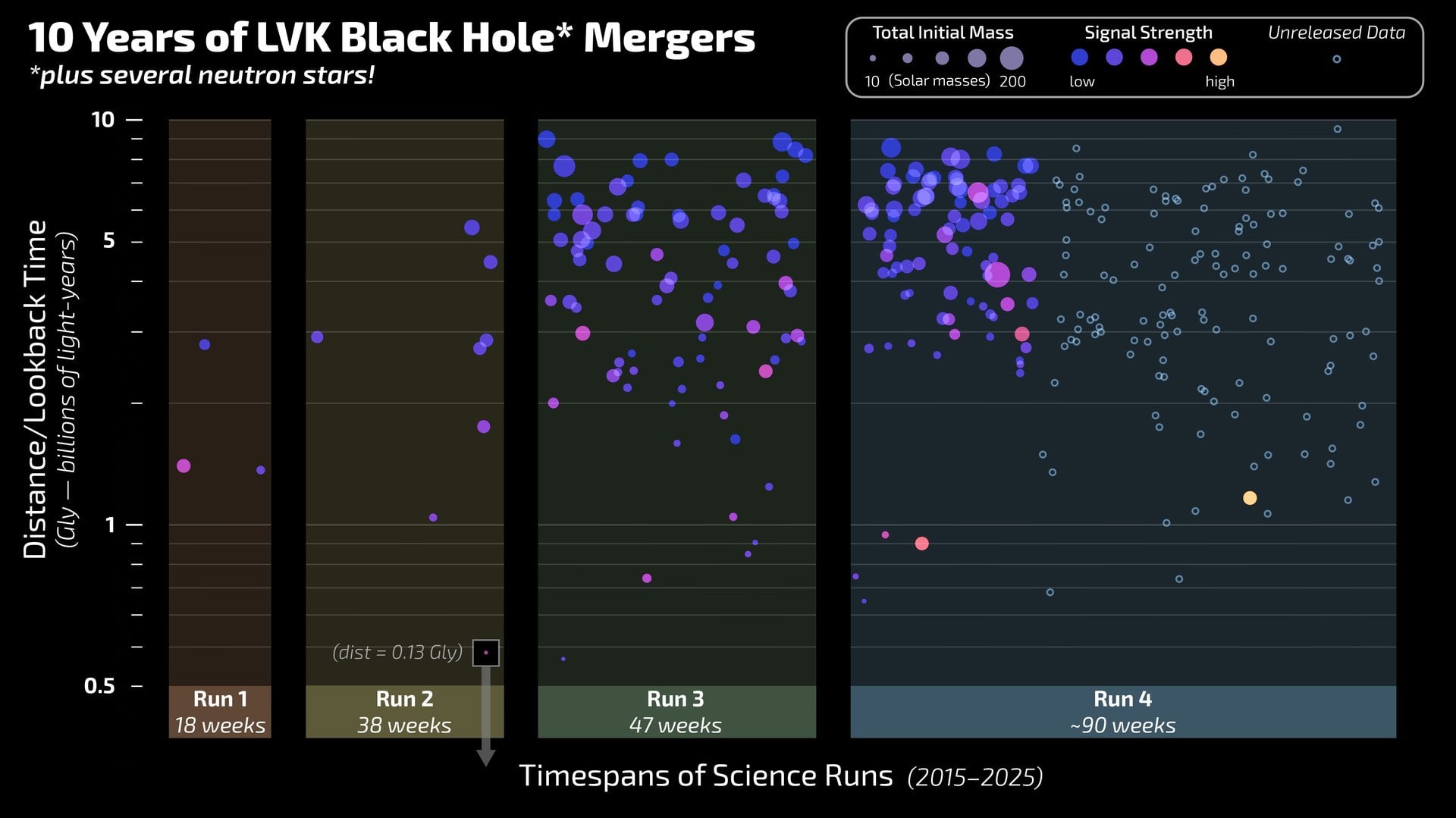
The LVK catalog now includes more than seventy high‐confidence binary black‐hole (BBH) events. Each carries its own statistical power, but the ability to stack constraints across multiple detections yields even sharper null‐tests of GR. Figure above, adapted from LVK public outreach materials, depicts the diversity of event masses and redshifts.
To convey the richness of the dataset, the next table collates summary properties for a representative subsample that spans the mass spectrum.
| Event | z | Primary Mass (M⊙) | Secondary Mass (M⊙) | Final Spin | Network SNR |
|---|---|---|---|---|---|
| GW150914 | 0.09 | 36 ± 5 | 29 ± 4 | 0.68 ± 0.04 | 24 |
| GW170729 | 0.48 | 50 ± 10 | 35 ± 8 | 0.81 ± 0.05 | 10 |
| GW190521 | 0.83 | 85 ± 11 | 66 ± 10 | 0.73 ± 0.09 | 14 |
| GW200220 | 0.12 | 11 ± 2 | 8 ± 1 | 0.43 ± 0.07 | 22 |
| GW230728 | 0.35 | 27 ± 3 | 23 ± 2 | 0.64 ± 0.03 | 18 |
Because each event contributes a posterior probability distribution rather than a single value, combined analyses employ hierarchical Bayesian techniques. One constructs hyper‐parameters that describe the population distribution—such as power‐law indices for the primary‐mass spectrum—and then marginalizes over single‐event posteriors. Any gravitational parameter that is universal across events, e.g., the graviton mass, then integrates coherently, and the confidence interval narrows by roughly the square root of the number of events, assuming similar SNRs.
Alternative Theories Under Siege
The goalposts for what constitutes an “alternative” theory of gravity are ever‐shifting. Nevertheless, broad classes persistently resurface in theoretical literature and warrant direct confrontation with the GW data.
Scalar–Tensor TheoriesEmbodied by Jordan–Brans–Dicke frameworks, these theories introduce a scalar field φ coupled to curvature. Dipole radiation is their smoking gun, surfacing at the −1 PN level. LVK constraints on the dipole parameter kill off whole swaths of the parameter space, pushing the Brans–Dicke coupling constant ωBD > 105, competitive with Cassini spacecraft results.Einstein–Æther and Hořava–Lifshitz GravityThese break Lorentz symmetry by adding a time‐like vector field or by positing anisotropic scaling at high energies. Modified dispersion relations and additional polarization modes become inevitable, neither of which appear in LVK data. Current limits demand Lorentz‐breaking coefficients at the 10−15 level or smaller.Massive Gravity and Bimetric TheoriesTo endow the graviton with mass while avoiding pathologies like the Boulware–Deser ghost, one resorts to covariant dRGT or Hassan–Rosen constructions. The aforementioned graviton‐mass bound slashes the allowed parameter plan by several orders of magnitude, leaving only fine‐tuned niches arguably unattractive on theoretical aesthetic grounds.Extra Dimensional ScenariosBraneworld models predict leakage of gravity into higher dimensions, effectively altering the 1/r2 law at certain distance scales. Ringdown tests are especially potent here because QNM spectra depend on the effective dimensionality of spacetime. No anomalies have surfaced.
“When you have eliminated the impossible, whatever remains—however improbable—must be GR.” — Tongue‐in‐cheek adaptation of Conan Doyle, overheard at GR23 Conference, 2026
Data Challenges: Systematics and Noise Artefacts
Scientific integrity demands circumspection. While the statistical weight of current results supports GR, one must remain vigilant against misinterpretation owing to instrumental or astrophysical systematics.
- Calibration Uncertainties: Detector strain is reconstructed from photodiode readouts subject to amplitude and phase calibration. Systematic calibration drifts of even 3% could masquerade as PN‐order deviations.
- Waveform Systematics: Template families may omit high‐spin or precession effects, generating systematic biases. Collaboration between NR and analytical groups has trimmed these errors to sub‐percent but not yet negligible levels.
- Glitches and Blip Transients: Non‐astrophysical transients occasionally mimic short GW signals. Machine‐learning classifiers, veto channels, and coincidence requirements mitigate but do not eliminate the risk.
- Environmental Couplings: Terrestrial gravity gradient noise (GGN) arising from atmospheric density fluctuations remains a limiting factor below ~10 Hz, where next‐generation detectors hope to operate.
Future Horizons: Detectors on the Drawing Board
The march of technological progress almost guarantees that today’s “advanced” interferometers will seem quaint compared to their successors. Consider a brief survey of upcoming facilities and their projected capabilities.
| Facility | Status | Armlength / Baseline | Frequency Band (Hz) | Strain Sensitivity (1/√Hz) | Science Objectives |
|---|---|---|---|---|---|
| Advanced LIGO Plus | Commissioning | 4 km | 5 – 5000 | 1.5×10⁻²⁴ | Enhanced BBH counts, stochastic background |
| Cosmic Explorer | Conceptual Design | 40 km | 3 – 5000 | 3×10⁻²⁵ | High‐z BBHs, matter effects in neutron‐star mergers |
| Einstein Telescope | Design Study | 10 km (triangle) | 1 – 5000 | 5×10⁻²⁵ | Precision cosmography, primordial GW background |
| LISA (space‐based) | Implementation Phase | 2.5 million km | 10−4 – 1 | 10−20 | Supermassive black‐hole mergers, EMRIs, tests of GR in mHz band |
| TianQin | Prototype | 1.7 million km | 0.1 – 10 | — | Cross‐check of LISA signals, dual tracking of massive BH binaries |
The gain in strain sensitivity translates into access to more distant and less massive systems, each affording unique leverage on gravity. For example, LISA will probe the capture of stellar‐mass objects by supermassive black holes—extreme mass‐ratio inspirals (EMRIs)—which execute hundreds of thousands of orbits in the strong‐field regime and thus deliver an unprecedented laboratory for mapping spacetime geometry.
Synergies with Electromagnetic and Neutrino Astronomy
While most BBH mergers manifest as “dark” in photons, multimessenger strategies remain relevant. Some theoretical models, such as those involving magnetized accretion disks around merging black holes or perturbations of circumbinary gas, forecast weak but detectable electromagnetic counterparts. Neutrino telescopes like IceCube likewise scan for high‐energy bursts coincident with GW triggers. Although no unambiguous BBH counterpart has yet emerged, the joint non‐detections impose upper limits on baryon loading and magnetic field strengths near the merger site—ancillary data that feed back into tests of gravity by constraining environmental effects that could mimic or mask new physics.
Educational and Philosophical Ramifications
The verification of GR in ever‐stronger fields reinforces a paradigm wherein laws of nature exhibit an astonishing domain of validity. Yet there is a flipside: the absence of deviations, despite increasingly sensitive experiments, may signal that quantum gravity effects either decouple from low‐energy observables or hide behind Planck‐scale feebleness. Philosophically, we confront whether a physical theory can ever be deemed complete when the experiments needed to falsify it recede perpetually into higher energies or greater precisions.
From an educational perspective, the accessibility of LVK data archives enables universities worldwide to incorporate real data into graduate curricula. Students can download strain data, apply open‐source analysis pipelines, and reproduce professional results within a semester. This democratization accelerates human capital development, broadening the community engaged in gravity research and hence diversifying the pool of ideas that might pierce present theoretical impasses.
Conclusions: General Relativity Endures, The Quest Continues
Black‐hole mergers have evolved from theoretical curiosities to observational cornerstones that define twenty‐first‐century gravity studies. The symphony of inspiral, merger, and ringdown encodes the dynamics of spacetime under conditions unattainable elsewhere. As of GWTC-4.0, every credible deviation test—from PN coefficients to QNM spectroscopy—has crowned Einstein the provisional victor. Nevertheless, the victory is provisional precisely because science is a provisional enterprise. LVK’s own roadmap, coupled with the ambitious next generation of ground‐ and space‐based observatories, all but guarantees an ongoing cascade of data—orders of magnitude richer than current troves. Should nature harbor surprises in the gravitational sector, those surprises will eventually surface. If not, a deeper lesson awaits: perhaps the union of quantum mechanics and curved spacetime does not begin with rewriting GR but with reimagining quantization itself.
For More Information
The following references provide foundational background and current frontiers. All links are open‐access whenever possible.
- GWTC-4.0: Tests of General Relativity. I. Overview and General Tests, Abac et al. (2026).
- GWTC-4.0: Tests of General Relativity. II. Parameterized Tests, Abac et al. (2026).
- GWTC-4.0: Tests of General Relativity. III. Tests of the Remnants, Abac et al. (2026).
- Yunes & Siemens (2018), Rev. Mod. Phys. 90 015004: “Gravitational‐Wave Tests of General Relativity with Binary Inspirals.”
- Official LISA Mission Website — technical documents, data challenges, and educational materials.
- Gravitational Wave Open Science Center (GWOSC) — public repository for GW data and analysis tutorials.
- Cosmic Explorer Design Study — blueprints for the 40 km next‐generation interferometer.
- Einstein Telescope Project — European underground triangular detector concept.