Over the last five decades of planetary exploration, the Jovian satellite Io has steadily evolved from an astronomical curiosity into an indispensable laboratory for understanding tidal heating, silicate volcanism, and extreme thermodynamic disequilibria. On the surface it is a jeweled maelstrom whose incandescent fissures outline wandering continents of sulfur snow; beneath the surface it is the seismically trembling product of a three-body tug-of-war that forces molten rock to circulate on time-scales measured in hours rather than millennia. Because of its uniquely violent environment, every incremental improvement in our observational capability has been rewarded with radical new insights—insights that reverberate through geophysics, astrobiology, orbital mechanics, and comparative planetology. The recent pre-print by Mura et al. (2026), based on radiometric data from the Jupiter InfraRed Auroral Mapper (JIRAM) onboard NASA’s Juno spacecraft, therefore continues a venerable tradition: it challenges the status quo by arguing that the community may have underestimated Io’s global thermal output by roughly an order of magnitude. If confirmed, the finding would have seismic consequences—figuratively and literally—for our understanding of tidal dissipation in the Jovian system, as well as for models of magma-ocean stability and resurfacing rates on tidally stressed bodies throughout the Universe.
1 | Contextualizing Io in the Landscape of Planetary Volcanism
Io was catapulted to fame when Voyager 1, hurtling past Jupiter in March 1979, transmitted a single, near-horizon frame of an ethereal, umbrella-shaped plume extending 270 km above an otherwise airless plain. That discovery, achieved serendipitously by navigation engineer Linda Morabito, instantaneously rewrote textbooks: it proved that massive, energy-intensive volcanism was not an early, long-cooled phase of terrestrial planet evolution but a phenomenon that can persist on kilometer-scale moons under the right forcing conditions. Succeeding decades reinforced the singular nature of Io’s volatile-poor, ultramafic volcanism, yet simultaneously revealed profound analogies to terrestrial subduction margins, Hawaiian caldera cycles, and even mid-ocean ridge processes. At the same time, a parade of synergistic missions—Voyager, Galileo, New Horizons, Juno, and a plethora of Earth-based adaptive-optics campaigns—provided a time-domain archive that captures individual vents waxing and waning, mountains collapsing, and flows erupting for thousands of square kilometers in a matter of months.
| Mission / Year(s) | Key Instruments Relevant to Io | Spatial Resolution at Closest Approach | Major Contributions to Io Science |
|---|---|---|---|
| Voyager 1 & 2 (1979) |
Imaging Science Sub-system (ISS), Photopolarimeter, IR Interferometer | ~1.8 km px⁻¹ | Discovery of volcanic plumes; global color mapping; measurement of tenuous SO2 atmosphere |
| Galileo Orbiter (1995-2003) |
Solid State Imager (SSI), Near Infrared Mapping Spectrometer (NIMS), Plasma Sub-system | ~10 m px⁻¹ (SSI during I27 fly-by) | Repeated monitoring of paterae; identification of >100 active hotspots; constraints on interior models |
| New Horizons (2007 fly-by) |
Linear Etalon Imaging Spectral Array (LEISA), Long Range Reconnaissance Imager (LORRI) | ~12 km px⁻¹ | Time-lapse imaging of Tvashtar plume; confirmation of high eruption temperatures (≤1650 K) |
| Juno (2016-present) |
Jupiter InfraRed Auroral Mapper (JIRAM), Stellar Reference Unit (SRU), Microwave Radiometer (MWR) | ~1-5 km px⁻¹ (JIRAM at perijove) | Thermal characterization of lava lakes; refinement of heat-flow estimates; first high-lat coverage since Voyager |
| James Webb Space Telescope (2022-present) |
NIRSpec, MIRI | ~140 km px⁻¹ (diffraction limit at 4 μm) | Spectro-imaging of eruption curtains; constraints on silicate vs sulfuric compositions; monitoring of global heat patterns |
1.1 The Enigma of Heat-flow Bottlenecks
From Galileo’s halcyon days until the last decade, the canonical estimate for Io’s global heat flow hovered near 1 × 10¹⁴ W (100 TW). That value, derived from a composite of visible-light hotspot counts, Voyager-era infrared thermometry, and geophysical reconstruction of plume lofting energies, was already extraordinary: it corresponds roughly to tenfold the aggregate geothermal heat flux of Earth despite Io’s thousand-fold smaller mass. Even so, the energy budget had become paradoxical. Tidal-dissipation models that explained Laplace resonance locking, latitudinal migration of dissipative stresses, and mantle convection patterns tend to predict 3-6 × 10¹⁴ W of steady-state heating. Where was the missing 200-500 TW being dissipated? Was it simply radiated away at wavelengths outside our detection limits, or sequestered transiently in mantle magma chambers, or lost through transient plumes escaping to Jovian space? Mura et al. (2026) argue persuasively for the first option: a large, previously neglected component of the radiative budget emerges in the far-infrared regime emanating from “cool,” yet unexpectedly wide, lava crusts.
2 | The JIRAM Paradigm Shift: How a Multi-Band Imager Redefined Expectations
Central to the new narrative is the JIRAM instrument, a dual-camera/spectrometer operating in two primary bands: 2–2.2 μm (K-band) optimized for auroral H3+ emissions, and 4–5 μm (so-called M-band) tailored for thermal imaging of >600 K surfaces. JIRAM is therefore, almost serendipitously, an ideal sensor for Io’s fretwork of lava lakes that glow intensely at 4.5 μm. However, the instrument also benefits from an extended sensitivity tail out to 8 μm, permitting indirect constraints on surfaces at or below 250 K—temperatures far too low for classical M-band‐only analyses. By combining this broad spectral response with sophisticated, pixel-scale energy balance reconstructions, the JIRAM team performed what amounts to a radiometric census of 32 lava lakes, capturing both their peripheral neon-hot annuli and their voluminous, sub-incandescent interiors.
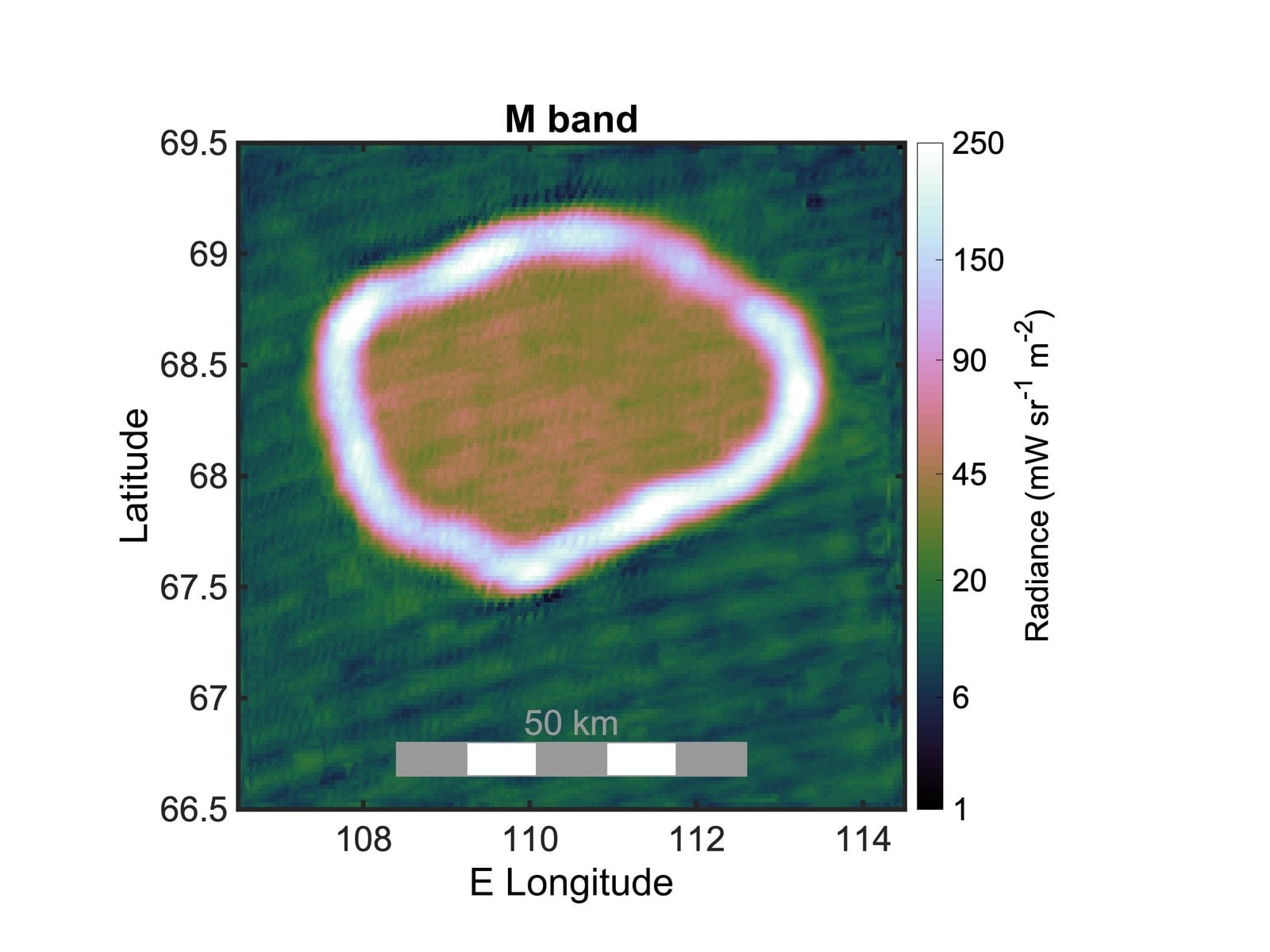
Figure 1 – Multi-band JIRAM composite. Violet tones trace 2 μm reflection, crimson highlights denote >800 K emission zones, and orange overlays indicate 200–400 K crusts previously invisible to M-band-only surveys.
2.1 Instrumental Sensitivity Versus Thermal Regimes
| Instrument | Peak Spectral Band(s) | Optimal Temperature Range Detected | Primary Geological Insights Enabled |
|---|---|---|---|
| Galileo NIMS | 0.7–5.2 μm | 450–1800 K | Eruption temperature bounds; compositional mineralogy of silicates vs sulfur allotropes |
| Juno JIRAM (K-band mode) |
2.0–2.2 μm | 650–2000 K | Hotspot identification; H3+ auroral tracing |
| Juno JIRAM (M-band mode) |
4.6–5.1 μm | 200–1200 K | Bulk lava lake thermometry; infrared albedo of crust |
| JWST NIRSpec | 1–5 μm (high-res) | 500–2000 K | Silicate speciation; temporal eruption tracking every <10 days |
| ALMA Band-6 | 1.3 mm | 30–120 K | SO2 frost distribution; plume fallback deposition |
The elegance of Mura’s methodological advance is less about entirely new hardware than about making fuller use of existing hardware. By integrating the weak but measurable 7–8 μm tail, the authors extended the useful radiance window for lakes that had hitherto seemed “dark” in the mid-IR. Such crusts, although emitting primarily at wavelengths peaking near 13 μm, still contribute a steep Rayleigh-Jeans slope into JIRAM’s bandpass. When aggregated over annular areas up to 20 km in diameter, the power sum becomes spectacular.
3 | Dissecting the Lava Lake Microcosm: Crust–Magma Interplay
Understanding Io’s paterae demands a three-component model: (1) a melt-sustained, convecting interior dominated by ultramafic compositions possibly exceeding 1600 K; (2) a proto-crust undergoing conductive cooling from ~900 K down to ~500 K in a matter of hours; and (3) a semi-rigid surface crust whose upper centimeters fall toward 120–300 K, depending on diurnal insolation and shadowing. The latter two layers, though cooler per unit area, can constitute >90 % of the lake’s physical extent at any given snapshot. Therefore, any infrared survey that saturates at 600 K (Galileo NIMS) or preferentially bins only >500 K signals (ground-based Keck sequences) neglects the elephant in the room: the cold but gargantuan felsic tusk of thermal inertia.
“Our findings imply that the visible ‘lava lakes’ observed by Voyager and Galileo represent no more than the glowing wick on an invisible candle. The bulk of the candle—i.e. the cooler crust overlying a magma reservoir—radiates primarily at wavelengths most previous imagers inadvertently ignored.” (Mura et al., 2026)
3.1 Transient Versus Persistent Lakes: A Taxonomic Clarification
One might reasonably suspect that not every of Io’s ∼400 documented paterae obeys the same thermal constitution. Indeed, analogies to earthly volcanology suggest at least three families:
- Fully Magma-Flooded Caldera-Style Lakes – Exemplified by Loki Patera (the Solar System’s largest active lava lake, ~200 km × 200 km), these systems display periodic brightening interpreted as crustal overturn waves. JIRAM reveals that Loki’s “cold” interior contributes upward of 85 % of the lake’s radiant power.
- Hybrid Magma-Conduit Networks – These include features such as Pele and Tupan Patera, where a central vent sustains a partial lava pond ringed by lava flows frozen into a mosaic of blocky lava. Thermal outputs here are heterogeneous; one quadrant may rival Etna’s output while adjacent regions linger near 180 K.
- Collapse‐Pit and Sill-Fed Paterae – Often smaller (<20 km diameter), these show sporadic effusive flares but no persistent crust. They likely tap shallow sills metastably perched above the intrusive magma ocean. Their cool annuli are thinner, implying minor contributions to global heat flow.
| Patera Name | Diameter (km) | Active Regime | Peak Peripheral T (K) | Median Crustal T (K) | Revised Power Output (GW) | Classical Estimate (GW) |
|---|---|---|---|---|---|---|
| Loki | 240 × 200 | Periodic overturn | 950 | 260 | 600 | ≈60 |
| Pele | 30 | Persistent lava pond | 1050 | 310 | 85 | 15 |
| P63 | 18 | Hybrid | 920 | 235 | 80 | 7–20 |
| Janus Patera | 36 | Intermittent flares | 970 | 190 | 40 | ~5 |
The comparative magnitude of these revisions is nothing short of staggering. Loki’s new 600 GW figure alone surpasses the entire geothermal output of Earth by ~35 %. And yet Loki is but one of several hundred known hotbeds. Even if the power law scaling tapers off for smaller paterae, a conservative integration suggests a planet-level heat flow well above 8 × 10¹⁴ W—finally commensurate with theoretical dissipation estimates.
4 | Implications for Tidal Dissipation and Orbital Evolution
An upward revision in Io’s heat flux reverberates through multiple coupled systems:
- Orbital Resonance Stability – The outward migration rate of Io’s orbit, governed by energy transfer from Jupiter’s rotation via tidal bulging, depends on how much energy is ultimately radiated. A higher heat output quickens angular-momentum transfer, marginally altering Laplace resonance phasing with Europa and Ganymede over geological times.
- Interior Stratification – The partitioning of dissipation between mantle and asthenosphere controls whether a global magma ocean can remain gravitationally stable or whether density inversions trigger cumulate overturn. Revised power favors a vigorously molten asthenosphere at 20-100 km depth, compatible with magnetometer-inferred induction layers.
- Magnetospheric Loading – Io supplies ≥1 ton s⁻¹ of material to the Io Plasma Torus. Enhanced heat implies more vigorous venting of NaCl, SO, and O2, which in turn modulates Jovian auroral intensities.
4.1 Modeling Energy Partitioning: Lessons from Numerical Simulations
Finite-element viscoelastic codes treat Io as a layered sphere subjected to periodic gravitational potential fields. Such models reproduce observed surface topography (peak∼11 km scarps) only if rheological parameters include a hot, low-viscosity zone capable of dissipating 1–3 × 10¹⁴ W. The JIRAM-informed revision relaxes parameter degeneracy dramatically, anchoring best-fit solutions near viscosity values of 1014 Pa s in the upper mantle—strikingly similar to terrestrial asthenosphere ranges. Therefore, the new dataset crystallizes a convergence between observation and modeling that had previously been plagued by thousand-fold ambiguities.
5 | Temporal Dynamics: Crustal Resurfacing Rates Revisited
A tantalizing derivative of multiband radiometry is the ability to infer cooling ages. If one adopts a canonical basaltic conduction model (Fourier solution for semi-infinite half-space), surface temperature T obeys
T(t) = T0 − 2(T0 − T∞) erf(d/2√(κt)),
where T0 is initial eruption temperature (~1450 K for komatiitic basalt), T∞ ≈ 90 K is background surface equilibrium under eclipse, d is crustal thickness (~0.3 m for a nightly freeze), and κ ≈ 10⁻⁶ m² s⁻¹. Inverting this yields ages of ~13 years for crustal plates measured by JIRAM at 200 K, in pleasing agreement with Mura’s decade-scale overturn periodicity.
| Measured Surface T (K) | Inferred Cooling Age (years) | Dominant Physical State | Anticipated Mechanical Behavior |
|---|---|---|---|
| 600 | 0.02 | Plastic melt skin | Wrinkle instabilities; bubble degassing |
| 400 | 0.3 | Vesicular basalt crust | Rift crack nucleation; laminar convection below |
| 300 | 1.9 | Porous, partially lithified | Plate rafting; large-scale foundering potential |
| 200 | 13.2 | Brittle basalt plate | Subduction into magma; overturn wave trigger |
| 120 | 49.7 | Thermally dead, dust-mantled | Passive transport on lava currents; mechanical breakup |
Why, then, do we fail to witness large-scale morphological evolution over decadal baselines in Voyager-to-Juno imagery? One leading hypothesis posits a self-similar overturn geometry. Raft plates, once submerged, may be immediately replaced by adjacently fractured plates, preserving gross outlines even while microscopic textures churn. Alternatively, resurfacing may preferentially propagate inward from edges, reshaping interiors while frontier boundaries remain pinned against caldera walls.
6 | Observational Challenges: Dynamic Range, Saturation, and Resolution
Transformative as JIRAM’s results are, the instrument still confronts several handicaps: saturated pixels at >1200 K, constrained temporal coverage enforced by Juno’s 53-day orbit, and modest spatial resolution compared with Galileo’s 1990s nadir. Consequently, finer-scale crustal heterogeneities remain unmapped, which could bias global integrations upward or downward.
| Error Source | Magnitude Estimate | Effect on Heat-Flux Budget | Mitigation Approach |
|---|---|---|---|
| Pixel Saturation | Up to 25 % loss of hottest annulus radiance | Underestimation of high-T rims | Sub-frame exposure bracketing; synthetic unsaturated reconstruction |
| Spatial Smearing | 3–8 km at 45° emission angle | Smoothing of small hotspots; blending of cool/hot | Deconvolution techniques; forward modeling PSF |
| Emissivity Uncertainty | ±0.05 in ε for basalt vs sulfur | ±7 % power error | Lab measurements at Io-relevant p & T; JWST spectroscopy to map compositions |
| Projection Geometry | Latitudinal parallax at poles | Area misestimation >10 % | Bundle adjustment with SPICE kernels; polar fly-bys |
| Temporal Alias | 53-day revisit | Missed flash eruptions; stochastic undersampling | Ground-based queue scheduling; Flagship orbiter mission |
7 | Comparative Planetology: What Io Teaches Us About Other Worlds
The intellectual dividends of deciphering Io’s heat engine extend beyond the Jovian system.
- Earth’s Archean Past – Silicate eruption temperatures on Io (1 600–1 800 K) mirror hypothesized komatiitic lavas on early Earth. Studying Io’s crustal overturn cycles therefore offers an observable proxy for archaean tectonics.
- Extrasolar Super-Io Exoplanets – Short-period rocky exoplanets at 1–2-day orbits around M-dwarfs can experience tidal fluxes surpassing Io’s by an order of magnitude. Radically revised scaling relations for heat flow calibrate models predicting their volcanic albedo variability—key data for next-generation direct imaging missions.
- Ice-Covered Ocean Worlds – Although Europa and Enceladus dissipate tidal energy largely as frictional heat in ice, the thermal balance lessons from Io inform how invisible colder layers (<120 K) may dominate energy budgets—critical for assessing subsurface ocean sustainment.

Figure 2 – Concept art highlighting Io’s volcanic activity juxtaposed with Europa’s icy calm, illustrating divergent tidal dissipation regimes.
8 | Future Prospects: Missions and Instrument Concepts
Addressing the residual uncertainties in Io’s heat budget, crustal mechanics, and plume chemistry will require targeted missions. Current contenders include ESA’s JUICE (although its trajectory gives limited Io coverage) and proposals for a dedicated Io Volcanic Observer (IVO) in NASA’s Discovery program. Equally crucial is building complementary ground-based infrared networks to provide high-cadence monitoring between spacecraft snapshots.
| Instrument | Key Specs | Primary Science Return |
|---|---|---|
| Hyperspectral Thermal Mapper (HyTM) | 5–25 μm, 50 m px⁻¹ | Resolve full crustal temperature gradient; mineral spectroscopy of lava |
| High-Energy Neutron Spectrometer | 0.4-10 MeV neutrons | Magma H2O trace; irradiation effects of Jovian magnetosphere |
| LiDAR Topographer | 30 cm vertical accuracy | Detect collapse pits; model crust thickness evolution per orbit |
| Sub-mm SO2 Radiometer | 200–400 GHz | Quantify plume mass flux; correlate with thermal events |
| Dual-Frequency Radar Sounder | 5 MHz & 50 MHz | Probe melt lens depth; constrain global magma ocean continuity |
9 | Broader Scientific and Philosophical Resonances
Beyond the technical nitty-gritty, the revelation that a moon barely larger than Earth’s own can outshine our planet’s geothermal furnace by an order of magnitude underscores an oft-forgotten truth: size is not destiny. Energy budgets in the cosmos are sculpted by interplay—between tidal resonances, orbital eccentricities, and material rheologies—which can conspire to make an ostensibly minor world the most energetic. That recognition reverberates across disciplines, inviting geologists, atmospheric chemists, and astrobiologists alike to revisit assumptions about what kinds of worlds can host dynamic or even potentially habitable environments.
“If there is a single moral to be extracted from Io’s thermal excess, it is that equilibrium is scarce in a gravity-bound Universe. Where forces oscillate, energy accumulates, and in that accumulation lies the crucible of geological novelty.”

Figure 3 – Numerical simulation of a crustal overturn wave sweeping across Loki Patera, highlighting thermal fronts (white) and cooler trailing crust (blue).
10 | Conclusions
JIRAM’s multiband scrutiny has upended a 40-year thermal orthodoxy, revealing that Io radiates not merely from flamboyant fire-fountains but from vast, faintly glowing crustal seas whose aggregate power likely exceeds previous estimates by a factor of ten. This amendment reconciles long-standing discrepancies between observational and theoretical energy budgets, strengthens dynamical models of the Jovian resonance chain, and injects fresh vigor into mission planning. Perhaps most importantly, it offers a cautionary tale: planetary systems are seldom transparent about where they stash their energy, and only by expanding observational bandpasses—both literal and conceptual—do we perceive the missing lumens.
For More Information
The reader is encouraged to consult the following resources for deeper engagement with the topics discussed:
- Lava Lakes on Io: Crust Age and Implications for Thermal Output – Mura et al. (2026) [Pre-print].
- The JWST Puts Io’s Volcanic Nature in the Spotlight – Universe Today feature article.
- Tidal Dissipation in Io and the Jovian System – Peale et al., Nature, 2002.
- Gazetteer of Io Nomenclature – USGS Astrogeology Center.
- NASA Solar System Exploration – Io Overview.
- Io After Galileo: A New View of Jupiter’s Volcanic Moon – LPI Digital Book (free PDF).