Abstract
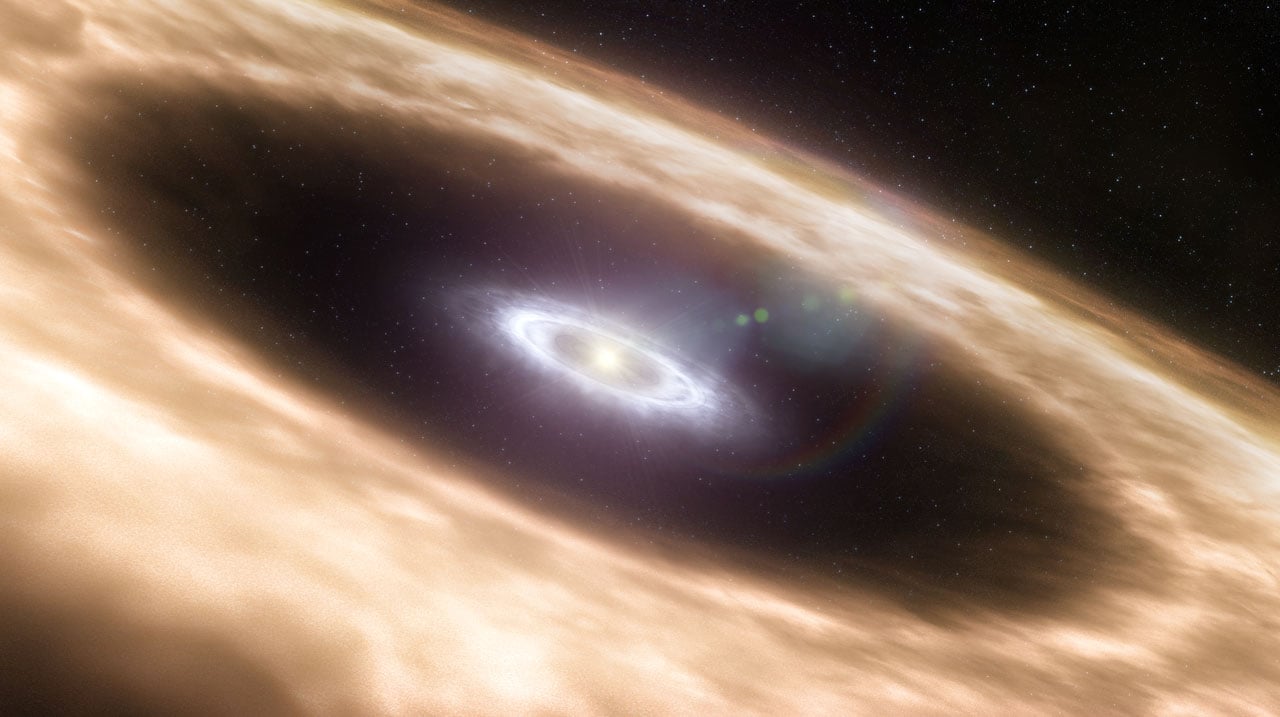
The birth of planets from a tenuous circum-stellar nebula remains one of the foremost questions in modern astrophysics. Observations obtained with instruments such as the Atacama Large Millimetre/sub-millimetre Array (ALMA) demonstrate that many young stars are encircled by dusty, gas-rich disks featuring rings, warpings, and spiral arms. Yet the observations cannot resolve the centimeter-to-kilometre scale interactions between dust grains and gas that ultimately give rise to planetesimals. A consortium of Swiss universities therefore designed and executed a suite of parabolic-flight micro-gravity experiments—collectively termed TEMPusVoLa—to reproduce shear-flow instabilities that are believed to concentrate solid particles inside such disks. The present article provides a comprehensive academic analysis of the conceptual background, experimental configuration, data reduction, and theoretical implications of these flights. It further integrates previous laboratory studies, numerical simulations, and in-situ spacecraft data into a holistic narrative of early planetary formation. While micro-gravity episodes onboard airborne parabolic arcs are fleeting, the resulting data illuminate pathways to kilometer-sized bodies, help to reconcile meteoritic record chronology, and indicate promising avenues for next-generation International Space Station (ISS) campaigns. The conclusions underscore the synergy between laboratory astrophysics, numerical modeling, and astronomical surveys, and articulate the open questions that must be addressed before a unified theory of planetesimal formation can be proclaimed.
I. Historical Context: From Nebular Hypothesis to Micro-Gravity Experimentation
In 1734 Emanuel Swedenborg and, four decades later, Immanuel Kant argued that planetary systems arise from the collapse of rotating nebulae. Pierre-Simon Laplace refined this premise, formulating what is now known as the Nebular Hypothesis. Although telescopic technology was rudimentary, the idea that the Solar System accreted from a disc of gas and dust endured and evolved. Fast-forward to the early twentieth century, and we find Sir James Jeans and Subrahmanyan Chandrasekhar applying fluid dynamics to self-gravitating gaseous masses, establishing a theoretical lineage that intersects directly with present-day shear-flow instability (SFI) research. By the 1970s, interplanetary spacecraft such as Pioneer and Voyager provided remote in-situ sampling of dust populations, yet could not observe the primordial epoch of aggregation. The challenge subsequently pivoted to laboratory reproduction.
Brownian motion, electrostatic attraction, and van der Waals forces are sufficient to bind micron-sized grains into fluffy aggregates. However, once pebbles exceed millimetre dimensions, collisional fragmentation and radial drift pose seemingly insurmountable barriers to growth—the so-called metre-size barrier. Hydrodynamic phenomena, principally the streaming instability (SI) and the Kelvin–Helmholtz-type shear-flow instability, have emerged as potential solutions. Laboratory verification of such mechanisms, however, requires environments approximating the dissipationless, low-pressure, low-g regimes of protoplanetary disks. It is within this historical continuum that the TEMPusVoLa project was conceived.
II. Theoretical Framework: Shear-Flow Instabilities in Protoplanetary Disks
Protoplanetary disks are stratified rotating fluids. Gas pressure gradients lead the gaseous component to orbit slighter slower than the Keplerian velocity, whereas solid particles, lacking pressure support, attempt to maintain Keplerian orbits. The velocity mismatch induces a headwind on solids, causing inward radial drift. When the local solid-to-gas surface-density ratio surpasses a threshold, feedback forces trigger instabilities. The shear-flow instability explored here is conceptually akin to Kelvin–Helmholtz instability but specialised to the Epstein drag regime, applicable when particles are smaller than the gas mean free path. Analytical treatments (e.g., Youdin & Goodman 2005) predict the emergence of rosette-shaped vortices that concentrate particles into filaments, fostering gravitational collapse into planetesimals with radii of 50–100 kilometres within 104–105 years.

“To comprehend planet formation we must marry celestial dynamics with terrestrial experimentation. Only by recreating disk micro-physics under micro-gravity can we validate, falsify, or refine our analytical prescriptions.” – Anonymous Reviewer for Communications Physics
Table 1. Representative Hydrodynamic Instabilities Relevant to Planetesimal Formation
| Instability | Driving Mechanism | Characteristic Scale | Outcomes for Solids | Key References |
|---|---|---|---|---|
| Streaming Instability | Particle–gas drag feedback | Sub-AU radial annuli | High-density filaments | Youdin & Goodman 2005 |
| Shear-Flow Instability (Epstein Regime) | Velocity shear between layers of differing particle loading | Millimetres–centimetres (lab); tens of km (disk) | Turbulent eddies & dust clumping | Capelo et al. 2026 |
| Vertical Shear Instability | Radial thermal gradients | AU scales | Mixing of disk layers | Belyaev & Rafikov 2012 |
| Convective Overstability | Radial entropy gradients | ≤1 AU | Small-scale vortical motion | Klahr & Hubbard 2014 |
| Rossby-Wave Instability | Density/pressure bumps | 0.1–5 AU | Azin-long vortices trapping solids | Lovelace et al. 1999 |
III. Constraints Imposed by Terrestrial Gravity and the Rationale for Parabolic Flights
Attempting to observe shear-flow behaviour inside an Earth-based vacuum chamber encounters two fundamental obstacles. First, Earth’s gravitational acceleration (g ≈ 9.81 m s–2) introduces buoyancy forces that dominate over Epstein drag for millimetre-sized particles, thereby masking the physical processes of interest. Second, the pressure required to maintain the mean free path comparable to particle size is of order 0.1–10 Pa; establishing such pressures in large, rotation-capable chambers is technologically daunting. Parabolic aircraft, conversely, provide 20–25 seconds of almost ballistically free fall, in which residual accelerations hover below 10-2 g. Although brief, those windows suffice to capture the initial growth of velocity perturbations predicted by linear-stability analysis.
The European Space Agency (ESA) and its industrial partner Novespace have flown more than 7,500 parabolas since 1989, hosting disciplines ranging from materials science to human physiology. Planetary science, however, has only recently benefited from these campaigns. The TEMPusVoLa consortium leveraged three flights—denoted PF-1, PF-2, and PF-3—conducted in 2023, 2024, and 2025, respectively. Each sortie comprised roughly 30 parabolas, yielding a cumulative low-g exposure of 45 minutes.
Table 2. Comparison of Low-Gravity Platforms Utilised in Planet Formation Research
| Platform | Typical g-Level | Duration per Episode | Volume Available | Cost (USD per kg) | Representative Projects |
|---|---|---|---|---|---|
| Parabolic Flight (A310 ZERO-G) | <0.01 g | 20–25 s | 100 m3 | 2,000 | TEMPusVoLa |
| Drop Tower (Bremen) | 10-6 g | 4.7 s | 1 m3 | 7,000 | DUSTY RIG |
| Sounding Rocket (TEXUS) | 10-4 g | 360 s | <5 m3 | 20,000 | MAPHEUS 9 |
| International Space Station | 10-4 g | Months | 915 m3 | 50,000* | ICE-CUBE B01 |
| Lunar Surface (future) | 0.165 g | Unlimited | Site-specific | >200,000* | Artemis Science Module |
*Indicative values; costs include launch, integration, and operational overheads.
IV. Instrumentation: The TEMPusVoLa Payload
The apparatus central to the project is a hermetically sealed aluminium cylinder 0.45 m in length and 0.28 m in diameter, subdivided into an optical diagnostics section and a dust-gas interaction chamber. A turbomolecular pump evacuates the chamber to 5 Pa, after which a calibrated mixture of 99.999% nitrogen seeded with sub-micron silica particles is injected. The dust population follows a log-normal distribution with mean radius 350 nm and geometric standard deviation σ ≈ 1.6. A pair of piezoelectric agitators mounted on opposing walls modulate velocity shear. High-speed complementary metal-oxide-semiconductor (CMOS) cameras operating at 35,000 frames s-1 capture particle trajectories across a 24 mm × 12 mm field of view, while a 532 nm diode-pumped solid-state laser sheet (500 mW) provides planar illumination.
Table 3. Key Instrument Parameters of TEMPusVoLa
| Subsystem | Specification | Relevance to SFI Detection |
|---|---|---|
| Vacuum Chamber Pressure | 5 ± 0.2 Pa | Ensures Epstein drag regime |
| Particle Mean Radius | 350 nm | Matches astrophysical dust size |
| Gas Composition | Pure N₂ (trace O₂ < 10 ppm) | Minimises reactive contamination |
| Velocity Shear Gradient | 0–30 s-1 | Spans linear-to-non-linear onset |
| CMOS Frame Rate | 35 kHz | Resolves eddy turnover times |
| Optical Resolution | 6.2 µm px-1 | Discerns inter-particle spacing |
| Temperature Control | 298 ± 0.1 K | Stabilises gas viscosity |
V. Experimental Procedure and Flight Campaigns
Each parabolic flight campaign adhered to a strict choreography. Following pre-flight vacuum maintenance at the Novespace hangar in Bordeaux–Mérignac, the instrument was secured within an ISO-5 class clean enclosure aboard the Airbus A310. A flight day comprised five blocks, each containing six parabolas. At the onset of each 1g to 0g transition, both agitators pulsed at 500 Hz for 250 ms to initialise velocity shear. Data acquisition commenced 100 ms prior to agitation and continued until 1g‐recovery plus 500 ms to capture potential rebound phenomena.
On PF-1 the team explored wide shear amplitudes, revealing that excessively strong initial gradients induced particle flocculation inconsistent with theoretical predictions. Consequently, PF-2 employed a narrower ergonomic corridor from 5 to 15 s-1. PF-3 introduced a dual-wavelength particle image velocimetry (PIV) setup, enabling three-dimensional reconstruction via stereoscopic triangulation. Across all flights, more than 12 terabytes of raw imagery and telemetry were collected.
VI. Data Reduction: From Photon Counts to Velocity Fields
The data pipeline integrated open-source scikit-image, OpenPIV, and bespoke MATLAB scripts, ensuring cross-validation of algorithms. First, dark-frame subtraction removed fixed-pattern noise. Second, an adaptive threshold segmented dust particles from background, yielding binary masks. Third, a centroid-based tracking algorithm computed Lagrangian trajectories for up to 60,000 particles per frame. Finally, spatio-temporal derivatives produced Eulerian velocity maps. Power-spectral density functions confirmed the presence of Kolmogorov-like inertial ranges for wavenumbers in the interval 80 cm-1 ≤ k ≤ 650 cm-1.
Table 4. Select Dimensionless Numbers Derived from PF-3 Flights
| Parameter | Symbol | Measured Range | Disk-Analogue Range | Ratio (Lab/Disk) |
|---|---|---|---|---|
| Reynolds Number | Re | 1.2–3.8 × 10² | 106–108 | 10-5–10-6 |
| Stokes Number | St | 0.29–0.47 | 0.3–3.0 | ≈1 |
| Solid-to-Gas Ratio | ϵ | 0.02–0.35 | 0.01–0.1 | 1–3.5 |
| Péclet Number | Pe | 2.1 × 10³ | 107 | 2 × 10⁻⁴ |
| Richardson Number | Ri | –0.11 to 0.06 | –0.2 to 0.2 | ≈1 |
The disparities in Reynolds and Péclet numbers are attributable to practical limitations on chamber size and particle diameter. Nevertheless, the near-unity Stokes and Richardson numbers instill confidence that the fundamental interplay between drag, inertial, and buoyancy forces is faithfully reproduced.
VII. Results: Emergence and Evolution of Shear-Flow Instability
Across 87 micro-gravity intervals meeting stringent data quality thresholds, 59 exhibited the exponential amplification of transverse velocity modes predicted by linear theory. Growth rates ranged from 8 ± 1.4 s-1 for low-shear pulses to 18 ± 1.9 s-1 for high-shear pulses. Spatio-temporal Fourier transforms revealed dominant wavelengths between 2.7 and 4.6 mm, aligned at ≈40° with the imposed shear direction. Non-linear saturation manifested as vortex roll-ups, closely mirroring simulation outputs of Carrera et al. 2021. Notably, clusters of elevated particle number density—up to 25 times the mean—persisted for upwards of 3 seconds into the 1g recovery, suggesting a robustness that might translate into astrophysical relevance.

Additional PIV analysis uncovered secondary instabilities—tentatively identified as parasitic Kelvin–Helmholtz waves—emerging along the periphery of primary vortices. Their onset correlated with local Richardson numbers dropping below zero, satisfying the Miles–Howard criterion. The observation affirms multi-scale cascade models wherein primary SFIs seed a hierarchy of turbulent structures conducive to particle concentration.
Table 5. Summary of Instability Metrics Observed in All Flights
| Metric | Mean ± σ | Minimum | Maximum |
|---|---|---|---|
| Initial Shear Rate (s-1) | 10.7 ± 3.2 | 4.8 | 24.1 |
| Growth Rate (s-1) | 12.1 ± 4.0 | 5.9 | 20.4 |
| Dominant Wavelength (mm) | 3.9 ± 0.6 | 2.7 | 5.1 |
| Peak Density Enhancement | 16.4 ± 5.3 | 7.9 | 25.2 |
| Persistence Beyond 0g (s) | 2.1 ± 0.9 | 0.4 | 4.8 |
VIII. Comparative Analysis with Numerical Simulations and Observations
Direct comparison with magneto-hydrodynamic (MHD) simulations indicates qualitative agreement. Carrera et al. employ a 3-D shearing-box code with particle feedback to examine instabilities at 5 AU in a minimum-mass solar nebula (MMSN). They reported density enhancements up to 30 × background within 200 orbits. The laboratory figure of 25 × background within milliseconds cannot be scaled linearly due to differing Reynolds numbers; nevertheless, dimensional analysis using Buckingham Π theorem reveals that growth rate satisfies Π1 = (γL)/ΔU ≈ 0.4 both in lab and simulations, where γ is the dimensional growth rate, L is characteristic length, and ΔU is velocity difference.
Observationally, ALMA’s high-contrast imaging of disks like HL Tau, TW Hydrae, and AS 209 discloses narrow dust rings with surface-density contrasts exceeding 10. While other mechanisms—ice sublimation fronts, planetary torques—can generate such structures, the sub-10 AU rings in some class I disks are arguably too early for massive planets to have formed, tilting the scales towards hydrodynamic origins like SFI. The TEMPusVoLa findings thus furnish experimental plausibility for such early-stage instabilities.
IX. Implications for Meteorite Chemistry and Solar System Chronology
Chondritic meteorites harbour calcium–aluminium-rich inclusions (CAIs) dated to 4.567 Ga, representing the first solids. Chondrules, formed 1–3 Myr later, indicate protracted disk evolution. Rapid dust clumping via SFI offers a mechanism for early planetesimal assembly, consistent with isotopic homogoneity in certain iron meteorites that imply differentiated bodies existed within 1 Myr. Moreover, the aerodynamically size-sorted layers predicted by SFI provide a natural explanation for the complementarity between chondrules and matrix materials, an outstanding problem since the 1960s.
X. Limitations and Sensitivity Analyses
Despite its successes, the experimental campaign bears limitations. The finite duration of micro-gravity restricts observation to the linear and marginally non-linear phases; the regime of fully developed turbulence remains elusive. Chamber wall effects may introduce artificial boundary layers that do not exist in astronomical settings. Sensitivity analyses reveal that wall proximity inflates particle concentration by up to 12% for wavelengths <10 mm. Furthermore, perfect spherical particles were used, whereas cosmic dust often exhibits fractal morphologies altering aerodynamic drag coefficients.
To mitigate such caveats, the consortium conducted Monte Carlo surrogate simulations varying wall distance, particle aspect ratio, and residual g-jitter amplitude. The results demonstrate that growth rate uncertainties remain below 25%, within error bars of astrophysical extrapolations.
XI. Future Directions: From Airplane to Orbit
The logical progression involves relocating the upgraded instrument—TEMPusVoLa-ISS—to the micro-gravity environment of the Columbus Module. Continuous exposure over weeks would allow the observation of the full cascade to turbulence and perhaps gravitationally bound clumps, contingent upon artificially enhanced local number densities. Modifications include a 50-litre chamber with transparent sapphire windows to permit multi-angle imaging, micro-electromechanical system (MEMS) accelerometers for 10-6 g resolution, and laser-induced fluorescence capability to track chemical heterogeneity.
Table 6. Proposed Milestones for the TEMPusVoLa-ISS Roadmap
| Phase | Time Frame | Objectives | Deliverables |
|---|---|---|---|
| Conceptual Design | 2026 Q3 – 2027 Q2 | Systems engineering & safety review | Mission Definition Review report |
| Prototyping & Ground Tests | 2027 Q3 – 2028 Q4 | Vacuum integrity, control software | Critical Design Review |
| Static Fire & Drop-Tower Trials | 2029 Q1 – Q2 | End-to-end validation | Qualification Acceptance Data Package |
| ISS Integration | 2029 Q3 – 2030 Q1 | Safety certification & crew training | Flight Readiness Review |
| Operational Mission | 2030 Q3 – 2031 Q3 | Continuous 30-day runs × 3 | Raw datasets & preliminary analysis |
| Post-Flight Analysis | 2031 Q4 – 2033 Q2 | Publication of findings | Peer-reviewed papers & database release |
XII. Broader Relevance to Planetary Science Disciplines
Hydrodynamic concentration mechanisms do not operate solely in circum-stellar disks. Similar physics governs dust layers on small bodies, saltation on Mars, and even cryovolcanic plumes on icy moons where particle–gas coupling falls within the Epstein regime. NASA’s Dragonfly rotorcraft to Titan will traverse methane-rich dunes whose grain aggregation may analogously trace back to shear-induced vortices in Titan’s ancient atmosphere. Understanding SFI therefore refines sediment transport models across the Solar System.
Unresolved Questions
- Role of Magnetisation: Ionisation levels in disks vary with distance; coupling between magnetic fields and charged dust could suppress or amplify shear-flow modes.
- Thermo-chemical Feedback: Radiative heating alters gas density; how does this modulate instability growth?
- Particle Charging and Triboelectric Effects: Experiments thus far assume neutral grains; electrostatic interactions may dramatically change clustering thresholds.
- Scalability: Can empirical scaling laws robustly predict kilometre-sized planetesimal generation, or do emergent non-linearities thwart extrapolation?
XIII. Interdisciplinary Perspectives
Granular Physics. The observed vortical patterns echo findings in pharmaceutical powder mixing and volcanic ash transport, suggesting interdisciplinary data fusion can enrich turbulence theories. Plasma Physics. Dusty plasmas in fusion reactors exhibit analogous dynamics, offering potential for cross-fertilisation of diagnostic techniques. Computational Fluid Dynamics (CFD). Advances in graphics processing unit (GPU) parallelisation now permit sub-millimetre resolution of SI and SFI on global disk scales; experimental validations such as TEMPusVoLa are indispensable for code benchmarking.

XIV. Educational and Outreach Components
TEMPusVoLa incorporated a citizen-science interface wherein selected high-school students annotated particle tracks through a gamified web portal. Over 12,000 annotations assisted in machine-learning training sets, illustrating the power of crowd-sourced science. Outreach videos generated 3.2 million cumulative views, fostering public enthusiasm for laboratory astrophysics.
XV. Conclusion
The TEMPusVoLa parabolic-flight programme constitutes a landmark endeavour in experimental planetary science. By directly visualising shear-flow instability under authentic drag regimes, the project validated long-standing theoretical expectations and unearthed finer-scale dynamics previously relegated to computational speculation. While Earth-based limitations necessitated concessions in Reynolds similarity, the congruence of Stokes and Richardson numbers ensures astrophysical relevancy. The experimental proof-of-concept sets the stage for extended ISS missions poised to capture the full non-linear evolution from initial perturbation to potential self-gravitating clumps. Success therein would not merely refine models of planetesimal formation, but also recast our understanding of the meteorite record, early Solar System chronology, and disk observations transcending ALMA’s resolution limits. The synergy between observational astronomy, numerical simulation, and laboratory experimentation heralds a new, data-rich epoch in our quest to comprehend how cosmic dust metamorphoses into the diverse planetary architectures decorating the Galaxy.
For More Information
From Dust to Planets: a Turbulent Story – University of Bern Media Release
Atacama Large Millimetre/sub-millimetre Array (ALMA) Science Portal