When the James Webb Space Telescope (JWST) commenced its scientific observations in July 2022, it opened an unprecedented window into the cosmos, allowing astronomers to peer deeper into the universe’s history than ever before. Among its astonishing discoveries are the enigmatic Little Red Dots (LRDs), which are faint celestial objects identified as existing a mere 600 million years post-Big Bang. This finding has prompted intense discussions within the scientific community regarding their true nature.
Initial analyses suggested that these LRDs might be galaxies due to their significant luminosity, which indicated they harbor immense stellar masses. However, this hypothesis quickly became controversial due to the sheer number of LRDs observed during such formative years of the universe. This abundance poses a challenge to existing theories about the formation and evolution of cosmic structures, necessitating a re-examination of our understanding of the early universe.

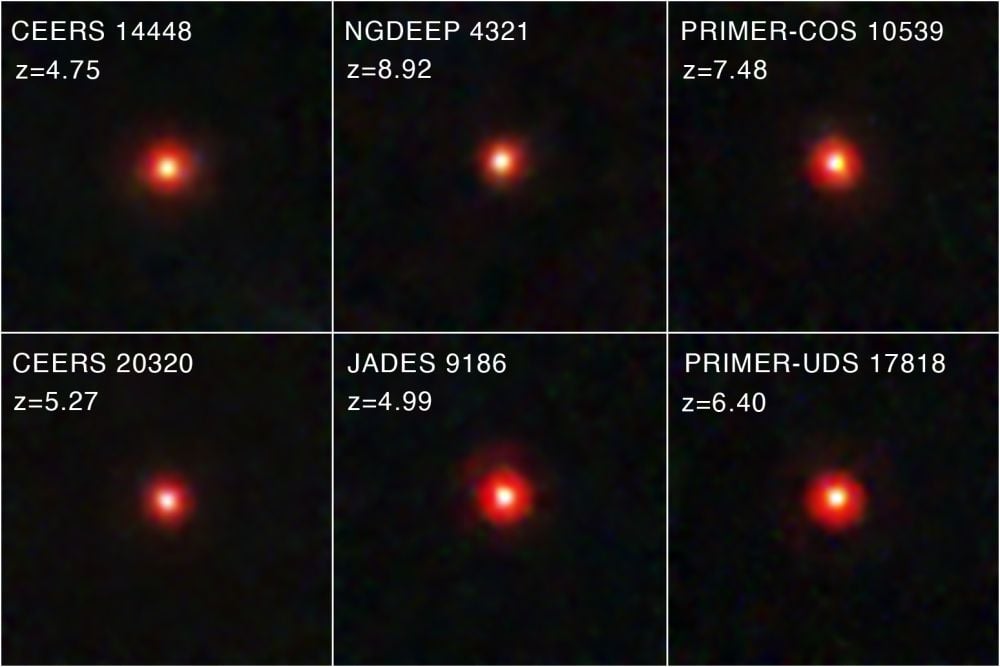
LRDs are faint and challenging to observe, as this RGB image created from the JWST image filter data shows. Image Credit: Killi et al. 2024. A&A
The prevailing discourse includes a radical hypothesis that they are not galaxies at all but rather a fundamentally different type of astronomical entity known as Supermassive Stars (SMS). These hypothetical stars, having an estimated mass around \(10^6\) solar masses, could represent crucial intermediate stages leading to the formation of supermassive black hole (SMBH) seeds. Such black holes are later responsible for powering early quasars observed in the nascent universe.
Understanding the Little Red Dots
The initial consensus surrounding the LRDs has been challenged by various studies, with researchers suggesting that the characteristics observed align more closely with that of SMS rather than conventional galaxies. This contention arises due to several distinct features seen in the LRDs:
- Brightness and Spectral Characteristics: Preliminary studies indicated that LRDs exhibited an unexpected brightness, suggesting an energy output not conducive to standard galaxies.
- Absence of Detectable X-rays: Unlike typical Active Galactic Nuclei (AGN), which are known for their X-ray emissions, LRDs display no such activity.
- Flat Infrared Spectrum: LRDs manifest a flat spectrum in the infrared range, contrasting sharply with known AGNs.
- Low Variability: Over the duration of observations, LRDs have shown little variability in brightness, a characteristic more aligned with the nature of large stars rather than galaxies.
The Hypothesis of Supermassive Stars
Within the context of this hypothesis, SMS are theorized to exist predominantly during the universe's formative epochs, forming under conditions that favored the assemblage of massive bodies devoid of metal content, often referred to as Population III stars. Such stars are believed to have played pivotal roles in early cosmic events, including:
- The rapid assembly of the universe's first SMBH seeds.
- The generation of early explosions as core-collapse supernovae, which could result in black holes.
- The establishment of the mechanisms required for black hole growth and subsequent galactic evolution.
The significance of this theory cannot be overstated, as it potentially restructures our comprehension of black hole emergence in the universe. Initial data indicates that LRDs may embody direct emissions from burning SMS, caught in a crucial phase right before their collapse. The fleeting nature of these stars could elucidate the rarity of LRDs and signify their momentous role in cosmic evolution.
The research titled "Supermassive Stars Match the Spectral Signatures of JWST's Little Red Dots" authored by Devesh Nandal and Abraham Loeb, delves deeper into the spectral characteristics of LRDs and evaluates the plausibility of the SMS model. Their findings are significant enough to inspire further inquiry into the cosmic origins of these fascinating entities.

This figure from previous research shows the infrared spectra from LRD's (red) with the spectrum from a well-studied AGN named Mrk231. While the AGN spectrum is expected to show a steeply rising shape at longer wavelengths, the LRD's is flat. Image Credit: Williams et al. 2024. ApJ
Research Findings and Implications
The findings of Nandal and Loeb underscore the need for a re-evaluation of stellar evolution in the early universe. They developed detailed atmospheric models for SMS with an estimated mass of \(10^6\) solar masses, devoid of metals. Their model focused on reproducing observed characteristics aligned with LRDs, which include:
| Property | Observation | Model Prediction |
|---|---|---|
| Mass | ~\(10^6\) solar masses | ~\(10^6\) solar masses |
| Luminosity | High luminosity signatures | Matches LRD luminosity |
| Spectrum | Simultaneous presence of Hβ emissions | Reproduces observed spectral features |
The most compelling aspect of their research is the ability to predict both the luminosity and the spectral signatures of LRDs, validating the hypothesis that SMS could serve as the foundational backbone for early black hole formation. The observational characteristics, including the strong and broad Hβ emission line typically seen in LRDs, align with the simulations produced by the researchers.

This figure from the research shows the spectrum for MoM-BH-1, one of the JWST's Little Red Dots (black), and the spectra from the simulated supermassive star (red). A vertical green dashed line and red dotted line overlap, indicating agreement for the prominent H beta emission from the LRD. Image Credit: Nandal and Loeb 2025.*
The study eloquently postulates that SMS with significant mass can reproduce LRD spectral characteristics, establishing them as viable candidates for solutions regarding the origins of SMBH in the context of early cosmic development. As the authors assert, their model offers a coherent and self-consistent basis for understanding LRDs compared to alternative hypotheses which require more elaborate mechanisms that multiply variables without simultaneous emissions from a common source.
Challenges and Future Directions
Despite the promising advancements represented in their study, Nandal and Loeb acknowledge that further validation is paramount for corroborating these findings. Future investigations should endeavor to explore alternative pathways for the formation of various SMS mass groups, possibly predicting unique spectral features expected in LRDs. These investigations are essential for strengthening the hypothesis of SMS being direct progenitors of SMBH.
Challenges abound as researchers strive to confirm the nature of LRDs amid the complexities of early cosmic visibility constraints, where observational instruments must be operated at the margins of technological advancement. The JWST has indeed thrust the astronomical community into a new epoch of discovery, yet the remaining uncertainties call for relentless inquiry and artistic precision in research.
Conclusion
If indeed the Little Red Dots are not galaxies but instead represent the progenitors of today's supermassive black holes, this realization would have profound implications for our understanding of cosmic structure formation. As our observations and models continue to evolve, the LRDs stand at the forefront of astronomical research, captivating scientists with their mystery and potential.
While this research offers a striking affirmation of the SMS hypothesis, confirming such a theory is challenging. The quest to validate these concepts will further enrich our understanding of black hole formation and the broader cosmic narrative. With more advanced observational equipment and computational techniques on the horizon, succeeding generations of astronomers will witness unprecedented insights into these cosmic conundrums.