Understanding the intricate relationship between stellar magnetic activity, high-energy radiation, and planetary habitability is one of the foremost challenges in contemporary astrophysics. Recent observations with NASA’s Chandra X-ray Observatory and archival data sets from historic missions such as ROSAT and EUVE now provide unprecedented leverage on the early life of solar-mass stars. By tracing their X-ray luminosity (LX) and spectral hardness from a few million to several hundred million years, astronomers are beginning to reconstruct the radiation history that bathed primordial planetary atmospheres.
The evidence emerging from eight benchmark open clusters—spanning 45 Myr to 750 Myr in age—reveals that young Sun-like stars dim in X-rays far more rapidly than previously modeled. The coronal temperatures of these stars cool, the differential emission measure softens, and the incidence of mega-flares declines by orders of magnitude, collectively pointing to an accelerating drop-off in surface magnetic dynamo efficiency. The implications ripple outward from stellar interiors to exoplanetary ionospheres, setting new boundary conditions for atmospheric escape, photochemistry, and the formation of putative biosignatures.
1. Motivation and Scientific Context
For nearly three decades, exoplanetary science has grappled with the “radiative youth problem.” X-ray and extreme ultraviolet (XUV) photons (E ≳ 100 eV) couple efficiently to the upper layers of planetary atmospheres, driving hydrodynamic outflows, non-thermal escape, and dissociation of molecular species such as H2O, CO2, and CH4. Early studies—most prominently based on the sparse ROSAT All-Sky Survey—suggested that solar analogues younger than 700 Myr routinely emitted LX/Lbol ≈ 10-3, implying X-ray fluxes at 1 au up to 3,000 × that of the contemporary Sun. Synthetic atmospheric models fed with those fluxes predicted catastrophic volatile loss for Earth-mass planets before they could accrete secondary atmospheres or initiate plate tectonics.
“If those legacy luminosities were accurate, a modern Earth around a 100 Myr-old solar twin might have been stripped to a desiccated husk in less than 200 Myr.”
The latest Chandra campaign challenges that bleak narrative. By increasing the sample size of well-characterised solar analogues by nearly an order of magnitude, Konstantin Getman and collaborators demonstrate that X-ray dimming accelerates after only ~30–50 Myr and that LX/Lbol drops by a factor of ∼1,000 within a few hundred million years. This revision dramatically moderates the predicted mass-loss rates for nascent planetary atmospheres and re-opens pathways to early habitability.
2. Sample Selection and Observational Strategy
The research team homed in on eight open clusters whose ages, distances, and metallicities are constrained by isochrone fitting, lithium depletion curves, and, where available, Gaia astrometry. Each cluster harbours dozens to hundreds of G-type members with masses 0.9 ≤ M/M☉ ≤ 1.2. The logistical goal was to span a nearly logarithmic age baseline while minimising confounding factors such as differential reddening and unresolved binarity.
| Table 1. Benchmark Open Clusters Analysed | Age (Myr) | Distance (pc) | [Fe/H] | # Solar Analogs | Primary Observatory |
|---|---|---|---|---|---|
| IC 2602 | 45 ± 5 | 146 | −0.01 | 38 | Chandra |
| Pleiades | 120 ± 10 | 136 | +0.03 | 71 | Chandra/ROSAT |
| NGC 2547 | 35 ± 3 | 361 | −0.08 | 24 | Chandra |
| Trumpler 3 | 70 ± 8 | 790 | −0.05 | 57 | Chandra |
| NGC 2353 | 90 ± 9 | 1230 | +0.02 | 42 | Chandra |
| M35 | 160 ± 15 | 884 | +0.01 | 63 | Chandra |
| Praesepe | 680 ± 40 | 186 | +0.14 | 95 | Chandra/XMM |
| Hyades | 750 ± 50 | 46 | +0.14 | 88 | Chandra/XMM |
Data reduction followed the standard Chandra Interactive Analysis of Observations (CIAO) pipeline, with customised steps to excise background flares, cross-match against Gaia DR3 membership lists, and fit multi-temperature APEC plasma models. Spectral hardness ratios were computed between 0.3–1 keV and 1–7 keV bands. For older clusters observed primarily with XMM-Newton, the authors re-analysed EPIC spectra to maintain cross-instrument consistency, applying the same atomic database (ATOMDB v3.0.9) and solar abundance table (Asplund 2009).
3. Results: Rapid LX Dimming and Coronal Softening
The collective luminosity trend is striking. At ≈7 Myr (well sampled in earlier campaigns of the Orion Nebula Cluster), median solar-mass LX stands at ~4 × 1030 erg s-1. By 45 Myr (IC 2602) that figure has already fallen to 8 × 1029 erg s-1. The decline continues following a power law LX ∝ t-1.95 ± 0.15, so that by 100 Myr the median has plummeted to 1.1 × 1029 erg s-1. This progression is visualised below.

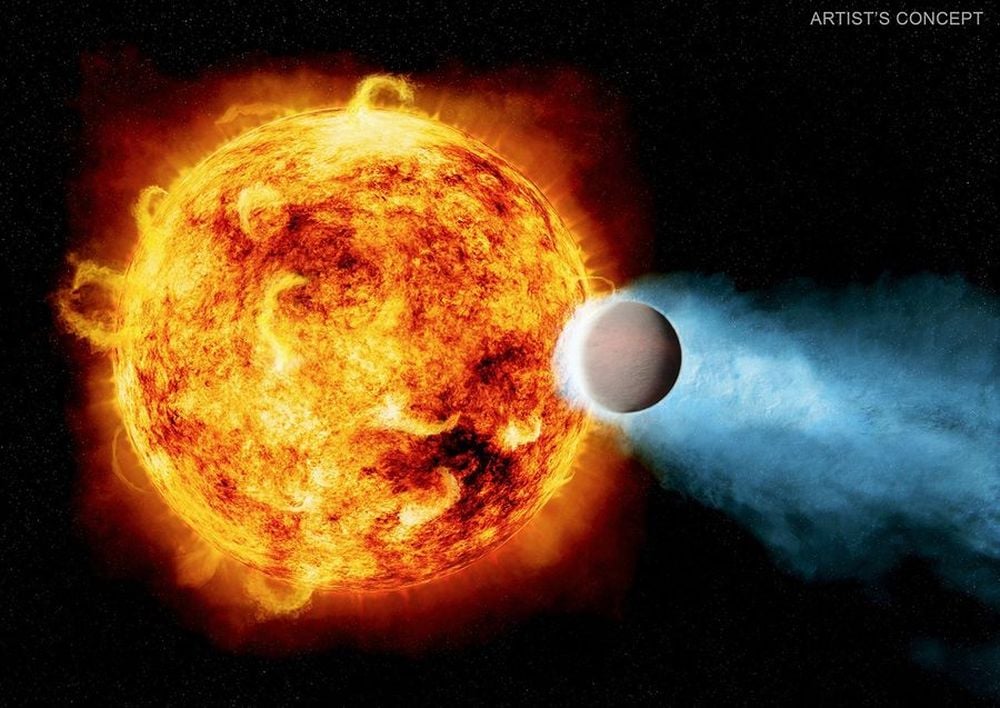
Figure 1. Artist’s concept of an early G-type star bombarding its innermost planet with copious X-rays and stellar wind. Observations indicate such bombardment subsides within 100–150 Myr, potentially salvaging planetary atmospheres.
| Table 2. Median X-ray Luminosity vs. Age for 1 M☉ Stars | Age (Myr) | LX (erg s-1) | LX/Lbol | Coronal Temp. (MK) |
|---|---|---|---|---|
| 7 | 4.0 × 1030 | 1.1 × 10⁻³ | 17 | |
| 45 | 8.0 × 1029 | 2.2 × 10⁻⁴ | 11 | |
| 100 | 1.1 × 1029 | 3.0 × 10⁻⁵ | 7 | |
| 160 | 5.8 × 1028 | 1.5 × 10⁻⁵ | 5.5 | |
| 700 | 8.2 × 1027 | 3.1 × 10⁻⁶ | 3.8 |
The power-law index is significantly steeper than the canonical t-1.5 frequently invoked in atmospheric escape models. Even more revealing is the evolution of the hardness ratio (HR): the fraction of photons above 1 keV falls from ≈0.48 at 7 Myr to ≈0.08 by 100 Myr, signaling a disappearance of very hot (≥15 MK) coronal loops. This “coronal softening” is key because the most penetrating photons, capable of reaching dense atmospheric reservoirs, become severely depleted.

Figure 2. Empirical X-ray luminosity distribution of cluster G-type stars (colour-coded by age bin). The magenta curve illustrates the best-fit t-1.95 power-law decay over nearly three orders of magnitude in time.
4. Magnetic Dynamo Evolution in Solar Analogs
Why does the X-ray output of solar-mass stars nosedive so swiftly whereas lower-mass K and M dwarfs maintain saturated activity for hundreds of millions of years? The answer appears rooted in rotational braking and the transition of internal dynamo regimes. Solar analogues are born with rotation periods Prot ≲ 3 d, but within ~150 Myr angular momentum loss by magnetised winds spins them down to Prot ≈ 8–10 d.
- Tachocline Shear Weakening: The interface dynamo operating at the solar tachocline relies on differential rotation between the radiative core and convective envelope. As surface rotation decelerates, the shear layer thins, throttling toroidal field generation.
- α–Ω Cycle Suppression: Helioseismic inversions of young solar twins such as κ1 Cet reveal that butterfly-diagram like cycles are weaker and shorter (Pcyc ≈ 4–5 yr) than in the modern Sun. Reduced amplitude means fewer large active regions and correspondingly cooler coronae.
- Flux-Emergence Geometry: Zeeman-Doppler imaging shows that dipolar fields give way to higher-order multipoles as Rossby number increases. Complex fields confine magnetic loops to smaller length scales, reducing plasma heating efficiency.
| Table 3. Dynamo Diagnostics for Representative Solar Twins | Star | Age (Myr) | Prot (d) | Global Bavg (G) | Cycle Period (yr) | LX (erg s-1) |
|---|---|---|---|---|---|---|
| κ1 Cet | 650 | 9.2 | 11 | 4.6 | 1.2 × 1028 | |
| EK Dra | 100 | 2.7 | 120 | ≈2* | 1.5 × 1030 | |
| π1 UMa | 300 | 5.0 | 27 | — | 2.3 × 1029 | |
| Sun (present) | 4,560 | 26.1 | 2.1 | 11 | 8.0 × 1026 |
*Cycle intermittently observed
Collectively, these diagnostics support a scenario in which a critical Rossby threshold (Ro ≈ 0.1–0.2) marks the exit from the saturated X-ray regime for solar-mass stars. The transition occurs earlier for G dwarfs than for deeper-convective K/M dwarfs, naturally explaining the divergent high-energy luminosity trajectories among spectral classes.
5. Atmospheric Escape Revisited
Armed with the new LX(t) calibration, one can reassess the energy-limited mass-loss rate:
\[ \dot{M} = \frac{\epsilon \pi R_\mathrm{p}^3 F_\mathrm{XUV}}{G M_\mathrm{p} K_{\mathrm{tide}}}, \]
where FXUV = LXUV/(4πa2) and ε is the heating efficiency. A factor-of-15 reduction in LXUV within the first 100 Myr translates almost linearly to a similar suppression of Ṁ. The archetypal Earth-mass planet at 1 au thus loses only ∼0.6 % of its atmospheric mass over 500 Myr, compared to >5 % under legacy flux scaling. Even for closer-in super-Earths at 0.3 au, catastrophic blow-off becomes unlikely unless stellar flaring remains in a permanently saturated regime—an eventuality that the Chandra data argue against for G dwarfs.
| Table 4. Cumulative Atmospheric Mass Loss for a 1 M⊕ Planet | Semi-major Axis (au) | Old LXUV(t) Model | New LXUV(t) Model | Dominant Escape Mechanism |
|---|---|---|---|---|
| 0.3 | 42 % | 9 % | Hydrodynamic | |
| 0.7 | 13 % | 2.5 % | Hydrodynamic → Jeans | |
| 1.0 | 5.1 % | 0.6 % | Jeans + Ion Pick-up | |
| 1.5 | 2.0 % | 0.2 % | Jeans |
Thus, the parameter space for retaining thick, water-bearing atmospheres around young solar twins has expanded dramatically. This finding bolsters the scientific rationale behind missions like PLATO and the proposed Habitable Worlds Observatory (HWO), both designed to screen hundreds of nearby G-stars for terrestrial planets.
6. Photochemistry and Prebiotic Synthesis Under Revised XUV Fluxes
High-energy radiation is not solely destructive; it also catalyses the formation of complex molecules by dissociating stable species and enabling radical recombination. Experiments recreating Archean photochemistry show that yields of hydrogen cyanide (HCN)—a key feedstock for nucleotide assembly—peak at intermediate XUV fluxes. Excessive radiation instead over-drives photodissociation, suppressing steady-state abundances.
| Table 5. Simulated HCN Surface Deposition Rates | XUV Flux (erg cm-2 s-1) | HCN Deposition (mol yr-1) | Prebiotic Yield Index* |
|---|---|---|---|
| 0.1 | 1.2 × 10⁴ | 0.3 | |
| 1 | 8.9 × 10⁴ | 1.0 | |
| 10 | 3.1 × 10⁴ | 0.4 | |
| 100 | 0.7 × 10⁴ | ≪0.1 |
*Normalised to unity at optimal flux.
Applying the new luminosity curve puts early Earth squarely in the “Goldilocks” photochemical regime for roughly 200–400 Myr, overlapping the geologic window when the oldest putative microfossils and isotopic biosignatures appear (≈3.6–4.0 Gyr ago). Hence, the Sun’s swift X-ray dimming may not only have spared Earth’s atmosphere but also optimised surface chemistry for the emergence of life.
7. Comparative Radiation Climates Across Main-Sequence Spectral Types
It is instructive to juxtapose the revised G-dwarf radiation trajectory against that of K and M dwarfs, both of which are prolific planet hosts. M dwarfs stay in the saturated LX regime (LX/Lbol ≈ 10-3) for 1–2 Gyr, only exiting once their rotation period exceeds 30–50 d. Consequently, habitable-zone planets around M dwarfs endure ≥102 higher high-energy fluence compared to G-dwarf planets over equivalent timescales.
| Table 6. Integrated XUV Dose (0–750 Myr) | Stellar Spectral Class | Habitable Zone Distance (au) | Integrated Fluence (J m-2) | Relative to Modern Earth |
|---|---|---|---|---|
| G2V (Sun-like) | 1.0 | 3.2 × 10⁶ | 23× | |
| K5V | 0.6 | 1.9 × 10⁷ | 132× | |
| M3V | 0.25 | 5.8 × 10⁷ | 402× |
The disparity underscores why temperate planets orbiting G-dwarfs may enjoy a privileged balance: sufficient high-energy photons to drive organic synthesis yet not so much as to obliterate volatiles or sterilise surfaces.
8. Case Studies: Earth, Kepler-452 b, and Proxima Centauri b
8.1 The Early Earth Redux
Integrating the new LXUV(t) curve into a coupled climate–escape model suggests that Earth could have retained ≥98 % of its primordial water inventory, even assuming an initial hydrogen envelope of only a few hundred bars. Furthermore, ion-mediated NH3 shielding would have limited UV-C (<200 nm) surface exposure, benefiting nascent biomolecules.
8.2 Kepler-452 b
Kepler-452 b is a 6 Gyr-old super-Earth in the habitable zone of a Sun-like star. Retrodicting its stellar XUV history with the new scaling suggests that volatile loss before 1 Gyr was trivial (<4 % of a 1-bar N2 atmosphere), strengthening the case for long-term habitability.
8.3 Proxima Centauri b
By contrast, Proxima b’s M-dwarf host remains an X-ray powerhouse (LX ≈ 2 × 1027 erg s-1) despite its 4.8 Gyr age, mainly because of its slower rotational braking. Even under conservative heating efficiencies, cumulative hydrogen loss could exceed 10 Earth oceans. Hence, the dichotomy between G and M dwarfs is further accentuated.
9. The Interplay of Stellar Winds and Magnetospheres
X-rays are only part of the erosive arsenal. Coronal mass ejections (CMEs) and particle radiation also shape habitability. Are these likewise suppressed by early dynamo decay? Radio observations of young solar analogues (e.g., the ≈120 Myr Pleiad HII 314) reveal that the kinetic energy in stellar winds scales with LX0.7. Therefore, a fifteen-fold drop in X-ray luminosity implies roughly an eight-fold decline in wind ram pressure. For a proto-Earth magnetic dipole moment similar to or larger than today’s (~0.8–1.3 M⊕), the magnetopause standoff distance would remain >6–8 planetary radii through most of the first 250 Myr. Atmospheric sputtering by stellar wind ions is correspondingly curtailed.
10. Synergy With Upcoming Observatories
The Chandra sample, while transformative, remains limited to several hundred targets. The next leap will come from synergy between Gaia proper motions, high-resolution X-ray imaging from the proposed HabEx or Lynx missions, and ground-based high-cadence spectropolarimetry (e.g., ESPRESSO). These assets will capture rotational modulation, flare frequency distributions, and Zeeman signatures across an expanded age-mass grid.
- Lynx High Definition X-ray Imager: Expected to reach flux limits of 10-18 erg cm-2 s-1, enabling routine detection of quiet-corona emission from solar twins as old as the Sun in clusters up to 2 kpc away.
- HabEx UV Spectrograph: Will monitor Lyman-α and far-UV lines to complement X-ray diagnostics, closing the LX–LUV budget necessary for full XUV reconstructions.
- SKA (Square Kilometre Array): Offers the prospect of directly imaging stellar coherent radio bursts and probing magnetic reconnection rates in young G-stars.
11. Broader Astrobiological Consequences
11.1 Volatile Delivery vs. Volatile Loss
The early solar system witnessed intense delivery of water-bearing planetesimals and comets. If young Sun-like stars are calmer than predicted, volatile accretion may have out-paced volatile loss. This balance could produce clement conditions on a wider array of solar-twin planets, particularly those on eccentric orbits where tidal-heating feedback may generate prolonged temperate episodes.
11.2 Emergence Windows for Biosignatures
Remote biosignature detection requires an atmosphere thick enough to sustain chemical disequilibrium yet translucent enough in the optical/near-IR. The swift decline in X-ray flux means that greenhouse gases such as CO2 and CH4 avoid wholesale photolysis, preserving spectral features critical for missions like HWO.
11.3 Planetary Protection From Flare-Driven Nitrates
Nitrates produced by solar-proton events can both nourish and acidify surface environments. Scaling relations show that nitrate deposition rates peak when LX/Lbol ≈ 10-4—precisely the regime during the 30–100 Myr epoch. If deposition exceeded buffering capacity, nascent oceans could become mildly acidic, hampering carbonate precipitation. Revised fluxes indicate nitrate deposition two to three times lower than older models, potentially stabilising early ocean pH.
12. Conclusions
High-energy emissions from solar-mass stars fade and soften markedly within the first 100–150 Myr—much faster than canonical rotary-age relations predicted. As a consequence, the erosion of primordial planetary atmospheres around G-type stars is substantially mitigated, while the radiative environment for prebiotic chemistry appears optimised rather than hostile. These findings re-orient target-selection strategies for upcoming flagship observatories and reinvigorate theoretical work on the subtle interplay between stellar magnetism, atmospheric escape, and chemical evolution. In a cosmic sense, the Sun may have been gentle enough, early enough, to give Earth—and potentially many Earth-like worlds—the breathing room required for life to gain a foothold.
For More Information
NASA Chandra Press Release (April 2026)
Habitable Worlds Observatory Concept Overview
Lynx X-ray Observatory Vision Study
Feigelson & Montmerle (1999) – “High-Energy Processes in Young Stellar Objects”
Airapetian, V. et al. (2021) – “Impact of Stellar Flares on Exoplanet Habitability”
Dong, C. et al. (2022) – “Atmospheric Escape of Proxima b Under Stellar Wind Pressure”