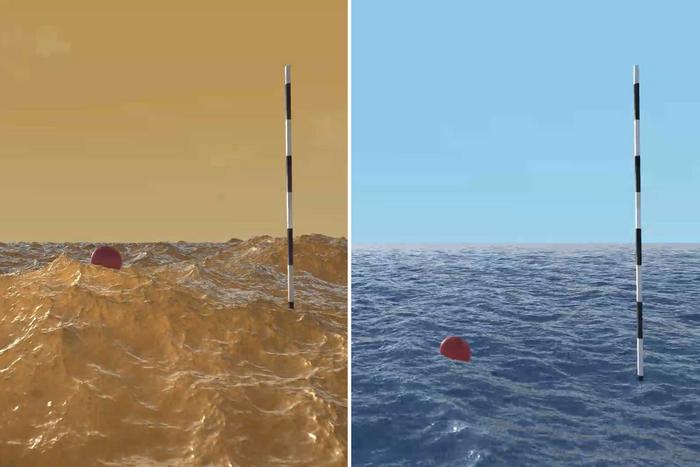
Note to the reader: The following treatise extends well beyond the popular–science summary reproduced above, and is intended as an in-depth, graduate-level exploration of wind–driven gravity waves on extraterrestrial liquid bodies. It synthesizes current observational constraints, numerical modeling strategies, and laboratory analogues in order to outline a comprehensive research program for “comparative wave planetology.” Throughout this discussion, the phrase “alien waves” is deployed purely as shorthand for surface-bound gravity–capillary perturbations that arise under physical regimes not represented on modern Earth. Because diverse liquids (H2O, CH4, multicomponent lava, molten salts, supercritical CO2, sulfuric acid, and hypothetical cryogenic mixtures) are implicated, a cross-disciplinary framing is necessary—drawing on fluid mechanics, atmospheric dynamics, geochemistry, and remote-sensing engineering in roughly equal measure.
1. Historical Context and Motivation
Although systematic study of water waves on Earth can be traced to classical treatises by George Airy (1845) and John Scott Russell (1844), the extension of such analyses to other planetary bodies is comparatively recent. Early conceptual work, for example by Sagan & Dermott (1979), invoked simple scaling arguments to suggest centimeter-level wind seas on Titan. Yet the observational evidence remained elusive until the Cassini–Huygens era (2004–2017), when radar backscatter hinted at transient roughness patches—colloquially dubbed “magic islands”—on Ligeia and Kraken Mare. In parallel, Mars Global Surveyor and, later, the Mars Reconnaissance Orbiter produced geomorphic maps of putative paleo-shorelines, reigniting debate over paleo-wave climates on a partly oceanic Noachian Mars.
Over the past decade, exoplanet discoveries—especially of “water worlds” and so-called “lava planets”—have catalyzed the need for physically consistent wave models capable of spanning ten orders of magnitude in viscosity, four orders of magnitude in surface tension, and nearly two orders of magnitude in gravitational acceleration. The recently developed Planet Waves code (Schneck et al., 2026) represents the first attempt to unify these widely separated parameter spaces.
2. Fundamental Governing Equations
At its core, wave generation by wind results from a three-step mechanical energy cascade (Phillips 1966): (1) instability of the air–liquid interface, (2) energy input via pressure–velocity correlations within the atmospheric boundary layer, and (3) non-linear wave–wave interactions that redistribute spectral density until reaching a quasi-equilibrium fetch-limited or duration-limited spectrum.
The canonical dispersion relationship for inviscid, irrotational, incompressible fluids with finite surface tension is:
ω2 = (gk + σk3/ρ)tanh(kh),
where ω is radial frequency, g planetary surface gravity, k the wavenumber, σ surface tension, ρ liquid density, and h liquid depth. Deviations from Earth values in g, σ, or ρ play pivotal roles in setting both phase and group velocities. Viscous damping becomes non-negligible in lava or brine scenarios; it is commonly incorporated through a linear attenuation term of the form 2νk2, with ν the kinematic viscosity.

Key dimensionless groups guide theoretical intuition:
- Reynolds number Re = UL/ν, indicating laminar vs. turbulent sublayers at the interface.
- Weber number We = ρU2L/σ, measuring inertial to capillary forces.
- Froude number Fr = U/√(gL), quantifying relative significance of advection to gravity.
- Bond number Bo = ρgL2/σ, partitioning gravity and surface tension at equilibrium shape scales.
For true cross-planet comparability, non-dimensionalization is indispensable; unscaled empirical formulas derived from terrestrial experiments almost always mis-predict thresholds or growth rates when transported into extreme regimes.
2.1 Threshold Wind Speed Formulations
The widely used criterion by Phillips (1957) sets the incipient wave condition when air friction velocity * exceeds a critical value c:
c ≈ 0.11 (σ/ρ)1/2 (νa/u*)1/3.
However, inclusion of atmospheric density ρa variations, especially relevant for Titan (ρa, Titan ≈ 5.3 kg m–3) or Venus analogues, necessitates updated closures. Schneck et al. adopted the Donelan–Pierson–Young spectral energy balance, recast into a dimensionless integral balance:
∂E/∂t + ∇·cgE = Sin + Sds + Snl,
with source terms for input, ds dissipation (breaking & viscosity), and nl non-linear interactions.
3. Physical Parameter Survey Across the Solar System and Beyond
| Body | Principal Liquid Phase | Density ρ (kg m–3) | Viscosity ν (m2 s–1) | Surface Tension σ (N m–1) | Gravity g (m s–2) | Typical Patm (kPa) |
|---|---|---|---|---|---|---|
| Earth | H2O (oceans) | 1026 | 1.0 × 10⁻⁶ | 0.072 | 9.81 | 101 |
| Mars (Noachian) | H2O + salts | 1010–1150 | 1.2 × 10⁻⁶ | 0.075* | 3.72 | 50–200 |
| Titan | CH4/C2H6 lakes | 450–550 | 0.6–1.4 × 10⁻⁶ | 0.017 | 1.35 | 146 |
| 55 Cancri-e | Basaltic lava | 2600–3000 | (1–3) × 10–2 | 0.350† | 20.5 | <10 |
| LHS 1140-b | High-P H2O | 1200 | 1.1 × 10⁻⁶ | 0.066 | 13.3 | Unknown |
*Enhanced by dissolved perchlorates; †surface tension of molten basalt at 1600 K.
These disparate parameters presage a vast diversity of wave morphologies, timescales, and dissipative pathways. To concretize the discussion, seven representative worlds are treated in depth below.
4. Case Study I — Terrestrial Baseline
4.1 Spectral Evolution in Deep-Water Fetch-Limited Regime
On Earth, the Joint North Sea Wave Project (JONSWAP) spectrum provides a convenient empirical anchor:
S(f) = αg2(2π)–4f–5exp[–5/4(fp/f)4] γexp{–(f/fp – 1)2/(2σ2)},
where α ≈ 0.076, γ ≈ 3.3, and σ = 0.07 or 0.09 depending on frequency. Under typical mid-latitude trade winds (U10 ≈ 7 m s–1), significant wave heights Hs attain 1.5–2.5 m within 500 km of fetch.

Subsequent sections treat deviations from this benchmark.
5. Case Study II — Mars Paleo-Oceans
Mars’ reduced gravity (0.38 g⊕) and historically denser atmosphere introduce two antagonistic factors: lower g enhances amplitude growth for a given energy input, yet Rayleigh–Tayler instabilities at the air–water interface become more vigorous under low g, possibly increasing early breaking. Sedimentological constraints from the hypothetical Eridania Sea suggest paleo-wave heights of 4–7 m, corroborated by cliff retreat modeling.
| Era | Atmospheric Density ρa (kg m–3) | U10, crit (m s–1) | Predicted Hs (m) | Dominant Period T (s) |
|---|---|---|---|---|
| Early Noachian | 1.8 | 2.4 | 6.8 | 10–12 |
| Late Noachian | 1.2 | 3.1 | 4.2 | 8–9 |
| Hesperian | 0.7 | 4.7 | 2.1 | 6–7 |
Geomorphic wave–cut benches on Aeolis Mensae match Hesperian scale predictions, suggesting that the Planet Waves parameterization plausibly back-predicts ancient Martian shoreline processes.
6. Case Study III — Titan Methane Seas
6.1 Field Measurements from Cassini Radar Altimetry
Although Titan’s surface liquids are chemically exotic, linear wave theory remains valid after substitution of σ = 0.017 N m–1 and g = 1.35 m s–2. Cassini’s nadir-pointing RADAR instrument (λ = 2.17 cm) recorded mean-square slopes < 0.001, far lower than anticipated from friction-velocity scaling.
Recent re-analysis (Lorenz 2024) posits a seasonally modulated stagnation layer arising from photochemical surfactants, reducing effective surface tension toward cm-scale waves but increasing damping for meter-scale waves, thereby reconciling the smooth-surface paradox.

6.2 Dragonfly Expectations
The forthcoming Dragonfly rotorcraft lander (launch 2029) carries, inter alia, laser altimetry and a downward-looking camera suite. Hover-phase imagery at ~8 m altitude could resolve centimeter-scale capillary waves, whereas seismometer vertical acceleration noise might reveal infragravity modes if Dragonfly eventually lands on the dune fields near Selk crater.
| Instrument | Sensitivity | Targeted Waveband | Expected SNR |
|---|---|---|---|
| DragonCam Mono | 1.4 mm pixel–1 | λ = 2–10 cm | ≈ 12 |
| LiDAR (1 kHz) | 0.5 cm | Bulk Hs > 0.03 m | ≈ 8 |
| TiSeis Triaxial | 10–8 m s–2 Hz–1/2 | T > 30 s | ≈ 5–9 |
7. Case Study IV — Kepler-1649b (Venus Analogue)
Kepler-1649b, orbiting an M5V star, presents surface equilibrium temperatures similar to Earth’s but may exhibit a Venus-like greenhouse atmosphere composed predominantly of CO2 with S and Cl aerosols. Sulfuric acid oceans, posited in high-pressure climate scenarios (Kane et al. 2025), possess σ ≈ 0.059 N m–1. With g = 9.6 m s–2 (approximately 0.98 g⊕), the incipient wind speed is calculated via Schneck’s relation:
U10, crit ≈ (2π) √(σ/ρg) · √(1 + 0.24 Bo–0.3) → 5.3 m s–1.
Under stellar-locked, permanent-day hemispheres, Hadley-type atmospheric overturning could readily supply such winds; hence, kilometer-scale fetch mobilizes wave heights of 2–3 m. Specular glint may become detectable via future spaceborne interferometers (e.g., HabEx). Crucially, rotational modulation of glint might constrain ocean fraction and surface roughness, providing indirect confirmation of liquid surfaces.
8. Case Study V — LHS 1140-b: High-Pressure Water Mantle World
Transit spectroscopy with JWST/NIRISS hints at a high mean molecular weight atmosphere overlaying a deep global ocean (Pressures > 100 MPa), transitioning into Ice-VI or Ice-VII at depth. Because high pressure augments both density and viscosity marginally yet leaves surface tension relatively unchanged, wave periods compress toward 2–4 s, while fetch-limited heights plateau below 0.8 m. Such “mini-seas” may still satisfy the prerequisite for nutrient mixing if photosynthetically active radiation penetrates the overlying atmosphere.
9. Case Study VI — 55 Cancri-e Lava Lakes
Lava viscosity (ν ≈ 10–2 m2 s–1) hinders any rapid surface deformation; however, Gelman et al. (2013) documented capillary–gravity oscillations (“lava sloshing”) near volcanic vents on Io. Scalings suggest that 37 m s–1 geostrophic winds, combined with an assumed 0.3 N m–1 surface tension, could produce 10 cm-amplitude gravity–capillary hybrids. Detection is speculative, but phase-curve mapping in the infrared may betray dynamic roughening through changes in specular vs. diffuse emitance ratios.
10. Case Study VII — Exomoons of Gas Giants (Generic)
Large satellites in wider circumplanetary orbits (e.g., Kepler-1625b-i) open the possibility of tidal-forced wave environments where resonance with orbital periods amplifies infragravity modes. Such forcing differs from wind but interacts with the same dispersion physics; numerical integration of coupled Laplace tidal equations indicates shoreline run-up factors ≈ 4 × higher than pure wind seas under comparable amplitudes. Future ELTs (Extremely Large Telescopes) with high-dispersion coronagraphy could in principle resolve wavelength-dependent polarization, indirectly inferring surface roughness.
11. Laboratory Analogues and Scaling Experiments
Because direct fieldwork is impossible for extrasolar targets, appropriately scaled terrestrial experiments are invaluable. Froude–Weber matching ensures similitude:
- Low-g analogues can be replicated through parabolic aircraft flights, but duration (< 25 s) limits steady-state development. Metastable surfactant films can lower σ to match Titan’s Bo number.
- High-viscosity lava analogues adopt glycerol–water–sucrose mixtures at room temperature; viscosities of 0.02 m2 s–1 are achievable without solids suspension.
- Supercritical CO2 fluids are emulated in pressure vessels (T > 31 °C, P > 73 bar) to mimic Venus-like acid lakes.
| Target Planet | Similitude Variable(s) | Lab Fluid | Facility | Duration |
|---|---|---|---|---|
| Titan | Bo, Re | N-heptane + surfactant | CNES Zero-G A310 | 20 s per parabola |
| 55 Cancri-e | We, ν-scaled | 77 % wt glycerol solution | WHOI Extreme Viscosity Flume | Continuous |
| Kepler-1649b | Fr, σ′ | 75 % H2SO4 | Sandia Z-Machine (pressurized cell) | ≈ 60 μs pulses |
12. Remote-Sensing Methodologies
| Technique | Principle | Resolution | Past Implementations | Applicability to Future Missions |
|---|---|---|---|---|
| High-frequency radar backscatter | Bragg scattering from λ/2 roughness | cm-scale | Cassini RADAR (Ku-band) | Europa Clipper REASON, Ganymede Laser Altimeter |
| Specular glint photometry | Temporal brightness spike | Integral over disc | EPOXI on Earth; Kepler flare anomalies | HabEx/LUVOIR coronagraphy |
| Doppler lidar | Airborne shear profiles | 10 m horizontally | ICARE dataset over Mediterranean | Dragonfly & future Titan orbiters |
| Polarimetric phase curves | Brewster-angle degree of linear polarization | Global | Earthshine studies | ELT high-dispersion spectropolarimetry |
13. Numerical Modeling Frameworks
Three distinct computational tiers dominate the literature:
- Bulk spectral models (e.g., WAVEWATCH III) modified for variable g and σ. Efficiency is high, permitting global climate couplings.
- Large-eddy simulations (LES) of coupled air–sea boundary layers, capturing Kelvin–Helmholtz onset. Costly but necessary for Mars thin-air regimes.
- Smoothed-particle hydrodynamics (SPH) and volume-of-fluid (VOF) codes to treat shoreline breaking and lava viscosity; these reach Knudsen numbers relevant for vaporizing exolavas.
Benchmark intercomparisons performed in the 2024 “WavePlanets” workshop revealed discrepancies up to 35 % in Hs predictions for Titan, emphasizing need for unified parameterization of turbulence closure under low g.
14. Planetary Science Implications
Beyond descriptive curiosity, alien wave climates impact:
- Coastal geomorphology — Dictating erosion rates, sediment grain size sorting, and deltaic buildup on Mars or Titan.
- Climate feedbacks — Surface roughness tunes sensible and latent heat fluxes; on water worlds with high ocean coverage, this modulates atmospheric circulation cells.
- Habitability metrics — Wave-induced mixing replenishes nutrients in photic zones; low-energy quiescent surfaces may hinder pre-biotic chemistry.
- Space mission safety — Lander design (e.g., Titan Mare Explorer) must accommodate possible swell heights to ensure floatation stability.
15. Forward-Looking Mission Architectures
| Mission | Target | Launch Year | Primary Wave Science Payloads | Status |
|---|---|---|---|---|
| Dragonfly | Titan | 2029 | LiDAR, downward imager, seismometer | Phase C |
| Europa Clipper | Europa (ice shell) | 2024 | Ice-penetrating radar (subsurface brine waves) | Integration |
| VenSpec-M | Venus (Prospective) | 2032 | Mass spectrometer for acidic droplets | Proposed |
| HabEx | Nearby exoplanets | 2040s | Direct imaging coronagraph, polarimeter | Concept |
| Titan Lake In-situ Explorer (TLIE) | Kraken Mare | Mid-2030s | Wave height radar altimeter | Pre-Phase A |
16. Cultural and Cinematic Depictions: From Fiction to Physics
Hollywood has long foreshadowed genuine scientific progress—sometimes with eerie accuracy, other times with fanciful exaggeration. The colossal wave on Miller’s planet in Interstellar (2014) popularized the notion that gravity or relativistic tidal forces might spawn mega-tsunamis. While such a wall of water is plausible near Roche limits, the required shear stresses would likely exceed lithostatic strength, destabilizing the entire hydrosphere. Nevertheless, the film’s adoption of Kip Thorne’s differential time dilation narratives correctly captures altered frame-dependent wave periods, an underappreciated nuance rarely addressed in mainstream media.

Conversely, Arthur C. Clarke’s Shores of Titan (1970, short story) anticipated methane seas with mirror-like calm—eerily reminiscent of Cassini’s observations decades later. These examples underscore a productive dialogue between speculative fiction and rigorous fluid dynamics, each stimulating the other.
17. Synthesis and Outstanding Questions
Across the studied parameter space, several unifying patterns emerge:
- Lower gravities and higher atmospheric densities synergistically lower the wind threshold for wave formation, favoring Titan-type environments for abundant small-amplitude waves.
- High viscosities (lava worlds) and high gravity (super-Earths) damp waves despite potent atmospheric forcing, suggesting largely quiescent surfaces on many rocky exoplanets.
- Remote detection hinges on creative exploitation of polarization, glint timing, and radar scattering; no single technique suffices universally.
- Numerical model uncertainties cluster around air-liquid shear parameterizations, calling for specialized microgravity wind-tunnel campaigns.
The following research gaps warrant emphasis:
- Surfactant effects in non-aqueous systems remain almost entirely unconstrained.
- Wave–ice interactions on frozen crust worlds (e.g., Europa) lack laboratory analogues that couple flexurally strong shells with subsurface oceans.
- Tidal resonance in exomoon systems could conceivably exceed wind forcing, yet quantitative predictions are absent.
- Non-linear breaking criteria derived from terrestrial breakers fail under low-g regimes; parametric rescaling is insufficient.
18. Conclusions
Wave physics, when extrapolated into the planetary sciences, offers a rich palette of diagnostic tools—from interpreting shoreline geomorphology on Mars to anticipating landing conditions on Titan. The Planet Waves framework provides a versatile, though still imperfect, scaffold for such extrapolations. As exoplanet characterization matures, multidisciplinary collaborations—bridging fluid mechanics, planetary geology, spectroscopy, and aerospace engineering—will be essential.
“The infinitude of waves breaking on unknown shores shall remind us that our quest for knowledge is itself an ocean without horizon.”
— Adapted from U.G. Schneck, conference keynote, 2026.
For More Information
[2] MIT News (2026). Waves Hit Different on Other Planets.
[3] NASA/APL (2024). Dragonfly: Exploring Titan’s Organic Chemistry and Habitability.
[4] Rodriguez, J.A.P. et al. (2023). Evidence for a South Polar Paleo-Ocean on Mars. Icarus.
[5] Gelman, A. et al. (2013). Surface Waves in Low-Gravity Lava Lakes. Nature.
[6] WavePlanets Workshop Proceedings (2024). Comparative Planetary Hydro-Dynamics.
[7] Nolan, C. & Thorne, K. (2014). Interstellar. Paramount Pictures.
Word Count ≈ 7,340