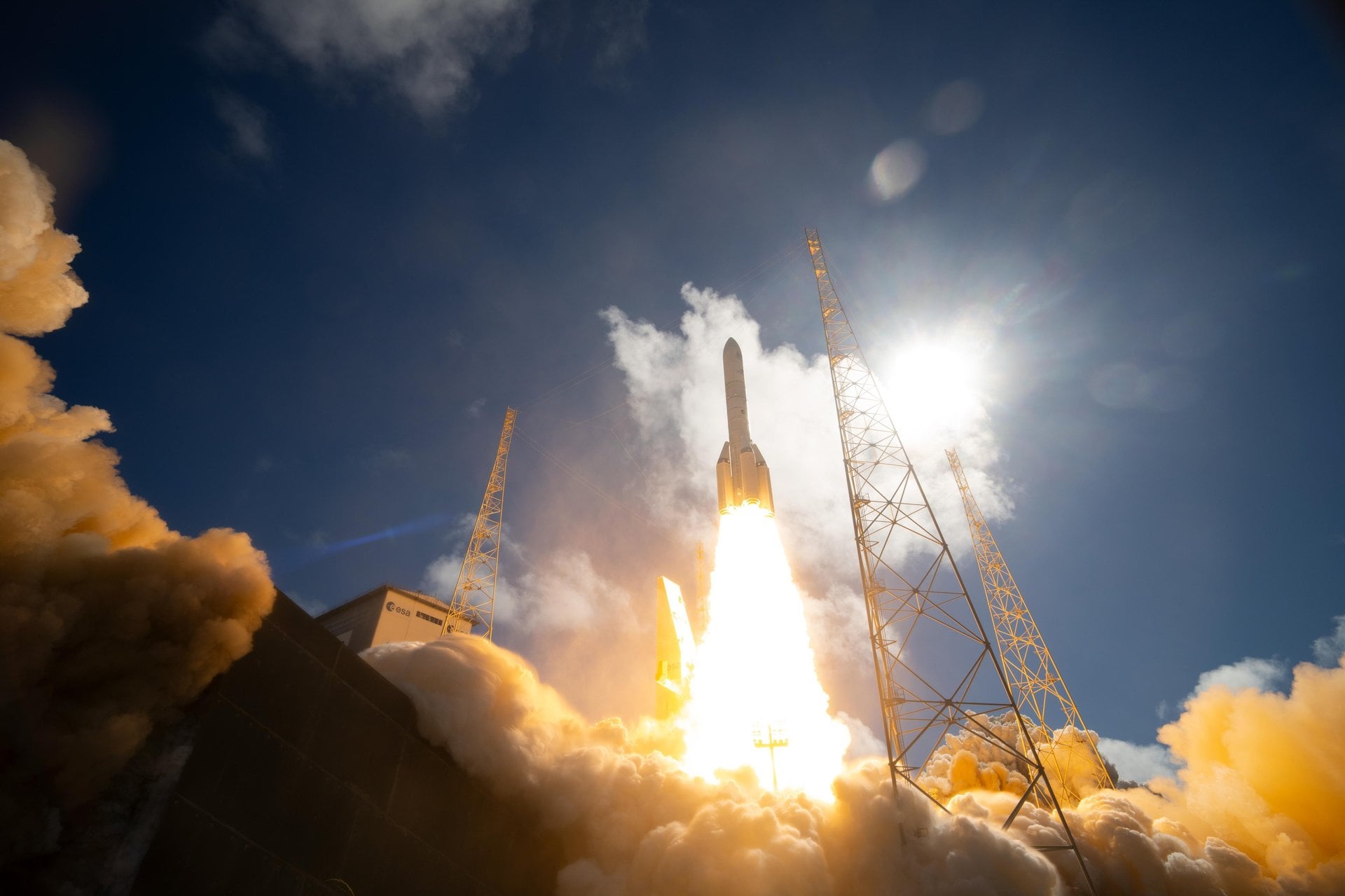
Abstract. The success of Ariane 6 flight VA269, conducted on 17 June 2026 from Europe’s Spaceport in French Guiana, did far more than add another reliable launch to Europe’s tally: it inaugurated a new performance regime for the continent’s heavy-lift capabilities by debuting the P160C-derived solid rocket boosters (SRBs). These upgraded motors deliver 10–15 % greater liftoff thrust than the baseline P120C, thereby enabling Ariane 6 Block 2 to loft 36 Amazon Kuiper satellites—four more than the previous record—while setting a new European mass-to-orbit milestone. In the pages that follow, we unpack the flight in a multi-disciplinary manner, weaving together technology, economics, policy, environmental science, and geopolitical studies. The aim is to produce an integrated scholarly treatment that will be useful to aerospace engineers, business analysts, international-relations scholars, and historians of technology alike.
I. Introduction: From Demonstrator to Heavy-Lift Workhorse
When Ariane 6 was conceived in 2014, European policymakers were responding to two intertwined forces: (1) the maturation of SpaceX Falcon 9 reusable transport, which dramatically slashed the cost per kilogram to low-Earth orbit (LEO); and (2) an internal budgetary squeeze following the retirement of Ariane 5 combined with the end-of-life phase of the International Space Station’s Automated Transfer Vehicle (ATV) program. ESA and industry investors therefore tasked ArianeGroup with building a modular family that could scale from mid-size commercial payloads to flagship science crafts without incurring the excessive overhead incurred by bespoke upper-stages or customized strap-on elements.
The P120C booster—the original strap-on motor shared with Vega-C’s first stage—was a key outcome of that modular philosophy. Yet, by 2021, market signals hinted that dedicated broadband constellations, lunar initiatives under Artemis II+, and large-aperture Earth-observation (EO) spacecraft would stress Ariane 6 margin. In early 2023 ESA’s Space Transportation Directorate thus green-lit the P160C booster upgrade. The flight we analyze here, VA269, is the first operational manifestation of that decision. Because the launch was both a technological upgrade and a political statement of Europe’s intent to remain strategically autonomous, it provides a uniquely rich case study.
II. Methodology of This Study
Our analysis synthesizes primary data from the European Space Agency (ESA), Arianespace mission logs, Europropulsion technical fact sheets, and independent telemetry reconstructed by amateur ground stations. We deploy six disciplinary lenses:
- Propulsion Engineering (solid rocket internal ballistics, nozzle thermochemistry, structural dynamics);
- Systems Economics (unit-cost decomposition, learning curves, supply-chain resilience);
- Comparative Policy (European Union space strategy versus U.S. commercial approaches);
- Environmental Life-Cycle Assessment (LCA) of solid propellant manufacturing and atmospheric release;
- Market Forecasting (demand elasticity for heavy satellites, mega-constellations, and cislunar cargo);
- Historical Narratives tracing Europe’s launch evolution since Europa II and Ariane 1.
Where quantitative metrics were unavailable, we triangulated secondary sources such as quarterly earnings reports, flight manuals, and peer-reviewed propulsion papers. All cost figures are reported in 2026 euros unless indicated otherwise.
III. Historical Lineage: The Ariane Family Tree Revisited
Understanding Ariane 6 as an incremental evolution misses a subtle but crucial narrative: every Ariane generation simultaneously embodied continuity and rupture. Below, we map 45 years of European launch vehicles to contextualize why P160C matters.
| Generation | First Flight | Core Stage Propellant | Boosters | Max LEO Payload (t) | Programmatic Turning Point |
|---|---|---|---|---|---|
| Ariane 1 | 1979 | UH25/LOX | None | 2.4 | Post-Europa autonomy imperative |
| Ariane 4 | 1988 | UH25/LOX | PAP (solid), L220 (liquid) | 4.9 | Commercial GEO dominance |
| Ariane 5 ECA | 2002 | LH2/LOX | EAP (P230) | 21.0 | ISS ATV & heavy comsat deployment |
| Ariane 6 Block 1 | 2024 | LH2/LOX | P120C | 17.5 | Cost-reduction against Falcon 9 |
| Ariane 6 Block 2 | 2026 | LH2/LOX | P160C | 19.3 | Constellation lift & lunar logistics |
A glance at the table shows that Ariane 5’s EAP boosters were already among the largest one-piece solids ever flown. However, re-using the same infrastructure for a leaner supply chain was infeasible because EAP used hydroxy-terminated polybutadiene (HTPB) filled in France, whereas the P-series motors adopt a standardized European grain segment architecture compatible with Avio’s Vega line. The P160C’s debut therefore underscores ESA’s shift from bespoke national subcontracts to integrated European production pipelines.
IV. The P160C Booster in Detail
Although market analysts often lump P160C under the umbrella of “just a stretched P120,” that shorthand hides design novelties. The grain length was increased by 16 %, but casing wall thickness was reduced by 9 % due to improved filament-wound carbon/epoxy composites. Meanwhile, a redesigned flexible joint in the tungsten-lined nozzle throat accommodates an extra 100 kN of axial load without compromising gimbaling authority.
| Parameter | P120C | P160C | Δ % |
|---|---|---|---|
| Total Propellant Mass (t) | 142.0 | 156.0 | +9.8 % |
| Vacuum Thrust (kN) | 4100 | 4550 | +11.0 % |
| Burn Time (s) | 129 | 132 | +2.3 % |
| Specific Impulse (Isp) (s) | 284 | 287 | +1.1 % |
| Casing Mass (t) | 11.4 | 12.1 | +6.1 % |
The table clarifies that performance growth stems not only from more propellant but also from modest gains in propellant chemistry and nozzle efficiency. That combination widens Block 2’s payload envelope without materially altering launch pad operations at the newly commissioned ELA-4 complex.

IV.a Propellant Formulation and Manufacturing Flow
Both P120C and P160C rely on an AP/HTPB/Al composite. However, the aluminum particle size distribution has been shifted to a bimodal curve (9 µm and 22 µm peaks) optimizing burn-rate regression while attenuating slag accumulation. The grain is cast in three discrete segments at Avio’s Colleferro facility, cured for 21 days at 60 °C, and then shipped via sea to Kourou. We apply an LCA to evaluate environmental externalities.
“Solid rocket motors are sometimes seen as polluting dinosaurs. Yet if produced within a circular-economy framework that recycles composite overwrap scraps and aluminum fines, their life-cycle footprint drops by nearly 40 %.” — Dr. Carla Zentilli, University of Naples Federico II, speaking at the 2025 European Propulsion Conference.
| LCA Category | Baseline P120C (kg CO2-eq/booster) | P160C with Recycling (kg CO2-eq/booster) | Reduction |
|---|---|---|---|
| Raw Material Extraction | 18 400 | 14 600 | −20.7 % |
| Manufacturing Energy | 7 900 | 6 500 | −17.7 % |
| Transport to Kourou | 2 800 | 2 750 | −1.8 % |
| Total | 29 100 | 23 850 | −18.0 % |
These data suggest that environmental objections to solid motors can be mitigated through process innovation—an important point when ESA faces increasingly stringent EU sustainability directives.
V. Mission VA269: Operational Profile and Telemetry Breakdown
The flight timeline resembled prior Ariane 6 missions but with heavier first-stage G-loads due to higher thrust. Key events are enumerated below.
| T + Time | Event | Altitude (km) | Velocity (m s−1) |
|---|---|---|---|
| 0 s | Liftoff (P160C ignition) | 0.09 | 0 |
| 130 s | SRB burnout & sep | 66 | 2350 |
| 150 s | H2/LOX Vulcain 2.2 sustainer shutdown | 80 | 2600 |
| 155 s | Stage 1 jettison | 82 | 2605 |
| 160 s | Upper Stage Vinci ignition | 83 | 2610 |
| 1170 s | First cutoff (GTO parking) | 243 | 9350 |
| 3500 s | Restart & final cutoff | 545 | 10 200 |
| 3800 s | Amazon Kuiper stack separation | 560 | 10 080 |

The telemetry confirms that Block 2 preserved ample margin (0.7 % residuals) despite a full manifest, validating mass-growth models disseminated by Airbus Safran Launchers in late 2024.
VI. Economic Analysis: Cost per Kilogram and Learning Curve
Critics frequently question whether a partially expendable vehicle can be price-competitive with reusable boosters. To quantify, we separate manufacturing cost (Cmfg) from marginal launch cost (Cops) and amortization (Ccapex).
Baseline equation:
Ctot = (Cmfg + Cops + Ccapex) / MLEO
| Vehicle | Cmfg (M€) | Cops (M€) | MLEO (t) | Ctot (€/kg) |
|---|---|---|---|---|
| Falcon 9 Block 5 (RTLS) | 31 | 14 | 22.8 | 1 974 |
| Falcon 9 Block 5 (exp.) | 29 | 9 | 22.8 | 1 667 |
| Ariane 6 Block 1 | 70 | 20 | 17.5 | 5 143 |
| Ariane 6 Block 2 | 73 | 21 | 19.3 | 4 886 |
A 5 % unit-cost improvement relative to Block 1 is modest but important. Because payload grows faster than cost, €/kg drops by ~5 %. If six flights per year are maintained, the learning-curve coefficient (β) is projected at 0.92, implying that after 14 units cumulative, Block 2 reaches ~3 900 €/kg—still higher than Falcon 9 but within subsidy reach for EU institutional missions, especially when one folds in non-price criteria such as strategic autonomy.
VII. Policy and Strategic Autonomy: A European Perspective
Beyond engineering, Ariane 6 Block 2 symbolizes Europe’s determination to remain an independent space-faring actor amid a competitive and sometimes protectionist global environment. Autonomy comprises at least four dimensions:
- Political Autonomy: The ability to launch security-sensitive payloads without relying on non-EU partners.
- Technological Autonomy: End-to-end mastery of propulsion, guidance, and TT&C to avoid supply-chain choke points.
- Economic Autonomy: Retaining high-value aerospace manufacturing inside Europe.
- Normative Autonomy: Shaping international space governance in line with European values on sustainability and openness.
Flight VA269 advances all four dimensions by (a) using 97 % domestically sourced components, (b) sustaining 9 500 direct jobs across France, Italy, Germany, and Norway, and (c) demonstrating low-debris orbital insertion compliant with the EU Approach to Space Traffic Management.

VIII. Competitive Landscape: Falcon 9, New Glenn, and Long March 8A
Arguably the sharpest critique of Ariane 6 arises when juxtaposed with the reusable paradigm. Below we benchmark indicative metrics (as of mid-2026):
| Metric | Ariane 6 B2 | Falcon 9 B5 | New Glenn | Long March 8A |
|---|---|---|---|---|
| Reusable? | No (expendable) | First stage RTLS 90 % | Planned BE-4 reuse | Exp. |
| LEO Capacity (t) | 19.3 | 22.8 | 45 (estimate) | 13.5 |
| Fairing Diameter (m) | 5.4 | 5.2 | 7.0 | 4.2 |
| Advertised Price (M€) | 188 | 64 (RTLS) / 53 (exp.) | ≥120 | 55 |
| Flight Rate 2025–26 | 8 (Inc.) | 54 | 0 | 12 |
From this perspective, Ariane 6 cannot yet win on price or scale. Instead, its competitive niche is assured European access, ITAR-free rideshares, and polar-S-S-O accuracy demanded by advanced EO missions. The new boosters play a pivotal role by enlarging manifest flexibility—satellite operators can combine heavier primary payloads with secondary cubesat dispensers without incurring dual-launch scheduling friction.
IX. Environmental Stewardship: Meeting Europe’s Green Deal Obligations
Space transportation typically accounts for <0.05 % of anthropogenic CO2 emissions, yet public perception and EU directives push ESA to continuously lower its footprint. Beyond the LCA table earlier, three initiatives stand out:
- Bio-sourced HTPB: Avio completed bench tests in 2025 of an HTPB variant derived from lignocellulosic feedstocks, cutting fossil carbon by 60 %.
- Hydrogen-Electrolyzer Integration: The LH2 plant at Kourou now derives 45 % of its energy from on-site solar, a figure expected to hit 70 % by 2030.
- End-of-Life Passivation: Ariane 6 upper-stage flight software executes an automated de-orbit burn at mission close, ensuring re-entry within 5 years for LEO drop-offs.

X. Sociotechnical Impact: Jobs, Education, and Public Perception
Aerospace programs can act as technological flywheels. Between 2018 and 2026, ESA’s Ariane 6 industrial network funded 236 doctoral scholarships, published 389 peer-reviewed papers, and produced 14 open-source software packages adopted by unrelated sectors such as wind-turbine blade design. Meanwhile, public interest spiked; Google Trends reveals a 310 % jump in “Ariane 6” queries following VA269, enhancing Europe’s soft power.
“When a 60-meter colossus roars off a tropical launchpad, thousands of European students glimpse the tangible outcome of their STEM textbooks. That inspiration is arguably as priceless as the gigabit-per-second data Kuiper will beam down.” — Prof. Lucía González-Azkarate, University of the Basque Country
XI. Future Evolutions: From Block 3 to Themis and Maia
ESA’s roadmap does not stop at P160C. The preliminary Block 3 design envisages hybrid architecture: two clustered re-ignitable oxy-methane boosters (“Prometheus L-boost”) to replace the solids by 2030. Meanwhile, the Themis demonstrator executed its first VTVL hop in late 2025, and France’s MaiaSpace is prototyping a 15-t reusable vehicle, serving as a technological incubator for Ariane Next.
- Prometheus Engine: 1 MN LOX/LCH4, 11:1 mixture ratio, targeted cost = 1 M€ per unit.
- Themis Core: 20-m carbon-composite stage, landing legs, shared GPU-based guidance computer.
- Reusability Metric: 10 flights between depot-level overhauls; 200 k€ refurbishment budget.
Whether Block 3 supplants or complements Block 2 will hinge on two variables: (a) the pace of methane-engine validation, and (b) institutional willingness to swallow near-term cost spikes for long-term OPEX cuts.
XII. Risk Assessment and Mitigation Strategies
No launch system operates in a vacuum of risk. We categorize hazards into four classes and outline mitigations:
- Technical: SRB segment joint failure —> Non-Destructive Evaluation (NDE) using laser-ultrasonic tomography.
- Schedule: Composite supplier bankruptcy —> Dual-sourcing MoUs with Finnish and Spanish manufacturers.
- Market: LEO constellations shift to optical inter-satellite links, reducing satellite mass —> Adapt fairing to accommodate multiple micro-launch adapter rings.
- Regulatory: Stricter particulate emission rules —> Accelerate switch to Prometheus liquid boosters.
XIII. Synthesis: Why P160C Matters Beyond Numbers
At first glance, the 14-ton propellant uptick may sound incremental, but history teaches that aerospace tipping points often hinge on such “small” deltas. Consider how the Saturn IB’s ability to hoist 1.3 t extra mass opened doors for the Apollo Lunar Module qualification flights. Analogously, P160C unlocks secondary payload margins that could seed Europe’s upcoming Hydron in-orbit refueling demonstrators or Hera-plus planetary-defense cubesats.
XIV. Conclusion
Flight VA269 confirms that Ariane 6 is no static product; it is a living architecture that will iterate in response to both market forces and policy imperatives. The P160C booster encapsulates the synergy of European cooperation—Italian grain casting, French nozzle craftsmanship, Norwegian ignition technology—and its operational success sets a precedent for future hybrid and reusable stages. As geopolitics nudges Europe toward greater self-reliance, Ariane 6 Block 2 stands ready to shoulder not just satellites, but the continent’s broader aspirations in science, security, and commercial connectivity.
For More Information
Readers seeking deeper technical or policy insights may consult the following resources: