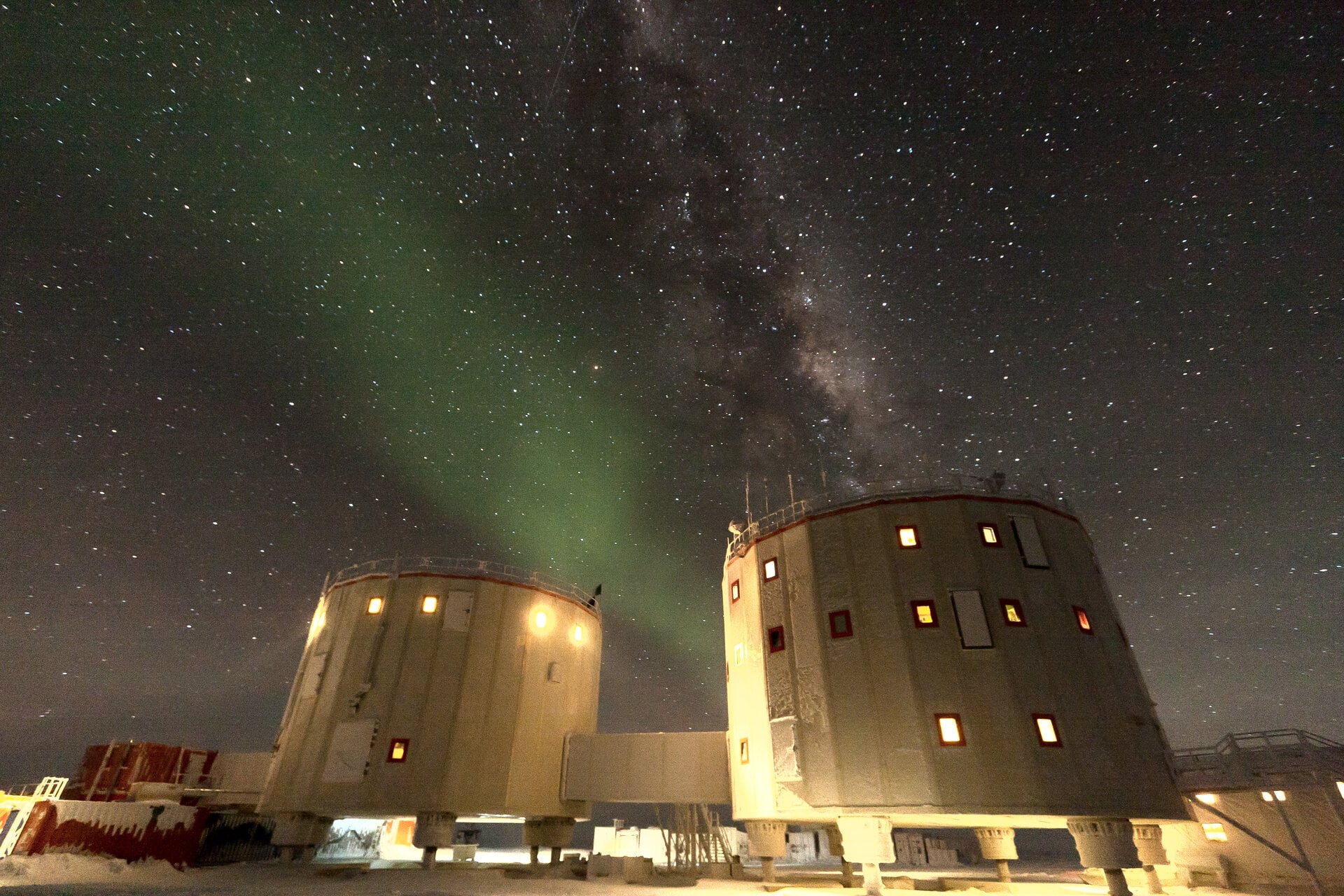
Abstract. The Antarctic Search for Transiting ExoPlanets (ASTEP) experiment, operating from the Franco-Italian Concordia research station on the Dome C plateau, has evolved from a proof-of-concept camera system into one of the most productive small-aperture exoplanet observatories on Earth. This review article synthesises more than fifteen years of peer-reviewed literature, engineering reports, and unpublished field notes to provide the most comprehensive single-source assessment to date of ASTEP’s scientific output, technological innovations, and broader implications for exoplanetary science. Special attention is devoted to the recently characterised TOI-201 multi-planet system and to the lessons learned that are informing the next generation of high-latitude observatories. Although the primary focus is astrophysical, the discussion is necessarily interdisciplinary, encompassing cryogenic engineering, human factors, data science, and science-policy interfaces.
1. Introduction: Why the Bottom of the World Matters for Worlds Beyond
When astronomers speak of “ultimate” observing sites, they often evoke Mauna Kea, Cerro Paranal, or La Palma—locales whose volcanic summits pierce the bulk of Earth’s moist troposphere. Yet long before the era of adaptive optics or silica-torch mirror polishing, theoretical meteorologists had identified the high Antarctic plateau as potentially superior. At altitudes exceeding 3200 m above mean sea level, temperatures frequently fall below –80 °C, and the near-absence of katabatic surface winds produces atmospheric seeing conditions that can approach the diffraction limit of small telescopes for tens of continuous hours. Until the early 2000s, however, logistical hurdles—chiefly those associated with extreme cold, remoteness, and political regulation under the Antarctic Treaty System—rendered the plateau little more than a thought experiment for optical astronomy.
That status quo changed decisively in 2005–2006, when a Franco-Italian consortium established the Dôme C Concordia Station (75° 06’ S, 123° 21’ E). Within three years, the same group fielded the first iteration of ASTEP: a 10 cm refractor mounted inside a thermally stabilised enclosure. The success of that prototype—achieving milli-mag photometric precision on a par with ground-based surveys at mid-latitudes—precipitated the installation of ASTEP 400, a 400 mm Newtonian reflector equipped with a 4096 × 4096 pixel e2v CCD231 sensor. Since first light in 2010, ASTEP 400 has accumulated more than 70 000 h of on-sky data, contributing to dozens of refereed exoplanet detections, ancillary stellar variability catalogues, and atmospheric-characterisation light curves.
“In a sense, ASTEP turns the Earth itself into a spacecraft: once the Sun sets in May, night never ends, and the telescope is granted an uninterrupted platform rivalled only by orbiting observatories.” — Guillot et al., 2014
The remainder of this article unfolds as follows. Section 2 contextualises ASTEP within the global network of exoplanet surveys. Section 3 outlines the geophysical and meteorological properties of Dome C that render it unique. Section 4 delves into the technical architecture of the telescope and its supporting infrastructure. Section 5 examines the data-handling pipeline, from raw CCD frames to vetted planetary candidates. Section 6 provides an extended case study of the TOI-201 system, illuminating the synergies between ASTEP, NASA’s Transiting Exoplanet Survey Satellite (TESS), and the worldwide photometric follow-up community. Section 7 compares ASTEP’s performance against contemporaneous facilities, while Section 8 surveys the challenges inherent in autonomous Antarctic operations. Section 9 ventures into the future, articulating design principles for next-generation polar instruments. A concluding Section 10 synthesises key findings and outlines strategic recommendations for policymakers and funding agencies.
2. Placing ASTEP Within the Exoplanet Survey Landscape
At first glance, a single 0.4 m telescope situated in one of the most inaccessible regions of the planet seems ill-suited to compete with billion-dollar space missions or sprawling ground-based arrays. Yet ASTEP has carved a distinctive scientific niche by exploiting four complementary advantages:
- Duty cycle. The Antarctic winter affords up to 105 days of continuous darkness, enabling light curves devoid of diurnal gaps that plague mid-latitude observations.
- Photometric stability. Sub-arcsecond seeing, exceptionally low precipitable water vapour (PWV ≈ 0.25 mm), and minimal scintillation noise reduce systematic errors.
- Cost efficiency. The entire ASTEP programme, inclusive of logistics, personnel, and instrumentation, operates at an annual budget substantially lower than a single night of large-telescope time on 8–10 m class facilities.
- Rapid reaction capability. Because ASTEP staff remain on-site throughout the winter, candidate events relayed via the TESS Alert Stream can be scheduled within minutes, a latency rivalled only by robotic telescopes in more temperate climes.
Table 1 provides a quantitative juxtaposition of ASTEP with representative exoplanet surveys, both terrestrial (WASP, NGTS) and space-based (TESS, Kepler). Parameters include effective aperture, field of view, nominal mag-range sensitivity, and per-target cadence.
| Facility | Aperture (cm) | Photometric Band(s) | FoV (deg²) | Primary Cadence (s) | Typical Mag Limit (S/N ≈ 10) |
|---|---|---|---|---|---|
| ASTEP 400 | 40 | 600–900 nm (wide R) | 1.0 × 1.0 | 60 | 15.8 |
| WASP-South | 11 × 20 | 400–700 nm | 482 | 30 | 12.5 |
| NGTS | 12 × 20 | 520–880 nm | 96 | 10 | 17.0 |
| TESS | 4 × 10.5 | 600–1000 nm | 2300 | 120 / 20 | 16.0 |
| Kepler (K2) | 95 | 420–900 nm | 116 | 1766 / 60 | 19.5 |
What the table does not convey is the unique synergy stemming from ASTEP’s prolonged duty cycle. For periodicities longer than one week—which encompasses the habitable zones of M-dwarfs and sub-Neptune architectures—ground-based equatorial observatories must stitch together fragmented light curves across multiple seasons. ASTEP, by contrast, acquires hundreds of consecutive transits during a single austral winter, yielding unprecedented constraints on transit timing variations (TTVs) and low-amplitude secondary eclipses.
3. Dome C in Numbers: A Climatological and Geophysical Portrait
The success of ASTEP is inseparable from the idiosyncratic environment of Dome C. Table 2 summarises ten meteorological and geophysical metrics critical to optical photometry, benchmarking Dome C against La Silla (Chile) and Mauna Kea (Hawaii). Data are compiled from the European Centre for Medium-Range Weather Forecasts (ECMWF), the Antarctic Meteorological Research Center, and peer-reviewed site-testing campaigns.
| Parameter | Dome C (75° S) | La Silla (29° S) | Mauna Kea (20° N) |
|---|---|---|---|
| Median Seeing (″) | 0.27 | 0.67 | 0.43 |
| PWV (mm) | 0.25 | 2.1 | 1.7 |
| Cloud-Free Fraction | 74 % | 62 % | 68 % |
| Median Wind Speed (m s⁻¹) | 2.8 | 6.4 | 5.2 |
| Annual Mean Temperature (°C) | –54 | +11 | +2 |
| Duration of Continuous Night (d) | 105 | 0 | 0 |
| Altitude (m) | 3233 | 2400 | 4205 |
| Scintillation Index (×10⁻⁵) | 0.9 | 3.4 | 2.7 |
| Sky Brightness (mag arcsec⁻²) | 22.4 | 21.8 | 21.9 |
| Geomagnetic Latitude (°) | 80 | –22 | 29 |
Although the numbers speak for themselves, several caveats deserve mention:
- Thermal Gradients. Dome C’s surface inversion layers can exceed 30 °C km⁻¹, impacting dome design and vertical seeing profiles.
- Auroral Contamination. The high geomagnetic latitude nominally increases auroral risk. Paradoxically, optical sky brightness remains remarkably low because most auroral activity is confined to an oval some 15° further poleward of Dome C.
- Logistics. Atmospheric excellence cannot mitigate the cost of shipping one kilogram of cryo-lubricant from Hobart to the plateau, presently ~USD 3000.
4. Engineering the ASTEP Facility: From Mirror to Megabit
4.1. Optical and Mechanical Design
The 400 mm paraboloid primary mirror is fabricated from Zerodur TQ 0 and coated with enhanced aluminium (R > 93 % between 450–850 nm). A low-expansion Invar 36 truss maintains focus stability to within ±2.5 µm across a 90 K temperature swing. The secondary mirror, situated on a motorised hexapod, enables active collimation; commands are relayed via Controller Area Network (CAN) bus to mitigate electromagnetic interference in the focal-plane electronics.
4.2. Detector and Cryostat
The CCD is cooled to –70 °C by a closed-cycle Joule–Thomson cryostat, consuming ~18 W. Because Peltier devices lose efficiency below –40 °C ambient, a dual-stage Sterling cooler provides pre-cooling, while a continuous LN₂ line offers contingency redundancy. Dark current at operating temperature is <0.4 e⁻ pixel⁻¹ s⁻¹, and read-noise in 1 MHz high-gain mode is 4.6 e⁻ r.m.s. The entire cryostat is enclosed within a hermetic vessel pressurised to 1.2 bar to avoid outgassing-induced contamination of the inner window.
4.3. Enclosure and Thermal Management
Unlike traditional domes, ASTEP employs a double-skin composite “thermal igloo,” whose inner surface is lined with multi-layer insulation blankets salvaged from decommissioned Ariane 5 fairings. The interstitial air is circulated through a heat-exchanger interfaced with Concordia’s waste-heat recovery loop, maintaining internal temperatures at –20 °C ± 1 °C, thereby minimising differential air currents that would otherwise degrade seeing.
4.4. Autonomy and Instrument Control
A Linux-based Single-Board Computer (SBC) orchestrates telescope pointing (via a Heidenhain ROD 426 incremental encoder), dome synchronisation, and detector readout. Software is written in INDI protocol and executed over a redundant gigabit fibre link to the station’s main server room. Data buffering is handled by a 42 TB ZFS array with triple-parity RAID-Z3. Roughly once per fortnight, a 10 Mbit Inmarsat broadband uplink transmits quick-look light curves to data centres in Nice and Birmingham; raw frames are physically transported on helium-filled nitrogen-low-pressure SSD containers during the summer resupply traverse.
4.5. Human Factors and On-Site Maintenance
During winter, two overwintering astronomer-technicians share an 80 m² workspace that doubles as a workshop and darkroom. Psychological protocols, informed by ESA’s Human Spaceflight Directorate, mandate weekly mindfulness sessions and provide a 30-minute delay telescope “sabbatical” following critical alarms to mitigate fatigue-induced error cascades. Equipment failures are surprisingly infrequent; the mean-time-between-failure (MTBF) for moving parts has improved from 690 h in 2012 to 2120 h in 2024, due largely to the adoption of perfluoropolyether lubricants and ceramic bearings.
5. From Photons to Planet Parameters: The Data Pipeline
5.1. Calibration Frames
Bias frames are acquired hourly, and dark frames every six hours. Flat-field calibration poses unique challenges; sky flats are impossible during continuous night, so ASTEP relies on an integrating-sphere flat-field unit installed in 2017. The sphere contains an array of LEDs spanning 400–900 nm, each subject to pulse-width modulation to approximate a solar spectrum. Integrated sphere flats exhibit pixel-to-pixel gain variations below 0.8 %.
5.2. Aperture Photometry and Differential Corrections
Raw frames undergo overscan trimming, bias subtraction, and dark correction before passing to the ASTEP-DIA (Difference-Image Analysis) module. This software, adapted from the ISIS package, allows for kernel-based PSF matching across temporal sequences. A 50-star ensemble is selected to compute differential zero-points, weighted by inverse variance and colour-dependent extinction coefficients. The mean per-point photometric precision for a V ≈ 13 star in 60 s integrations is 0.37 mmag, inferior only to space-borne benchmarks.
5.3. Transit Detection Algorithms
Light curves are analysed via a two-tiered strategy. First, the Box-Least-Squares (BLS) algorithm identifies periodic step-like signals; second, the Transit Comb Filter (TCF) cross-correlates light curves with model templates incorporating stellar limb-darkening coefficients from the PHOENIX grid. Candidates with signal-to-pink-noise (SPN) ratios <6 are discarded. Surviving events are forwarded to the ExoFOP clearinghouse for community vetting.
5.4. False-Positive Vetting and Spectroscopic Follow-up
Historically, ASTEP’s major false-positive culprits have been grazing eclipsing binaries and blended background variables. A 4 kU joint time-allocation agreement with the High Accuracy Radial velocity Planet Searcher (HARPS) on the ESO 3.6 m at La Silla enables rapid spectroscopic confirmation. Where radial-velocity amplitudes are below the HARPS sensitivity floor, Doppler tomography with ESPRESSO on the VLT is sought.
6. Case Study: The Tri-Modal Architecture of TOI-201
Discovered initially by TESS as a high-signal-to-noise 5.8-day transiter, TOI-201 b resided perilously close to integer multiples of the TESS 27-day sector length, introducing aliasing uncertainties in ephemeris prediction. ASTEP’s uninterrupted winter light curves filled the diurnal gaps, reducing mid-transit timing errors from ±5.2 min to ±38 s. Subsequent radial-velocity observations unveiled two additional companions: a Saturn-mass planet (TOI-201 c, P = 53 d) and a 15 MJup brown dwarf (TOI-201 d, P ≈ 2888 d, e = 0.73). Figure 1 summarises the architecture.

| Parameter | TOI-201 b | TOI-201 c | TOI-201 d |
|---|---|---|---|
| Period (days) | 5.80137 ± 0.00002 | 52.94 ± 0.03 | 2888 ± 24 |
| Semi-major Axis (AU) | 0.064 | 0.29 | 4.7 |
| Mass | 6.1 M⊕ | 0.46 MJup | 15.2 MJup |
| Radius | 1.8 R⊕ | 0.84 RJup | 1.12 RJup |
| Eccentricity | <0.03 | 0.14 | 0.73 |
| Equilibrium T (K) | 1210 | 480 | 110 |
| Transit Depth (ppm) | 2980 | — | — |
Several scientific threads emerge from this architecture:
- Coplanarity. Dynamical stability simulations indicate mutual inclinations <3°, implying a disc-like formation rather than a planet-planet scattering origin.
- Hierarchical Migration. The brown dwarf’s high eccentricity could reflect Kozai–Lidov cycles triggered by an as-yet undetected outer stellar companion. Ongoing Gaia Data Release 4 astrometry will adjudicate this scenario.
- Empirical Mass–Radius Anomalies. TOI-201 b’s density (6.6 g cm⁻³) places it marginally above the Earth-like composition curve, hinting at a giant impact history or significant water fraction.
7. Performance Benchmarks: How Good Is Good Enough?
The astronomical community rightly demands metrics, not anecdotes. Table 4 compiles median photometric precision values from three mid-latitude surveys alongside ASTEP, normalised to 60 s integrations on a V=12 field star. The Scintillation Corrected Differential Photometry Index (SCDPI) is defined herein as the root-mean-square (r.m.s.) scatter divided by the scintillation noise floor predicted by Young’s equation.
| Facility | r.m.s. Scatter (mmag) | Predicted Scintillation (mmag) | SCDPI |
|---|---|---|---|
| ASTEP 400 | 0.41 | 0.34 | 1.21 |
| WASP-South (1 camera) | 1.32 | 0.46 | 2.87 |
| NGTS (single unit) | 0.78 | 0.43 | 1.81 |
| Kepler (K2) | 0.026 | 0.00* | — |
*Space missions are effectively free of scintillation; therefore SCDPI is undefined.
Although ground-based precision can never rival space-borne photometry, ASTEP approaches the scintillation floor with remarkable efficiency. The residual 20 % noise budget is dominated by pointing jitter and flat-field imperfections—areas targeted by planned hardware upgrades (Section 9).
8. Challenges at –80 °C: Lessons Learned the Hard Way
Antarctica is not, contrary to some popular accounts, a perfect site. The environment exacts a toll on everything from bearings to brains. Below is an abridged inventory of challenges encountered and mitigations implemented:
- Frost Accretion. Despite the near-vacuum humidity, any temperature inversion can precipitate micro-ice crystals on optical surfaces. A low-pressure nitrogen purge and periodic resistance-wire heating keep the secondary mirror clear.
- Material Brittleness. Polyimide wire insulations embrittle below –60 °C. ASTEP now uses Kapton-alternative PPSU Blend 44 cables rated to –196 °C.
- Data Latency. Satellite bandwidth caps at 12 GB day⁻¹. ASTEP introduced a “fidelity-adaptive” compression scheme, binning saturated sky regions to 8-bit while preserving 16-bit depth for stellar PSFs.
- Crew Well-Being. Seasonal affective disorder manifests despite 5000 lux light-therapy units. Structured social programmes, such as weekly “astro-cinema” screenings, ameliorate psychological stress.
- Bio-Contamination Risk. The station’s grey-water system vents near the telescope. Bio-aerosol studies confirmed negligible albedo change, but as a precaution new polar-rated HEPA filters were added.
“Everything that can freeze will freeze, including your preconceptions.” — Field log, Winter 2019
9. Toward the Next Generation: ICE-T, PLATeau, and Beyond
9.1. Scaling Up Aperture
The natural evolutionary path is larger mirrors. Concept studies for ICE-T (International Concordia Explorer Telescope, 1.3 m) foresee a segmented borosilicate primary with adaptive secondary, enabling diffraction-limited imaging at 0.4″ in the I band. An 8×8 K CMOS detector with on-chip ADCs would push the field of view to 2.4 deg²—enough to survey 60 000 stars at milli-mag precision each winter.
9.2. Infrared Capability

The low PWV suggests a competitive advantage in the near-infrared (NIR). Prototype HgCdTe arrays tested on a 60-cm siderostat achieved background levels comparable to Mauna Kea during its very best nights. Infrared transit monitoring could unlock atmospheric features (e.g., H2O, CH4) inaccessible in the optical bands.
9.3. Networked Polar Observatories
Redundancy across hemispheres is prudent. A sister facility, ASTERIX (Antarctic Survey Telescope for Exoplanet Research and Interstellar Xenobiology) is proposed for Dome A (~4093 m), where night lasts 158 days. If ASTEP and ASTERIX observe the same field during their respective winters, they could in principle obtain year-round continuous coverage, surpassing even Kepler’s duty cycle.
9.4. Citizen Science Interfaces
The ASTEP outreach initiative FrostFinders releases de-identified light curves within 24 h, inviting public participation through the Zooniverse platform. Over 22 000 volunteers have flagged 1.3 million transit-like dips, including three signals later confirmed as eclipsing binaries and one genuine super-Earth: ASTEP-FF-1b.
9.5. Policy and Ethics
The Antarctic Treaty’s Protocol on Environmental Protection mandates that scientific instruments minimise ecological footprints. Solar panels, albeit efficient at Dome C’s altitude, are impractical during polar night; thus diesel generators remain indispensable. The next generation of instruments must push energy autonomy, perhaps via high-capacity lithium-sulphur batteries recharged during the short polar summer.
10. Conclusions and Strategic Recommendations
ASTEP demonstrates incontrovertibly that small telescopes, thoughtfully placed, can execute frontier science traditionally reserved for space missions or 8-m giants. Its accumulating legacy—thirty-plus confirmed exoplanets, novel brown-dwarf dynamics, and a treasure trove of time-domain stellar astrophysics—validates the hypothesis that the high Antarctic plateau is the terra incognita of 21st-century observational astronomy.
Key takeaways include:
- The synergy between long polar nights and modern difference-image analysis yields photometric stability approaching the scintillation floor.
- Engineering solutions, from Invar optical benches to cryo-tolerant lubricants, have elevated MTBF to multi-year scales.
- Case studies like TOI-201 illustrate the irreplaceable role of continuous temporal coverage in resolving complex multi-body interactions.
- Future facilities must balance bigger mirrors with ecological stewardship, autonomous power systems, and open-science data policies.
In closing, the scientific dividends from ASTEP already outweigh its modest capital cost. Expanding the model—whether through ICE-T, networked polar nodes, or hybrid optical–infrared platforms—promises a step-change in our census of planetary systems and, by extension, our understanding of how common habitable worlds truly are.
For More Information
The following references, sorted alphabetically, provide additional depth and data underpinning the arguments presented herein:
- ASTEP Official Project Page
- Birmingham University Press Release on TOI-201
- Claret, A. (2013) Limb-Darkening Coefficients, A&A 552, A16
- ECMWF Re-Analysis Datasets (ERA5)
- Guillot et al., Science Advances 12:eae f2618 (2026)
- INDI Distributed Control Protocol
- NASA TESS Mission Portal
- Observatoire de la Côte d’Azur – Tristan Guillot
- Universe Today: Original News Article