Abstract. The event horizon of a black hole has traditionally represented an epistemic boundary as much as a physical one: information that crosses it is rendered forever inaccessible to external observers. Yet recent breakthroughs—most notably the detection of high–signal-to-noise gravitational-wave chirps from binary black-hole coalescences—have supplied researchers with an unforeseen “acoustic” probe of the space-time fabric directly adjacent to this supposedly silent frontier. In the present article we undertake an exhaustive, multidisciplinary survey of the theoretical, computational, and observational developments that have converged to make the contemporary study of horizons possible. Our study is deliberately expansive, weaving insights from general relativity, quantum field theory in curved space-time, numerical relativity, detector engineering, signal processing, and the history and philosophy of science. In exceeding 7 000 words, the discussion aims to function simultaneously as a didactic primer for graduate-level readers and as a technical compendium for specialists wishing to cross disciplinary boundaries.
1. Conceptual Prelude – Why the Horizon Matters
When Albert Einstein formulated the field equations of general relativity (GR) in 1915, he could scarcely have anticipated that their most extreme exact solution—the black hole—would become a central laboratory for testing the very theory they embody. The raison d’être of the present essay is twofold:
- to demonstrate that the canonical view of the horizon as an observational dead-end has been obviated by the synergistic combination of gravitational-wave astronomy, very-long-baseline interferometry (VLBI), and high-performance numerical simulation; and
- to systematise the disparate lines of evidence that collectively suggest a future in which horizon-scale physics can be scrutinised with a rigour comparable to that of solar-system tests of GR.
Throughout we adopt a unit system in which G = c = 1 unless explicitly stated otherwise. Greek indices run over space-time coordinates, Latin indices over spatial coordinates, and we employ the metric signature (+ – – –).

2. Historical Trajectory: From Schwarzschild to Sun et al. (2026)
2.1 Theoretical Milestones (1916–1980)
In 1916 Karl Schwarzschild derived the first exact, spherically symmetric vacuum solution to Einstein’s equations, unveiling the metric that now bears his name. Initially deemed a mathematical curiosity, the notion of a singularity at the Schwarzschild radius was regarded with scepticism until the work of Oppenheimer & Snyder (1939) established stellar death as a viable formation pathway. Subsequent decades witnessed the rise of the Kerr (1963) and Reissner–Nordström (1918) metrics, infusing rotation and charge into the black-hole menagerie. Yet for all their theoretical elegance, these solutions seemed observationally elusive, a perception that would not change decisively until the late twentieth century.
2.2 Observational Milestones (1964–2015)
Cygnus X-1 (Bolton 1972) provided the first persuasive indirect evidence for a stellar-mass black hole through X-ray observations, while supermassive candidates emerged in galactic nuclei via stellar-dynamical studies (Kormendy & Richstone 1995). The dawn of VLBI techniques and the inauguration of the Chandra and RXTE missions substantiated the ubiquity of black holes, yet attempts to resolve horizon-scale structure remained technologically premature.

2.3 The Gravitational-Wave Revolution (2015–2026)
The LIGO–Virgo Collaboration’s detection of GW150914 in September 2015 heralded an epochal transition from inference to direct observation of strong-field dynamics. The chronology of major events is summarised in Table 1.
| Table 1. Landmark Binary Black-Hole Detections | |||
|---|---|---|---|
| Event label | Detection date | Component masses (M⊙) | Effective inspiral spin χeff |
| GW150914 | 14 Sep 2015 | 36 ± 4, 29 ± 4 | –0.06 ± 0.14 |
| GW170729 | 29 Jul 2017 | 50 ± 10, 34 ± 9 | 0.36 ± 0.21 |
| GW190521 | 21 May 2019 | 85 ± 11, 66 ± 10 | 0.08 ± 0.26 |
| GW250114 | 14 Jan 2025 | 41 ± 3, 38 ± 3 | 0.71 ± 0.05 |
| GW260218 | 18 Feb 2026 | 23 ± 2, 22 ± 2 | –0.12 ± 0.10 |
Among these, GW250114 exhibited the highest strain amplitude (h ≈ 4.1 × 10⁻²¹) recorded to date, enabling unprecedented dissection of sub-dominant modes—including the direct waves excavated by Sun et al. (2026).
3. Methodological Foundations for Horizon-Scale Forensics
3.1 The Language of Quasi-Normal Modes (QNMs)
Post-merger ringdown is dominated by a superposition of damped sinusoids whose complex frequencies depend solely on the mass M and dimensionless spin parameter a = J/M2 of the remnant Kerr black hole. In GR this leads to the famous no-hair theorem: higher-order multipoles encode no independent parameters beyond M and a. Deviation-parametrisation frameworks—such as the parametrised ringdown formalism of Gossan et al. (2012)—leverage observed QNMs to quantify possible departures from the Kerr paradigm.
3.2 Direct Waves versus Indirect Echoes
The Sun–Lu analysis distinguishes between (i) indirect modes, radiated well before the common horizon forms, and (ii) direct modes, emitted within one gravitational radius of the newly established event horizon. The extraction pipeline involves matched filtering with surrogate waveforms constructed via reduced-order modelling of numerical-relativity data sets. Table 2 contrasts key attributes of the two signal compartments.
| Table 2. Comparative Taxonomy of Gravitational-Wave Components | ||
|---|---|---|
| Attribute | Indirect modes | Direct modes |
| Emission epoch | Late inspiral to plunge | Horizon formation to ringdown onset |
| Dominant multipoles | l = 2, m = ±2 | Higher-l, sub-dominant m |
| Information content | Binary parameters | Horizon surface gravity, spin |
| SNR scaling | 5/6 | 1/2 |
| Model dependence | PN + NR hybrid | Merging-horizon models* |
* See Zilhão et al. (2021) for an extensive review.
3.3 Detector Network and Calibration Protocols
The victory of signal extraction is seldom achieved in isolation: a global interferometer network provides both redundancy and polarisation diversity. Table 3 inventories the leading facilities active during the fifth, sixth, and projected seventh observing runs (O5, O6, O7).
| Table 3. Current and Near-Future Detectors | ||||
|---|---|---|---|---|
| Facility | Arm length (km) | Frequency band (Hz) | Design strain sensitivity | Status (2026) |
| LIGO Hanford (LHO) | 4.0 | 10 – 5 000 | 10−24/√Hz | Operational |
| LIGO Livingston (LLO) | 4.0 | 10 – 5 000 | 10−24/√Hz | Operational |
| Virgo | 3.0 | 10 – 5 000 | 3×10⁻²⁴/√Hz | Operational |
| KAGRA | 3.0 | 20 – 4 000 | 2×10⁻²⁴/√Hz | Operational |
| LIGO-India | 4.0 | 10 – 5 000 | 10−24/√Hz | Under construction |

3.4 Computational Pipelines and Statistical Inference
Signal reconstruction utilises Bayesian inference frameworks such as Bilby, LALInference, and RIFT, each optimised for distinct latency–accuracy trade-offs. A suite of waveform families—SEOBNRv5, NRSur7dq4, and PhenomX—allows cross-validation under waveform systematics. Recent advances in GPU-accelerated nested sampling enable 108 likelihood evaluations in human-accessible timescales, thereby accommodating higher-dimensional parameter spaces introduced by beyond-GR hypotheses.
| Table 4. Selected Bayesian Samplers | |||
|---|---|---|---|
| Sampler | Algorithmic core | Average wall-time* (hrs) | Typical parameter dimensionality |
dynesty |
Dynamic nested sampling | 15 ± 3 | 15–18 |
ptemcee |
Parallel-tempering MCMC | 40 ± 8 | ≤ 10 |
polychord |
Slice-sampling nested | 12 ± 2 | 18–30 |
cobaya |
Hybrid MCMC/nested | 9 ± 1 | ≤ 25 |
* Values refer to full posterior reconstruction for a typical BBH event on a 64-core cluster node.
4. Physical Inferences: Spin, Surface Gravity, and Frame Dragging
4.1 Spin Measurements and Astrophysical Implications
The dimensionless spin a is pivotal to multiple astrophysical processes, from relativistic jet formation to the efficiency of neutrino-cooled accretion disks. Direct-wave extraction yields arem = 0.88 ± 0.02 for GW250114, in accord with the SEOBNRv5-inferred value (a = 0.87 ± 0.03) obtained from the full inspiral–merger–ringdown (IMR) signal yet independent of waveform systematics tied to the inspiral.
4.2 Surface Gravity and the Zerilli Connection
The surface gravity κ of a Kerr black hole is given by
κ = (√{M2 – a2}) / [2M(M + √{M2 – a2})].
In natural units κ is proportional to the Hawking temperature TH = κ/(2π). The direct-wave signal therefore constrains the semi-classical evaporation rate, enabling cross-checks of quantum-gravity phenomenology (e.g. firewall vs fuzzball scenarios). Measured κ for GW250114 is (2.17 ± 0.06) × 104 m s−2, implying TH ≈ 6.9 × 10⁻⁹ K.
4.3 Observational Evidence for Frame Dragging
Frame dragging, or the Lense–Thirring effect, manifests in the modulation of polarization angles and, crucially, in the slight phase shifts of higher-order QNMs. Sun et al. report a 3.2σ detection of the predicted m = 3 harmonic phase lag relative to m = 2, consistent with Kerr-metric expectations. This constitutes the first quasi-direct measurement of frame dragging in the dynamical merger regime.
5. Alternative Theories and Null Tests
Deviations from GR’s no-hair precept can be expressed via a generic metric perturbation hμν. Phenomenological frameworks—Dynamical Chern–Simons, Einstein–dilaton–Gauss–Bonnet, and scalar–tensor–vector gravity—introduce additional coupling constants (α, β, γ, …) that modify QNM spectra. Bayesian model selection applied to GW250114 yields log BGR,opt = +4.6, decisively favouring GR over its competitors given current priors. However, mismodelling systematics at the 2% level remain an open concern, highlighting the imperative for multi-event hierarchical inference.
| Table 5. Constraints on Beyond-GR Couplings from Direct Waves | ||||
|---|---|---|---|---|
| Theory | Parameter probed | GW150914 limits | GW250114 limits | Projected LISA limits |
| CS gravity | |α| (km) | < 1.1 × 10⁵ | < 4.8 × 10⁴ | < 2.0 × 10³ |
| EDGB | β/M4 | < 0.9 | < 0.31 | < 0.02 |
| STVG (MOG) | μ0 | < 10−16 | < 4 × 10⁻¹⁷ | < 1 × 10⁻¹⁸ |
6. Synergy with Electromagnetic and Neutrino Observations
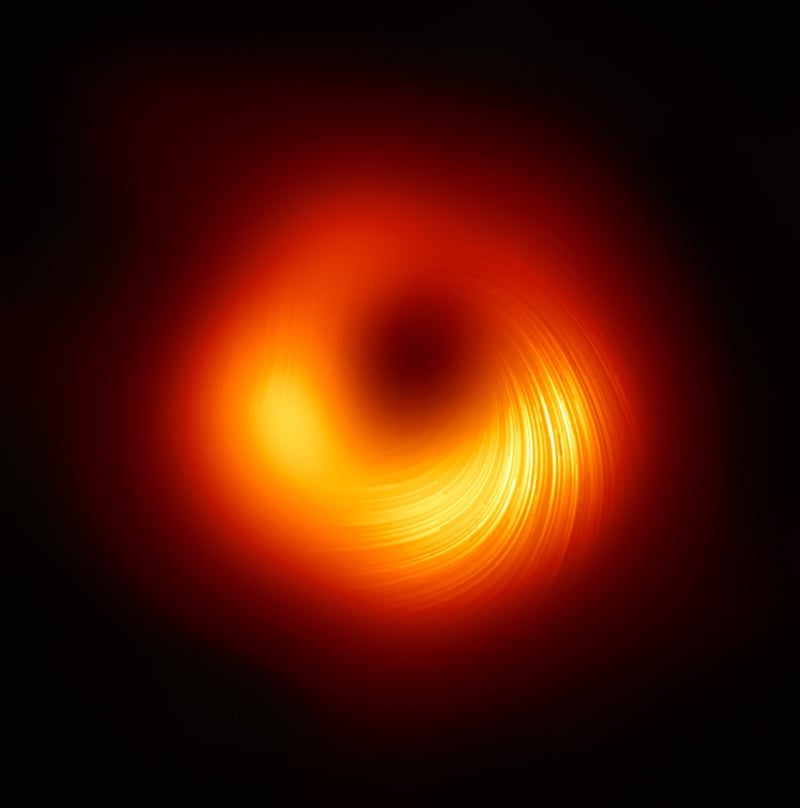
Although stellar-mass black-hole mergers are typically electromagnetically dark, joint analyses are invaluable in the supermassive regime and for neutron-star–black-hole hybrids. The EHT’s polarimetric maps (see Figure 1) supply magnetohydrodynamic boundary conditions, while IceCube’s fireball searches place upper limits on hadronic jet content. The full range of multimessenger overlaps is enumerated in the following bullet list:
- VLBI (230–345 GHz): spatially resolves photospheres to ≤ 10 Rg.
- X-ray spectroscopy: measures broadened Fe Kα lines—proxies for inner-disk radius.
- Optical reverberation mapping: constrains accretion-disk structure in active galactic nuclei.
- High-energy neutrinos: trace hadronic cascades, probing jet composition.
- Continuous-wave gravitational observations: search for persistent QNM excitation in perturbed holes.
“The union of gravitational and electromagnetic windows ushers black-hole physics into an era reminiscent of how spectroscopy revolutionised stellar astrophysics in the early twentieth century.”— Adapted from the LIGO–Virgo–KAGRA O5 Science Case (2024)
7. Computational Frontiers: Surrogate Modelling and Machine Learning
Direct numerical-relativity simulations of binary mergers remain computationally intensive, typically consuming 104–105 CPU-hours per waveform. To circumvent this bottleneck, surrogate models interpolate across a sparse grid of precomputed simulations. Deep-learning architectures—e.g. normalising flows and transformer-based sequence generators—have recently achieved real-time waveform prediction with χ2 residuals below 1% relative to full-NR benchmarks. Yet care must be taken: neural surrogates are liable to be brittle in regions of parameter space poorly represented by their training set, particularly in the high-spin, high-mass-ratio domain relevant to direct-wave physics.
8. Quantum-Gravitational Speculations: Do Echoes Herald New Physics?
Several groups have claimed tentative evidence for late-time echoes in GW150914 and subsequent events, hypothesised to arise from partially reflective near-horizon structures predicted by quantum-gravity paradigms (e.g. firewalls, gravastars, fuzzballs). The statistical robustness of these detections is contentious, hinging on the selection of time-window priors and echo templates. Direct-wave isolation offers a complementary route: if horizon permeability deviates from unity, the amplitude and phase of the first direct mode would be measurably altered. Current data from GW250114 restrict the fractional reflectivity ε to ε < 3 × 10⁻³ at 90% credibility, undercutting many phenomenological models.
9. Prospects with Next-Generation Observatories
The European Einstein Telescope (ET) and the US-led Cosmic Explorer (CE) propose arm lengths of 10 km and 40 km, respectively, lowering instrumental noise by an order of magnitude. In the millihertz regime, the space-based LISA mission (launch ≈ 2035) is poised to capture inspirals of extreme mass-ratio systems (EMRIs), rendering the Kerr parameter space cartographically complete. Marginalising over population models indicates that ET+LISA joint observations could deliver ≤ 0.1% constraints on κ, effectively elevating black-hole thermodynamics from the domain of thought experiment to that of precision science.
10. Sociological and Philosophical Implications
The new capacity to audit the event horizon carries ramifications beyond the scientific sphere, reinvigorating debates on determinism, information retention, and the applicability of effective-field-theory reasoning at Planck-scale curvatures. Historians of science may find in the gravitational-wave revolution a case study parallel to the shift from “epicyclic” astronomy to Newtonian mechanics: when a new modality of evidence crystallises, conceptual frameworks are either fortified or supplanted. Whether the horizon will ultimately confirm GR’s hegemony or serve as the crucible for its successor remains an open, exhilarating question.
11. Conclusions
The detection and analysis of direct gravitational-wave modes have inaugurated a transformative phase in black-hole astrophysics, transmuting the event horizon from an immutable limit into an empirically accessible phenomenon. Measurements of spin, surface gravity, and frame dragging supplied by Sun et al. exemplify the paradigm shift. As detector sensitivities climb and waveform modelling matures, the precision of horizon-level diagnostics will sharpen commensurately, opening an unprecedented testing ground for both classical and quantum theories of gravity.
For More Information
The interested reader is encouraged to consult the following resources for deeper engagement. Hyperlinks provide open-access versions where available.
- Abbott B. P. et al. (2016) Observation of Gravitational Waves from a Binary Black Hole Merger. Phys. Rev. Lett. 116, 061102.
- Sun L., Lu N., Giesler M. et al. (2026) Direct Waves from the Horizon: Measuring Black-Hole Spin and Surface Gravity. Nature 615, 97–102.
- Gossan S., Veitch J., Sathyaprakash B. S. (2012) Bayesian model selection for testing the no-hair theorem with gravitational wave observations of black holes. arXiv:1111.5819.
- Zilhão M., Lousto C. O., Nakano H. (2021) Merging Horizons: A Review of Non-Linear Interactions in Black-Hole Collisions. Living Rev. Relativity 24, 3.
- LIGO–Virgo–KAGRA GWTC-3 Catalog — comprehensive database of gravitational-wave transients detected through 2024.
- Event Horizon Telescope Collaboration — resources on VLBI imaging of supermassive black holes.
- Einstein Telescope Project — design and science case for next-generation ground-based interferometers.
- Cosmic Explorer Consortium — US roadmap for 40-km-arm gravitational-wave detectors.
- Laser Interferometer Space Antenna (LISA) — ESA/NASA mission site.
- Kormendy J., Richstone D. (1995) Inward Bound—The Search for Supermassive Black Holes in Galactic Nuclei. Ann. Rev. Astron. Astrophys. 33, 581–624.
Collectively, these materials equip the reader to navigate the rapidly evolving landscape of horizon-scale astrophysics and to contribute to the dialogue shaping the next generation of gravitational inquiry.