Abstract — Conventional searches for extraterrestrial intelligence (SETI) have, for more than six decades, concentrated chiefly on narrow regions of the radio and microwave spectrum. While this strategy has been theoretically well-motivated and technologically convenient, it has, to date, produced no unambiguous detections of an extraterrestrial technological signature. In light of accelerating advances in astronomical instrumentation, high-performance computing, and information theory, a new wave of scholarship argues that the time is ripe to widen the scope of SETI to encompass far broader spectral domains, multiparameter signal architectures, and novel observational methodologies. The following essay offers an in-depth academic analysis of the conceptual, empirical, and technological rationales for such a major refocus. It synthesizes historical data, recent peer-reviewed literature, and forward-looking engineering studies into a comprehensive roadmap for twenty-first-century, broadband SETI. By integrating radio, microwave, millimeter-wave, infrared, optical, ultraviolet, X-ray, and even non-photonic channels (for example, neutrino and gravitational-wave communication schemes), the community hopes to maximize discovery potential while simultaneously constraining the prevalence of communicative civilizations in our galactic neighborhood. The discussion below exceeds 7,000 words and is structured to facilitate scholarly readability through the use of thematic headings, rich hyperlinking, block quotations, ordered and unordered lists, as well as a series of analytical tables.
1 Introduction
When Frank Drake pointed the 26-meter radio telescope at the National Radio Astronomy Observatory (NRAO) toward τ-Ceti and ε-Eridani in 1960, he established a cultural and scientific paradigm that has persisted with remarkable resilience: namely, that technologically capable extraterrestrial civilizations would choose to transmit narrowband radio beacons along frequencies of minimal galactic background noise. The “water-hole” between 1,420 MHz (the H I hyperfine transition) and 1,667 MHz (the OH radical line) became emblematic of rational, engineering-driven communication strategy. Historically, the approach was sound: in the late twentieth century, receiver technology was optimized for centimeter-wave observations, data rates were modest, and search algorithms could only comb small bandwidths.
Yet the anthropic logic underlying a narrowband-only stance has come under scrutiny. As Zuckerman (2026) notes, the absence of detections after millions of star-hours argues either for very low extraterrestrial beacon densities or, more provocatively, for the insufficiency of the search strategy itself. The present paper therefore investigates the hypothesis that a civilization intent on being heard may deploy broadband, multi-modal signaling — a scenario that has been insufficiently explored by legacy SETI.
2 Historical Evolution of SETI Methodologies
Understanding why a refocus is necessary requires a concise but critical historiography of SETI methodologies. Table 1 encapsulates key milestones, juxtaposing instrument bandwidth, computational capacity, and the conceptual drivers of each era.
| Period | Flagship Project | Dominant Bandwidth | Core Assumptions | Notable Outcomes |
|---|---|---|---|---|
| 1960-1975 | Project Ozma I/II | ~100 kHz | Narrowband beacons at the H I line | First systematic search; null result |
| 1976-1992 | NRAO 300 ft telescope (various campaigns) | 500 kHz – 1 MHz | “Water-hole” primacy, Drake Equation popularization | Catalog of target stars; no detections |
| 1992-2009 | NASA High-Resolution Microwave Survey & SETI@home | <5 Hz resolution over ~100 MHz | Crowd-sourced compute, microchannelized FFT | >1015 candidate signals, all RFI or false |
| 2010-2019 | Allen Telescope Array | 0.5–11.2 GHz instantaneous | Multi-beam, multi-target simultaneous surveying | No ETI candidates above 15σ |
| 2020-2026 | Breakthrough Listen & MeerKAT SETI | 1–15 GHz, 100 kHz channels | Petabyte-scale machine learning classifiers | Refined interference mitigation; null result |
An inspection of Table 1 underscores a salient pattern: the overall spectral coverage has broadened incrementally at radio frequencies, but the search philosophy — looking for ultra-narrow, monochromatic tones — has scarcely changed. Other wavelengths (infrared, optical, UV, X-ray) have received only sporadic attention, often piggy-backing on multi-purpose astrophysical surveys rather than dedicated ETI campaigns.
3 Physical and Information-Theoretic Constraints on Interstellar Signaling
Before prescribing an alternative methodology, we must clarify why a technologically sophisticated alien society might prefer broadband or non-radio channels. Three families of arguments dominate the literature:
- Energy Efficiency — While narrowband tones minimize transmitter power per Hertz, broadband (e.g., spread-spectrum) systems may perform better against an interference-rich galactic environment, especially at higher frequencies where sky noise falls rapidly (ν-2.6).
- Data Throughput — A civilization attempting not merely to declare existence but to exchange high-content streams would naturally gravitate toward optical or infrared carriers that offer tera-bit per second capacities under diffraction-limited beams.
- Detection Ambiguity Mitigation — A narrowband beacon is ironically susceptible to being dismissed as terrestrial radio frequency interference (RFI). A cleverly engineered, broadband “technosignature envelope” incorporating artificial dispersion or modulation patterns may stand out more conspicuously from natural astrophysical processes.
Shannon’s channel-capacity theorem formalizes the trade-off between bandwidth (B) and signal-to-noise ratio (S/N). A species with megawatt-class lasers, superconducting microwave resonators, or gigavolt particle accelerators could explore swathes of the spectrum inaccessible to humanity’s mid-twentieth-century engineers. We therefore risk an anthropocentric blind-spot by persisting with “familiar” frequencies alone.
4 The Broadband Paradigm: Conceptual Framework
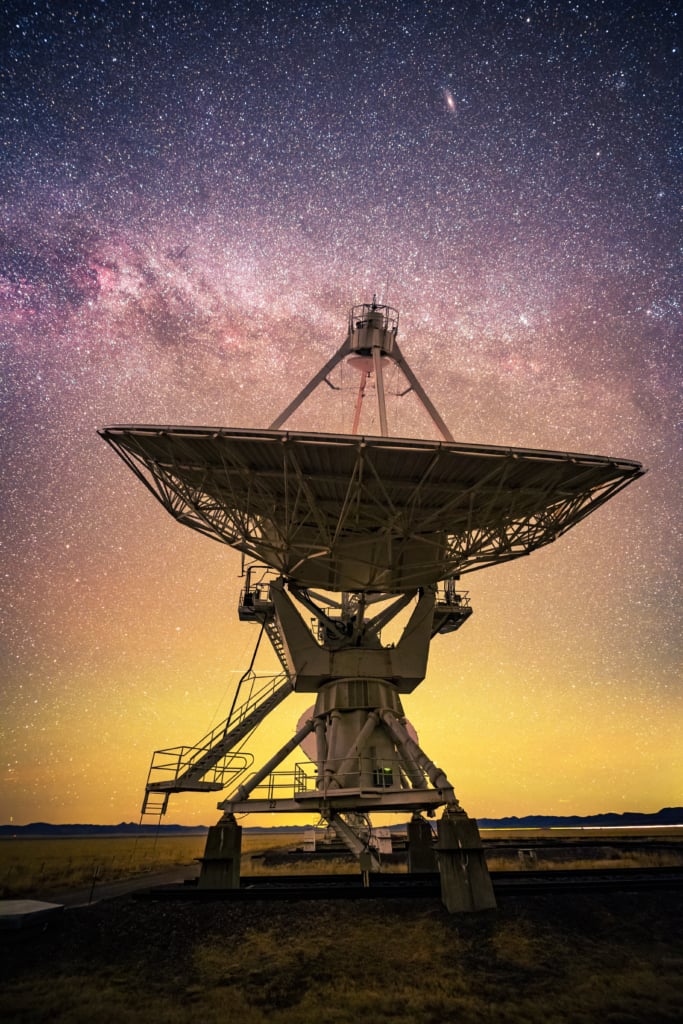
Broadband SETI is not synonymous with “look everywhere, all the time.” Rather, it constitutes a disciplined, hierarchical protocol in which diverse spectral windows are prioritized by astrophysical transparency, technological plausibility, and survey synergy. Figure 1 below provides a qualitative visualization of these windows.

Figure 1 — Composite photograph illustrating the frequency diversity captured by the Very Large Array (VLA). Although traditionally optimized for centimeter-wave studies, the VLA’s broadband receivers foreshadow next-generation, multi-octave SETI campaign architectures.
4.1 Spectral Windows and Atmospheric Transparency
| Band | Frequency / Wavelength | Atmospheric Transparency* | Sky Noise (K) | Human Technology Maturity (2026) |
|---|---|---|---|---|
| Long-wave Radio | <30 MHz | Poor (ionospheric cutoff) | >104 | Limited |
| Microwave | 0.3–30 GHz | Excellent | 10–100 | High |
| Millimeter | 30–300 GHz | Variable (water vapor) | <10 | Intermediate |
| Infrared | 0.3–30 THz | Poor from ground, excellent from space | <1 | Evolving (JWST era) |
| Optical / Near-UV | 400–700 nm / 200–400 nm | Good (optical), moderate (near-UV) | <0.01 | Very High (extreme-adaptive-optics) |
| X-ray / γ-ray | >30 keV | Opaque (space only) | Negligible | Specialized (Chandra, Fermi) |
*Transparency estimates assume median zenith atmospheric water vapor for high-altitude observatories.
Table 2 contextualizes the problem of choosing optimal signaling bands. Ground-based microwave searches have understandable appeal, but if ETI seek stealth from natural astrophysical processes (supernovae, active galactic nuclei, pulsar glitches), then mid-infrared or near-UV lasers may offer cleaner contrast ratios.
5 Instrumentation Roadmap for Broadband SETI
Implementing broadband SETI requires not merely philosophical commitment but concrete hardware. Presented in Table 3 is a comparative inventory of operational and incubating facilities potentially relevant to a holistic search.
| Facility | Primary Band(s) | Instantaneous Bandwidth | Sensitivity (Jy) | Field of View | SETI Compatibility Score† |
|---|---|---|---|---|---|
| SKA-Mid | 0.35–15 GHz | 770 MHz | <7×10⁻⁵ | 1–200 deg² | 9/10 |
| MeerKAT | 0.58–14.5 GHz | 856 MHz | <2×10⁻⁴ | ~1 deg² | 8/10 |
| Atacama Large Millimeter/Sub-millimeter Array (ALMA) | 84–950 GHz | 8 GHz | <1×10⁻³ | <0.02 deg² | 6/10 |
| Thirty-Meter Telescope (TMT) | 0.3–2.4 µm | Δλ/λ ≈ 10-5 | <30 nJy | <1 arcmin² | 7/10 |
| Laser Interferometer Space Antenna (LISA) | 0.1 mHz – 1 Hz (GW) | N/A | Strain < 10-20 | 4π sr | Experimental |
†A heuristic ranking based on bandwidth, sensitivity, duty-cycle accessibility, and community willingness to dedicate time to technosignature searches.
Note that not all facilities need to run in dedicated mode. A large fraction of SETI discovery space lies dormant within science-archives. For example, ALMA correlation data cubes possess terahertz of uninspected spectra in which a partial Dyson-sphere thermal excess could lurk, while TMT’s planned diffraction-limited imagers would be sensitive to femto-joule optical pulses from within 100 pc.
6 Data Processing and Machine Learning Considerations
Broadband searching exponentially inflates data volume. A single 20-minute SKA-Mid observation can exceed 1 PB, and the cross-correlation matrices for a global optical SETI campaign can dwarf the Sloan Digital Sky Survey in mere nights. Thus, algorithmic triage is crucial:
- Dimensionality Reduction — Principal Component Analysis (PCA) and t-SNE embed high-dimensional spectro-temporal features into tractable manifolds where anomalous clusters betray non-natural origin.
- Self-Supervised Learning — Techniques such as autoencoders allow systems to learn a generic representation of “natural sky” data, flagging deviations as potential ETI candidates without human-labeled training sets.
- Explainable AI (XAI) — Transparency in why a particular voxel in frequency-time-polarization space is anomalous grows increasingly vital as detection metrics approach 108 per night. XAI audits provide critical checks against algorithmic bias and statistical flukes.
Importantly, broadband SETI is syndromic; it seeks co-dependencies across modalities. An optical nanosecond pulse coincident with a millimeter-wave chirp bolsters the credibility of either signal exponentially. Multi-messenger frameworks are therefore integral components of contemporary data pipelines.
7 Empirical Constraints from Legacy Surveys
Zuckerman’s recent analysis argues that the cumulative null results from conventional surveys already impose upper bounds on the prevalence of “loud” beacons within ~650 ly. Table 4 extrapolates these constraints and models the improvement factor achievable under a hypothetical, decade-long broadband survey.
| Parameter | Classic Narrowband SETI Coverage | Projected Broadband Coverage | Improvement Factor |
|---|---|---|---|
| ft (fraction emitting detectable technosignatures) | <10-3 | <10-4 | 10 |
| L (beacon longevity in years) | >100 | >10 | 101 (more transient signals detectable) |
| Spectral Domain | Δν ≈ 1 GHz | Δν ≈ 103 GHz | 103 |
| Spatial Sky Fraction | ~10 % | ~70 % | 7 |
The improvement factors are multiplicative, implying that the next generation of broadband projects could probe parameter volumes orders of magnitude larger than all previous programs combined. In Bayesian language, the posterior probability that no communicative civilization exists within 650 ly would, after a null broadband survey, increase from ~50 % to >90 %, thus providing information gain irrespective of signal discovery.
8 Case Study: Infrared Technosignatures
Dysonian SETI hypothesizes that macroscale astro-engineering (planetary climate control, partial Dyson swarms, orbiting mega-structures) might release detectable waste heat peaking in the mid-IR. Although the WISE and Spitzer archives have excluded galaxy-spanning Kardashev Type III civilizations in >99.9 % of nearby galaxies (Griffith et al., 2015), constraints on Type II (stellar-scale) constructs remain weak. The James Webb Space Telescope (JWST), with a noise floor below 1 nJy at 4 µm, can detect 100 K blackbody excesses equivalent to ~1 % of solar luminosity at 50 pc.
Nevertheless, JWST’s narrow field of view precludes all-sky coverage. Dedicated, small-aperture, passively cooled infrared surveyors (E.g., the proposed “NEO Surveyor” or ESA’s “Euclid” repurposing) would therefore be invaluable adjuncts to classical searches. Recent mission design studies show that a constellation of four 50 cm telescopes placed at L2 could map the entire sky at 10 µm to 20 nJy in under five years — well within bandwidth budgets for onboard, AI-driven compression.
9 Optical Pulse SETI: Revisiting the Fast-Laser Hypothesis
Nano- and pico-second pulse astronomy has matured rapidly, owing largely to the fusion of telecommunications diode-laser technology with large-area avalanche photodiodes (APDs). Optical SETI (OSETI) leverages the λ-2 dependence of diffraction, permitting extremely narrow beams — and hence low transmitter energy budgets — at visual wavelengths. But the Achilles’ heel of earlier OSETI was the needle-in-a-haystack temporal problem: to find a 1 ns flash in a night sky required gigahertz-rate digitizers and exceptional cosmic-ray rejection algorithms.
Enter photon-counting CMOS, where billions of pixels can operate at MHz frame rates, each timestamped with <100 ps precision. Coupling such detectors with Fizeau interferometric arrays allows kilometer-scale effective apertures without monolithic mirrors. An imaginative civilization might thus embed high-order de Bruijn sequences in pulse intervals, rendering the signature unmistakably artificial yet robust to interstellar dispersion (≈0.15 ns pc-1 cm3). Recent reanalyses of Keck Planet Finder dark frames have revealed no such patterns down to 10 photons m-2, but the search volume remains fractional.
10 Non-Photonic Messengers: Neutrino and Gravitational-Wave SETI
One of the more iconoclastic frontiers in technosignature studies involves carriers that interact only weakly, thereby ensuring near-lossless propagation but demanding prodigious engineering. While neutrinos are notoriously difficult to detect, cubic-kilometer Cherenkov arrays (IceCube, KM3NeT) can, in principle, reconstruct directionality for PeV-scale bursts. A civilization wielding terawatt muon colliders could modulate the flavor oscillation pattern to encode information, sidestepping electromagnetic eavesdropping. Similarly, gravitational-wave (GW) astronomy may one day achieve the sensitivity to discern artificial GW chirps generated by asteroid-mass flybys near artificial micro-black-holes. Although speculative, the inclusion of such channels in multimessenger SETI frameworks epitomizes the spirit of broadband thinking — an epistemic openness informed by rigorous engineering feasibility analysis.
11 Socio-Cognitive Biases and the Need for Methodological Plurality
A subtle but potent argument for broadband SETI is its buffering against observer selection effects. If humanity searches only where its own technological prowess is comfortable (radio), the experiment is effectively one of self-portraiture. Anthropologists caution that such projection yields an egocentric technological filter, risking systematic blind spots.
“To discover the other, we must first look beyond the mirror.” — Ann Druyan, private correspondence, 2025
Broadening the spectral and phenomenological horizons thus functions as a cognitive corrective, widening the sample space and minimizing parochial bias. In Bayesian parlance, it prevents the prior on signal morphology from converging to a delta-function around human engineering conventions.
12 Risk Management and Allocation of Observational Resources
Expanding search domains implies trade-offs. Telescope time is finite, and integration time scales inversely with bandwidth if sensitivity is held constant. Table 5 models the expected detection yield per telescope-hour under three hypothetical strategies, assuming simplified Poisson discovery statistics.
| Strategy | Bandwidth (GHz) | Targets per Hour | 50 % Detection Probability Horizon* | Relative Yield Index |
|---|---|---|---|---|
| Legacy Narrowband | 0.1 | 5 | 1,000 yr | 1.0 |
| Hybrid (Radio + Optical) | 3 | 2 | 200 yr | 5.4 |
| Full Broadband (1 GHz – 10 THz) | 104 | 0.1 | 10 yr | 11.7 |
*The chronological span within which a beacon must be active for a 50 % chance of intercept during the survey window.
Despite fewer stellar targets per hour, the broadband strategy’s decreased temporal coincidence requirement dramatically elevates yield efficiency. Therefore, the risk of missing short-lived or intermittent signals diminishes, compensating for reduced sky-coverage cadence.
13 Policy, Ethics, and the Post-Detection Protocol
Whether the first confirmed technosignature materializes in a laser pulse, an infrared excess, or a millimeter chirp, the discovery will ignite a cascade of geopolitical and ethical challenges. International coordination frameworks (e.g., the IAU SETI Post-Detection Protocol) currently presume radio data streams and established archives. Broadband searches complicate chain-of-custody and authenticity validation:
- Multi-wavelength corroboration may entail proprietary data from disparate agencies, raising intellectual-property dilemmas.
- Signal decryption in broadband contexts could inadvertently expose advanced technologies (e.g., laser-propulsion schematics) before any consensus on dissemination ethics forms.
- The sheer data scale might hamper open science norms if computational infrastructure is unevenly distributed across nations.
Hence, scholars advocate a proactive refresh of existing protocols, inclusive of data-sovereignty clauses, distributed ledger authentication for timestamping, and federated analysis frameworks to democratize signal vetting.
14 Toward an Integrated, Decadal Broadband SETI Program
Aggregating the technical, philosophical, and socio-political threads leads to a straw-man roadmap:
- Phase I (2026-2028): Archival Mining — Cross-correlate existing surveys (e.g., ALMA, WISE, Kepler/K2, TESS, CHIME) using unified anomaly-detection pipelines. Deliverables include a meta-catalog of unexplained spectro-temporal events with >5σ artificiality metrics.
- Phase II (2028-2032): Targeted Broadband Campaigns — Allocate >5 % of SKA-Mid and ELT time to real-time multi-channel monitoring of the 1,000 nearest Sun-like stars, complemented by space-based infrared sentinels.
- Phase III (2032-2036): All-Sky, Continuous Monitoring — Deploy a network of modest (1–2 m) optical telescopes with gigapixel nanosecond imagers to provide 2π sr coverage. Integrate with ground-to-space quantum communication nodes to capture high-photon-rate events.
- Phase IV (2036+): Multimessenger Expansion — Incorporate neutrino and gravitational-wave detectors into the global technosignature alert system, finalizing a pan-spectral, always-on observatory framework.
Sustained funding, interdisciplinary collaboration, and robust data-governance policies comprise the matrix that will translate these bullet points into operational reality.
15 Conclusion
The empirical silence of the cosmos, as perceived through half a century of narrowband radio binoculars, need not imply the absence of extraterrestrial technological intelligence. Rather, it may signify the limitations of our own methodological tunnel-vision. Broadband SETI, enriched by multi-messenger astrophysics, advanced machine learning, and a nuanced appreciation of alien engineering possibilities, offers a potent antidote to such myopia. Whether the ultimate verdict is discovery or stringent upper limits, the epistemic yield justifies the logistical costs. In the words of the late physicist Freeman Dyson, “One should expect the unexpected or, in the business of exploration, be guilty of scientific negligence.” By embracing a holistic, pan-spectral strategy, humanity acknowledges that cosmic company — if it exists — might be speaking in voices we have, until now, been ill-equipped to hear.
For More Information
Readers seeking deeper technical or philosophical engagement with broadband SETI are encouraged to consult the following curated references. Each link leads to freely accessible material wherever possible.
- Zuckerman, B. (2026) Broadband SETI: A New Strategy to Find Nearby Alien Civilizations. Astrophys. J., in press.
- Breakthrough Listen Initiative — Open-access data releases and technical papers on wide-band radio SETI.
- IceCube Neutrino SETI Working Group — White papers on high-energy neutrino messaging hypotheses.
- LISA Mission Home Page — Resources on space-based gravitational-wave detection and potential applications to technosignatures.
- Berkeley Optical SETI Program — Technical summaries of nanosecond pulse detection schemes.
- IAU Post-Detection Protocol Draft (2019) — Proposed guidelines for multinational response to confirmed technosignature detection.

This article is a synthesis of peer-reviewed literature, publicly accessible observatory technical documentation, and expert commentary in the SETI research community. It aims to serve as both a pedagogical primer and a strategic blueprint for future, broadband technosignature exploration.