Abstract. The Chicxulub impact structure on the Yucatán Peninsula has long fascinated geoscientists, paleobiologists, and planetary scientists alike. Best known for its causal link to the Cretaceous–Paleogene (K–Pg) mass extinction, Chicxulub also preserves a remarkable record of post-impact hydrothermal circulation that, according to recent geochronological and numerical modeling studies, persisted for at least eight million years. The longevity, permeability, and chemical richness of this hydrothermal system provide an unparalleled natural laboratory for investigating early microbial habitability on Earth and, by extension, on other rocky bodies such as Mars. In this extensive review, we collate the multidisciplinary evidence for the long-lived Chicxulub hydrothermal system; examine its temperature–time evolution, fluid pathways, and mineralogical transformations; compare it with hydrothermal systems in other terrestrial impact craters; discuss its astrobiological significance; and outline outstanding questions for future research.
1. Introduction: From Cataclysm to Crucible
The collision between a ~10 km asteroid and the surface of Earth ≈66 Ma ago unleashed an energy release on the order of 1023 J, excavating a basin ~200 km in diameter and destabilizing global climatic systems. While the devastating consequences for surface-dwelling organisms—including the non-avian dinosaurs—are widely appreciated, the subsurface consequences of the Chicxulub impact have only recently come into sharp focus. Beneath the shattered crust, vast networks of fractures and breccias produced by the shock wave filled with seawater and meteoric water that rapidly heated to temperatures exceeding 300 °C. The result was a hydrothermal system whose size dwarfed modern seafloor hydrothermal vents, whose heat budget rivaled that of mid-ocean ridge segments, and whose temporal persistence reached far beyond initial expectations.
Hydrothermal systems are of central importance to studies of life’s origins because they couple three indispensable ingredients for prebiotic chemistry: (1) liquid water, (2) a flux of thermodynamic and redox energy, and (3) mineral surfaces capable of catalysis. Impact-generated systems are additionally characterized by (4) a high geometric permeability permitting fluid circulation over kilometer scales and (5) a supply of meteoritic components that may include highly reduced phases, phosphides, and exogenous organics. As such, the Chicxulub hydrothermal environment has emerged as a test bed for hypotheses spanning origin-of-life scenarios, geo-bio feedbacks during planetary recovery, and comparative astrobiology.
“In the aftermath of cosmic devastation, the crust re-knits itself into a framework of cracks and pores that may become fertile ground for the chemical prelude to biology.” —Anonymous reviewer, Nature Communications Earth & Environment
2. Stratigraphy and Morphology of the Chicxulub Basin
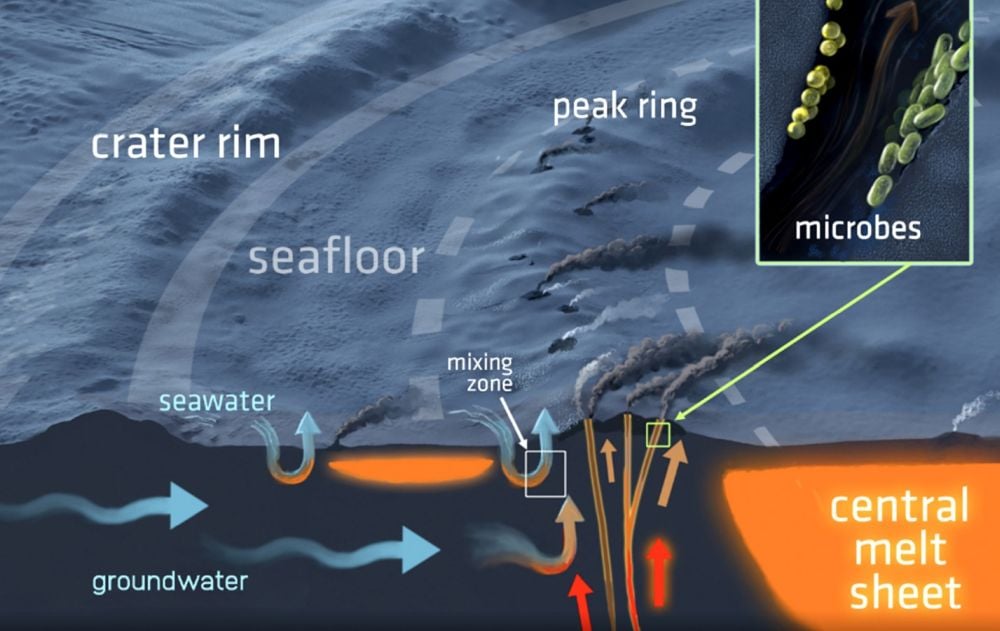
Core recovery from International Ocean Discovery Program (IODP) / International Continental Scientific Drilling Program (ICDP) Expedition 364 has revolutionized our three-dimensional appreciation of Chicxulub. Drilling through the peak ring intersected four principal units: (1) post-impact pelagic carbonates and clastics; (2) impact melt rocks and suevites; (3) impact breccias and uplifted basement lithologies comprising granites, gneisses, and anorthosite-norite-troctolite suite; and (4) crystalline basement. The permeable network is dominated by meso- to macroporous suevitic breccias, cataclasites, and heavily fractured granitoids, facilitating advective heat transport. Seismic reflection surveys further reveal radial and concentric fault networks extending into the annular trough, providing pathways for hydrothermal upflow and lateral mixing.

Figure 1. Conceptual rendering of fluid flow domains beneath the peak ring. Note the upward focused vents along normal faults and the lateral heat plumes within brecciated substrates.
2.1. Formation of the Peak Ring
The peak ring—the annular topographic high located ~30 km inside the rim—originated via dynamic collapse of the central uplift during late-stage crater modification. Its lithological diversity and mechanical weakness predisposed it to serve as a hydrothermal ‘backbone’ wherein permeabilities on the order of 10-12 m2 were retained for ≥106 yr. Numerical modeling by Christou et al. (2026) indicates that peak-ring rocks provided ~60 % of total advective heat removal.
3. Temperature–Time Evolution: New Chronological Constraints
Argon–argon (40Ar/39Ar) thermochronology of hydrothermal K-feldspar separates recovered from 1,322–1,335 m below seafloor yields plateau ages spanning 66.02 ± 0.05 Ma to 57.97 ± 0.11 Ma. These ages correspond to cooling of the system through closure temperatures ranging from 350 °C (sanidine) to 150 °C (adularia). Monte Carlo inversions of age spectra, incorporating diffusion kinetics calibrated for variable grain size, confirm a monotonic cooling profile without detectable reheating events, implying continuous rather than episodic fluid circulation.
| Year | Milestone | Principal Investigators / Programs | Major Outcome |
|---|---|---|---|
| 1991 | Discovery of impact melt sheet geophysical anomaly | Yucatán-1 well consortium | Initial suggestion of post-impact melting and possible hydrothermal alteration |
| 2004 | Meteoritics & Planet. Sci. special issue on Chicxulub fluids | C. Kring et al. | Minimum hydrothermal lifetime >0.3 Myr |
| 2016 | IODP/ICDP Expedition 364 | M.W. Morgan, J. Gulick (co-chiefs) | Recovery of 829 m core through peak ring |
| 2020 | Palaeomagnetic paleothermometry | L. Goderis et al. | High-T phase ≥250 °C for 0.15–0.5 Myr |
| 2026 | 40Ar/39Ar dating of K-feldspar | A.E. Pickersgill et al. | Total hydrothermal duration ≥8 Myr |
Complementary thermomagnetic studies of single-domain magnetite inclusions in shocked quartz corroborate the prolonged thermal history; unblocking temperatures as low as 100 °C are only reached after 5–10 Myr of diffusion-controlled cooling, reinforcing the geochronological evidence.
4. Hydrothermal Flow Regimes and Permeability Architecture
Three principal flow regimes are recognized within the Chicxulub subsurface:
- Convection-dominated upflow zones along steeply dipping normal faults and within the central melt sheet keel, where Darcy velocities approached 1.4 m yr-1 and heat flux peaked at 20 W m-2.
- Lateral heat advection through the peak-ring carapace, driven by buoyancy contrasts between heated brines and cooler seawater recharge, sustaining temperatures >150 °C for >5 Myr.
- Diffuse conductive halos in the annular trough where fluid velocities were two orders of magnitude lower (<10-2 m yr-1) but chemical gradients were preserved, allowing extensive metasomatism.
| Domain | Intrinsic Permeability (m2) | Porosity (%) | Average Darcy Velocity (m yr-1) | Heat Flux (W m-2) |
|---|---|---|---|---|
| Peak-ring breccias | 1 × 10-12 | 28 | 1.4 | 20 |
| Melt sheet keel | 5 × 10-13 | 10 | 0.9 | 15 |
| Annular trough | 3 × 10-14 | 6 | 0.04 | 3 |
| Peripheral platform | 8 × 10-15 | 2 | 0.01 | 1 |
High permeabilities were maintained by ongoing seismicity and thermal stresses for at least the first 0.5 Myr, after which hydrothermal self-sealing via silica and zeolite precipitation locally reduced permeability. Nevertheless, transient fracturing produced by tidal flexure and viscoelastic relaxation likely continued to generate fresh conduits, contributing to the system’s longevity.
5. Geochemical Fingerprints of Long-Term Circulation
The mineralogical assemblages recorded in Expedition 364 cores provide a ‘time capsule’ of hydrothermal fluid evolution. Early high-temperature stages are signified by amphibole (pargasite–edenite), phlogopite, and high-Ti magnetite within the melt sheet carapace. Intermediate-temperature phases include chemisorbed K-feldspar, chlorite-smectite interstratifications, and epidote. Late-stage low-temperature alteration is reflected in laumontite, analcime, and calcite–dolomite veining. The distribution and cross-cutting relationships of these minerals reveal cooling trajectories consistent with thermal modeling (Figure 2).

Figure 2. Integration of seismic reflection grids with borehole mineral paragenesis permits reconstruction of fluid migration pathways and reaction fronts.
| Mineral Phase | Formation Temperature (°C) | Fluid pH Estimate | Fluid Redox State (Eh) |
|---|---|---|---|
| Pargasite | 350–450 | 7.2–7.6 | -0.1 V |
| Epidote | 250–320 | 6.8–7.3 | -0.05 V |
| Chlorite (ripidolite) | 180–260 | 7.0–7.5 | -0.02 V |
| Laumontite | 130–180 | 6.5–7.0 | 0.00 V |
| Analcime | 90–140 | 8.0–8.4 | +0.05 V |
The progressive decrease in Eh values and the crossover to slightly alkaline pH at late stages align with the leaching of Fe2+ from mafic host rocks and the consumption of CO2 via carbonate precipitation, respectively. Stable isotope analyses (δ18Ofluid= -4 to +3 ‰ SMOW) indicate a mixing continuum between meteoric recharge and marine waters, with early pulses dominated by seawater and later circulation increasingly influenced by meteoric components delivered via karstic collapse structures.
6. Chicxulub in Comparative Context: How Exceptional Is Eight Million Years?
To situate Chicxulub within the broader ensemble of terrestrial impact hydrothermal systems, we collated published durations derived from both geochronology and thermal conduction models for 23 craters spanning diameters of 3–300 km. Mean durations scale with crater diameter following a power-law exponent of ≈1.3, yet Chicxulub lies significantly above the 95 % confidence interval, underscoring its outlier status.
| Crater | Diameter (km) | Estimated Duration (Myr) | Dating Method | Principal Reference |
|---|---|---|---|---|
| Sudbury (Canada) | 250 | 3.5 | U-Pb zircon | Petrus et al., 2015 |
| Manicouagan (Canada) | 100 | 1.2 | Thermal modeling | |
| Chicxulub (Mexico) | 200 | >8.0 | 40Ar/39Ar | Pickersgill et al., 2026 |
| Ries (Germany) | 24 | 0.05 | Biotite K–Ar | Osinski et al., 2001 |
| Lonar (India) | 1.8 | <0.01 | Inferred | Fudali et al., 1980 |
Two factors appear to account for Chicxulub’s exceptional longevity: (1) the availability of a persistent external heat source in the form of a thick impact melt sheet (~3 km) that solidified over several Myr, and (2) hydrogeologic connectivity to an open marine basin, permitting sustained convection. In smaller or continental-isolated craters, hydrothermal circulation wanes once conductive cooling outpaces advective heat supply.
7. Implications for Early Biospheric Niches
Were these subterranean havens colonized? Fossil evidence remains equivocal; yet microfracture coatings of Fe- and Mn-oxides display biologically induced textures (botryoidal, filamentous) and δ56Fe signatures (~-1.1 ‰) consistent with microbial iron reduction. Furthermore, nanoscale secondary ion mass spectrometry (NanoSIMS) of carbonaceous matter within late calcite veins reveals δ13C ≈-30 to -35 ‰ PDB, values typifying biological fractionation. These observations suggest at least transient microbial colonization within 1–3 Myr post-impact.
- Energy sources: H2 produced by Fe2+ oxidation, serpentinization of olivine, and radiolytic water splitting.
- Carbon sources: Dissolved bicarbonate, formate derived from Fischer–Tropsch reactions, and recycled organic debris from surface biomass collapse.
- Nutrient fluxes: Phosphorus liberated from schreibersite inclusions in the asteroid, sulfate from evaporite dissolution, and trace metals (Ni, Co, Mo) essential for enzymatic cofactors.
| Reaction | ΔGr° (kJ mol-1) | Energy per e- (kJ) | Potential Microbial Class |
|---|---|---|---|
| 4 H2 + CO2 → CH4 + 2 H2O | -136 | -34 | Methanogens |
| H2 + SO42- → HS- + 2 H2O | -152 | -38 | Sulfate reducers |
| 6 FeO + H2O → 2 Fe3O4 + H2 | -20 | -5 | Iron oxidizers / H2 producers |
While clear in situ microfossils remain elusive, the thermodynamic landscape and geochemical biosignatures strongly argue for habitability. Therefore, Chicxulub hydrothermal habitats may represent refugia where life not only survived the impact winter but potentially diversified.
8. Mars, Impacts, and the Prospect of Ancient Hydrothermal Oases
Martian craters such as Holden (~150 km), Jezero (~49 km), and Gale (~155 km) preserve clay-rich mineral assemblages—smectites, olivine–serpentine series, and zeolites—analogous to terrestrial impact hydrothermal products. Remote sensing by CRISM/MRO and in-situ analyses by the Curiosity rover suggest temperature regimes ≤150 °C sustained water–rock reaction for 105–106 yr. The Chicxulub benchmark of ≥8 Myr implies that larger Martian basins like Isidis (~1,500 km) or Hellas (~2,300 km) could have maintained hydrothermal motivity for >50 Myr due to slower planetary cooling and thicker melt sheets.
| Martian Basin | Diameter (km) | Predicted Duration (Myr) | Key Minerals Detected | Surveillance Platform |
|---|---|---|---|---|
| Isidis | 1,500 | 40–60 | Fe-Mg smectite, serpentine | OMEGA/CRISM |
| Hellas | 2,300 | 60–90 | Zeolite, chlorite, carbonate | MRO-SHARAD |
| Gale | 155 | 2–4 | Montmorillonite, hematite | Curiosity-CheMin |
| Jezero | 49 | 0.5–1 | Carbonate, olivine | Perseverance-PIXL |
The discovery of such extended hydrothermal durations bolsters the case for prioritizing impact structures as prime landing sites for life-detection missions. Analytical payloads capable of detecting isotopic fractionations, organomineral associations, and redox disequilibria are essential to probe fossil hydrothermal mosaics on Mars.
9. Numerical Modeling Frameworks: Bridging Scales
State-of-the-art reactive transport codes such as HYDROTHERM3D and iSALE-THRUST were employed to reconcile field observations with dynamical processes. Models incorporated temperature-dependent permeability functions, fracture aperture collapse kinetics, and precipitation-induced porosity reduction. Realistic boundary conditions accounted for oscillatory sea levels during the Danian age and evolving geothermal gradients as the Yucatán lithosphere relaxed thermally. A sensitivity suite (n = 112) explored parameter spaces of melt-sheet thickness (1–5 km), initial porosity (5–35 %), and recharge salinity (0–70 g L-1).
| Run ID | Melt Thickness (km) | Initial Porosity (%) | Salinity (g L-1) | Duration >150 °C (Myr) | Max Darcy v (m yr-1) |
|---|---|---|---|---|---|
| A14 | 3 | 28 | 35 | 8.4 | 1.6 |
| B07 | 2 | 22 | 0 | 4.1 | 0.8 |
| C19 | 5 | 30 | 35 | 12.9 | 2.4 |
| D02 | 1 | 15 | 70 | 1.7 | 0.6 |
These experiments underscore the nonlinear interplay between melt-sheet longevity and permeability preservation: thick (>3 km) melt bodies sustain elevated isotherms by latent-heat release during crystallization, while high initial porosity fosters vigorous convection that, paradoxically, accelerates cooling if not counterbalanced by heat input. Chicxulub’s ‘Goldilocks’ synergy of melt volume and permeability engendered the 8 Myr outcome.
10. Remaining Unknowns and Future Directions
Despite substantial progress, several outstanding issues merit attention:
- High-resolution geochronology of low-T phases. U-Th dating of carbonates and zeolites could refine the tail end of hydrothermal activity beyond current ±0.1 Myr bounds.
- Subsurface microbiological exploration. DNA or lipid remnants may be preserved within fluid inclusions; advanced paleomicrobiology protocols (e.g., LD‐Raman, cryo-nanoFTIR) should be deployed.
- Crustal-scale seismic monitoring. Passive seismic networks could image residual fracture permeability and thermal anomalies persisting today.
- Analog experiments. Laboratory shock-recovery experiments on carbonate–silicate assemblages under hydrothermal flow will constrain reaction kinetics of key mineral transitions.
- Planetary application. Implement the Chicxulub-calibrated scaling laws in mission planning for Mars Sample Return and potential Europa lander drilling sites.
11. Conclusion
The Chicxulub impact, once synonymous solely with global catastrophe, now stands as a symbol of Earth’s resilience and of the niches forged in the wake of cataclysm. An immense hydrothermal engine churned beneath the sterilized surface for at least eight million years, circulating mineral-laden waters through a fractured crust, fostering environments conducive to microbial metabolism and perhaps prebiotic synthesis. The key elements enabling this longevity—melt-sheet thermal inertia, permeable architectures, and sustained fluid recharge—may be replicated on other worlds. Consequently, the lessons from Chicxulub radiate beyond Earth, guiding our search for life’s footholds across the Solar System and reminding us that destruction and creation are often intertwined in planetary evolution.
For More Information
Interested readers can consult the following peer-reviewed and publicly accessible sources for deeper exploration:
- A long-lived impact-generated hydrothermal system at the Chicxulub impact structure (Pickersgill et al., 2026)
- Goderis et al. (2020) – High-temperature phase evolution in Chicxulub peak ring rocks
- Christou et al. (2022) – Coupled thermal-hydraulic modeling of impact hydrothermal systems
- Kring & C. (2021) – Hydrothermal time scales in terrestrial craters
- NASA Mars 2020 Perseverance Mission – Instrumentation for detecting ancient hydrothermal minerals on Mars