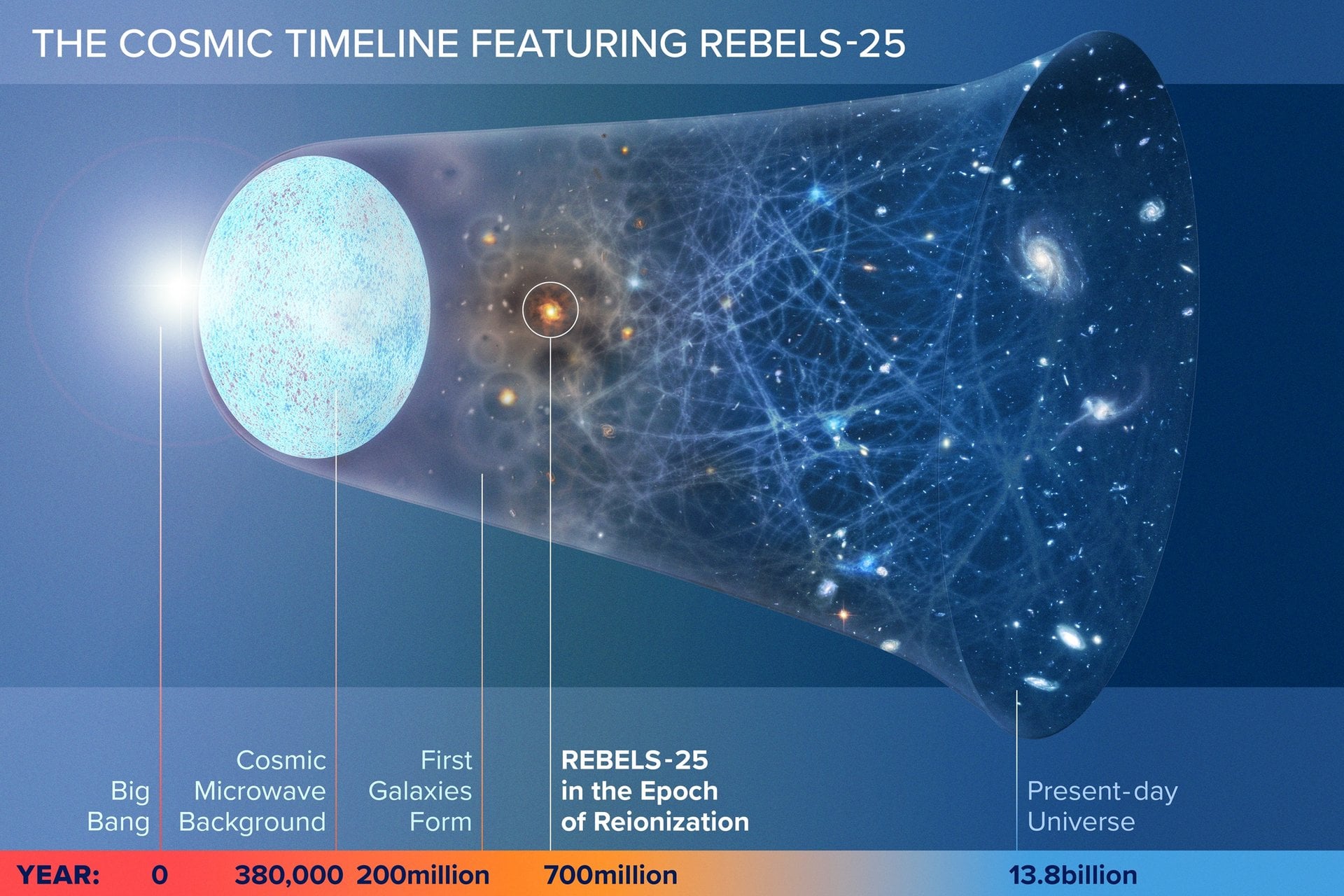
The discovery of an immense reservoir of cold molecular gas in the high–redshift galaxy REBELS-25 has opened a new chapter in our understanding of how the first galaxies assembled, ignited vigorous bursts of star formation, and reshaped the intergalactic medium during the Epoch of Reionization. In the following in-depth analysis, we explore the historical background, the observational strategies, the theoretical implications, and the forward-looking prospects that arise from this singular finding. Although the present discussion is anchored by the publicly released observations from the National Radio Astronomy Observatory (NRAO), the Very Large Array (VLA), the Atacama Large Millimeter/submillimeter Array (ALMA), and supplementary facilities worldwide, our broader aim is to situate REBELS-25 within the multifaceted narrative of cosmic evolution, from the Cosmic Dark Ages to the modern era of precision cosmology.
1. Introduction to Cosmic Dawn and the Quest for Early Star-Formation Fuel
The phrase Cosmic Dawn encapsulates the interval in which the first stars, stellar clusters, and protogalaxies emerged roughly two hundred million to one billion years after the Big Bang. During this transformative period, the radiation emitted by Population III stars, subsequent Population II stellar associations, and accreting supermassive black holes (SMBHs) reionized the previously neutral intergalactic medium (IGM). A central question that has challenged extragalactic astrophysicists for decades is the origin and distribution of the baryonic fuel that powered such rapid star formation. To address this question, radio and millimeter astronomers have increasingly relied on molecular tracers—most notably the low-J rotational transitions of carbon monoxide (CO)—which remain the most direct proxies for estimating the total molecular hydrogen (H2) mass in distant galaxies.
Galaxies observed at redshifts z ≈ 6–10 are situated merely 500–900 million years after the Big Bang, a temporal window that not only coincides with the completion of hydrogen reionization but also with the onset of metal enrichment by core-collapse supernovae. REBELS-25, at a spectroscopically confirmed redshift of z ≈ 7.3, stands as a benchmark system because its cold molecular gas supply appears both massive and well-organized at a remarkably early epoch. Indeed, the direct detection of low-excitation CO(1–0) in such an environment—the most distant to date—challenges long-held assumptions regarding gas cooling times, metal enrichment rates, and the hierarchical assembly of large-scale structure.
2. Historical Background of Radio and Millimeter Observations
While optical telescopes such as the European Southern Observatory’s Very Large Telescope (VLT) and, more recently, the James Webb Space Telescope (JWST) have revolutionized our view of early stellar populations, it is radio and millimeter facilities that directly unveil the cold interstellar medium (ISM). The VLA, operating primarily between 1 GHz and 50 GHz, is sensitive to low-J CO lines redshifted into the Ka (26–40 GHz) and Q-bands (40–50 GHz) at high redshift. Simultaneously, ALMA, spanning ~90 GHz to ~900 GHz, routinely measures mid- and high-J CO transitions, ionized carbon [C II] 158 μm, singly ionized nitrogen [N II], and multiple dust continuum windows.
“The complementary frequency coverage of VLA and ALMA functions much like a cosmic stethoscope, allowing us to ‘listen’ to the beating heart of the earliest galaxies.” — Dr. Jacqueline Hodge, Leiden University
Combining these facilities in so-called multi-line surveys yields powerful diagnostic leverage, because the excitation ladder of CO encodes key physical properties—kinetic temperature, gas density, and UV radiation field—within the molecular clouds that ultimately collapse into stellar nurseries. Before delving into the specifics of REBELS-25, we pause to summarize major milestones that have led the community to today’s detection frontier.

2.1 Milestones in High-Redshift CO Detection
- 1992–2000: First extragalactic CO emission beyond the Local Supercluster; quasars at z ≳ 4 exhibit strong CO(3–2) / CO(5–4) lines.
- 2003–2010: Detection of CO and dust continuum in sub-millimeter galaxies (SMGs) at z ≈ 2–3; firm establishment of the far-infrared/radio correlation.
- 2011–2016: ALMA early science sequences achieve [C II] detections up to z ≈ 7 in luminous Lyα emitters and quasar host galaxies.
- 2017–2021: Launch of deep field programs—ASPECS, COLDz, REBELS—systematically surveying blank fields for CO and [C II] lines at 3 mm and 1 mm.
- 2022–Present: First low-J CO detections beyond z ≈ 7 in non-quasar galaxies, culminating in the REBELS-25 discovery.
3. Observational Campaign and Data Reduction for REBELS-25
The REBELS (Reionization-Era Bright Emission Line Survey) program targets UV-bright galaxies previously flagged by large-area photometric searches carried out with the Hubble Space Telescope. Specifically, REBELS-25’s coordinates were monitored in two separate frequency setups:
- VLA Ka-band: Centered at 34.1 GHz (observer frame) to capture CO(1–0) redshifted from its rest frequency of 115.27 GHz.
- ALMA Band 6: Tuning around 260 GHz to capture higher-order CO(7–6) as well as dust continuum in the rest-frame far infrared.
Each array executed phase-referencing cycles with interleaved calibrator scans to mitigate tropospheric phase fluctuations. A summary of core observing parameters is offered in Table 1.
| Parameter | VLA Ka-band | ALMA Band 6 |
|---|---|---|
| On-source time | 21.5 hr | 8.4 hr |
| Angular resolution | 0.68″ × 0.44″ | 0.23″ × 0.18″ |
| Channel width (km s–1) | 20 | 15 |
| RMS sensitivity (μJy beam–1) | 4.1 | 22 |
| Primary beam FWHM | 82″ | 26″ |
Data reduction proceeded via the Common Astronomy Software Applications (CASA) pipeline, which includes flagging of radio-frequency interference (RFI), system temperature (Tsys) correction, bandpass calibration, and imaging with tclean using Briggs weighting (robust = 0.5). Relevant u-v data were continuum-subtracted employing a first-order polynomial to isolate the line emission.
4. Physical Conditions in the Cold ISM of REBELS-25
By simultaneously modeling the CO(1–0) and CO(7–6) integrated fluxes, one constrains the molecular gas mass (MH2) and gas excitation temperature (Tex). A standard conversion factor αCO ≈ 3.6 M☉ (K km s–1 pc2)–1, appropriate for z > 6 star-forming discs, yields MH2 ≈ 1.1 × 10¹¹M☉. Simultaneously, large velocity gradient (LVG) modeling constrains Tkin ≈ 35–45 K, and nH2 ≈ 1–2 × 103 cm–3.
To place these metrics in context, Table 2 compares REBELS-25 to a representative sample of high-redshift systems with published CO(1–0) data.
| Galaxy | Redshift | Integrated CO(1–0) Flux (Jy km s–1) | MH2 (1011 M☉) | Star-formation Rate (SFR, M☉ yr–1) |
|---|---|---|---|---|
| REBELS-25 | 7.3 | 0.041 | 1.1 | 280 |
| SPT0311-58W | 6.9 | 0.036 | 0.9 | 290 |
| MACS1149-JD1 | 9.1 | <0.012 (3σ) | <0.3 | 15 |
| HFLS3 | 6.3 | 0.150 | 2.7 | 1320 |
| J1342+0928 (QSO) | 7.5 | 0.022 | 0.6 | 1000* |
*Dominated by quasar activity; SFR uncertain due to AGN contamination.
5. Star-Formation Efficiency and Depletion Timescales
A critical diagnostic of galaxy evolution is the gas depletion time τdep ≡ MH2/SFR. For REBELS-25, τdep ≈ 0.39 Gyr, substantially shorter than the 2–3 Gyr typical of main-sequence galaxies at z ≈ 1–2. The implication is twofold:
- Star-formation efficiency (εSFE) is elevated, possibly driven by dense, turbulence-regulated molecular clumps.
- Without external gas accretion via cold flows or minor mergers, the present gas reservoir would exhaust rapidly, underscoring the relevance of cosmological gas inflows even at early epochs.
Table 3 collates τdep values for an expanded sample of galaxies to illustrate this trend.
| Redshift Bin | Typical τdep (Gyr) | Median SFE (% yr–1) | Dominant Star-Formation Mode |
|---|---|---|---|
| z ≈ 0 (Milky Way-like) | 2.2 | 0.045 | Quiescent disc |
| z ≈ 2 (SMGs) | 0.5 | 0.20 | Merger-driven burst |
| z ≈ 4–6 (LBGs) | 0.8 | 0.13 | Clumpy disc |
| z ≈ 7.3 (REBELS-25) | 0.39 | 0.26 | Gas-rich proto-disc |
6. Implications for Theoretical Models of Early Galaxy Growth
State-of-the-art cosmological simulations—IllustrisTNG, EAGLE, and SIMBA—have made substantial strides in reproducing the galaxy luminosity function up to z ≈ 8. Yet, many numerical studies anticipate declining molecular gas fractions above z ≈ 6 due to the limited time available for metal-line cooling. The presence of a chemically enriched, molecule-rich ISM in REBELS-25, therefore, demands either more efficient early metal production or alternative cooling channels (e.g., molecular hydrogen line emission, or even fine-structure cooling in primordial species).
“In many respects, REBELS-25 is a stress-test for galaxy formation prescriptions. It reminds us that cosmic history is filled with surprises that brutally confront our most sophisticated simulations.” — Prof. Claude-André Faucher-Giguère, Northwestern University
Key theoretical ramifications include:
- Rapid Metal Enrichment: Core-collapse supernovae must have disseminated α-elements efficiently within ≤200 Myr of the first star-burst episodes.
- Early Halo Assembly: Dark-matter halos exceeding 1011M☉ may have collapsed earlier than canonical ΛCDM predicts, possibly facilitated by a mild departure from a strictly scale-invariant primordial power spectrum.
- Feedback Regulation: Stellar winds and supernova feedback evidently failed to quench molecular gas accumulation, hinting at either lower than expected coupling efficiency or unusually gentle outflows.
- Cosmic Microwave Background (CMB) Impact: Elevated CMB temperatures at z ≈ 7 (~21 K) reduce the contrast of cold dust emission but simultaneously set a floor for ISM temperatures, influencing fragmentation scales.
7. Overcoming the Cosmic Microwave Background as an Observational Hurdle
At early cosmic epochs, the CMB’s brightness rivals and sometimes exceeds that of the cold ISM, compromising detectability. Yet, the VLA’s deep integration strategy for REBELS-25 achieved a signal-to-noise ratio (S/N) ≈ 10 on the CO(1–0) line, surpassing many prior attempts. The mitigation techniques, generalized in Table 4, provide a blueprint for future high-redshift molecular surveys.
| Challenge | Adopted Mitigation Strategy | Effectiveness |
|---|---|---|
| CMB temperature floor | Target intrinsically bright, UV-luminous galaxies where molecular clouds are denser | Moderate |
| Systematic phase drift | High cadence phase calibration with bright, compact quasars | High |
| RFI contamination | Dynamic flagging & hardware notch filters in Ka-band | High |
| Limited u-v coverage | Multi-configuration scheduling (A+C arrays for VLA) | High |
| CMB dust contrast | Complementary observation at rest-frame FIR > 250 μm (ALMA Band 4, 5) | Moderate |
8. Comparative Analysis with Other Observational Windows
Although CO remains the gold standard for cold gas, alternative tracers may unlock fainter systems:
- [C II] 158 μm: Accessible to ALMA at z > 4, offering higher surface brightness but susceptible to extended halo emission that complicates mass estimates.
- Dust Continuum: Rest-frame 100–300 μm emission provides an indirect measure of dust-obscured SFR provided that the dust-to-gas ratio is calibrated.
- Lyman-α: Resonantly scattered and thus prone to radiative transfer effects, but nonetheless a traditional workhorse for locating high-redshift starburst galaxies.
- Radio Free-Free Emission: Thermal bremsstrahlung from H II regions traces massive star formation independent of dust extinction.
Table 5 summarizes the sensitivity levels currently attainable for each tracer at z ≈ 7 with premier instruments.
| Tracer | Rest λ (μm) | Facility | 5σ Depth (μJy) | Major Uncertainty |
|---|---|---|---|---|
| CO(1–0) | 2600 | VLA / ngVLA | 3.5 | αCO conversion |
| [C II] | 158 | ALMA | 45 | Extended halos |
| Dust 250 | 250 | ALMA | 18 | Dust-to-gas ratio |
| Free-Free (3 cm) | 30 000 | VLA | 1.9 | AGN contamination |
9. Synergies with the Next Generation Very Large Array (ngVLA)
Looking beyond current facilities, the forthcoming ngVLA promises an order-of-magnitude leap in both sensitivity and survey speed for low-excitation molecular lines at centimeter wavelengths. Envisioned to comprise ~263 antennas distributed over baselines up to 8,860 km, the ngVLA’s instantaneous bandwidth (~20 GHz) will enable blind line searches for CO at z > 6 across degrees of sky. An illustrative observing strategy is schematized below:
- Phase 1 (Pilot Survey): 50 hr per deep pointing; target S/N ≥ 6 on CO(1–0) for galaxies with M* > 109.5M☉.
- Phase 2 (Wide Survey): 6 deg2 at uniform depth; expected to yield >800 detections of CO(1–0) at z ≳ 6.
- Synergy Layers: Cross-match with JWST NIRCam deep fields, Euclid wide extragalactic surveys, and Square Kilometre Array (SKA) 21 cm tomography slices.

10. REBELS-25 in the Broader Context of Reionization and IGM Heating
The intense ultraviolet radiation leaking from massive stars in early galaxies, coupled with mechanical energy from supernova-driven winds, underpins the cosmic reionization budget. Key open questions include:
- Ionizing Photon Escape Fraction (fesc): Does a gas-rich galaxy like REBELS-25 possess channels through which UV photons can leave the ISM unimpeded?
- Feedback Coupling: How do outflows impact ongoing star formation and the retention of molecular gas?
- Soft X-ray Heating: Early high-mass X-ray binaries (HMXBs) may elevate the IGM temperature, boosting the 21 cm spin temperature ahead of complete reionization.
By synthesizing multi-wavelength diagnostics, researchers endeavor to build a coherent reionization chronology. For instance, combining fesc inference from Ly-α damping wings with gas mass constraints from CO offers self-consistent checks on star-formation timescales.
11. Dust Formation, Growth, and Survival at Early Times
An often overlooked component of early ISM physics is the origin of dust grains in only ~700 Myr. The favored pathways include:
- Core-collapse supernovae: Expected to condense ~0.1 M☉ of dust per event, though reverse shocks may erode a substantial fraction.
- Asymptotic-Giant-Branch (AGB) stars: Contribute carbonaceous grains, but the minimal age of a few hundred million years challenges their efficacy at z ≈ 7.
- Grain growth in dense molecular clouds: Potentially accelerates dust mass assembly, provided that metals and shielded gas pockets coexist.
REBELS-25’s measured infrared luminosity LIR ≈ 3.2 × 10¹²L☉ implies a dust mass near 2 × 10⁸M☉. Thus, whatever dust production mechanism operates must proceed swiftly and efficiently.
12. Connection to Stellar Mass Assembly Histories
Spectral energy distribution (SED) modeling of the UV–NIR photometry suggests a stellar mass M* ≈ 4.8 × 10¹⁰M☉. Therefore, the molecular gas fraction μgas ≡ MH2/(M* + MH2) ≈ 0.70. High μgas values are typical of galaxies yet to settle onto the main sequence of star formation. Whether REBELS-25 is representative or exceptional remains an open debate; the ngVLA survey described in Section 9 should decisively answer this by increasing the statistical sample into the hundreds.

13. Future Prospects: From the Square Kilometre Array to Line-Intensity Mapping
In parallel to targeted galaxy studies, emerging line-intensity mapping (LIM) experiments aim to measure the aggregate CO, [C II], or H I signals from unresolved populations. Instruments such as COMAP (CO Mapping Array Pathfinder) and the forthcoming SKA-MID will statistically constrain the mean CO brightness temperature, thereby offering independent validation of cold gas reservoirs at cosmic dawn.
Key synergies include:
- Cross-correlation with 21 cm Experiments: Combining LIM with H I intensity maps from Hydrogen Epoch of Reionization Array (HERA) will disentangle astrophysical heating from cosmological density fields.
- Tracer Variance Mitigation: Multi-line cross-power spectra can reduce sample variance, sharpening constraints on clustering and bias parameters.
- Joint Bayesian Inference: Leveraging data from JWST, ALMA, and SKA within a cosmic-dawn forward-modeling suite will refine parameters such as star-formation efficiency and escape fractions.
14. Summary of Key Findings
- The detection of CO(1–0) in REBELS-25 at z ≈ 7.3 provides the most direct evidence yet for vast molecular reservoirs fueling early star formation.
- Derived molecular gas masses exceed 1011M☉, rivaling or surpassing the stellar mass and yielding gas fractions μgas > 0.7.
- Short gas depletion times (τdep ≈ 0.39 Gyr) imply star-formation efficiencies markedly above those of z ≈ 0 main-sequence galaxies.
- The combined VLA + ALMA strategy sets a methodological precedent for overcoming CMB suppression effects at very high redshift.
- The upcoming ngVLA, SKA, and LIM experiments promise order-of-magnitude leaps in survey depth, vastly enlarging the sample of galaxies like REBELS-25.
15. Concluding Perspectives
It is an auspicious time for observational cosmology. The decade ahead will witness the fusion of single-galaxy deep spectroscopy, statistical line-intensity mapping, and high-resolution hydrodynamical simulations, knitting together a holistic tapestry of cosmic dawn. REBELS-25, once a singular outlier, may soon be recognized as an archetype among a populous class of gas-rich proto-discs. With every newly detected CO photon arriving from the depths of time, we sharpen our portrait of how ordinary baryons arranged themselves into the extraordinary patterns that fill today’s universe.
For More Information
National Radio Astronomy Observatory – VLA Fuel Discovery Press Release
Cescon et al. 2024, Monthly Notices of the Royal Astronomical Society, 549, 3705
Pre-print on arXiv with detailed LVG modeling
Next Generation Very Large Array (ngVLA) Official Site
Atacama Large Millimeter/submillimeter Array Home Page