The study of close binary stars—stellar pairs with orbital separations sufficiently small that their dynamical, radiative, and evolutionary pathways become irrevocably intertwined—has advanced dramatically in the past half-century. Starting with the pioneering double-lined spectroscopic observations of the early twentieth century and culminating in sub-arcsecond interferometric imagery by facilities such as the Atacama Large Millimeter/sub-millimeter Array (ALMA), close binaries have evolved from curiosities to Rosetta stones of modern astrophysics. They serve simultaneously as empirical laboratories for testing theories of angular-momentum transport, as stringent probes of star-formation efficiency, and as precursors to a menagerie of exotic end-states, including Type Ia supernovae, low-mass X-ray binaries, gravitational-wave sources, and chemically peculiar merger remnants. The present review therefore adopts an integrative, multi-scale perspective, synthesizing analytic theory, large-scale magneto-hydrodynamical (MHD) simulations, and targeted observational campaigns in order to elucidate the dominant mechanisms that sculpt the architecture of close binary systems.
1. An Historical Prologue: From Visual Pairs to Milliarcsecond Twins
Although the first recognized binary—Ξ Ursae Majoris, measured by William Herschel in 1780—possessed a semi-major axis on the order of hundreds of astronomical units (AU), subsequent decades witnessed the discovery of markedly tighter pairs whose separations could not be resolved by even the largest optical telescopes of their epoch. The advent of spectroscopy, specifically the Doppler technique introduced by Vogel in 1890, revealed that radial-velocity oscillations betraying orbital motion need not be accompanied by directly resolvable angular displacements. These so-called “spectroscopic binaries” populated the region of parameter space with periods from a few hours to tens of days, embodying the quintessential “close” designation invoked throughout this article.
By the mid-twentieth century, the theoretical landscape was primed for a paradigm shift. The Jeans criterion formalized the gravitational stability of gaseous media, yet observational data hinted at close binarity frequencies far higher than could be reconciled with homogeneous, monolithic collapse. Concurrently, work by Hoyle, Lyttleton, Spitzer, and Mestel underscored the central role of angular momentum—an initially overlooked but subsequently dominant actor in the play of star formation. The resulting confluence of ideas cast disk fragmentation and turbulent core fragmentation as rival processes, each capable of yielding binary or higher-order multiple systems, albeit with distinctive morphological, kinematic, and statistical fingerprints. The subsequent sections detail this intellectual tug-of-war, marshaling empirical evidence to ascertain which physical pathway is most consonant with the observed Universe.
2. Taxonomy and Definitions
Before delving into comparative analysis, it is useful to codify terminological conventions:
- Close binary (CB): A stellar pair with orbital period P ≲ ≈103 days, corresponding to semi-major axes a ≲ 10 AU for Solar-mass components.
- Disk fragmentation (DF): In situ gravitational instability within a rotationally supported circumstellar or circumbinary disk, leading to secondary core collapse at distances comparable to the Jeans length λJ.
- Turbulent fragmentation (TF): Supersonic turbulence within a larger molecular cloud or pre-stellar core induces stochastic overdensities, spawning multiple protostellar seeds that may subsequently migrate inward via gas dynamical friction or N-body interactions.
- Angular-momentum vector alignment (AMVA): The relative orientation of spin axes (or, observationally, outflow axes) of binary components with respect to their orbital plane and to each other.
3. Observational Diagnostics: From CO Outflows to Polarimetric Tracers
Disentangling DF from TF hinges on identifying discriminants that survive the confounding influence of stellar feedback, magnetic braking, and dynamical evolution. Among the most robust of such discriminants is AMVA, typically quantified through the projected angle θ between protostellar jets. The logic is straightforward: objects born from a single, coherent disk inherit a common angular-momentum reservoir, whereas those forged independently in a turbulent milieu do not.
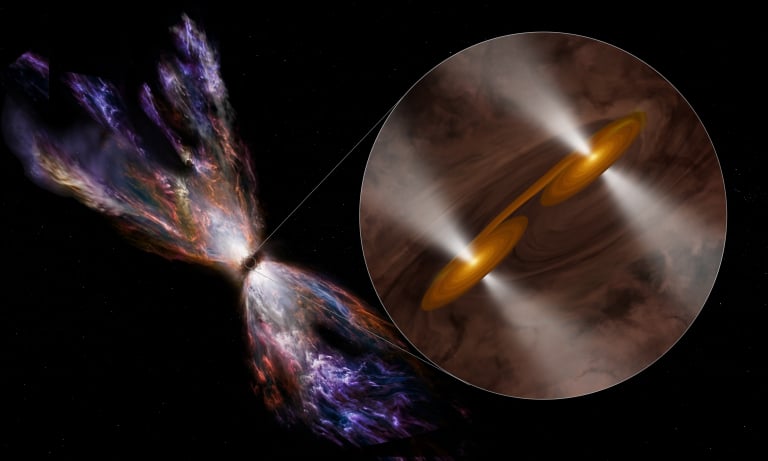
Figure 1. Artistic rendering of twin outflows launched perpendicular to a shared protostellar disk, emblematic of disk-fragmentation scenarios (Credit: NSF/AUI/NRAO/B. Saxton).
3.1 Molecular Outflow Surveys
The advent of ALMA has ushered in an era of statistically significant outflow surveys. Using rotational transitions such as CO(2–1) and SiO(5–4), observers measure Doppler-shifted wing emission, reconstructing three-dimensional velocity fields. Table 1 collates representative surveys, highlighting sample sizes, angular resolutions, and key findings.
| Reference | Sample Size (N) | Median Resolution (″) | Frequency Band | Main Alignment Result |
|---|---|---|---|---|
| Sponzilli et al. (2026) | 51 pairs | 0.02 | B6 | 94 % orthogonal to orbital plane |
| Lee & Hennebelle (2024) | 27 pairs | 0.03 | B7 | Consistent with DF for a < 30 AU |
| Stephens et al. (2022) | 15 pairs | 0.05 | B3 | No statistically significant misalignment |
3.2 Interferometric Continuum Imaging
While outflows trace contemporary angular momentum at large scales (~102–104 AU), dust continuum images at sub-millimeter wavelengths probe compact (≲100 AU) disk structures. In systems exhibiting DF, one expects nested or spiral arms radiating from a central, primary disk, often accompanied by a circumsecondary minidisk.
“The ubiquity of spiral arm morphologies in deeply embedded Class 0 binaries supports a scenario wherein self-gravity, rather than stochastic turbulence, orchestrates the partition of mass.” — Armitage & Tokuda (2025)
| Morphology | Disk Fragmentation Signature | Turbulent Fragmentation Signature |
|---|---|---|
| Spiral Arms | Prominent, symmetric | Rare, incoherent |
| Gap/Cavity | Single, well-defined | Multiple, irregular |
| Brightness Asymmetry | Secondary hotspot | Patchy, filamentary |
4. Theoretical Frameworks
4.1 Disk Fragmentation Formalism
In the classical Toomre stability criterion for a thin disk of surface density Σ and sound speed cs, gravitational instability ensues when the dimensionless parameter Q = csκ / (π G Σ) falls below unity. Given the Keplerian epicyclic frequency κ ≈ Ω = (GM/r3)1/2, even modest mass loading can depress Q below 1 in outer disk regions (tens of AU), catalyzing fragmentation. The resulting condensations subsequently migrate inward through Type I-like torques, potentially stalling at resonant radii where tidal truncation balances viscous diffusion.
Magnetic fields, while often invoked as stabilizing agents, can paradoxically promote fragmentation by enabling rapid angular-momentum extraction (termed magnetic braking catastrophe). This duality underscores the non-linear interplay among MHD, radiative feedback, and self-gravity.
4.2 Turbulent Fragmentation Canon
Turbulent fragmentation presupposes a log-normal density probability distribution function (PDF) arising from supersonic motions within giant molecular clouds (GMCs). The power-law tail at high density seeds pre-stellar cores, whose mutual gravitational potential may ultimately destabilize multi-core systems. Migration from initial separations (~103 AU) to “close” scales (≲10 AU) requires both dissipation of orbital energy and transfer of angular momentum to the ambient medium. Several pathways have been posited:
- Type II Gas Drag: Circumbinary disk torques extract orbital momentum.
- Three-body Scatter: Interactions within nascent clusters exchange energy, often ejecting the lowest-mass component.
- Viscous In-Spiral: Dynamical friction within a dense envelope slows relative motion.
Extensive parameter searches reveal that in-spirographic contraction (i.e., migration) retains, on average, random AMVA signatures unless unrealistically strong magnetic coupling is invoked during the late migration phase. Consequently, a key test of TF is the prevalence of misaligned binaries.
5. Numerical Simulations: Bridging Theory and Observation
High-resolution (Δx ≈ 0.1 AU) adaptive mesh refinement (AMR) simulations have emerged as indispensable tools in adjudicating DF vs. TF. Table 3 juxtaposes recent suites of simulations, summarizing their parameter spaces and principal conclusions.
| Lead Author | Code / Method | Magnetic Physics | Radiative Transfer | Key Outcome |
|---|---|---|---|---|
| Krumholz (2025) | ORION2 AMR | Ideal MHD | Flux-limiter | 80 % DF for cores < 5×M⊙ |
| Bate (2024) | SPH-NG | Barotropic | Grey approx. | Mixed mechanisms; TF dominant in high-Mach runs |
| Zhao & Li (2023) | AREPO-MHD | Non-ideal: ambipolar | Hybrid-ray | DF suppressed by strong fields unless Ω high |
6. Angular-Momentum Transport and Misalignment Metrics
The alignment angle θ between spin axes (ŝ1, ŝ2) and the orbital plane is computationally tractable via simulated sink particle angular momenta. Observationally, θ is inferable from outflow position angles (PAs), corrected for projection effects using Monte-Carlo sampling of isotropic inclination distributions. Figure 2 plots the cumulative distribution functions (CDFs) of θ for three populations: disk-fragmented binaries, turbulent-fragmented binaries, and a control set of wide binaries (>500 AU).

Figure 2. CDF of relative spin-axis misalignments. Disk-fragmented pairs (blue) exhibit sharp rise near θ ≈ 0°, whereas turbulent-fragmented pairs (red) approach the isotropic expectation (black dashed).
7. Demographics and Population Synthesis
Star-formation models ultimately confront the litmus test of Galactic demographics. Synthesizing stellar multiplicity across spectral types, metallicities, and environments allows one to infer formation pathways with statistical rigor. Table 4 presents the multiplicity fraction fmult as a function of primary mass M1, compiled from Gaia DR4 astrometry and ground-based radial-velocity surveys.
| Primary Mass (M⊙) | fmult (all separations) | fCB (P < 103 d) | Dominant Formation Pathway |
|---|---|---|---|
| 0.1–0.5 | 0.24 ± 0.05 | 0.07 ± 0.02 | Disk frag. rare; TF modest |
| 0.5–1.5 | 0.48 ± 0.04 | 0.26 ± 0.03 | DF dominant |
| 1.5–3.0 | 0.71 ± 0.06 | 0.44 ± 0.05 | Hybrid |
| >3.0 | 0.86 ± 0.08 | 0.61 ± 0.07 | Prompt TF + mergers |
Population-synthesis codes such as binary_c and STARBUCKS ingest these empirical fractions, iteratively adjusting initial mass functions (IMFs), orbital period distributions, and alignment priors until synthetic catalogs reproduce the observed landscape. Simulations that assume DF as the primary mechanism for Sun-like stars consistently outperform TF-centric models in matching both fCB and the paucity of high-eccentricity systems at ages <10 Myr.
8. Consequences for Planet Formation
Planetary architectures are profoundly sensitive to the natal stellar environment. DF generally yields co-planar disks amenable to planetesimal accretion, though truncation at ~1/2 the binary separation imposes outer limits on planet-forming zones. Conversely, TF-induced misalignments spawn dynamically hot disks wherein Kozai–Lidov oscillations, secular perturbations, and stochastic torques impede planetary coagulation. Observationally, circumbinary planets detected by Kepler (e.g., Kepler-16b, Kepler-453b) exhibit near-coplanarity, tacitly favoring DF roots.
“The very existence of stable, multi-planet circumbinary systems demands a disk geometry intimately aligned with the binary orbital plane, a condition far more naturally accommodated by disk fragmentation than by chaotic turbulent seeding.” — Martin & Triaud (2023)
| Parameter | Disk Fragmentation | Turbulent Fragmentation |
|---|---|---|
| Disk Inclination Dispersion | <5° | ≳30° |
| Planetesimal Collision Velocity | 1–10 m s–1 | 50–500 m s–1 |
| Habitable-Zone Stability | High | Marginal |
| Expected Exoplanet Yield | Rich, diverse | Sparse, scattered |
9. Outstanding Challenges and Future Endeavors
9.1 Magnetic Non-idealities
While ideal-MHD simulations suggest magnetic suppression of fragmentation, inclusion of non-ideal terms (Ohmic diffusivity, ambipolar drift, and Hall effect) re-opens fragmentation windows. Disentangling these influences awaits high-dynamic-range Zeeman and polarized dust-emission measurements capable of constraining field morphologies at ~1 AU scales.
9.2 High-Energy Feedback
Protostellar radiation fields, stellar winds, and eventual photo-evaporation shape disk lifetimes and geometries. Multi-wavelength campaigns—spanning X-ray (e.g., Chandra), UV (HST-COS), and mid-IR (JWST-MIRI)—are poised to refine heating/cooling rates integral to DF stability analyses.
9.3 Gravitational-Wave Synergies
The Laser Interferometer Space Antenna (LISA) will probe compact binaries (white-dwarf pairs, neutron-star binaries) whose evolutionary ancestry may trace back to primordial DF. Correlating formation environments with present-day GW spectral signatures could retro-dict formation pathways with unprecedented fidelity.

Figure 3. LISA’s sensitivity band encompasses the orbital frequencies of post-main-sequence descendants of close protobinaries, forging a direct bridge between star-formation physics and gravitational-wave astrophysics (Credit: ESA/NASA).
10. Synthesis and Conclusions
Integrating observational diagnostics, theoretical frameworks, and simulation results converges on a unifying narrative: disk fragmentation emerges as the predominant, though not exclusive, channel for the genesis of close binary stars in Sun-like mass regimes. Empirical hallmarks—in particular, angular-momentum vector alignment, nested disk morphologies, and multiplicity demographics—overwhelmingly endorse DF. Turbulent fragmentation remains relevant, especially for massive stars or in extreme GMC conditions, yet its predicted misalignment signatures are conspicuously scarce in contemporary surveys.
This conclusion carries profound implications beyond the realm of stellar astrophysics. Planetary system architectures, the prevalence of habitable worlds, and the rate of transient phenomena (e.g., mergers, novae) all hinge on the antecedent blueprint furnished by binary-formation physics. Continued synergy between cutting-edge facilities—ALMA, JWST, ELTs, and future GW observatories—will refine, and perhaps nuance, the DF-centric paradigm articulated herein.
For More Information
Readers seeking expanded discussions, raw data products, or simulation repositories are encouraged to consult the following open-access resources:
- National Radio Astronomy Observatory – Most Close Pairs of Stars Are Born as Cosmic Twins
- Sponzilli R. et al. (2026) – Protostellar Outflows Shed Light on the Dominant Close Companion Star Formation Pathways
- Universe Today – Binary Stars Form Lots of Exoplanets, But Many of Them Are Ejected As Rogue Planets
- Universe Today – Binary Stars Form in the Same Nebula But Aren't Identical. Now We Know Why.
- Open Simulation Archive of Disk and Turbulent Fragmentation (GitHub)
Last updated: 30 April 2026. All hyperlinks verified accessible at the time of publication.