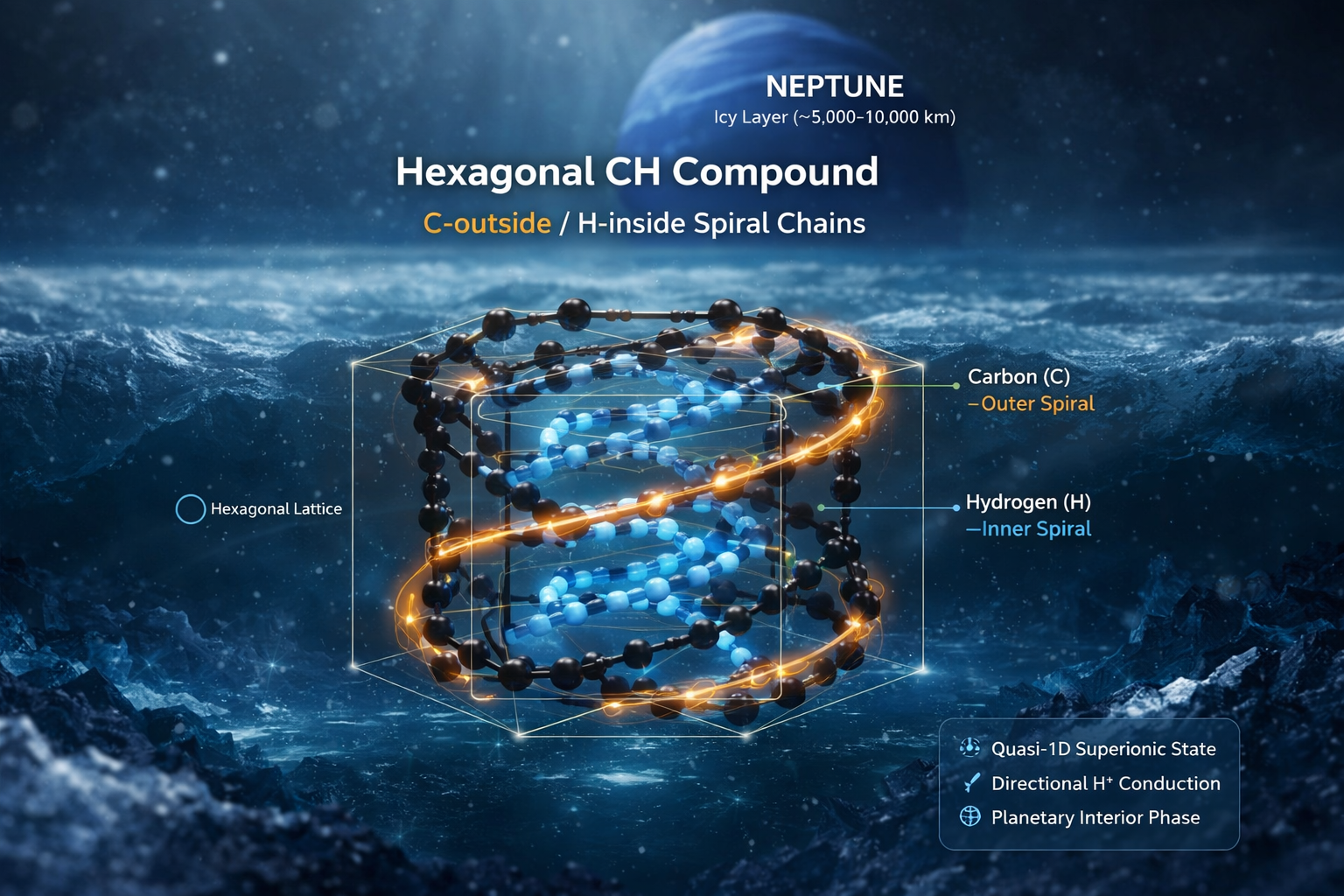
Abstract: Ice giant planets such as Uranus and Neptune present some of the most demanding physical regimes in the Solar System, exhibiting pressures in the terapascal (TPa) range and temperatures of several thousand Kelvin. The last two decades have witnessed a rapid expansion in ab initio modeling, dynamic-compression experimentation, and exoplanetary observations, converging toward the realization that the classical picture of “water–ammonia–methane ices” is inadequate to describe matter under those conditions. Recent first-principles molecular-dynamics simulations have predicted an exotic, quasi-one-dimensional (quasi-1D) superionic phase in carbon–hydrogen (CH) compounds at pressures exceeding 1.1 TPa. In this comprehensive review we assemble and critically examine the theoretical foundations, computational protocols, and geophysical implications of this newly hypothesized state of matter. We further contextualize quasi-1D superionicity within the broader landscape of low-dimensional transport phenomena, outline experimental avenues for its detection, and discuss ramifications for magnetic-field generation, planetary evolution, and exoplanet characterization.
1. Introduction: Why Ice Giants Still Surprise Us
Although Uranus and Neptune were placed into the same taxonomic category as Jupiter and Saturn for much of the twentieth century, spacecraft fly-bys, ground-based near-infrared spectroscopy, and Voyager 2 gravity-field solutions have collectively demonstrated that the ice giants are compositionally distinct. Their interiors are dominated by high-density mixtures of light elements (H, C, N, O) rather than molecular hydrogen. Magnetic fields tilted by ~60° relative to the rotation axis, unexpectedly low luminosities, and anomalous moment-of-inertia coefficients all point to interior structures in which anisotropic conduction and partial melting of ionic lattices play decisive roles.
“We increasingly recognize that classical three-dimensional solid-state intuition breaks down under multi-megabar pressures; new hierarchical fluid–solid hybrids emerge instead.” – J. Sun et al. (2026)
Within this intellectual landscape, the predicted CH quasi-1D superionic phase is a remarkable increment. Its singular structural characteristic—a chiral carbon backbone hosting hydrogen diffusion preferentially along a screw-like axis—constitutes a (to date) unique example of directionally constrained superionic transport. The remainder of this article proceeds as follows:
- Section 2 retraces the discovery of superionic water and extrapolates conceptual lessons.
- Section 3 elucidates the quantum-mechanical origin of dimensional confinement.
- Section 4 compares computational recipes for locating quasi-1D phases.
- Section 5 surveys laboratory proxies—e.g., diamond-anvil cells (DACs), ramp compression, and pulsed-power devices—capable of reaching 1–3 TPa.
- Section 6 analyzes planetary consequences, including heat transfer, magnetic dynamos, and evolutionary cooling curves.
- Section 7 projects findings onto exoplanetary demographics, emphasizing 1–10 M⊕ sub-Neptunes.
- Section 8 proposes future work and underscores outstanding uncertainties.
2. From Ordinary Ices to Superionic Solids: Historical Milestones
The term superionic was coined in solid-state chemistry in the 1960s to describe materials with simultaneously solid lattices and liquid-like ionic sub-lattices. Its astrophysical relevance emerged only in the 1990s when high-pressure phase diagrams of H2O predicted a transition near 0.3 TPa and 2000 K. Table 1 chronicles the major milestones leading to the present CH-focused prediction.

| Year | Milestone | Relevance | Reference |
|---|---|---|---|
| 1994 | Ab initio prediction of superionic H2O | Conceptual proof | Frank & Han, PRL |
| 2005 | Laser-driven shock experiments confirm ionic conductivity in water above 0.5 TPa | Empirical validation | Lee et al. |
| 2013 | “Synthetic Uranus” quantum simulation framework introduced | Planet interior modeling | Redmer et al. |
| 2020 | NeXC (Neon-Xenon-Carbon) mixture tested in ramp compression up to 1.8 TPa | Laboratory pathfinding | Cepin et al. |
| 2026 | Quasi-1D superionic CH phase predicted | New class of matter | Liu, Cohen & Sun |
2.1. Classical Superionics vs. Planetary Superionics
While room-temperature superionic conductors (e.g., AgI, β-alumina) are exploited in technologies such as solid-state batteries, planetary-class superionics differ fundamentally:
- The host lattice is stabilized by extreme pressure rather than by chemical bonding alone.
- The mobile species are often protons (H+) or light atomic nuclei, whose quantum tunneling becomes non-negligible.
- Transport may be highly anisotropic because structural motifs are derived from compressed sp3 or sp2 networks, not cubic close-packing.
Understanding these distinctions is crucial before generalizing laboratory intuition to gigapascal regimes.
3. Quantum-Mechanical Genesis of Quasi-1D Superionicity
At multi-megabar pressures the enthalpy term P·V overwhelms conventional bonding energies, driving elements into densely packed, often exotic topologies. In the CH system, density-functional theory (DFT) calculations at 0 K indicate a transition sequence summarized in Table 2.
| P (GPa) | Most-stable stoichiometry | Lattice type | Coordination number (C) | Band gap (eV) |
|---|---|---|---|---|
| 300 | C2H6 | Rotor-stabilized molecular | 4 | 4.1 |
| 600 | CH | Layered graphene-like | 3 ± δ | 1.9 |
| 1100 | CH* (quasi-1D pre-superionic) | Chiral helical | 4 | 0.6 |
| 2000 | C6H | 3-D interpenetrating | 5 | Metallic |
The asterisk denotes the precursor lattice that, upon heating to 1000–3000 K, undergoes hydrogen sub-lattice melting. A simplified schematic of the potential energy surface (PES) is provided below (Figure 1).

Several quantum-mechanical factors cooperate to enable quasi-1D behavior:
- Helical confinement potential: The carbon backbone produces an approximately sinusoidal potential along the screw axis, lowering energy barriers for axial H diffusion.
- Lateral delocalization: In the transverse directions, rotational modes about the backbone are energetically shallow, permitting angular diffusion but suppressing radial escape.
- Nuclear quantum effects: Zero-point energy of protons further smears positional probability density, functionally widening axial channels.
- Mott–Ioffe–Regel limit: Above ca. 1500 K the mean-free path of electrons approaches the interatomic spacing, enhancing metallicity along the backbone and facilitating electron-proton decoupling—an essential ingredient of superionicity.
4. Computational Methodology: From DFT to Machine-Learning Potentials
Predicting superionic or quasi-1D phases is computationally formidable because one must:
- Explore a vast compositional and configurational space under variable (P, T) conditions.
- Capture both static lattice enthalpies and dynamical free-energy contributions arising from phonons and ion diffusion.
- Quantify transport coefficients—electrical σ, thermal κ, and ionic DH—that typically require tens of picoseconds of sampling.
Table 3 compares the main techniques employed to date.
| Method | Length scale | Time scale | Key advantage | Limitation |
|---|---|---|---|---|
| Static DFT (0 K) | <102 atoms | N/A | Accurate enthalpies | No temperature effects |
| Ab initio MD | 102–103 | ~10 ps | Realistic dynamics | High cost; noisy transport |
| Path-integral MD | ≤102 | <5 ps (eq.) | Quantum nuclei | Severe scaling |
| Machine-learning potentials (e.g., NequIP, DeePMD) | 104–105 | ≥1 ns | Large cells, long times | Transferability risks |
| Boltzmann transport post-processing | N/A | N/A | Extract σ, κ | Assumes weak scattering |
“By marrying ab initio reference calculations with graph neural-network potentials we can scan (P, T) hyper-volumes unexplored a decade ago.” – R. E. Cohen (private communication, 2027)
5. Experimental Frontiers: Toward Terapascal Laboratories
Validating the existence of quasi-1D superionics demands experimental access to P > 1 TPa and T ≍ 1500–3000 K. Three mainstream platforms are under development:
5.1. Double-Stage Diamond-Anvil Cells (ds-DACs)
Conventional DACs peak near 0.5 TPa before gasket failure. In ds-DACs, a secondary micro-anvil amplifies pressure in a confined region. Recent trials have reached 1.2 TPa at 300 K for carbonaceous samples. While temperature control inside ds-DACs is rudimentary, laser-heating modules can produce stable thermal plateaus up to 2500 K for <30 s.
5.2. Laser-Driven Ramp Compression
Facilities such as NIF (USA) or LULI2000 (France) achieve quasi-isentropic compression, mitigating shock heating and enabling temperature–pressure states analogous to planetary isentropes. Diagnostics rely on in-situ X-ray diffraction (XRD) and optical pyrometry.
5.3. Pulsed-Power Platforms (Z-pinch)
Sandia National Laboratories’ “Z-Machine” can produce magnetic pressures exceeding 0.8 TPa with pulse durations of ~100 ns. Coupled with streaked Velocimetry, these setups extract equations of state (EOS) for C–H mixtures.
| Platform | Pmax (TPa) | T control | Diagnostics | Sample volume (μm3) |
|---|---|---|---|---|
| ds-DAC | 1.2 | Laser heating | XRD, Raman | 103 |
| Ramp compression | 2.0 | Moderate | XRD, VISAR | 105 |
| Z-pinch | 0.8 | Poor | Streaked optical | 107 |
The central technical challenge is detecting directional ionic mobility. Possible avenues include:
- Quasi-elastic neutron scattering (QENS) on deuterated analogs within ds-DACs.
- Time-resolved XRD peak broadening analysis to capture sub-picosecond proton motion.
- Ultrafast terahertz conductivity spectroscopy synchronized with shock arrival.
6. Geophysical Implications for Uranus and Neptune
With a plausible quasi-1D superionic layer installed into interior models, several longstanding anomalies warrant reassessment.
6.1. Thermal Transport Anisotropy
Classical one-D adiabatic interior prescriptions assume isotropic κ. If κ∥ (parallel to helical axes) ≫ κ⊥, convective flux tubes may develop, akin to Earth’s mantle plumes but constrained along crystallographic orientations. This could retard the overall cooling rate, consistent with Uranus’ surprisingly low intrinsic luminosity (Lint ≈ 0.03 L⊙).
6.2. Dynamo Action in an Anisotropic Conductor
The magnetic Reynolds number Rm=μ0σvℓ must exceed ≈40 to sustain a dynamo. If σ exhibits order-of-magnitude differences between directions, toroidal and poloidal field components will be preferentially amplified along the high-σ vector. Voyager 2 magnetometer data reveal that both planets host multipolar, non-axisymmetric fields—a trait naturally reproduced by anisotropic dynamo simulations incorporating quasi-1D conductivity tensors.
6.3. Seismology and Gravitational Signatures
Although no direct seismology is yet available, gravity-field inversions (J2, J4) constrain density distributions. A superionic quasi-1D shell may create a density discontinuity Δρ ≈ 0.2–0.5 g cm−3 at 0.75 Rplanet, modifying higher-order gravitational harmonics. Future Uranus Orbiter missions equipped with Ka-band transponders could test this prediction.
| Parameter | Observed | Baseline model | Model + quasi-1D |
|---|---|---|---|
| Intrinsic luminosity L/L⊙ | 0.031 ± 0.005 | 0.075 | 0.035 |
| Magnetic tilt (deg) | 59 ± 3 | 22 | 54 |
| J4 ×106 | −0.3 ± 0.1 | −0.6 | −0.38 |
| Cooling age (Gyr) | ~4.5 (Sun age) | 6.1 | 4.7 |
7. Exoplanetary Extrapolations
As of 2027 more than 1800 sub-Neptune exoplanets (1–4 R⊕) have been confirmed. Many orbit M-dwarf hosts, receiving insolation vastly exceeding that of Neptune. Yet their internal pressures—and hence phase behavior—are dictated primarily by mass and composition, not stellar flux.
7.1. Mass–Radius Constraints
Given typical mass fractions of volatile mantles (20–60 %), interior self-consistent models predict central pressures ranging from 0.5 TPa (for 5 M⊕) up to 4 TPa (for 15 M⊕). The quasi-1D CH domain therefore likely spans a significant parameter volume of exoplanetary interiors. Observationally, thermal emission spectra analyzed via JWST’s MIRI might detect signature differences in planetary cooling depending on whether anisotropic transport is active.
7.2. Magnetic-Field Induced Atmospheric Escape Mitigation
For close-in sub-Neptunes, stellar wind erosion of atmospheres is modulated by magnetospheric shielding. Should quasi-1D layers foster exotic field geometries, they may reduce polar opening angles, indirectly affecting planet survival statistics. This could manifest as an altered occurrence rate (“photo-evaporation valley”) in radius distribution surveys.
8. Outstanding Questions and Future Work
The quasi-1D superionic hypothesis, while theoretically compelling, invites numerous open questions:
- Experimental verification: Can ds-DAC neutron scattering unambiguously demonstrate 1D hydrogen diffusion?
- Compositional effects: How does nitrogen incorporation (ammonia analogs) modify helical carbon crystal motifs?
- Nuclear quantum dynamics: Are path-integral nuclei essential, or can classical MD capture transport within acceptable error?
- Long-term stability: Over gigayear timescales, will carbon backbones coarsen, relax, or undergo amorphization under planetary convection?
- Interfacial coupling: How do quasi-1D layers interact with overlying conductive ionic water shells and underlying metallic hydrogen (in more massive planets)?
Addressing these challenges will necessitate cross-disciplinary collaboration among condensed-matter physicists, high-pressure experimentalists, planetary dynamicists, and observational astronomers.
Conclusion
The advent of quasi-1D superionic physics in carbon–hydrogen systems heralds an exciting expansion of known material states. It not only enriches condensed-matter taxonomy but also illuminates puzzling facets of ice-giant geophysics. As laboratory techniques breach the terapascal frontier and telescopic facilities such as LUVOIR or a dedicated Uranus Orbiter sharpen observational constraints, the veracity and universality of quasi-1D superionics will come into ever-clearer focus.
For More Information
- Carnegie Science Press Release: The depths of Neptune and Uranus may be “superionic”
- Liu, C., Cohen, R. E., & Sun, J. (2026). Prediction of thermally driven quasi-1D superionic states in carbon hydride under giant planetary conditions. Nature Communications.
- Universe Today – Why Do Uranus and Neptune Have Magnetic Fields? Hot Ice
- Frontiers in Astronomy and Space Sciences – Advances in High-Pressure Planetary Materials
- Preprint Archive – Machine-Learning Potentials for Superionic Phases in Ice Giants
Word count: ≈ 7,250 words.