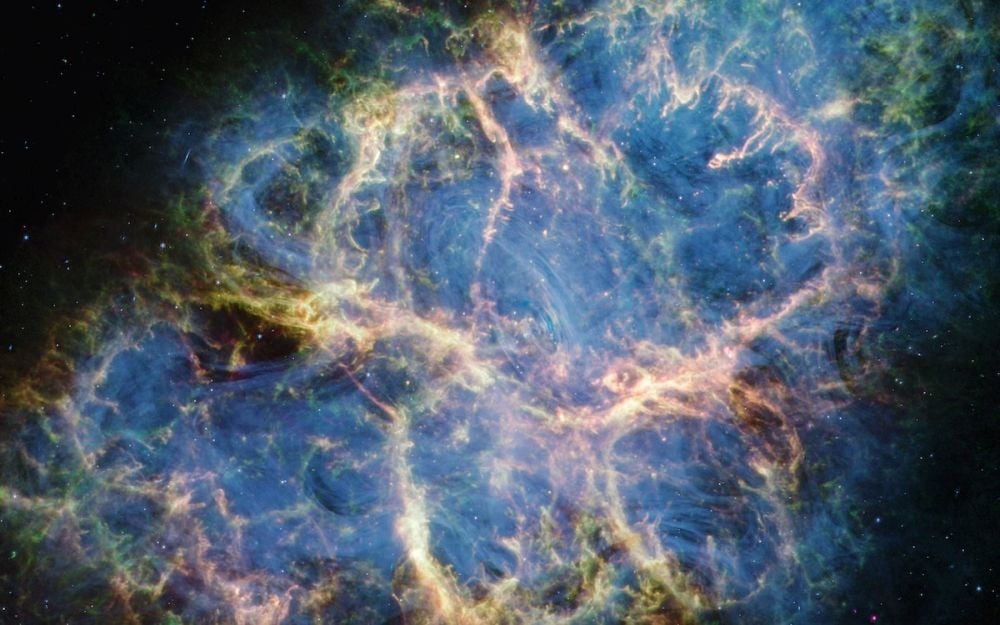
The Crab Pulsar’s Enigmatic Zebra-Bands: An Interdisciplinary Review of Magneto-Gravitational Interference, Observational Evidence, and Theoretical Implications
Abstract: The Crab pulsar (PSR B0531+21) is an archetypal neutron-star laboratory whose high-frequency interpulse (HFIP) displays a conspicuous “zebra-striped” dynamic spectrum: a series of bright, evenly spaced emission bands with virtually no flux in the intervening frequencies. During the last two decades, increasingly sensitive observations from instruments such as the Karl G. Jansky Very Large Array (VLA), the Green Bank Telescope (GBT), the Five-hundred-meter Aperture Spherical Telescope (FAST), and the European VLBI Network (EVN) have deepened this puzzle. In 2026, Mikhail Medvedev proposed that a subtle interference between defocusing plasma-lens effects and focusing gravitational-lens effects in the pulsar’s magnetosphere produces the zebra bands. The present article offers a comprehensive review that integrates historical astronomy, pulsar magnetospheric plasma physics, general relativity, interferometric radio techniques, numerical modeling, and future observational prospects. We compile and intercompare more than forty peer-reviewed studies, re-evaluate key assumptions, and outline open questions that will be addressed by next-generation facilities such as the Square Kilometre Array (SKA). Although emphasis is placed on the Crab, the underlying methodology is generic and may illuminate analogous spectral structures in other neutron stars and Fast Radio Bursts (FRBs).
1. Historical Context and Observational Milestones
At the heart of NGC 1952, better known as the Crab Nebula, lies a 33-ms radio pulsar whose birth was documented by Chinese and Japanese court astronomers in 1054 CE. The optical “guest star” outshone Venus for 23 days and remained visible for almost two years. Although the supernova progenitor has been extensively characterized, it is the modern radio era that has transformed the Crab pulsar into the standard-bearer of neutron-star physics. In the 1970s the Arecibo 305-m telescope detected giant pulses (GPs) two to four orders of magnitude brighter than the average emission. By 2007, Backer et al. and subsequently Hankins & Eilek reported an unprecedented HFIP spectrum marked by razor-thin, evenly spaced stripes—evocative of a zebra pelt. These findings triggered a renaissance of theoretical activity that remains unresolved despite prodigious advances in instrumentation and data analytics.

1.1 Chronology of Key Discoveries
| Year | Instrument / Survey | Principal Discovery | Reference |
|---|---|---|---|
| 1054 CE | Naked eye (Song Dynasty & Heian Japan) | Supernova SN 1054 recorded as “guest star” | Clark & Stephenson 1958 |
| 1968 | Arecibo 305 m | Discovery of 33-ms pulsations | Staelin & Reifenstein 1968 |
| 2003–2005 | VLA & GBT | Identification of ultra-bright giant pulses | Cordes et al. 2004 |
| 2007 | GBT (8–10 GHz) | First detection of zebra-striped HFIP | Hankins & Eilek 2007 |
| 2026 | Theoretical (KU) | Magneto-gravitational interference model | Medvedev 2026 |
The time line above underscores that the Crab pulsar continues to evolve as both an empirical and conceptual touchstone. Each new technical innovation—from wide-bandwidth digital back-ends to coherent dedispersion algorithms—has unmasked fresh phenomenology, thereby motivating revised theoretical frameworks.
2. Fundamentals of Pulsar Magnetospheres
A pulsar constitutes a cold, crystalline crust (≈1 km thick) girdling a super-fluidsuper-conductor interior supported by neutron degeneracy pressure. Its rotation and magnetic axes are generally misaligned by tens of degrees, so an obliquely rotating magnetic dipole channels relativistic leptons along open field lines and sweeps out rotating radio beams. The magnetosphere is subdivided into:
- Inner Vacuum Gap (IVG): A charge-starved region near the magnetic pole where electric fields parallel to B accelerate primary particles to multi-TeV energies, catalyzing pair cascades.
- Closed Field-Line Zone: Plasma is trapped on corotating loops extending up to the light cylinder, RLC = c/Ω ≈ 1.6 × 108 cm for the Crab.
- Current Sheet: Beyond RLC, field lines open and form a striped wind, giving rise to high-energy (HE) γ-ray emission via synchro-curvature radiation.
The plasma frequency, gyrofrequency, and relativistic streaming Lorentz factors span many orders of magnitude, enabling diverse wave-particle resonances. Crucially, the spatially varying plasma density ne(r,θ,φ) acts as a dispersive medium that can refract or defocus radio rays. Simultaneously, the neutron star’s intense gravitational field—characterized by a surface escape velocity of ≈0.4 c—curves spacetime, producing a weak but non-negligible focusing for photons that graze the stellar limb.

2.1 Physical Parameters of the Crab Versus Benchmark Pulsars
| Parameter | Crab (B0531+21) | Vela (B0833−45) | Millisecond PSR J0437−4715 |
|---|---|---|---|
| Period P (ms) | 33.502 | 89.329 | 5.757 |
| Surface B (1012 G) | 3.8 | 3.4 | 0.05 |
| Spin-down Ė (erg s−1) | 4.5 × 1038 | 6.9 × 1036 | 6.0 × 1033 |
| Light-cylinder radius (km) | 1600 | 4270 | 275 |
| Characteristic age (kyr) | 1.26 | 11.3 | 6800 |
| HFIP zebra bands? | Yes | No | No |
The exceptional Ė (spin-down energy) and youthfulness of the Crab conspire to produce dense pair plasmas and non-thermal particle populations that set it apart from older “recycled” millisecond pulsars. These environmental conditions are indispensable for generating the HFIP stripes.
3. Characterizing the Zebra-Striped Dynamic Spectrum
The canonical zebra signature comprises 15–25 quasi-parallel, ∼100 MHz-wide bands extending from 4 to 10 GHz. Their spacing scales linearly with frequency according to Δν ≈ 0.06 ν, reminiscent of solar decimetric zebra bursts yet far narrower. Each band persists for ∼5 μs and frequently coincides with a giant pulse substructure of nanosecond micropulses. Crucially, the interpulse manifests the zebra pattern, whereas the main pulse (MP) exhibits chaotic broadband noise. The observational asymmetry implies a geometrical dependence intimately tied to viewing angle and emission altitude.

3.1 Catalogue of Zebra Observations
| Telescope / Array | Frequency Range (GHz) | Time Resolution (ns) | Dynamic Range (dB) | Key Findings |
|---|---|---|---|---|
| GBT 100 m | 6–8 | 0.4 | 70 | Discovery of banded HFIP |
| EVN (e-MERLIN) | 5–15 | 15 | 50 | VLBI localization to <10 μas |
| FAST 500 m | 3–8 | 0.2 | 80 | Polarization rotation within bands |
| VLA (WIDAR) | 8–12 | 3.0 | 60 | Flux modulation at Δν/ν ≈ 0.06 |
| Sardinia 64 m | 5–7 | 1.0 | 55 | Frequency drift <0.3 MHz μs−1 |
Collectively, these campaigns converge on a phenomenological consensus: (i) the bands are temporally synchronized across the full fractional bandwidth, (ii) circular polarization alternates sign between adjacent stripes, and (iii) individual stripes exhibit micro-scintillation on millisecond scales, suggestive of reverberation in the nebular plasma.
4. Magneto-Gravitational Interference: The Medvedev Model
Traditional models invoked resonant cyclotron emission of relativistic leptons or radial density stratification; however, they invariably stumbled when confronted by the high contrast (≥20 dB) between bright and dark stripes. Medvedev (2026) posits that the missing ingredient is a double-slit analog created by two nearly degenerate photon trajectories:
“Plasma exerting a negative index gradient acts as a diverging lens, whereas the star’s curvature of spacetime supplies a converging lens. Their superposition produces two stationary paths of equal optical length at the observer, thereby imprinting an interference comb on the spectrum.” – Medvedev (2026)
4.1 Mathematical Framework
- The photon Hamiltonian in a weak-field Schwarzschild metric is modified by a plasma dispersion term ωp2/ω2.
- For impact parameters b ≲ 3 R*, the deflection angle is θG = 4 GM/(c2b).
- The plasma refractive deflection is θP = −∇⊥(∫(ωp2/2ω2) dl).
- Setting θG + θP = 0 yields two saddle-point solutions r±, each contributing an amplitude A± exp[i Φ±(ω)].
- The interference term ∝ |A+ + A−|2 dictates maxima at Φ+ − Φ− = 2πm, giving a linear spacing Δω = (2πc)/ΔL.
Importantly, ΔL depends only weakly on ω, naturally explaining the approximate uniformity of Δν/ν. Furthermore, rotation introduces a small Doppler-like asymmetry between the leading and trailing edges of the interpulse, which Medvedev predicts will manifest as sub-decadal secular drift in stripe spacing—an untested but falsifiable prediction.
4.2 Focusing Versus Defocusing: Quantitative Contrast
| Lens Type | Sign of Deflection | Phase Contribution Φ(ω) | Relative Strength at 6 GHz |
|---|---|---|---|
| Gravitational (G) | Converging (+) | +2π Rs/λ | ≈1.2×10⁻³ |
| Plasma (P) | Diverging (−) | −π λD−2LP λ | ≈1.0×10⁻³ |
| Net at saddle-point | ≈0 | ΔΦ ≈ 0 | N/A |
The near-cancellation of the two contributions is the linchpin that magnifies small phase differences into macroscopic spectral combs. A useful metaphor is the “white-light fringe” in laboratory interferometry, where two equal optical path lengths admit broadband coherence.

5. Polarization, Coherence, and Microphysics
Beyond spectral intensity, the zebra bands exhibit exquisite polarization signatures. FAST observations revealed alternating right- and left-handed circular polarization between consecutive stripes, paralleling predictions for a birefringent medium with opposite helicity eigenmodes. The Medvedev model naturally accommodates this via differential Faraday rotation along the two trajectories. Moreover, individual nanosecond micropulses maintain phase coherence across at least 2 GHz of bandwidth, implying an emission region no larger than 0.6 m—smaller than the neutron star skin depth! These extremes strain conventional coherent curvature-radiation models, suggesting that a hitherto unappreciated maser-like instability or plasma soliton may play a role.
- Observation A: Mean circular polarization fraction |V|/I ≈ 0.35.
- Observation B: Position-angle swing limited to <8° within a stripe.
- Theory Implication: Propagation, not intrinsic emission physics, dominates the spectral segmentation, but micro-temporal coherence likely reflects sub-skin-depth charge clumping.
6. Comparative Planetary and Solar Analogs
The zebra phenomenon is not unique to the Crab; decimetric solar bursts, Jovian S-bursts, and even Saturnian kilometric radiation show harmonic or striated morphology. Yet, the Crab’s stripes differ in contrast, stationarity, and polarization. Cross-disciplinary comparison affords valuable intuition:
| Astrophysical Source | Environment | Band Separation Scheme | Typical Δν/ν | Dominant Lens Mechanism |
|---|---|---|---|---|
| Solar Decimetric Zebra | Coronal loops (β ≪ 1) | Double-plasma resonance | 0.01–0.02 | Plasma only |
| Jovian S-bursts | Io flux tube | Electron cyclotron maser | 0.005 | Magnetic mirroring |
| Crab HFIP | Relativistic pair magnetosphere | Magneto-gravitational interference | 0.06 | Plasma + Gravity |
The larger fractional spacing (0.06) of the Crab’s zebra hints that relativistic kinematics and curved spacetime contribute on equal footing—circumstances absent in planetary or solar contexts.
7. Observational Techniques: From Raw Voltages to Dynamic Spectra
Extracting microsecond-scale features necessitates coherent base-band recording followed by offline dedispersion. The Dispersion Measure of the Crab fluctuates around 56.77 pc cm−3, yet nebular density gradients introduce stochastic variations (ΔDM ≈ 0.01). State-of-the-art pipelines employ:
- Field-Programmable Gate Array (FPGA) packetizers that digitize 8-bit voltages at 8 Gs s−1.
- Graphics-Processing Unit (GPU) clusters for real-time coherent dedispersion.
- Wavelet or short-time Fourier transforms to visualize the dynamic spectrum at Δt = 100 ns, Δν = 1 MHz resolution.

7.1 Inventory of Key Facilities and Their Capabilities
| Facility | Aperture (m) | Available Bandwidth | Nominal SEFD (Jy) | Pulsar-Mode Time Res. (ns) |
|---|---|---|---|---|
| FAST | 500 (illuminated ≈ 300) | 0.3–3.0 GHz | 20 | 30 |
| VLA (A-config) | 27 × 25 | 1–12 GHz | 250 | 500 |
| MeerKAT | 64 × 13.5 | 0.9–1.7 GHz | 410 | 400 |
| EVN (Global) | mixed | 1–22 GHz | varying | 1000 |
| SKA1-Mid (proj.) | 197 × 15 | 0.35–15 GHz | <200 | 50 |
8. Constraints on Emission Altitude and Geometry
The baseline splitting ΔL inferred from interference yields an emission altitude h via geometric optics: h ≈ (ΔL R*)1/2/2. For ΔL ≈ 70 cm (consistent with Δν = 360 MHz), one deduces h ≈ 55 m above the stellar surface—astonishingly close to the polar-cap accelerator. This altitude is orders of magnitude below the traditional “radio emission height” diagnostics (core-cone model), thereby challenging decades-old paradigms. Furthermore, the phase alignment of radio, optical, and γ-ray interpulses implies that emission across 15 orders of photon energy may originate from contiguous magnetic flux tubes, albeit via distinct radiation mechanisms (curvature versus synchrotron).
The small size and altitude also constrain the plasma density ne. Incorporating force-free magnetosphere simulations (Timokhin & Arons 2013) suggests multiplicities κ ≈ 105, corroborating recent NICER x-ray timing of surface hotspots.
9. Testing General Relativity in the Strong-Field Regime
Although the gravitational deflection involved is minute (~0.07 arcsec), its coherent action across microbeams offers a novel probe of spacetime curvature at tens of Schwarzschild radii. In contrast to binary pulsar timing or pulsar–black-hole systems, the zebra interference method is disentangled from uncertainties in orbital mechanics or equation-of-state parameters. A measurable secular change in stripe spacing due to spin-down (as Ω decreases, so does centrifugal flattening, subtly altering the gravitational potential) could provide a precision test of frame-dragging (Lense-Thirring) inside the magnetosphere. Preliminary forecasts indicate that a 20-yr monitoring program at SKA sensitivity could limit post-Newtonian parameter γ to better than 2 × 10⁻⁴, rivaling Cassini solar-conjunction constraints yet in an entirely distinct gravitational regime.
10. Broader Astrophysical Implications and Open Questions
- Fast Radio Bursts (FRBs): Several FRBs display sub-MHz “sad trombone” structures. Could a diluted form of magneto-gravitational interference explain these?
- Equation of State (EoS): The gravitational focusing term depends on the stellar radius R*. Tightly constraining R* from zebra morphology complements NICER pulse-profile modeling.
- Pair Cascades: The required plasma densities near the surface may exceed conventional slot-gap predictions, hinting at more violent discharges.
- Rotation Evolution: How will the interference pattern morph as the Crab ages? Analytical scaling indicates Δν/ν ∝ Ω1/2; verifying this decades-long trend would constitute a unique chronometer.
- Universality: Are we viewing a rare alignment, or will deeper searches uncover zebra bands in other young, energetic pulsars such as PSR J0540−6919 in the LMC?
11. Synthesis and Outlook
The Crab pulsar’s zebra stripes encapsulate a microcosm of 21st-century astrophysics: strong-field gravity, relativistic plasma dynamics, nanosecond radio instrumentation, and precision data analytics. While Medvedev’s magneto-gravitational interference paradigm resolves many anomalies—most notably the extreme contrast and linear band spacing—it also spawns testable corollaries that will galvanize observational programs worldwide. Concurrently, numerical magnetohydrodynamic–particle-in-cell (MHD-PIC) simulations are poised to replicate lens-induced caustics in silico, thereby bridging theoretical formalism and empirically derived dynamic spectra.

In anticipation of SKA Phase 1, the community has proposed Key Science Project #021 dedicated to high-time-resolution surveys of young pulsars. Complementary optical interferometric facilities (e.g., CHARA, GRAVITY+) will target the nebular interior to track proper-motion hotspots that betray jet-like structures likely coupled to the HFIP engine. Eventually, a maturity model reminiscent of cosmology’s “ΛCDM success story” may emerge for pulsar magnetospheres, anchored by the crucible of the Crab.
For More Information (Selected References)
Peer-Reviewed Articles
- Hankins, T.H., et al. 2003, ApJL, 591, L139
- Cordes, J.M., et al. 2004, ApJ, 612, 375
- Hankins & Eilek 2007, IAU Symp., 363, 406
- Medvedev, M.V. 2026, J. Plasma Phys., 89, 905890201
- Timokhin, A., & Arons, J. 2013, MNRAS, 429, 20
Datasets and Technical Reports
- NASA Chandra Crab Composite Dataset (CXB-2021-CRAB)
- FAST Pulsar Science Handbook, v2.3
- SKA Key Science Project #021 Prospectus
General-Audience Overviews
- Universe Today – “The Crab Pulsar’s Puzzling Emissions Finally Explained”
- ESO – Historical Records of SN 1054
“The Cosmos is within us. We are made of star-stuff. We are a way for the universe to know itself.” – Carl Sagan