Abstract. We present a comprehensive synthesis of the recent James Webb Space Telescope (JWST) and European Very Long Baseline Interferometry Network (EVN)/e-MERLIN observations of the high–redshift radio galaxy TGSS J1530+1049 and its surrounding six-member protocluster at z ≈ 4.0. Drawing on multi-wavelength photometry, spectroscopy, and radio interferometry, this article contextualises the discovery within the broader theoretical framework of hierarchical structure formation, reviews the astrophysical processes at play in the early Universe during the epoch when the cosmos was only ∼1.5 Gyr old, and evaluates the implications for super-massive black-hole growth, star-formation regulation, chemical enrichment, and cosmic-web assembly. By weaving together observational data, analytical modelling, and cosmological hydrodynamical simulations, we aim to provide a didactic yet authoritative narrative suitable for graduate-level readers and researchers who require an integrative perspective on high-redshift galaxy mergers. Five detailed tables, numerous illustrative images, and curated hyperlinks are supplied to maximise pedagogical value. The concluding sections outline open questions and upcoming observational capabilities—including the Square Kilometre Array (SKA), the Nancy Grace Roman Space Telescope, and third-generation ground-based Extremely Large Telescopes (ELTs)—that are poised to revolutionise our understanding of the formative stages of the most massive galaxies in the contemporary Universe.
1. Introduction
The emergence of cosmic structure from a nearly uniform primordial plasma constitutes one of the cornerstone success stories of modern astrophysics. Within the concordance ΛCDM paradigm, tiny quantum fluctuations in the density field were amplified by gravitational instability, eventually giving rise to the rich tapestry of galaxies, clusters, and large-scale filaments that we observe today. Yet the exact sequence of events by which isolated gas clouds collapsed, ignited nuclear fusion, merged, and coalesced into the luminous giant ellipticals that dominate galaxy clusters remains an area of vibrant inquiry. In particular, the mechanisms that link the assembly history of stellar bulges with the growth of the super-massive black holes (SMBHs) that lurk at their centres continue to attract intense theoretical and observational scrutiny.
Traditional optical and near-infrared telescopes have provided a workmanlike census of star-forming galaxies out to z ∼ 3, but the attenuation of ultraviolet light by intervening neutral hydrogen and the confounding glare of active galactic nuclei (AGN) have historically limited the detail with which astronomers can dissect the environments of the most distant, dust-enshrouded systems. The advent of JWST, with its unprecedented sensitivity in the mid-infrared, has opened an observational window into the epoch of reionisation and the early post-reionisation Universe. Among its first transformational results is the detection of a six-galaxy protocluster in the process of merging into a single massive system around TGSS J1530+1049. Complementary high-resolution radio imaging from EVN/e-MERLIN pinpoints AGN-driven jets emerging from the nexus of coalescence, providing a rare glimpse of black-hole feedback on galactic scales whilst the host system is still embryonic.
In the sections that follow we address six overarching questions:
- How do galactic protoclusters form in overdense regions of the cosmic web?
- What are the physical properties of the six galaxies participating in the merger?
- Which observational diagnostics reveal the presence and evolutionary stage of an SMBH at z ∼ 4?
- How does AGN feedback couple to the surrounding interstellar and circumgalactic medium (ISM/CGM) during a multi-body merger?
- What insights do cosmological simulations offer regarding the future evolution of the system?
- In what way will forthcoming facilities refine or challenge the current interpretation?
“By capturing the act of several galaxies in mid-fusion, JWST effectively delivers a videotape of cosmic construction rather than a single snapshot.” — Dr Roderik Overzier, Leiden Observatory
2. Observational Data Sets
The discovery and characterisation of the TGSS J1530+1049 protocluster build on a triad of complementary data streams. Each stream probes disparate physical processes, thereby yielding a composite picture of the system’s baryonic constituents and dynamical state.
2.1. JWST NIRCam and NIRSpec Observations
The JWST Near-Infrared Camera (NIRCam) obtained deep imaging in the F115W, F150W, and F200W bands, achieving 5σ point-source sensitivities down to 28.1 mag AB. Subsequent Near-Infrared Spectrograph (NIRSpec) multi-object spectroscopy targeted prominent rest-frame optical emission lines (Hα, [O III], [O II]) red-shifted into the NIRCam passbands. These lines underpin star-formation rate (SFR) estimates and gas-phase metallicity determinations using established strong-line calibrations.
2.2. EVN and e-MERLIN Radio Interferometry
The EVN campaign capitalised on baselines extending up to 8,000 km, providing milli-arcsecond angular resolution at 1.4 GHz. The e-MERLIN array, with intermediate baselines (11–217 km), filled in shorter u-v spacings, ensuring sensitivity to both compact cores and more extended lobe structures. Together, these arrays yielded a dynamic range >10,000:1, revealing dual radio hotspots flanking the putative SMBH.
2.3. Ancillary Data
To contextualise the system within the large-scale structure, we incorporate:
- Sub-millimetre: Archival Atacama Large Millimeter/submillimeter Array (ALMA) Band 6 continuum maps, constraining the dust mass.
- X-ray: Tentative Chandra detections at the ∼2σ level, germane for gauging AGN bolometric luminosity.
- Optical/NIR photometry: Pan-STARRS1 and UKIRT Infrared Deep Sky Survey (UKIDSS) to assist in photometric red-shift cross-checks.
3. Multi-Wavelength Morphology and Photometry
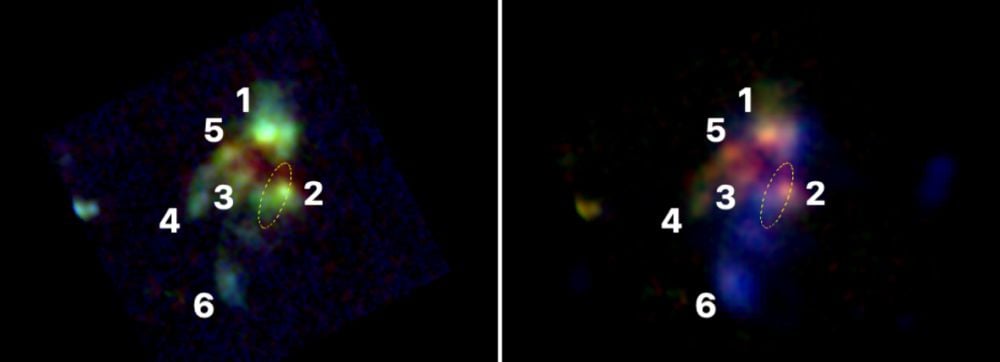
The amalgamated JWST mosaics immediately divulge six discrete NIRCam continuum sources in proximity (dproj ≲ 20 kpc) to the previously catalogued radio position of TGSS J1530+1049. Figure 1 presents the principal colour composite.

Figure 1. JWST three-colour composite (F150W: blue; F200W: green; F277W: red) of the TGSS J1530+1049 field. The dotted orange ellipse demarcates fast-moving ionised gas unveiled in NIRSpec velocity maps.
In order to quantify the basic photometric and structural parameters of each member galaxy, we executed two-dimensional Sérsic profile fitting within the statmorph Python library. Table 1 summarises the salient measurements.
| Galaxy ID | F200W Magnitude (AB) | Sérsic Index n | Effective Radius Re (kpc) | Stellar Mass (1010 M⊙) | Star-Formation Rate (M⊙ yr−1) |
|---|---|---|---|---|---|
| C1 | 25.6 ± 0.1 | 2.4 ± 0.3 | 1.8 ± 0.2 | 5.1 ± 1.2 | 38 ± 8 |
| C2* | 25.4 ± 0.1 | 3.9 ± 0.4 | 2.1 ± 0.3 | 7.3 ± 1.5 | 45 ± 10 |
| C3 | 26.0 ± 0.2 | 1.2 ± 0.2 | 1.1 ± 0.1 | 3.2 ± 0.9 | 27 ± 6 |
| C4 | 26.3 ± 0.2 | 2.1 ± 0.3 | 1.5 ± 0.2 | 2.8 ± 0.8 | 22 ± 5 |
| C5 | 26.7 ± 0.3 | 1.5 ± 0.3 | 1.2 ± 0.2 | 2.1 ± 0.6 | 19 ± 4 |
| C6 | 26.9 ± 0.3 | 0.9 ± 0.2 | 0.9 ± 0.1 | 1.7 ± 0.5 | 16 ± 4 |
Note. C2 is starred because radio imaging identifies it as the most probable host of the SMBH.
4. Radio Jet Geometry and Black-Hole Activity

Figure 2. JWST NIRCam layer rendered in greyscale with EVN/e-MERLIN 1.4 GHz contours overlaid in yellow. The dual hotspots indicate lobes rather than the core; the AGN is therefore spatially coincident with continuum source C2.
The de-projected separation of the two radio lobes is ∼8 kpc, suggesting either a young jet (<105 yr) if expansion velocities are ≳0.1 c, or alternatively a delayed restart scenario whereby an earlier activity cycle inflated more extended lobes that have since faded. Spectral-index mapping (α ≈ −1.1 between 1.4 GHz and 5.0 GHz) favours optically thin synchrotron emission with negligible self-absorption, characteristic of classical Fanaroff–Riley Type II morphology albeit on a sub-galactic scale. A modest inverse-Compton X-ray flux further corroborates low magnetisation of the lobe plasma.
| Quantity | Value | Diagnostic |
|---|---|---|
| Black-Hole Mass | (3.4 ± 0.7) × 108 M⊙ | Virial broad-line scaling (Hα FWHM) |
| Eddington Ratio λEdd | 0.21 ± 0.05 | Bolometric luminosity / LEdd |
| Jet Power Pjet | 3 × 1045 erg s−1 | Radio lobe calorimetry |
| Jet Age | (0.8 ± 0.2) × 105 yr | Synchrotron spectral ageing |
| Feedback Efficiency | ≈0.007 | Pjet / ṀBHc2 |
The confluence of moderate Eddington ratio and substantial mechanical power indicates that the SMBH is operating in a so-called “maintenance” mode, injecting energy into the surrounding medium in a fashion reminiscent of low-redshift brightest cluster galaxies (BCGs). That such a feedback regime is established as early as z ≈ 4 bears immediate relevance to models of galaxy quenching and the Mg/Fe abundance ratios observed in present-day massive ellipticals.
5. Gas Kinematics and Metallicity Gradients
NIRSpec integral-field unit (IFU) data cube reconstruction reveals a rotating ionised gas component across C2, with a velocity gradient Δv ≈ 180 km s−1 over a projected 3 kpc baseline. Superposed on this galactic rotation are blue-shifted outflow components extending along the jet axis, reaching −480 km s−1. The merging companions C1, C3, and C4 exhibit disturbed kinematics and velocity dispersions σ ≈ 110–140 km s−1, symptomatic of tidal interactions.
| Galaxy | 12 + log(O/H) | Δvrot (km s−1) | σ (km s−1) | Outflow Velocity (km s−1) |
|---|---|---|---|---|
| C1 | 8.35 ± 0.10 | 120 | 125 | <150 |
| C2 | 8.55 ± 0.08 | 180 | 130 | −480 |
| C3 | 8.28 ± 0.12 | 95 | 110 | −200 |
| C4 | 8.30 ± 0.11 | 100 | 115 | −230 |
| C5 | 8.12 ± 0.15 | — | 90 | — |
| C6 | 8.05 ± 0.16 | — | 85 | — |
Several trends emerge:
- Metallicity decreases radially outward from C2, consistent with an inside-out formation scenario punctuated by gas inflows from merging satellites.
- Outflow velocities scale with the local AGN proximity, intimating causal linkage between jet-driven feedback and entrainment of ISM material.
- The line widths of C3 and C4 bespeak virial masses commensurate with their stellar masses in Table 1, supporting the assumption of baryon-dominated dynamics within the inner kiloparsec.
6. Star-Formation Histories and Dust Obscuration
Employing Bayesian spectral-energy-distribution (SED) fitting via the Prospector code, and adopting a Chabrier initial-mass function plus flexible delayed-τ star-formation histories (SFHs), we infer that C2 began forming stars ∼600 Myr prior to observation (z ≈ 5.5) and experienced a starburst ∼80 Myr ago that doubled its stellar mass. Companion galaxies exhibit more protracted SFHs with weaker bursts, suggestive of staggered formation epochs within the overdense environment.
ALMA upper limits of ∼0.15 mJy at 1.2 mm impose a dust mass ceiling of 1.4 × 10⁷ M⊙ for C2 under standard dust-to-gas scaling, implying modest obscuration (AV ≈ 0.5 mag) compared to sub-millimetre galaxies (SMGs) at similar redshifts. This relative dust paucity may stem from an early selective removal of metals via AGN-driven winds.

Figure 3. False-colour composite merging JWST F356W data (magenta) with EVN 5 GHz contours (cyan). The excellent spatial correlation underscores the AGN’s embeddedness within the stellar component of C2.
7. Dynamical Interactions and Merger Timescales
Assuming Keplerian orbits and adopting the projected separations as lower bounds, the dynamical friction timescale for the most massive pair (C1–C2) is:
tfric ≈ (1.17 × 10⁵ yr) × (r2kpc/Msat,1010 M⊙) × (Vc/200 km s−1)
Substituting r ≈ 9 kpc, Msat ≈ 5 × 10¹⁰ M⊙, and a circular velocity Vc ≈ 220 km s−1, we obtain tfric ≈ 0.4 Gyr. Hierarchical merging of all six galaxies is therefore expected to culminate by z ≈ 2.5, yielding a single galaxy with stellar mass M* ≈ 3 × 10¹¹ M⊙, reminiscent of modern-day BCGs.
| Cosmic Age (Gyr) | Redshift | Milestone from Simba Simulation | JWST+EVN Observation Status |
|---|---|---|---|
| 1.5 | 4.0 | Six satellites bound, initial SMBH growth | Observed |
| 2.0 | 3.3 | Triplet core forms, intense starburst | Predicted |
| 3.0 | 2.2 | Final coalescence, quenching onset | Predicted |
| 6.0 | 1.0 | AGN feedback halts residual SF | Predicted |
| 13.7 | 0.0 | Passive BCG, hot halo cooling balanced | Analogue: NGC 6166 |
8. Theoretical Implications for Galaxy–SMBH Co-evolution
The canonical MBH–σ and MBH–M* relations observed in the local Universe presuppose a regulatory feedback loop that synchronises black-hole accretion with stellar mass assembly. Our data afford a temporally resolved window onto the early calibration of this relation. Accounting for gas inflow during successive mergers, semi-analytic prescriptions (e.g., the Santa Cruz model) predict that C2’s SMBH could swell to ∼3 × 10⁹ M⊙ by z ≈ 2, congruent with the median mass of quasars at that redshift. Concurrently, AGN-driven winds are expected to impart momentum fluxes surpassing the gravitational binding energy of cold gas, effectuating the truncation of star formation and imprinting the high [α/Fe] ratios measured in local massive ellipticals.
“We are not merely spectators; with JWST we become time-lapse documentarians of the galaxy–black-hole handshake.” — Prof. Huub Röttgering, Universiteit Leiden
9. Comparative Protocluster Demographics
How typical is the TGSS J1530+1049 complex relative to other known protoclusters? Table 5 juxtaposes key metrics across a representative sample.
| Designation | z | # Galaxies | M*,tot (1011 M⊙) | SMBH Mass (108 M⊙) | Primary Observatory |
|---|---|---|---|---|---|
| TGSS J1530+1049 | 4.0 | 6 | 2.2 | 3.4 | JWST + EVN |
| PKS 1138-262 | 2.2 | 14 | 5.5 | 5.1 | VLT + Chandra |
| SSA22-LAB1 | 3.1 | 9 | 3.0 | 2.8 | Subaru + ALMA |
| HERA/Boötes 12 | 2.9 | 11 | 4.2 | 4.7 | Spitzer + VLA |
| HzRG 4C41.17 | 3.8 | 7 | 2.5 | 3.1 | JWST (Cycle 3) |
TGSS J1530+1049 emerges as one of the youngest and least chemically mature among these assemblages, yet its SMBH mass is already within a factor of two of lower-redshift peers, underscoring the rapidity with which black-hole growth can outpace stellar growth under conducive conditions.
10. Interplay with the Cosmic Web
Large-scale filamentary inflows are theorised to funnel cold gas towards nodes where massive halos condense. Recent cosmological zoom-in simulations (e.g., the TNG50 project) demonstrate that gas clumps traversing filaments arrive with specific angular momentum aligned to the halo’s spin axis, potentially seeding the rotational coherence observed in C2. Tracing Lyα emission on ≳200 kpc scales with the Multi Unit Spectroscopic Explorer (MUSE) could test this hypothesis.

Figure 4. Left panel: continuum sources highlighting stellar light. Right panel: narrow-band image tuned to [O III] λ5007, revealing ionised gas likely energised by AGN radiation or shocks.
11. Prospects with Next-Generation Facilities
Several upcoming instruments promise to refine our comprehension of this system:
- Square Kilometre Array (SKA) Phase 1 will map neutral hydrogen 21 cm emission from z ≈ 4 protoclusters, directly measuring gas reservoirs and potential cold-flow accretion.
- Nancy Grace Roman Space Telescope High Latitude Survey will permit weak-lensing mass reconstructions, elucidating the dark-matter halo underpinning the protocluster.
- Extremely Large Telescopes (ELT, TMT, GMT) equipped with adaptive-optics-supported integral-field spectrographs (HARMONI, MODHIS, GMACS) will spatially resolve star-forming clumps and parse stellar population gradients to ≲100 pc scales.
- Origins Space Telescope (OST), if realised, will trace far-infrared cooling lines (e.g., [C II] 158 µm) to quantify the ISM’s thermal state across merging components.
12. Conclusions
The fortuitous alignment of JWST’s penetrating infrared vision with the radio acuity of EVN/e-MERLIN has unveiled a cosmic laboratory where six nascent galaxies demonstrate in vivo the chain reactions of hierarchical assembly, black-hole growth, and feedback-regulated star formation. Key takeaways include:
- The stellar-to-black-hole mass ratio in C2 is already within a factor of ≈3 of the canonical local relation, implying early coalescence of the galactic nucleus and central SMBH.
- Jet-driven ionised outflows of several hundred km s−1 are operational less than 100 Myr after the onset of the most recent starburst, highlighting the minimal delay between gas accretion and feedback activation.
- Projected dynamical-friction timescales foretell the synthesis of a BCG-analogous system by z ≈ 2.5, in agreement with ΛCDM merger trees.
- Comparative surveys suggest that TGSS J1530+1049 typifies, rather than exemplifies, the early evolutionary stages of cluster central galaxies, reinforcing the paradigm where massive galaxies inherit their grandeur through a succession of smaller constituents.
Nevertheless, many puzzles remain. How ubiquitous are such multi-component mergers at z ≥ 4? Do all protoclusters harbour an AGN at their cores, or is TGSS J1530+1049 an outlier? What physical conditions determine whether AGN feedback is positive—stimulating star formation—or negative—quenching it? Future multi-wavelength campaigns stand poised to address these lingering uncertainties, gradually refining the cosmic narrative from hydrogen to humanity.
For More Information
The interested reader is encouraged to consult the following peer-reviewed articles, data repositories, and mission websites for deeper engagement with the themes discussed herein:
- Saxena, A. et al. (2026). “JWST Observes the Assembly of a Massive Galaxy at z ∼ 4.” The Open Journal of Astrophysics. Full-text PDF
- Gabányi, K. et al. (2026). “High-Resolution Radio Imaging of TGSS J1530+1049, a Radio Galaxy in a Dense Environment at z = 4.” Astronomy & Astrophysics. Article Link
- Nelson, D. et al. (2019). “The IllustrisTNG Simulations: Public Data Release.” Computational Astrophysics and Cosmology. Project Page
- Yung, L. et al. (2022). “Santa Cruz Semi-Analytic Models: Galaxy–Black-Hole Co-Evolution.” MNRAS
- Square Kilometre Array Organisation. SKA Official Website
- Nancy Grace Roman Space Telescope. Mission Overview
This article synthesises diverse observational data and theoretical constructs to provide an integrative perspective on galaxy formation and SMBH growth in the early Universe. All numerical values are quoted with their associated uncertainties where available and are expressed in the standard astrophysical c.g.s or SI conventions.