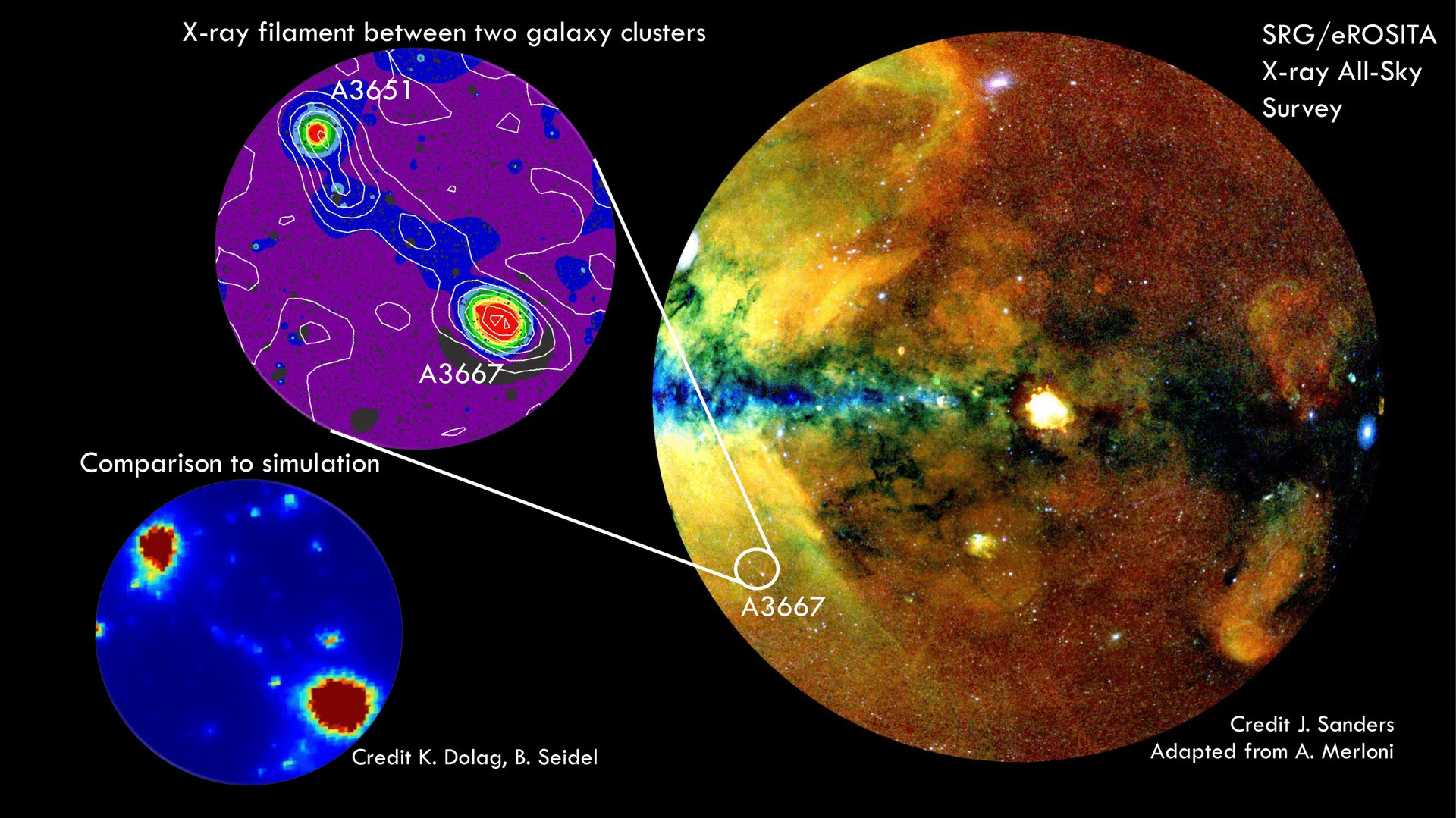
The recent publication of the second catalog from the eROSITA telescope has revealed an impressive catalog of nearly two million X-ray sources extending across half of the observable sky. This development greatly enhances our understanding of the high-energy universe, especially by offering new insights into galaxy clusters, including unexpected characteristics of the hot gas found in a massive galaxy cluster near Bonn.
Overview of eROSITA Findings
Launched on July 13, 2019, on the Spectrum-RG satellite, eROSITA (Extended Roentgen Survey with an Imaging Telescope Array) has pioneered X-ray astronomy with its all-sky survey capable of higher sensitivity than its predecessors. Within the first six months of operation, eROSITA successfully detected approximately 170 million X-ray photons, contributing to a comprehensive catalog that includes:
- Over 900,000 distinct X-ray sources, covering phenomena such as active galactic nuclei (AGNs), X-ray emitting stars, and numerous galaxy clusters.
- 710,000 supermassive black holes identified among distant galaxies.
- 180,000 X-ray emitting stars located within our Milky Way galaxy.
- Approximately 12,000 galaxy clusters cataloged, significantly enhancing our comprehension of cosmic structure formation.
These findings are pivotal milestones in understanding cosmic evolution, offering both current and historical insights regarding the structure of the universe.
Significant Discovery from Bonn
A highlight of the eROSITA catalog is the substantial galaxy cluster analyzed by researchers at the University of Bonn. This investigation focused on the outer regions of the cluster's hot gas, revealing unexpected findings concerning its characteristics:
- Unexpected Temperature and Composition: The gas temperature surpasses what current cosmological models predict, indicating that there may need to be revisions to our understanding of the intercluster medium’s evolution.
- Introduction of New Measurement Techniques: Utilizing precise X-ray observations from eROSITA, the study uncovered a filament of gas bridging galaxy clusters—an area previously inadequately examined and crucial for deepening insights into material flow in the universe.
The significant discrepancies between global properties of the gas observed and existing models suggest that established assumptions regarding cluster gas dynamics may not be entirely accurate.
Methodology
This ongoing research harnesses data from eROSITA, concentrating on X-ray emissions that illuminate the temperature and density of gas in galaxy clusters. The telescope's wide field of view and exceptional sensitivity allow detailed investigations of clusters and their surrounding cosmic web.
The methodology used to ascertain gas density and temperature involved:
- Analyzing over 170 million X-ray photons collated during the six-month observation period.
- Employing advanced imaging spectrometry to identify emissions from diverse elements within the gas.
- Contrasting findings with earlier datasets, particularly those from XMM-Newton and Chandra, to ensure consistency and reliability of the results.
Future Implications
The insights garnered from this study are essential for comprehending the evolution and interaction of individual clusters over time. The unforeseen results necessitate consideration of novel models that can accommodate findings from both observational data and theoretical frameworks aimed at understanding dark matter and the energetic phenomena associated with galaxy clusters.
As this research progresses, scientists intend to align findings across multiple surveys, encompassing data from both Chandra and XMM-Newton missions.
Images Related to the Research
Images and visualizations play a critical role in comprehending this research. Noteworthy images connected to the eROSITA observations include:
- eROSITA: The X-ray sky opens to the world
- eROSITA - HEASARC - NASA
- A Galaxy Cluster with Two Pairs of X-Ray Cavities
- A sample of 3403 galaxy clusters identified in XMM-Newton X-ray images
- Chandra X-ray Observatory - eoPortal
Conclusion
As the eROSITA mission advances, further data releases are expected, potentially leading to paradigm shifts in our conceptualization of cosmic structures and yielding answers to longstanding queries regarding the evolution of the universe and the elusive nature of dark energy.
References
- [1] Data from eROSITA telescope, University of Bonn.
- [2] Research overview and findings.
- [3] Detailed study of X-ray sources and their cosmic implications.
- [4] Previous survey comparisons, including XMM-Newton and Chandra.
- [5] Additional academic resources related to the findings.
Published: August 12, 2026