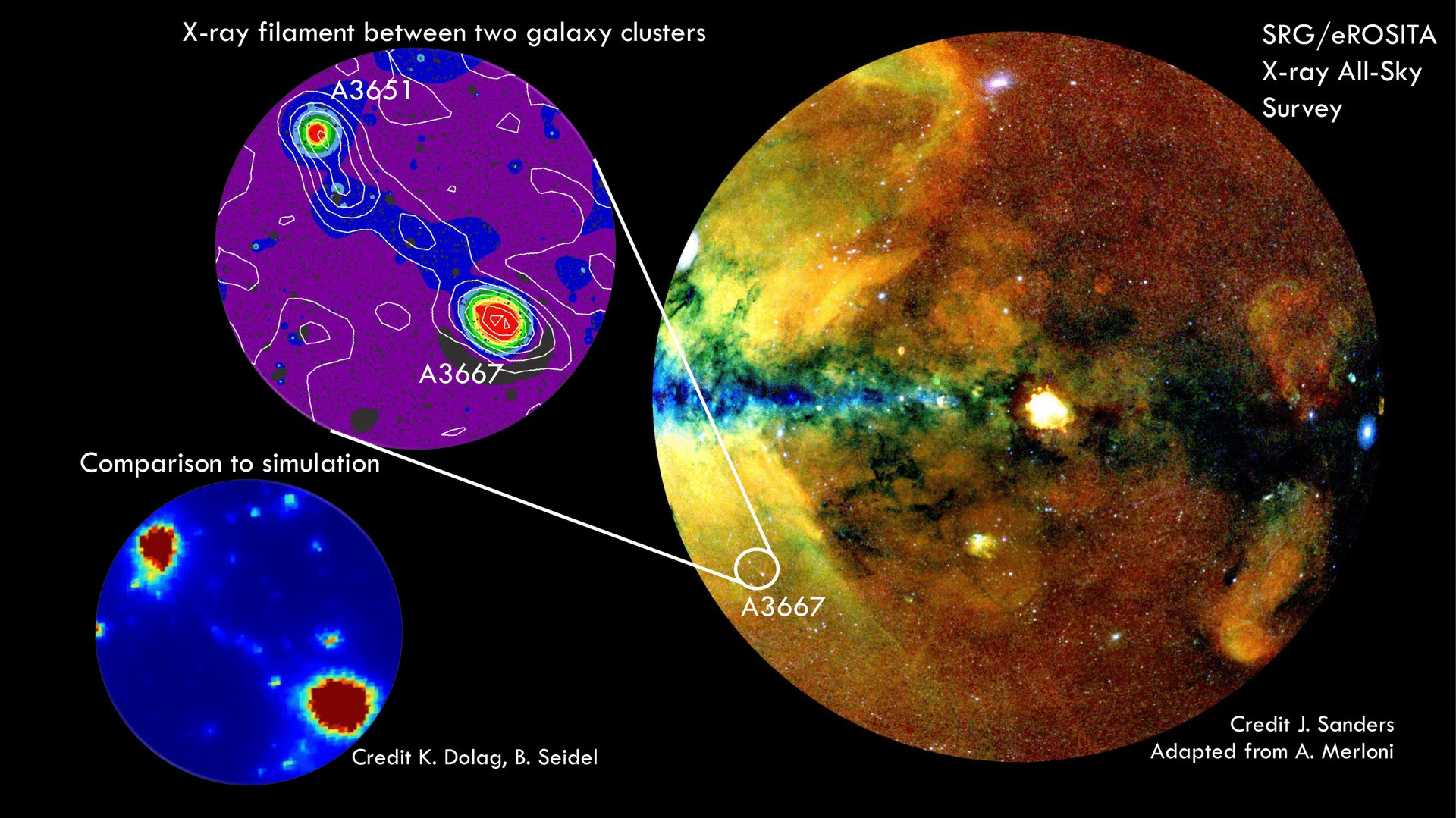
The eROSITA telescope, a collaborative astronomical mission, has recently completed its second extensive catalogue, unveiling nearly two million X-ray sources across half of the sky. This impressive catalog represents a doubling of previously known X-ray sources, revealing insights that significantly enhance our understanding of the cosmos.
Significant Findings
Among these new discoveries is a groundbreaking finding from a team at the Argelander Institute for Astronomy, which investigated the faint emissions from the outer regions of a massive galaxy cluster. This cluster is located where fresh material enters along filaments of gas that stretch between galaxy clusters. The analysis revealed that this gas is hotter, denser, and contains fewer heavy elements than existing models predict.
Methodology
Using the eROSITA telescope aboard the Spectrum-RG satellite, this research leveraged high-energy X-ray observations to analyze cosmic structures. The telescope was launched into space on July 13, 2019, and its early observations from December 2019 to June 2020 generated a wealth of data, including approximately 170 million detected X-ray photons.
Key Highlights of the eRAS1 Catalogue
- Approximately 900,000 sources.
- Includes around 710,000 active galactic nuclei (AGN).
- Features about 12,000 galaxy clusters, including the peculiar one studied by the Bonn team.
The Research Team
The study was led by Prof. Dr. Thomas Reiprich from the Argelander Institute for Astronomy, with key contributions from researchers like Jakob Dietl and Hannah McCall.
Limitations
Despite these significant findings, the current models of galaxy formation and evolution may require refinement. The mismatch in predicted metallicity and temperature in the detected gas signifies gaps in our existing understanding of cosmic evolution.
Conclusion
The eROSITA X-ray survey provides an unprecedented view of the nearby universe, reshaping our understanding of galaxy clusters and the gas that fills the cosmic web. It opens new avenues for future research, specifically aimed at understanding the nature of dark matter and the formation of clusters of galaxies.
References
| Source | Description |
|---|---|
| eROSITA: The X-ray sky opens to the world - University of Bonn | The German eROSITA consortium released the data for its share of the first all-sky survey by the soft X-ray imaging telescope. |
| Homing in on the X-ray sky with eROSITA's second data ... | An article discussing the eROSITA telescope's findings and analysis on gas emissions from galaxy clusters. |
| The X-ray sky opens to the world | Max Planck Institute for Extraterrestrial Physics | The first complete sky image from eROSITA reveals over 900,000 X-ray sources. |