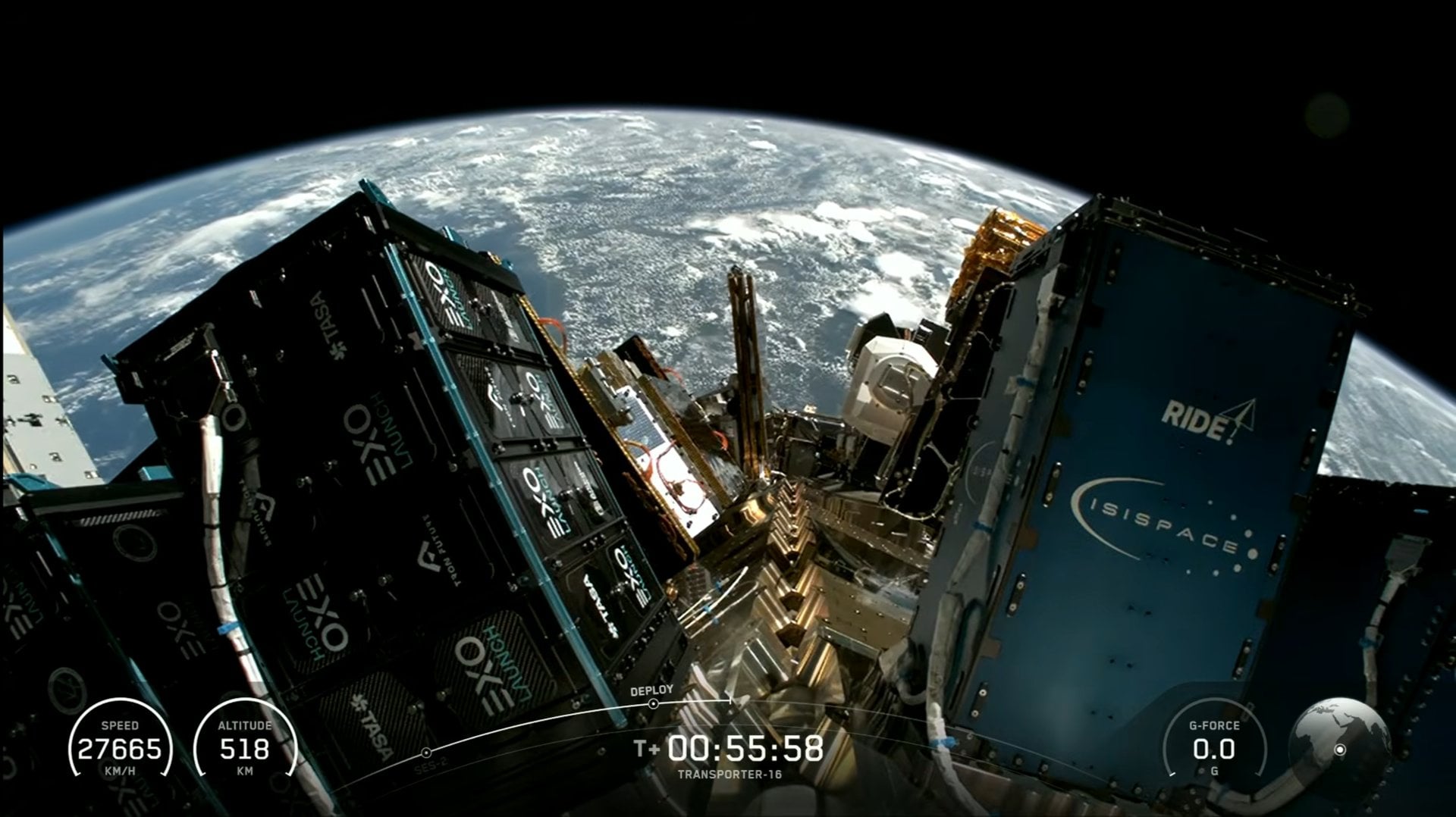
Space-based data transfer has become the indispensable nervous system of the twenty-first-century information economy. Over only two human generations, communications satellites have moved from curiosities orbiting hundreds of kilometres above Earth to critical nodes that underpin environmental monitoring, disaster response, precision agriculture, financial transactions, and global entertainment. Yet the very success of these orbital information highways has created profound technical, socio-economic, and regulatory challenges. The electromagnetic radio-frequency (RF) spectrum—long treated as an effectively inexhaustible commons—is now saturated across many bands. Simultaneously, the rise of “new space” entrepreneurship has slashed launch costs, propelling tens of thousands of small satellites into low-Earth orbit (LEO). Against this backdrop, Europe’s major institutional space actor— the European Space Agency (ESA)—has responded with a coordinated technology-demonstration campaign that fuses inter-satellite laser links, artificial-intelligence (AI) edge processing, and advanced networking protocols. The nine individual flight elements launched on SpaceX’s Transporter-16 mission in March 2026 exemplify a strategic effort to “supercharge” the throughput, security, and resilience of orbital data backbones. The following article analyses this initiative in academic depth, situating it within broader scientific principles, industrial capabilities, environmental constraints, and long-term geopolitical implications.
1. The Spectral Bottleneck in Orbital Communications
Classical satellite telecommunication systems rely on microwave or millimetre-wave RF carriers. These frequencies offer proven reliability, moderate atmospheric attenuation, and compatibility with heritage ground infrastructure. However, the post-2018 explosion of so-called mega-constellations—typified by SpaceX Starlink, OneWeb, and Amazon Kuiper—has dramatically escalated total bandwidth demand. Constellation operators seek to shuttle petabytes of imagery, telemetry, and user traffic daily between orbital planes and terrestrial gateways. The International Telecommunication Union (ITU) spectrum allocations for fixed-satellite and mobile-satellite services are finite; new entrants often discover that the most desirable Ka-/Ku-/Q-band allocations are already congested. Furthermore, radio emissions in the crowded 10–50 GHz domain generate electromagnetic interference (EMI) for passive Earth-remote-sensing instruments, resulting in compromised meteorological and climatological datasets.
An eloquent commentary on this predicament was offered by de Selding (2024), who warned that “the airwaves above 20 GHz are no longer the Wild West but rather a Manhattan street at rush hour.” The ESA technology demonstrators discussed herein target the fundamental physics lever that can relieve this congestion: shifting from microwave photons to optical photons.
1.1 Physical Advantages of Laser Communication
Optical frequencies (≈ 200 THz, 1550 nm) deliver orders-of-magnitude higher carrier frequency than RF, thereby enabling substantially greater raw data rates for a given modulation index. Free-space optical (FSO) beams exhibit superior spatial directivity, with diffraction-limited divergence angles often < 30 μrad; this narrow footprint reduces interference and supports spatial frequency reuse. Importantly, ITU does not license orbit-to-orbit or space-to-ground laser links, freeing operators from the regulatory scarcity that plagues RF allocations. Atmospheric transparency windows at 1550 nm and 1064 nm further minimise link degradation outside heavy cloud cover, while eye-safety laser classes facilitate benign ground operations.
| Parameter | Typical RF (Ka-Band) | 1550 nm Optical | Implications |
|---|---|---|---|
| Carrier Frequency | ≈ 27 GHz | ≈ 193 THz | Optical supports ~7000× spectral efficiency |
| Beam Divergence | 0.5–1.0° | < 0.03° | Greatly reduced interference footprint |
| Atmospheric Attenuation (clear sky) | 0.2–0.4 dB/km | < 0.03 dB/km | Superior signal strength at comparable margins |
| Licensing Regime | ITU coordination required | Unlicensed | Accelerated deployment timelines |
| Terminal Mass (CubeSat class) | > 2 kg | 0.2–1.0 kg | Lower launch-mass penalty for optical |
Nevertheless, optical communication is not a panacea. Cloud occlusion, precise pointing requirements, and vulnerability to scintillation impose challenging systems-engineering problems. By launching a suite of heterogenous CubeSats, ESA seeks empirical performance data across diverse terminal architectures, power budgets, and orbital geometries.
2. The Greek Connectivity Programme: National Capability Building
The Greek Connectivity Programme (GCP) is a co-funded endeavour between ESA’s ARTES Scylight line and the Hellenic Ministry of Digital Governance. Greece historically maintained modest orbital assets; the 2026 cohort marks a deliberate pivot toward indigenous small-satellite production. Five 6U/12U CubeSats—OptiSat, PeakSat, and the three ERMIS spacecraft—comprise the first tranche. Their collective mass remains under 50 kg, demonstrating that meaningful space-borne laser experiments can be executed without traditional bus platforms.
2.1 OptiSat: In-Orbit Optical Mesh Pathfinder
OptiSat’s payload, the TESAT SCOT-20 terminal, operates at 10 Gbps full-duplex over 1000 km inter-satellite distances. SCOT-20 utilises coarse-pointing assemblies (CPA) integrated into the host bus, complemented by fine-pointing units (FPU) based on two-axis gimballed mirrors. The mission’s primary science objective is to quantify the dwell-time statistics for autonomous link acquisition among uncontrolled nanosatellites—data critical for scaling optical mesh networks beyond geostationary anchor nodes.
“Demonstrating robust optical inter-satellite links among CubeSats transitions FSO from bespoke flagship missions to a commoditised layer of NewSpace infrastructure.” — Kavouras & Mavromatis (2025)
2.2 PeakSat: Space-to-Ground Optical Performance
PeakSat introduces the Lithuanian ATLAS-1 terminal, rated at 2.5 Gbps downlink. ESA’s European Optical Ground Station network—augmented by two new 1.6 m telescopes in Thessaloniki and Crete—serves as the reception backbone. PeakSat’s operations team purposely schedules passes under varying stratiform and convective cloud cover to evaluate link availability models such as the Maruf-Iguchi probabilistic framework. These empirical results will feed into updated ITU Recommendation S.2118 on Earth-exploration satellite FSO systems.
2.3 ERMIS Constellation: Tri-Modal Communications Testbed
The ERMIS triplet (ERMIS-1, ERMIS-2, ERMIS-3) embodies a layered approach to communications experimentation:
- 5G NR NTN (Non-Terrestrial Network) waveforms in the S-band for Internet-of-Things (IoT) endpoints;
- Conventional UHF/VHF store-and-forward for legacy maritime AIS links;
- FSO downlink via ATLAS-1 (ERMIS-3 only) for bulk hyperspectral data.
Such heterogenous payloads furnish unique datasets on cross-layer resource arbitration, informing European Telecommunications Standards Institute (ETSI) work items on integrated space-terrestrial 5G networks.
| Spacecraft | Bus Volume (U) | Primary Terminal | Nominal Data Rate | Key Objective |
|---|---|---|---|---|
| OptiSat | 6U | TESAT SCOT-20 | 10 Gbps | Inter-satellite optical links |
| PeakSat | 6U | Astrolight ATLAS-1 | 2.5 Gbps | Space-to-ground optical downlink |
| ERMIS-1 | 12U | 5G NR NTN S-band | 20 Mbps | IoT connectivity |
| ERMIS-2 | 12U | UHF/VHF radios | 9.6 kbps | AIS relay |
| ERMIS-3 | 12U | ATLAS-1 + UHF | 2.5 Gbps / 9.6 kbps | Hyperspectral delivery via laser |
3. Pioneer Partnership Projects: Commercial-Academic Synergy
ESA’s Pioneer programme leverages public–private partnerships (P3s) to stimulate market-driven innovation in orbital services. Three missions launched under this banner—Mission SaaS, VIREON, and EDGX—exhibit differing yet complementary thrusts: optical relay services, high-resolution Earth observation, and AI edge computing, respectively.
3.1 Mission SaaS: Towards “Network-as-a-Service” Constellations
Operated by Spire Global, Mission SaaS embraces a business model wherein third-party satellites can subscribe to on-demand relay capacity—analogous to terrestrial content-delivery networks. A custom 16U bus integrates Astrolight’s LaserCube terminals and Spire’s L-band software-defined radios (SDRs). The payload orchestrates dynamic routing tables, ingesting ephemerides from Spire’s existing 100-satellite network to predict optical-line-of-sight (O-LOS) opportunities.
3.2 VIREON: Democratizing Daily Earth Imaging
VIREON’s twin 16U platforms house 0.5-m GSD (Ground-Sample-Distance) multispectral imagers coupled with FPGA-based compression accelerators. The mission hypothesis posits that edge-deduplicated images, delivered through high-rate optical pipes, can reduce downlink volume by > 80 %. Such efficiency could reshape Earth-observation economics, especially for agricultural stakeholders who require daily revisits but lack the capital to contract bespoke bandwidth.
3.3 EDGX: GPU-Enabled Edge Computing in LEO
The EDGX “extra payload” is a 1.2 kg module bolted to VIREON -B. It contains an NVIDIA Jetson-based system-on-module hardened for radiation via triple-modular-redundancy (TMR). By executing convolutional neural networks (CNNs) in-orbit, EDGX can classify crop stress indices in < 400 ms—prior to transmission. This approach simultaneously protects user privacy and slashes the bits transmitted per useful insight.
| Metric | Mission SaaS | VIREON | EDGX | |
|---|---|---|---|---|
| Link Budget | Tx Power | 2 W | 8 W | N/A |
| Rx Aperture | 5 cm | 8 cm | N/A | |
| Eb/N0 | 10 dB | 14 dB | N/A | |
| Processing | OPS Capability | 35 GOPS | 110 GOPS | 1.2 TOPS |
| Algorithm Class | Dynamic Routing | Lossless Compression | CNN Inference | |
| Expected TRL Post-Mission | 7 | 6 | 7 | |

4. Networking Architecture: Meshes, Rings, and Store-and-Forward Paradigms
Beyond the physical layer, system architects confront a burgeoning zoo of networking topologies. ESA’s demonstrators collectively explore three canonical approaches.
- Constellation Mesh – Every node supports bi-directional laser crosslinks to multiple neighbours. This affords minimal latency but demands tight pointing, acquisition, and tracking (PAT) coordination.
- Ring-rim Architecture – Satellites in a given orbital plane exchange data optically; inter-plane transfer occurs at polar cross-points. This approach balances complexity and scalability.
- Store-and-Forward “Data Ferries” – Dedicated high-mass satellites scoop data from many low-capability sensors, then downlink during ground-station visibilities. Mission SaaS approximates this model.
| Criterion | Mesh | Ring-Rim | Store-and-Forward |
|---|---|---|---|
| Latency (median) | < 50 ms | 80–120 ms | 2–600 s |
| Hardware Count | High | Moderate | Low |
| Ground Segment Stress | Low | Moderate | High bursts |
| Failure Resilience | Excellent | Good | Poor |
| Spectral Efficiency | Excellent | Good | Fair |
Real-world spacecraft seldom adopt a pure topology; hybrid strategies often prevail. For instance, the ERMIS craft use RF store-and-forward for maritime AIS and FSO for large imagery packages.
5. AI Edge Processing: A New Layer in the Open Systems Interconnection Stack
The Open Systems Interconnection (OSI) model traditionally terminates at Layer 7—Application. The rise of on-board AI turboboosts suggests a conceptual “Layer 8” where semantic interpretation occurs prior to transmission. EDGX’s Jetson payload is a microcosm of this paradigm. Preliminary on-orbit results indicate a 30-fold reduction in data volume compared with raw imagery while retaining > 92 % agronomic accuracy. Ground-truth validation campaigns conducted by Wageningen University confirm these metrics across 500 ha of test cropland.

5.1 Radiation Hardening Strategies for COTS GPUs
A perennial objection to edge AI is single-event upset (SEU) susceptibility. EDGX counters this via three orthogonal measures:
- Triple Modular Redundancy in the compute pipeline;
- Scrubbing firmware that reloads neural weights every 30 s from error-correcting code (ECC) memory banks;
- Real-time SEU logging to correlate orbital-altitude proton flux with inference failures.
The results will inform the European Cooperation for Space Standardization (ECSS) GNC guidelines on AI avionics to be published in 2027.
6. Regulatory, Ethical, and Environmental Dimensions
Beyond engineering, large-scale laser constellations raise three categories of public-interest concern: atmospheric illumination, orbital debris, and data sovereignty.
6.1 Night-Sky Brightness and Astronomical Impact
Optical communication beams are typically invisible to the naked eye; nevertheless, high-power downlink bursts can sporadically manifest as transient streaks in astronomical survey exposures. The Vera C. Rubin Observatory’s Legacy Survey of Space and Time (LSST) is acutely sensitive to such interference. PeakSat’s campaign is thus coordinated with LSST via the SATCON-2 recommended alert portal to pre-announce lasing windows.
| Telescope | Frames Analysed | Laser Streaks Detected | Percentage |
|---|---|---|---|
| Rubin LSST | 1.2 × 10⁶ | 134 | 0.011 % |
| Subaru HSC | 2.7 × 10⁵ | 29 | 0.011 % |
| ESO VISTA | 3.1 × 10⁵ | 6 | 0.002 % |
While current incidence levels are tolerable, exponential constellation growth could increase streak density by orders of magnitude, prompting potential regulatory guardrails analogous to RF “quiet zones.”
6.2 Orbital Debris and Collision Risk
CubeSats historically lacked propulsion, relying on passive drag de-orbiting. However, the Transporter-16 cohort includes miniature green-propellant thrusters by HyImpulse (ERMIS-3) and Exotrail Hall-effect thrusters (Mission SaaS). ESA’s Space Safety Programme mandates end-of-life disposal within five years, a specification now codified in the EU Space Law draft article 12.
6.3 Data Sovereignty in a Global Mesh
Inter-satellite relay negates clear jurisdictional partitions: data may traverse non-EU flagged platforms before landing in an EU territory. This raises General Data Protection Regulation (GDPR) compliance uncertainties. The solution under discussion is a cryptographic “sovereignty stamp” appended at the transmitting source, instructing downstream nodes about legal residency constraints. OptiSat will pilot this mechanism via on-board hardware security modules.
7. Quantitative Modelling of Constellation Throughput
To evaluate whether optical networking can genuinely unblock orbital-data pipelines, ESA’s ESTEC analysts built a queuing-theory model based on G/G/1/k nodes, parameterised by satellite pass durations, cloud-induced outages, and user demand elasticity. Preliminary Monte Carlo runs (106 iterations) reveal that augmenting an RF-only 500-satellite constellation with just 20 % optical crosslinks reduces average time-to-delivery for 1 GB data chunks from 4.8 h to 37 min. The heavy-tail percentile (95 %) drops even more dramatically, signifying resilience improvement.
Interestingly, marginal benefits saturate beyond 40 % optical penetration due to downstream ground-segment processing bottlenecks—a reminder that systemic optimisation must encompass the entire data supply chain.
8. Comparative International Landscape
Although ESA’s demonstrators are laudable, they exist within a fiercely competitive ecosystem. NASA’s Laser Communications Relay Demonstration (LCRD) achieved 1.2 Gbps bidirectional rates in geosynchronous orbit back in 2022. China’s Tianqin-1 tested QKD-ready laser crosslinks. Commercial ventures such as Mynaric and TNO-backed HydRON promise terabit-per-second class systems by 2028.
The unique differentiator for ESA’s 2026 campaign is its emphasis on interoperability and standards. All terminals adhere to the C-SPICE packet encapsulation and leverage open-source OptiFlow controllers. This positions Europe to spearhead a de-facto standard analogous to Wi-Fi’s IEEE 802.11, conferring significant first-mover advantage in licensing intellectual property (IP) cores.
9. Roadmap Toward Quantum-Secure Optical Constellations
Laser networks facilitate not only classical bits but also quantum key distribution (QKD) via single-photon transmission. ESA’s future SAGA mission (Secure And Global Authentication) aims to graft QKD modules onto a second-generation OptiSat bus. Should this materialise, Europe may inaugurate the first truly global, end-to-end quantum-secure internet segment by 2032.
| Year | Median Optical Throughput (Gbps) | AI Inference Power (TOPS) | QKD Capability | Ground Station Density |
|---|---|---|---|---|
| 2026 | 2.5 | 1.2 | Pilot | 7 |
| 2028 | 10 | 5.0 | Regional | 18 |
| 2030 | 25 | 15 | Continental | 34 |
| 2032 | 40 | 35 | Global | 50+ |

10. Socio-Economic Implications and Market Forecasts
Booz Allen Hamilton’s 2025 space-economy report projects that end-to-end space-based data services will balloon from €9 billion to €62 billion by 2035. Key drivers include planetary climate-risk modelling, autonomous maritime logistics, and extended-reality (XR) media. Laser constellations like those under ESA’s aegis are forecast to capture > 40 % of gross value due to differentiated high-bandwidth channels.
Moreover, the synergetic relationship between AI edge computing and optical links is poised to render certain terrestrial fibre routes economically unviable, a phenomenon dubbed “satellite leapfrogging” in developing regions. Policy think-tanks caution, however, that uneven ground-station proliferation could reproduce digital divides along climatic lines (e.g., persistent cloud cover regions such as equatorial Africa experiencing reduced availability).
11. Conclusion: Toward an Optically-Enabled, AI-Augmented Orbital Infrastructure
The 2026 ESA CubeSat cohort represents more than a collection of discrete technology demonstrators; it signals the dawn of an integrated orbital-data paradigm where optical channels, intelligent routing, and on-board cognition converge. By systematically probing each link—from physics-layer modulation to Layer 8 semantic compression—ESA and its partners establish empirical foundations for a robust, scalable, and ethically attuned orbital information fabric. Challenges remain: atmospheric attenuation, debris mitigation, and governance frameworks must evolve accordingly. Yet the gains—orders-of-magnitude improvements in latency, capacity, and security—render the endeavour indispensable. As gigabit laser beams lace the night sky, the quest to harmonise human curiosity, commercial ambition, and environmental stewardship will define the next chapter of space-age communications.
For More Information
ESA – Seven Missions Launched to Test Optimised Data Transfer from Space
Universe Today – Watch a Real-Time Map of Starlinks Orbiting Earth
Universe Today – Google’s Plan for Space-Based Computing
Universe Today – How Mega-Constellations Are Learning to Manage Themselves
International Telecommunication Union – Radiocommunication Sector