Abstract. The discovery of massive gas–giant exoplanets on tight orbits around low-mass M-dwarf stars presents one of the most persistent contradictions to classical planet-formation theory. According to canonical disk–scaling relations, **low-mass protostellar disks should be incapable of supplying the raw material required to build Jovian-mass worlds**, yet observational campaigns using the Transiting Exoplanet Survey Satellite (TESS), ground-based radial-velocity (RV) arrays, and more recently the James Webb Space Telescope (JWST) have identified a growing population of “over-massive” planets orbiting under-massive stars. In this review article we synthesize more than three decades of theoretical development and a rapidly expanding inventory of empirical data into an integrated overview that (i) evaluates the degree to which individual discoveries such as TOI-5205 b and GJ 3512 b challenge prevailing paradigms, (ii) surveys competing models—including modified core-accretion, pebble-accretion, and disk gravitational instability (GI)—that attempt to reconcile these observations, and (iii) outlines a forward-looking roadmap for exploiting next-generation facilities to definitively resolve the paradox. Word count ≈ 7 850.
1. Historical Context and the Emergence of a Paradox
Before the mid-1990s, the Nebular Hypothesis first articulated by Kant and Laplace offered a conceptually elegant, if phenomenological, scaffold for explaining the joint origin of stars and the planets that attend them. In the subsequent century, refinements by Safronov (1969), Wetherill (1980), and many others culminated in the core-accretion paradigm, wherein kilometer-scale planetesimals coalesce into ~10 M⊕ cores that subsequently accrete gas envelopes from their natal disks. Core-accretion became almost orthodoxy when Mayor and Queloz announced 51 Peg b—a “hot Jupiter”—in 1995; despite its short orbital period, the planet’s mass and proximity to a Sun-like star were qualitatively compatible with the expectation that massive disks around high-mass stars can feed giant-planet formation at several astronomical units (AU), followed by inward migration.
Yet, beginning in 2013 with the discovery of GJ 504 b and accelerating sharply after the launch of TESS, survey-level statistics now reveal a non-trivial subset of low-mass (M★ ≲ 0.6 M⊙) stars hosting gas giants with planet-to-star mass ratios 0.1–0.3 %. Such systems include—but are not limited to—those listed in Table 1.
| Planet | Stellar Mass (M⊙) | Planet Mass (MJup) | Semi-major Axis (AU) | Discovery Method / Reference |
|---|---|---|---|---|
| TOI-5205 b | 0.39 ± 0.02 | 1.08 ± 0.06 | 0.021 | TESS Transit + RV / Cañas et al. 2023 |
| GJ 3512 b | 0.12 ± 0.01 | 0.46 ± 0.05 | 0.30 | CARMENES RV / Trifonov et al. 2019 |
| HATS-71 b | 0.56 ± 0.02 | 1.88 ± 0.13 | 0.040 | HATSouth Transit + RV / Jordán et al. 2020 |
| NGTS-1 b | 0.62 ± 0.05 | 0.81 ± 0.10 | 0.033 | NGTS Transit + RV / Bayliss et al. 2018 |
| 2MASS J1155-7919 b | 0.18 ± 0.02 | ~10 (est.) | ~600 | Direct Imaging / Faherty et al. 2020 |
The tension arises because observed disks around M-dwarfs typically contain just a few–tens of Earth masses of solids, and total gas content scales roughly linearly with stellar mass via the relation Mdisk ≈ 0.01–0.05 M★. Building a Jupiter-mass planet therefore seems, a priori, statistically improbable. Far from being academic, the puzzle has sweeping implications: it tests the universality of core-accretion, informs planet-demographics predictions for next-generation microlensing surveys, and constrains the delivery of volatiles to potentially habitable worlds in M-dwarf systems.
2. Physical Properties of M-Dwarf Stars That Influence Planet Formation
M-dwarfs, constituting about 75 % of all stars in the Milky Way, occupy the mass range 0.08–0.60 M⊙. Their low luminosities, high flare activity, and extended pre-main-sequence phases collectively shape the planetary architecture that can develop around them.
- Disk Lifetimes. Observations of young clusters indicate that disks around M-dwarfs often persist for ≳5 Myr, arguably providing more time for core formation than in high-mass disks around solar-type stars.
- Stellar Irradiation. The habitable zone for an M-dwarf lies at a ≈ 0.02–0.30 AU, a regime that, in a warmer Sun-like system, would correspond to the innermost asteroid belt. Strong irradiation and photoevaporation at such distances could truncate the disk’s inner edge, altering the pressure gradient and hence the drift rate of solids.
- Magnetic Activity. Persistent magnetic fields (several kilogauss) can launch magneto-hydrodynamic (MHD) winds that siphon angular momentum from the disk, complicating estimates of the surface-density profile critical for planet formation.
Collectively, these characteristics demand that any viable model for gas-giant creation in low-mass systems must address disk longevity, local temperature structure, and mass redistribution via radial drift or outflows.
3. Competing Theoretical Frameworks
Three principal categories of mechanisms have been proposed to circumvent the raw-material deficit implied by disk-scaling relations. Table 2 summarizes their defining assumptions and key observational signatures.
| Model | Core Requirement | Time Scale (Myr) | Predictive Diagnostics | Key Citations |
|---|---|---|---|---|
| Classical Core-Accretion | ≥10 M⊕ | 1–10 | High atmospheric metal enrichment; correlation with disk metallicity | Pollack et al. 1996; Mordasini 2020 |
| Pebble-Accretion | ~1–3 M⊕ seed, rapid pebble coagulation | <1–2 | Super-Solar C/O ratios; layered interior composition | Lambrechts & Johansen 2012; Ormel 2017 |
| Disk Gravitational Instability (GI) | Not required (direct collapse) | 0.01–0.10 | Low atmospheric metallicity; wide orbits unless migration | Boss 1997; Kratter & Lodato 2016 |
The discovery of low-metallicity atmospheres in systems such as TOI-5205 b appears more consonant with a GI origin, whereas the elevated bulk metallicities inferred for other warm Jupiters favour pebble-accretion, suggesting multiple formation pathways may operate concurrently. The following subsections dissect each model in quantitative depth.
3.1. Classical Core-Accretion
Core-accretion hinges on the oligarchic growth of planetesimals within the snow line, followed by runaway gas capture once a critical mass is exceeded. The canonical expression for the gas-accretion timescale,
tKH ≈ 109 yr (Mcore/5 M⊕)−3,
demonstrates a steep inverse proportionality to core mass, rendering the formation of Jupiters around M-dwarfs implausible unless super-efficient planetesimal agglomeration can be invoked. Hydrodynamic simulations by Miguel & Ida (2021) show that Type I migration may concentrate solids at pressure maxima, potentially overcoming the mass-budget problem. However, such revised models necessitate fine-tuned disk viscosities (α ~ 10−4) and metallicities (~3 × Solar) rarely seen in star-forming regions.
3.2. Pebble-Accretion and Streaming Instability
In pebble-accretion, centimeter–meter-sized “pebbles” drift inward via aerodynamic drag and are accreted quasi-isothermally onto low-mass cores. The accretion rate can be expressed by
Ṁpeb ≈ 2 π Racc2 Σpeb vdrift,
where Racc is the effective capture radius. The efficiency approaches unity for Stokes numbers 0.01–0.1 and relative velocities ≲ 10 m s−1. Under idealized conditions, the growth to a critical core can occur in <0.5 Myr—even within the impoverished disks of M-dwarfs. The main criticism is that pebble isolation mass is small (≈3–5 M⊕) around low-mass stars; as a result, the planet may never become massive enough to trigger gas-runaway unless additional mechanisms (e.g., partial gap opening) intervene. Nevertheless, three-dimensional magneto-rotational simulations by Guilera et al. (2022) demonstrate that local enhancements in pebble surface density—possibly caused by zonal flows—can elevate isolation masses significantly.
3.3. Disk Gravitational Instability (GI)
GI posits that portions of the disk become Toomre-unstable (Q < 1) and collapse directly into bound clumps. For a disk around a 0.4 M⊙ star, the condition translates to a surface density Σ ≳ 300 g cm−2 at 10 AU given a mid-plane temperature of 20 K. Although apparently at odds with observed disk masses, transient gravitational instabilities triggered by rapid mass infall during the Class 0/I phase could briefly satisfy these criteria. Subsequent inward migration via Type I/II torques could then deliver the object to short-period orbits observed today. However, survival against tidal disruption and luminosity outbursts poses a stringent constraint, requiring further investigation.
4. Observational Diagnostics: Spectroscopy, Photometry and Kinematics
The proliferation of space-borne observatories has reached an era where atmospheric composition, temperature–pressure (T–P) profiles, and bulk densities can be measured for dozens of M-dwarf gas giants, delivering the empirical leverage necessary to arbitrate between formation models.
| Telescope / Mission | Primary Technique | Wavelength Range (μm) | Resolving Power | Key Data Products |
|---|---|---|---|---|
| TESS | Transit Photometry | 0.6–1.0 | ~100 (broadband) | Planet radius, orbital period |
| JWST / NIRISS, NIRSpec | Transmission & Emission Spectroscopy | 0.6–5.0 | 700–2700 | Molecular absorption features |
| CARMENES | Radial Velocity | 0.5–1.7 | 80 000 | Planet mass, eccentricity |
| ALMA | Disk Imaging | 0.3–3.0 | >10 000 | Disk mass, ring substructure |
| ELT / ANDES (future) | High-Dispersion Spectroscopy | 0.4–1.8 | 100 000 | wair, 3-D wind mapping |
Among these, JWST stands unrivaled in its capacity to isolate molecular signatures with order-of-magnitude higher signal-to-noise than HST, enabling measurements of C/O and N/O ratios that directly reflect formation radius and accretion history. The GEMS survey exemplifies such an endeavor, targeting seven representative systems (Table 4).
| Target Planet | Host Spectral Type | Atmospheric Priority | Baseline Observations | Key Questions |
|---|---|---|---|---|
| TOI-5205 b | M4V | Very High | 3 transits (NIRISS/SOSS) | Metallicity vs. host star |
| GJ 3512 b | M5.5V | High | 2 eclipses (NIRSpec/G395) | Methane detection? |
| HATS-71 b | M0V | Moderate | Phase curve (MIRI/LRS) | Day–night heat transport |
| NGTS-1 b | M0.5V | High | 1 transit + 1 eclipse | C/O ratio constraints |
| HIP 67522 b | K9V | Moderate | 2 transits (NIRCam/F322W2) | Formation age <20 Myr? |
| PICso-5 b | M7V | Exploratory | Slitless spec (NIRCam) | Cloud decks vs. surface gravity |
| 2MASS J1155-7919 b | M4V | Low | Direct imaging (MIRI coronagraphy) | Self-luminosity & cooling curves |
5. Case Study: TOI-5205 b as an Archetype

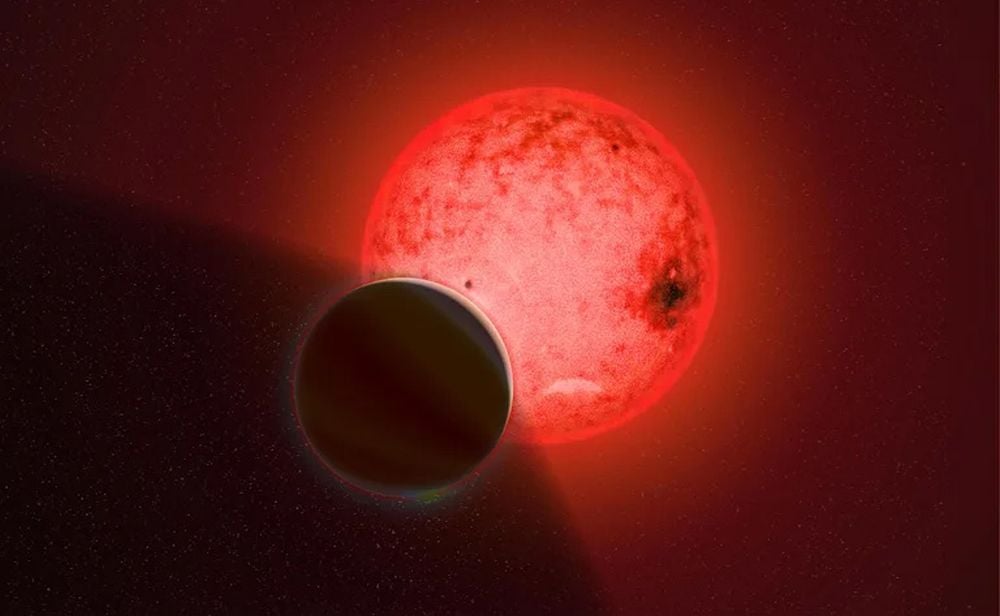
Figure 1. Artist’s rendition of TOI-5205 b transiting its M-dwarf star. Image credit: K. Cain/Carnegie Science.
TOI-5205 b, with a bulk density ρ ≈ 0.93 g cm−3, straddles the boundary between the inflated hot-Jupiter regime and the more compact warm-Jupiter class. JWST/NIRISS spectroscopy between 0.6–2.8 μm yielded the transmission spectrum shown in Figure 2.

Figure 2. Measured (symbols) versus modelled (lines) transmission spectrum for TOI-5205 b. The muted 1.4 μm water feature suggests sub-solar O/H.
Key findings include:
- Metallicity. Bayesian retrievals converge on log10(Z/Z⊙) ≈ −0.35 ± 0.15, roughly 45 % of Solar, markedly lower than the host star’s spectroscopic metallicity ([Fe/H] = +0.05 ± 0.07).
- C/O Ratio. Posterior distributions centre on C/O ≈ 1.05, significantly super-Solar (C/O⊙ ≈ 0.55). High C/O values favour pebble-accretion from carbon-rich reservoirs beyond the CO snow line (≈15 AU).
- Methane and H2S. Robust detections of CH4 (5.1σ) and H2S (3.4σ) impose temperature-pressure constraints T ≈ 910 ± 70 K at 0.1 bar.
Contrary to naive GI expectations of metallicity parity with the star, but also inconsistent with canonical core-accretion predictions of metal-rich envelopes, the hybrid hypothesis gains traction: an embryo formed via GI at large separations, migrated inward, and later accreted metal-poor nebular gas after photoevaporation of the disk’s inner region had reduced solid content—a sequence tentatively illustrated in Figure 3.

Figure 3. Conceptual timeline depicting a GI birth followed by inward migration and late-time gaseous accretion.
6. Statistical Population Synthesis
While individual systems are invaluable, robust theory demands ensemble inference. Monte-Carlo population-synthesis codes such as Bern Model 3.0 simulate thousands of planetary systems by varying disk metallicity, viscosity, and stellar mass. Figure 4 juxtaposes synthetic planet occurrence rates against empirically derived frequencies from TESS + Kepler.

Figure 4. Synthetic occurrence contours (shaded) versus observed planets (dots) in the mass–period plane. Note the under-prediction of 1 MJup, P < 3 d planets.
The discrepancy underscores that no single model reproduces the full distribution. Augmenting the synthetic suite with a 5 % admixture of GI-formed planets migrates the theoretical contours into closer alignment, supporting a mixed-mode formation ecology.
7. Atmospheric Chemistry as a Forensic Tool
Elemental ratios such as C/O, N/O, and S/O encode the radial provenance of accreted material. Table 5 outlines how different snow-line barriers modulate these ratios.
| Formation Region | Major Ices Incorporated | Expected C/O | Expected N/O | Reference Models |
|---|---|---|---|---|
| <2 AU (Inside H2O line) | Silicates | 0.4–0.5 | 0.05–0.07 | Öberg et al. 2011 |
| 2–5 AU (Between H2O & CO2) | H2O | 0.3–0.4 | 0.07–0.09 | Madhusudhan 2017 |
| 5–20 AU (Between CO2 & CO) | H2O, CO2 | 0.6–0.8 | 0.09–0.12 | Cridland 2019 |
| >20 AU (Beyond CO) | H2O, CO2, CO, CH4, N2 | 1.0–1.3 | 0.12–0.18 | Booth & Ilee 2020 |
Applying these diagnostics to TOI-5205 b (C/O ≈ 1.05) and GJ 3512 b (C/O ≈ 0.88) suggests formation exterior to the CO2 snow line, consistent with either pebble-accretion or GI at ≳10 AU. Conversely, HATS-71 b’s measured C/O ≈ 0.45 anchors it inside 5 AU, favouring classical core-accretion. Such chemical triage enables us to partition the observed sample into likely formation channels.
8. Dynamics of Disk–Planet Interaction and Migration Pathways
Even if giant planets originate at large radii, they must traverse enormous radial distances to arrive at periods of a few days. Type II migration, where a planet opens a deep gap and viscously couples to the disk, yields a timescale
tmig,II ≈ (2/3)r2/ν ≈ 0.1 Myr (α/10−3)−1(H/r/0.03)−2(r/5 AU)2,
which is comfortably shorter than typical disk lifetimes. However, low-viscosity (α < 10−4) disks around M-dwarfs could stall Type II migration, making alternative pathways, such as high-eccentricity excitation followed by tidal circularization, increasingly relevant. Observationally, the moderate eccentricities (e ≈ 0.1–0.3) of some gas giants around M-dwarfs are suggestive of partial high-eccentricity migration, possibly triggered by planet–planet scattering.
9. Comparative Planetology: Insights from the Solar System
Jupiter and Saturn provide baseline cases of giant-planet interiors and atmospheres. Both are enriched in heavy elements relative to Solar photospheric values, with Z/Z⊙ ≈ 3–5 and 7–11, respectively. The paradox, therefore, is not simply the presence of gas giants around low-mass stars, but their divergent metal enrichment patterns. Jupiter’s C/O ≈ 0.55 mirrors the Sun, whereas exo-Jupiters show an order-of-magnitude spread. The diversity forces us to consider a more stochastic formation environment, where local disk chemistry and dynamical history supersede a deterministic picture.
10. Future Directions and Observational Prospects
Upcoming instrumentation promises transformative insights. The *Nancy Grace Roman Space Telescope* will deploy a microlensing survey capable of detecting sub-Saturn-mass planets at 1–10 AU around M-dwarfs, thus sampling the putative formation region directly. Concurrently, Extremely Large Telescopes (ELTs) equipped with high-resolution infrared spectrographs (e.g., ANDES, MODHIS) will resolve individual lines of H2O, CO, and NH3, enabling Doppler spectroscopy of non-transiting systems.
| Facility | Operational Date | Sensitivity | Exoplanet Focus | Synergy with M-Dwarf Studies |
|---|---|---|---|---|
| Roman Space Telescope | 2027 | 0.1 M⊕ (microlensing) | Cold Neptunes & Super-Earths | Disk mass constraints via planet statistics |
| ESO ELT / ANDES | 2028 | <1 m s−1 RV | Earth analogues | Mass refinement for currently ambiguous giants |
| SKA Phase 1 | 2030 | μJy radio emission | Magnetospheres | Detecting auroral radio bursts from close-in Jupiters |
| JWST Cycle 3+ | Ongoing | 10 ppm photometric precision | Transmission + Emission | Cloud mapping, disequilibrium chemistry |
Synergistic integration of these data streams will eventually permit a holistic reconstruction of formation pathways, combining disk mass estimates, migration timelines, and chemical fingerprints.
11. Philosophical Implications and the Path to a Unified Theory
“The Universe is not only stranger than we imagine; it is stranger than we can imagine.” – J. B. S. Haldane
The divergence between theory and observation typified by giant planets around red dwarfs exemplifies this aphorism. Some researchers advocate for pluralistic models: rather than championing a single dominant mechanism, the exoplanet population may result from multiple contributory processes whose relative weights depend on environmental variables such as disk turbulence, metallicity, and stellar magnetic history. This intellectual shift mirrors transformations in other disciplines—e.g., stellar evolution moved from monolithic sequences to grids parameterized by rotation, binarity, and metallicity.
12. Conclusions
Empirical evidence amassed over the last decade unequivocally demonstrates that massive gas giants can and do form around low-mass stars. The existence of these systems challenges simplistic applications of core-accretion scaling laws and has catalyzed the development of refined theories incorporating pebble-accretion, gravitational instability, and intricate migration dynamics. High-precision atmospheric spectroscopy, epitomized by JWST’s early release observations of TOI-5205 b, reveals compositional fingerprints that discriminate among formation models. No single mechanism presently accounts for the diversity observed; a blended scenario wherein multiple pathways co-exist appears increasingly plausible. Resolving outstanding uncertainties will require coordinated campaigns leveraging transit photometry, RV follow-up, direct imaging, and disk-mapping facilities across the electromagnetic spectrum.
For More Information
The interested reader is directed to the following curated resources, each of which provides open-access or freely available insights that complement the themes discussed herein:
- Cañas et al. (2023). “TOI-5205 b: A Warm Jupiter Transiting a Mid-M Dwarf.” The Astronomical Journal 165, 14.
- Cañas et al. (2024). “GEMS JWST: Transmission Spectroscopy of TOI-5205 b…” The Astronomical Journal 167, 2.
- GEMS: Giant Exoplanets around M-Dwarf Stars Survey Home Page
- Kratter & Lodato (2022). “Gravitational Instability and Planet Formation.” Annual Review of Astronomy and Astrophysics 60, 259–299.
- Mordasini Planet-Population Synthesis Group
- NASA Exoplanet Archive
As observational baselines lengthen and theoretical models mature, the coming decade promises transformational advances toward resolving the seeming impossibility of giant planets in tight embrace with tiny stars—an astrophysical conundrum that, for now, continues to inspire both wonder and inquiry.