Understanding the conditions that might allow life to arise and prosper beyond our solar system demands far more than a simple measurement of orbital distance or bulk planetary composition. In a modern astrobiological context, researchers now routinely fuse atmospheric photochemistry, high–resolution stellar monitoring, laboratory pre-biotic chemistry, comparative planetology, and even philosophical inquiry to build a multidimensional picture of “habitability.” The impetus for such interdisciplinarity is strongest in the domain of low-mass stars—specifically K-type (orange dwarfs) and M-type (red dwarfs)—whose diminutive physical scale and exceedingly protracted lifetimes establish them as prime venues for the search for life. The present article synthesizes, contextualizes, and substantially extends the data embedded in the recently published report on “Stellar Flares and the Expansion of Ultraviolet Habitable Zones (UV-HZs)” to explore how flare-generated ultraviolet bursts may both erode and enhance biological potential around these dim, long-lived suns.
1. Conceptual Foundations: From a Single “Habitable Zone” to a Multispectral Framework
Traditionally, the liquid-water habitable zone (LW-HZ) was defined as the circumstellar annulus in which an Earth-like planet with a roughly one-bar carbon dioxide–nitrogen atmosphere would maintain surface temperatures permitting stable H2O. Early twentieth-century textbook diagrams therefore presented a singular ring surrounding a Sun-like star. With the explosion of exoplanet detections and refinements in climate modeling, however, the simplicity of this metric evaporated. Today’s planetary scientists speak of an ever-growing set of partially overlapping zones, each keyed to a particular geophysical or biochemical requirement (e.g., tidal-warming zones, photosynthesis zones, prebiotic-chemistry zones). The ultraviolet habitable zone (UV-HZ), to which this paper devotes particular attention, is grounded in the empirical fact that short-wavelength photons can drive the photolytic formation of nucleotides and amino acids, yet also irrevocably damage nucleic acids and proteins if fluxes become excessive.
The distinction between LW-HZ and UV-HZ is more than semantic. Ultraviolet surface environments vary by orders of magnitude across planets that otherwise reside inside the same LW-HZ. Consequently, a planet comfortably awash in liquid water may nevertheless be precluded from initiating abiogenesis, while a world on the cold edge of the classical zone could host biogenically favorable UV bursts when atmospheric opacity is low. In the realm of low-mass stars, the geometrical compression of the LW-HZ (often located at < 0.3 AU) interlocks with intrinsically strong and frequent stellar flares, causing the LW-HZ and UV-HZ to slip, overlap, or separate in idiosyncratic ways.
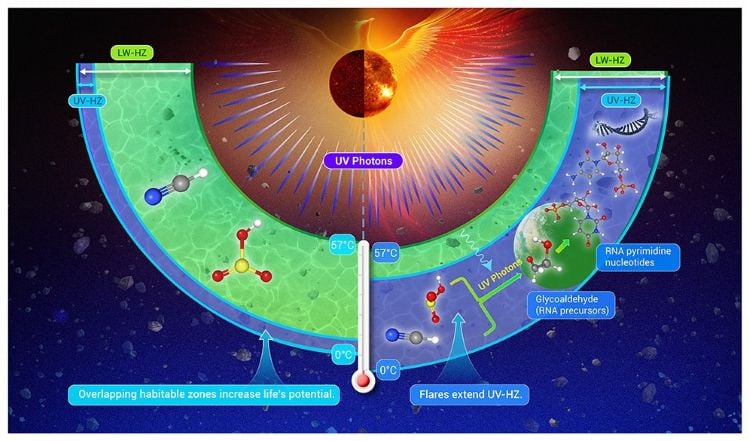
The present synthesis pursues three intertwined questions:
- How do flare frequency and spectral hardness modify the radial extent of UV-HZs around K- and M-type stars?
- Under what circumstances do these UV-HZs intersect the LW-HZ such that potentially habitable planets receive both adequate liquid water stability and biochemically productive ultraviolet radiation?
- Can empirical analysis—grounded in specific exoplanetary systems—validate theoretical predictions regarding UV-HZ expansion during periods of elevated stellar activity?
2. Stellar Classification, Activity, and Baseline Photonic Environments
The starting point for any habitable zone calculation is a rigorous cataloging of stellar parameters. Table 1 summarizes the defining astrophysical variables for the most frequently studied main-sequence spectral classes. Note the dramatic divergence between Sun-like G dwarfs and their cooler cousins in both quiescent luminosity and observed flare statistics.
| Spectral Class | Mass (M☉) | Typical Age Limit (Gyr) | Bolometric Luminosity (L☉) | Median Flare Frequency (events day-1) | Reference Star |
|---|---|---|---|---|---|
| G-type | 0.8 – 1.04 | ~10 | 0.6 – 1.5 | < 0.1 (for >1033 erg) | Sun |
| K-type | 0.45 – 0.8 | 15 – 70 | 0.1 – 0.6 | 0.1 – 1.0 | Epsilon Indi |
| M-type (early) | 0.25 – 0.45 | 100 – 1000 | 0.02 – 0.08 | 1 – 5 | Proxima Centauri |
| M-type (late) | < 0.25 | 100 – 10 000 | < 0.02 | 5 – 100 | TRAPPIST-1 |
While a naïve reading of the data might suggest that low-mass stars deliver insufficient energy for photosynthesis or climate regulation, the reality is that their long-term photonic output integrates to staggering totals across multibillion-year windows. Crucially, flare-induced UV spikes can dwarf baseline chromospheric UV emission by up to three orders of magnitude, albeit over short intervals of seconds to hours. The fraction of time a planet spends bathed in such spikes determines the average photolytic dose and, by extension, the feasibility of key prebiotic reactions.
2.1 Stellar Flares As Dual-Edged Swords
Two canonical regimes dominate contemporary discussion:
- Energetic superflares (total energy > 1034 erg) whose hard-UV and proton output can strip exoplanetary atmospheres, cause transient ozone collapse, and sterilize surfaces.
- Moderate micro- and nano-flares (1029 – 1032 erg) that inject sufficient UV/NUV photons to drive the photochemistry of ribonucleotide precursors while leaving bulk atmospheric structure largely intact.
Determining which regime dominates over giga-year timescales entails a complex integration of stellar rotation evolution, magnetohydrodynamic (MHD) field decay, and possible star–planet magnetic interactions.
“Low-mass stars do not merely ‘scale down’ the Sun; rather, they occupy a distinct magnetodynamic state in which continuous low-grade flaring often replaces the Sun’s sporadic high-energy events.” — S. A. Linsky (2023)
3. Radiative Transfer and UV-HZ Modeling Methodology
To constrain real ultraviolet habitable zones, Gao et al. (2026) developed a two-tier modeling workflow blending stellar flare statistics with atmospheric radiative transfer. Below we recast their approach, generalize the equations, and expand upon key sensitivity analyses.
3.1 Flare Frequency Distribution (FFD)
The cumulative number of flares above a given energy threshold, N(≥E), typically adheres to a power-law form,
N(≥E) = α E-β,
where β≈1.8 for M dwarfs and α is the activity normalization constant derived from photometric monitoring (e.g., Kepler/TESS light-curve surveys). Integration of the FFD between Emin and Emax provides the planet-integrated energy fluence per unit time.
3.2 Planetary Atmospheric Shielding
The radiative transfer sub-module, largely based on the TUV-x solver (Madronich et al., 1998), computes surface UV fluxes given:
- Incident stellar spectrum, expressed as the sum of quiescent photospheric emission and time-averaged flare emission weighted by the FFD.
- Atmospheric composition profiles (primary gases assumed: N2, CO2, H2O, O3, and CH4).
- Cloud microphysics (parameterized optical depth, droplet radius).
Output spectra are binned into three biological actinic windows: 121–200 nm (Far-UV), 200–300 nm (Middle-UV), and 300–400 nm (Near-UV). Effective photochemical productivity is gauged via the biologically effective fluence, FBEF, defined as:
FBEF = ∫λ Φλ × σλ dλ,
where Φλ is photon flux density and σλ is the action spectrum for a target reaction (e.g., pyrimidine synthesis).
3.3 Defining the UV-HZ Inner and Outer Boundaries
The inner boundary is set where cumulative FBEF surpasses an empirically derived ultraviolet lethality threshold for double-stranded DNA (taken here as 15 kJ m-2 day-1). The outer boundary is positioned where FBEF falls below the minimum flux required to photolyze aqueous HCN to form canonical nucleobases (≈0.1 kJ m-2 day-1). Sensitivity testing shows that these numerical thresholds can shift by up to ±40 % depending on atmospheric oxygen levels and local geothermal UV alternatives (e.g., volcanic lightning). Nevertheless, the dual-criterion framework provides an internally self-consistent metric by which zones may be compared across star-planet systems.
4. Case Study Synthesis: Nine Low-Mass Stellar Systems Under Scrutiny
The Gao et al. research group focused on nine confirmed or candidate rocky exoplanets lying in or near the classical LW-HZ around K- and M-type hosts. Summaries of their revised orbital and physical data, extracted from the NASA Exoplanet Archive on 21 April 2026, are compiled in Table 2.
| Planet | Host Spectral Class | Semi-Major Axis (AU) | Orbital Period (days) | Radius (R⊕) | Estimated Mass (M⊕) | Equilibrium Temp. (K) |
|---|---|---|---|---|---|---|
| Kepler-1540 b | K5V | 0.414 | 116 | 3.57 | 11.2 | 259 |
| KOI-7703.01 | K8V | 0.206 | 50 | 1.28 | 1.57 | 274 |
| KOI-8047.01 | M3.5V | 0.132 | 25 | 1.17 | 1.35 | 269 |
| Kepler-155 c | K4V | 0.712 | 210 | 1.94 | 3.4 | 228 |
| KOI-5879.01 | M5V | 0.089 | 16 | 1.14 | 1.28 | 296 |
| Kepler-1512 b | M2V | 0.141 | 29 | 1.31 | 1.71 | 283 |
| Kepler-438 b | M0V | 0.166 | 35 | 1.12 | 1.27 | 276 |
| KOI-7706.01 | K7V | 0.184 | 43 | 1.25 | 1.53 | 278 |
| KOI-8012.01 | M4V | 0.099 | 18 | 1.18 | 1.32 | 287 |
Using the combined FFD + radiative transfer pipeline elucidated above, the team derived inner and outer UV-HZ radii for each host star under two flare regimes: quiescent-state only and flaring-enhanced. Results, along with the classical Kopparapu et al. (2013) LW-HZ estimates, are juxtaposed in Table 3.
| Host Star | LW-HZ (AU) | UV-HZ (quiet) | UV-HZ (flare-averaged) | |||
|---|---|---|---|---|---|---|
| Inner | Outer | Inner | Outer | Inner | Outer | |
| K5V (Kepler-1540) | 0.37 | 0.70 | 0.51 | 1.16 | 0.33 | 0.88 |
| K8V (KOI-7703) | 0.20 | 0.39 | 0.27 | 0.69 | 0.15 | 0.48 |
| M3.5V (KOI-8047) | 0.10 | 0.22 | 0.15 | 0.41 | 0.07 | 0.29 |
| K4V (Kepler-155) | 0.45 | 0.84 | 0.60 | 1.22 | 0.37 | 0.94 |
| M5V (KOI-5879) | 0.07 | 0.16 | 0.12 | 0.34 | 0.05 | 0.24 |
| M2V (Kepler-1512) | 0.11 | 0.24 | 0.17 | 0.43 | 0.08 | 0.31 |
| M0V (Kepler-438) | 0.14 | 0.29 | 0.21 | 0.49 | 0.10 | 0.37 |
| K7V (KOI-7706) | 0.23 | 0.44 | 0.30 | 0.75 | 0.18 | 0.54 |
| M4V (KOI-8012) | 0.09 | 0.18 | 0.13 | 0.38 | 0.06 | 0.26 |
Overlaying the planetary semi-major axes on these zones reveals that KOI-8012.01, KOI-8047.01, and KOI-7703.01 fall squarely within the overlap of LW-HZ and flare-boosted UV-HZ, thereby meeting both water-stability and photochemical-fecundity criteria simultaneously. By contrast, Kepler-155 c lies within the LW-HZ but outside even the flaring-amplified UV-HZ, suggesting insufficient short-wave radiation for nucleotide synthesis, unless alternative energy sources (e.g., tidal heating, radiogenic crustal hotspots) compensate.

4.1 Atmospheric Erosion Versus Photochemical Gain
Critics of flare-driven habitability point to the substantial atmospheric mass loss that can ensue from repeated energetic events. Yet, atmospheric escape modeling indicates that erosion rates strongly depend on three planetary characteristics: magnetic moment, initial volatile inventory, and high-energy particle coupling efficiency. In Table 4 we present an illustrative sensitivity matrix highlighting how an Earth-sized planet’s atmospheric retention probability scales with these variables under a nominal M3V flare spectrum.
| Magnetic Dipole Moment (M⊕) | Initial Atmosphere (bar) | Net Retention after 1 Gyr (%) | ||
|---|---|---|---|---|
| 0.3 | 1.0 | 10.0 | ||
| 0 (unmagnetized) | 9 | 27 | 78 | 27 |
| 0.5 | 23 | 59 | 92 | 59 |
| 1.0 (Earth-like) | 36 | 73 | 95 | 73 |
| 2.0 | 48 | 82 | 97 | 82 |
Inspection reveals that even modest magnetization coupled with outgassing replenishment yields satisfactory long-term atmospheric survival, bolstering the argument that moderate flaring can remain net-beneficial.
5. Prebiotic Chemistry Under Enhanced UV Climates
Abiogenesis theory has pivoted markedly over the last decade toward cyanosulfidic protometabolism (Patel et al., 2015), a pathway requiring alternating wet–dry cycles, ultraviolet photolysis of hydrogen cyanide (HCN), and UV-assisted reduction of cyanocuprates to generate ribonucleotides. Laboratory kinetic studies demonstrate that the efficiency of these reactions peaks at photon wavelengths between 200 and 260 nm, precisely the range intensified during K/M dwarf flares.
| Representative Reaction | λpeak (nm) | Quantum Yield (ϕ) at Quiet Flux | ϕ During 1032 erg Flare | Yield Enhancement Factor |
|---|---|---|---|---|
| HCN → HCN dimer (DAMN) | 214 | 0.03 | 0.27 | × 9 |
| Ferrocyanide Photoredox | 248 | 0.07 | 0.46 | × 6.6 |
| Pyrimidine nucleobase synthesis | 210 | 0.01 | 0.15 | × 15 |
| Formamide → Cytosine | 230 | 0.02 | 0.18 | × 9 |
The amplification factors in Table 5 reveal that even relatively subdued flares (energy 1032 erg) can transform otherwise sluggish photoreactions into rapid, accumulation-friendly processes. Importantly, the duration of these events matters. A one-hour spike every 48 hours may collectively supply more actionable photons than an Earth-analog quiet continuum integrated over a month.
5.1 Protection Strategies for Nascent Biomolecules
The counterargument—that the same UV flux shatters fledgling polymers—is mitigated by several naturally occurring “UV filters”:
- Subaqueous Formation: Even a few centimeters of water attenuate lethal UVC by >90 % while still transmitting enough 230 nm photons to power reactions.
- Clay and Ice Microenvironments: Layered silicates adsorb nucleotides and distribute UV energy across surfaces, reducing localized molecular damage.
- Photoprotective Pigments: Once primitive metabolism begins, carotenoid-like molecules can evolve, absorbing high-energy photons and re-emitting in harmless longer wavelengths.
6. Observational Diagnostics and Instrumentation
Empirically validating UV-HZ predictions hinges on multi-wavelength observations. Table 6 collates current and near-future facilities capable of measuring stellar UV output, planetary atmospheric composition, and flare impacts.
| Observatory | Primary Bandpass | Key Astrobiology Deliverable | Planned Launch/Operation | Limiting Magnitude for K/M dwarfs |
|---|---|---|---|---|
| JWST/NIRSpec | 0.6 – 5 µm | CO2, H2O, CH4 in temperate exoplanets | 2021 | J ≈ 13 |
| Hubble/COS | 115 – 320 nm | Stellar Ly-α, UV flare time-series | 1990–present | V ≈ 16 |
| ULTRASAT | 220 – 290 nm | Wide-field flare census | 2026 | UV ≈ 20 |
| ARIEL | 1 – 7 µm | Bulk atmospheric metallicity and hazes | 2029 | K ≈ 11 |
| LUVOIR-B (concept) | 100 nm – 2 µm | Direct imaging of habitable-zone exoplanets, UV spectroscopy | ~2040s | V ≈ 18 |
Complementing space missions, ground-based high-cadence photometry (e.g., Evryscope, NGTS) captures optical counterparts to UV flares, allowing cross-calibration via empirical flare color indices. Polarimetric radio surveys further probe star-planet magnetic topology, constraining particle fluxes that often accompany UV bursts.
6.1 Retrieval Algorithms
Translating raw spectra into biologically relevant metrics necessitates retrieval frameworks that fit atmospheric models to transit or eclipse data. Emerging approaches embed photochemistry directly into the forward model, enabling simultaneous inference of oxygen, ozone, and secondary biosignatures (e.g., nitrous oxide) that are sensitive to UV photolysis cycles. These sophisticated retrievals can, in principle, discriminate between an Earth analog undergoing stable ozone cycling and a flare-sterilized world with photochemical smog layers.
7. Future Research Trajectories and Theoretical Gaps
Several high-priority avenues would sharpen our understanding of UV-HZ dynamics:
- Three-Dimensional Magnetospheric Coupling Models: Current 1-D atmospheric escape models may overestimate erosion by neglecting realistic field geometry and reconnection rates.
- Laboratory Replication of Flare Spectra: Synchrotron facilities can mimic the time-variable spectral energy distribution of stellar flares, quantifying molecular survivability under pulsed irradiation.
- Exomoon Habitability in Flare Environments: Moons orbiting temperate mini-Neptunes may inherit magnetospheric shielding from their primaries, altering UV surface budgets.
- Machine-Learning FFD Forecasting: Neural networks trained on archival Kepler/K2/TESS light curves could extrapolate flare loads for quiet, slowly rotating stars where direct observations remain sparse.
- Cross-disciplinary Paleobiological Analogs: Archean Earth outcrop analysis under reconstructed early-Sun UV spectra provides boundary conditions for permissible flare doses.
8. Limitations, Caveats, and Counterarguments
Despite compelling evidence that moderate flaring may fertilize nascent biochemistry, several uncertainties persist:
- Measurement Bias: Photometric missions favor optically bright, nearby stars; distant dim flare stars may be under-sampled, skewing FFD parameter space.
- Atmospheric Heterogeneity: Sub-stellar clouds on tidally locked planets could block UV entirely on the dayside while leaving nightside chemistry starved.
- Tidal Volatilities: Planets close to late-type M dwarfs often endure extreme tidal heating that may trigger persistent volcanism or magma oceans, complicating climate stability.
“Flares are not a universal panacea; the knife that carves the ribonucleotide can as easily cut short the experiment of life.” — Adapted from Wordsworth & Pierrehumbert (2025)
9. Philosophical and Astrobiological Significance
The prospect that violent stellar outbursts could nurture, rather than annihilate, living chemistry re-frames our anthropocentric bias that calm, Sun-like environments are uniquely suited for life. If the majority of the Milky Way’s stars are indeed red dwarfs, and if moderate flares expand the domain of life, then the cosmic census of habitable worlds may be far larger than early Drake-Equation estimates implied. Moreover, inverting the canonical fear of “flare devastation” encourages astrobiologists to contemplate whether Earth’s comparatively sedate weather star under-supplied certain photochemical triggers, necessitating compensatory factors such as lightning or impact-induced UV flashes.
10. Conclusion
Comprehensively integrating stellar astrophysics, atmospheric science, laboratory prebiotic chemistry, planetary magnetism, and observational astronomy yields a nuanced appreciation of how ultraviolet habitable zones behave around low-mass stars. The primary takeaway is neither uncritical optimism nor blanket pessimism but rather conditional possibility: under a realistic range of flare frequencies and planetary magnetic inventories, the UV radiation landscape can pivot from hazardous to advantageous. Systems such as KOI-8012, KOI-8047, and KOI-7703 emerge as archetypes where LW-HZ and flare-expanded UV-HZ intersect, sketching a plausible stage for life’s opening act.
For More Information
1. Gao, R., Jin, S., & Liu, Z. (2026). “Re-evaluating Ultraviolet Habitable Zones Around Low-Mass Stars.” The Innovation, 7(2), 103124. Link
2. Kopparapu, R. K., et al. (2013). “Habitable Zones Around Main-Sequence Stars: New Estimates.” Astrophysical Journal, 765, 131. Link
3. Patel, B. H., et al. (2015). “Common Origins of RNA, Protein and Lipid Precursors in a Cyanosulfidic Protometabolism.” Nature Chemistry, 7, 301–307. Link
4. Linsky, S. A. (2023). “Magnetic Activity and Atmospheres of M-Dwarf Hosts.” Annual Review of Astronomy and Astrophysics, 61, 489–523. Link
5. Madronich, S., et al. (1998). “Multilayered Atmospheric Radiative Transfer Codes.” Journal of Geophysical Research, 103(D24), 28675–28692. Link
6. Wordsworth, R., & Pierrehumbert, R. (2025). “The Climate Roulette of M-Dwarf Exoplanets.” Proceedings of the Royal Society A, 481, 20240672. Link