Astronomers Precisely Date Rare Brown Dwarf Companion, Offering New Test for How These Objects Cool
Astronomers at the University of Hawaiʻi have precisely measured the age of a nearby sun-like star and its unusual companion, known as a brown dwarf, an object that falls between a planet and a star. The discovery offers new clues into how brown dwarfs grow and change over time.
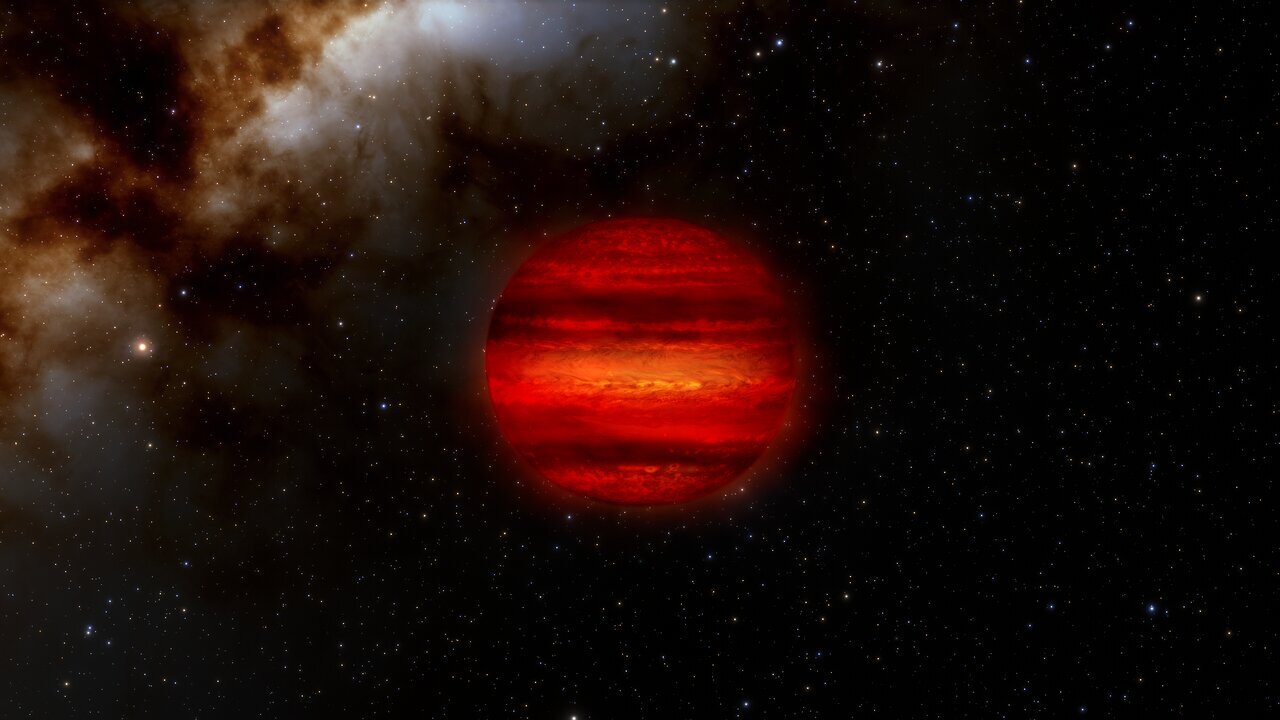
Brown Dwarf illustration. Credit: NOIRLab
Using the W. M. Keck Observatory on Maunakea, the team from the UH Institute for Astronomy (IfA) studied the HR 7672 system, composed of a sun-like star and a faint brown dwarf companion. With an instrument called the Keck Planet Finder, they tracked tiny five-minute pulsations in the star's light and used them to estimate its age to be about 2.3 billion years. The study is published in The Astrophysical Journal.
Because the brown dwarf formed at the same time as the star, the star's age also reveals the companion's age, giving researchers a rare chance to check on whether their models of how brown dwarfs cool throughout time are correct.
Shaping Discovery
For more than two decades, the HR 7672 system has helped shape how astronomers study brown dwarfs. Its companion, HR 7672B, was discovered in 2002 and was one of the first brown dwarfs ever directly imaged around a sun-like star using adaptive optics (AO), a technology that sharpens images blurred by Earth's atmosphere. Those early observations helped reveal how rare brown dwarfs are around sun-like stars at close orbital distances.
Brown dwarfs do not sustain the same energy-producing reactions as stars. Instead, they slowly cool and fade over time. But testing how that happens has been difficult, in part because scientists rarely know their exact ages.
With this new measurement, paired with what is already known about the object's energy output and mass, HR 7672B now stands out as a key reference point. The team compared their findings with several models and found the closest match with newer theories that better describe what's happening inside these objects.
More than 20 years ago, Michael Liu discovered HR 7672B using Keck AO. Today, Li is building on that work with this new high-precision age-dating of the same system.
Publication Details
Yaguang Li et al., A Test of Substellar Evolutionary Models with High-precision Ages from Asteroseismology and Gyrochronology for the Benchmark System HR 7672AB, The Astrophysical Journal (2026). DOI: 10.3847/1538-4357/ae4bdb iopscience.iop.org/article/10.3847/1538-4357/ae4bdb