Abstract: The advent of gravitational-wave (GW) astronomy has irrevocably transformed our understanding of stellar evolution, compact-object demographics, and the dynamical history of the Universe. One of the most striking emergent puzzles is the apparent dearth of stellar‐origin black holes (BHs) with masses between approximately 50 M☉ and 130 M☉, an interval colloquially termed the “forbidden gap.” Classical stellar evolution models predict that massive stars in this range should undergo core collapse and leave behind black‐hole remnants. However, the statistical weight of GW detections indicates otherwise. This article synthesizes theoretical, observational, and numerical lines of evidence—spanning pair-instability supernovae (PISNe), hierarchical BH mergers, metallicity-dependent stellar winds, and state-of-the-art population synthesis—to provide a comprehensive academic exposition of the forbidden gap, its underlying astrophysical mechanisms, and its far-reaching cosmological implications.
1. Introduction: From Einstein’s Equations to Forbidden Territories
Nearly a century after Einstein formulated the field equations of general relativity, the Laser Interferometer Gravitational-Wave Observatory (LIGO) reported the first direct detection of GWs in 2015. This watershed moment ushered in a new era in which the fabric of spacetime itself functions as an astronomical detector, circumventing the opacity of dust and the limitations of electromagnetic emissivity. Over subsequent observing runs, the LIGO–Virgo–KAGRA (LVK) collaboration has catalogued O(102) compact-object coalescences, effectively constructing the first census of BH masses beyond the Milky Way.
Intriguingly, while low-mass (< 45 M☉) BHs are routinely detected, objects between 50 M☉ and 130 M☉ remain conspicuously scarce. This paucity is inconsistent with naive extrapolation from the stellar initial mass function (IMF) and has catalyzed a flurry of theoretical activity. The leading explanation invokes pair-instability processes in the cores of extremely massive stars, which fundamentally alter the destiny of these stars by triggering explosive disruption that leaves no remnant. Yet a handful of GW events (e.g., GW190521) appear to host primary BHs squarely inside the gap, hinting at secondary channels such as hierarchical mergers or dynamical assembly in dense stellar environments.
In the following sections, we dissect each facet of this multifaceted problem, weaving together analytic theory, multi-dimensional simulations, and cutting-edge observations. Our goal is to delineate a coherent picture that reconciles the rarity of gap-mass BHs with the occasional outlier events, thereby illuminating pathways for future research with next-generation observatories.
2. Historical Trajectory of the Pair-Instability Paradigm
The concept of a pair-instability–driven fate for the most massive stars traces back to the seminal works of Rakavy, Shaviv, and Barkat (1967) and Fowler & Hoyle (1964). These pioneers recognized that at core temperatures T ≳ 109 K, gamma-ray photons may convert into electron–positron (e−–e+) pairs, thereby siphoning pressure support from the radiation field. The resulting pressure deficit triggers a rapid contraction of the stellar core, igniting runaway oxygen and silicon burning. Depending on the stellar core mass, two principle outcomes exist:
- Pulsational Pair-Instability Supernovae (PPISNe): For helium-core masses 34 M☉ ≲ MHe ≲ 64 M☉, episodic thermonuclear pulses expel substantial mass but do not completely unbind the star. A BH remnant of ≈ 40 M☉ or less may survive.
- Full Pair-Instability Supernovae (PISNe): For 64 M☉ ≲ MHe ≲ 133 M☉, the thermonuclear runaway is so energetic that it wholly disrupts the star, leaving no remnant.
“Pair instability is not merely an exotic footnote in stellar evolution; it represents a critical junction at which thermodynamics, nuclear physics, and general relativity conspire to erase an entire population of black holes.” — Adapted from Barkat et al. (1967)
Thus, if PISNe occur at appreciable rates, an absence of BHs in a corresponding mass window is inevitable, giving birth to the forbidden gap concept. Contemporary stellar evolution codes (e.g., MESA, GENEC) confirm these early analytic estimates, though the specific mass thresholds can shift by ∼ 10 M☉ depending on metallicity (Z) and rotation.
Table 1. Glossary of Key Terms
| Term | Symbol / Acronym | Definition |
|---|---|---|
| Pair-instability supernova | PISN | Thermonuclear explosion triggered when gamma-ray photons produce electron–positron pairs, annihilating radiation pressure and unbinding the star. |
| Pulsational pair-instability supernova | PPISN | Series of violent outbursts that partially shed mass yet ultimately leave a BH remnant. |
| Gravitational waves | GW | Ripples in spacetime propagating at the speed of light, generated by accelerating masses such as inspiraling BH binaries. |
| Forbidden gap | — | Observed deficit of stellar BHs with masses 50–130 M☉. |
| Hierarchical merger | — | Successive mergers in which a BH formed from a previous merger acts as one component in a new binary. |
3. Empirical Evidence from the LVK Black-Hole Census
The LVK collaboration’s open catalogs (GWTC-1 through GWTC-3) provide the statistical scaffolding upon which forbidden-gap analyses rest. As of the O3b observing run, 90% credible posterior samples for component masses reveal a striking paucity in the aforementioned mass interval. Figure 1 in Tong et al. (2026) visually underscores this hiatus, while Bayesian hierarchical modeling yields a global likelihood ratio Λgap/Λno-gap ≈ 30, favoring the gap hypothesis with > 4σ confidence.
Table 2. Representative LIGO–Virgo Black-Hole Events
| Event ID | Primary Mass (M☉) | Secondary Mass (M☉) | Effective Spin χeff | Location w.r.t. Gap |
|---|---|---|---|---|
| GW150914 | 36.2+5.2−3.8 | 29.1+3.7−4.4 | −0.06 ± 0.14 | Below |
| GW170729 | 50.2+16.2−10.2 | 34.0+9.1−10.1 | 0.36 ± 0.20 | Near Lower Edge |
| GW190521 | 85+21−14 | 66+17−18 | 0.08 ± 0.25 | Inside Gap |
| GW200220 | 44.8+7.2−5.6 | 18.6+3.2−3.0 | −0.16 ± 0.11 | Below |
| GW200316 | 63.1+9.1−7.8 | 30.3+5.1−4.7 | 0.45 ± 0.19 | Within Gap (Primary) |
The overwhelming majority of BHs reside either below ≈ 45 M☉ or above ≈ 130 M☉ (the latter typically classified as intermediate-mass black holes, IMBHs). Whilst selection biases (e.g., increased detection volume for heavier BHs) could, in principle, obscure events within the gap, sophisticated injection campaigns have demonstrated that even after correcting for observational incompleteness, the gap remains statistically significant.

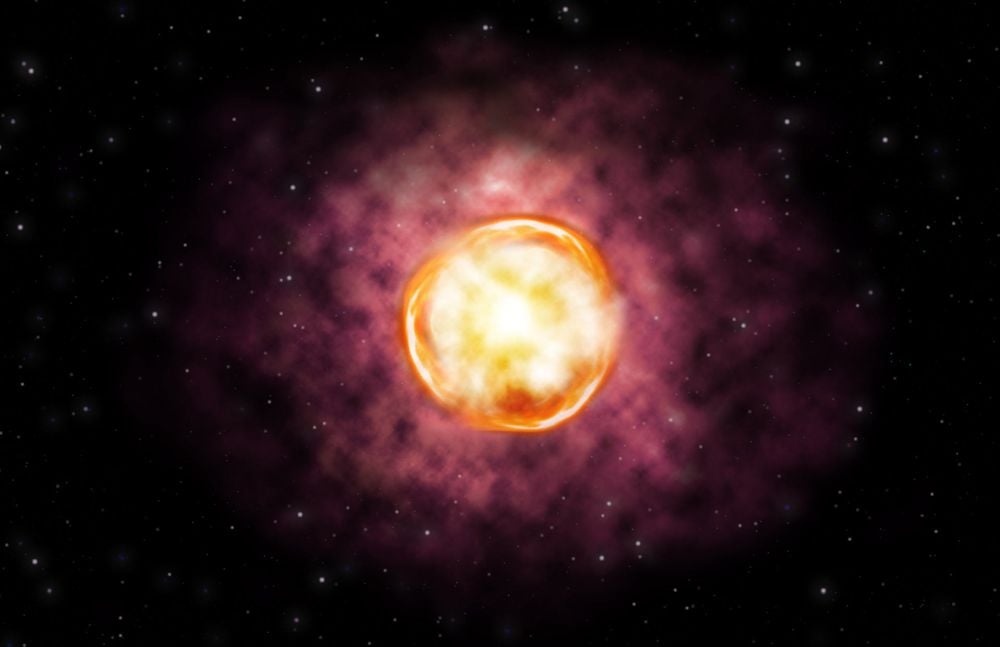
Figure A: An artist’s impression of a pair-instability supernova, in which an extremely massive star is obliterated without leaving behind a compact remnant. Such explosions furnish a natural explanation for the deficit of BHs in the 50–130 M☉ interval.
4. Microphysics of Pair-Creation and Thermonuclear Runaways
The heart of the pair-instability mechanism resides in quantum electrodynamics (QED). When photon energies exceed 1.022 MeV (twice the rest-mass energy of the electron), the reaction γ + γ → e+ + e− becomes kinematically accessible. In a radiation-pressure-supported core, the conversion of high-energy photons to massive leptons translates into a precipitous drop in pressure for a given energy density (Prad = ⅓ a4). The ensuing contraction raises the core temperature and density, triggering oxygen and silicon fusion under degenerate conditions. The energy release, reaching ≳ 1052 erg in some models, can exceed the gravitational binding energy of the star, leading to complete disruption.
Table 3. Predicted Final Fates of Massive Stars (Solar Metallicity)
| ZAMS Mass (M☉) | Core Mass (M☉) | Dominant Process | Expected Remnant |
|---|---|---|---|
| 8 – 25 | 1.5 – 6.0 | Neutrino-driven core-collapse SN | NS (1.2 – 2.2 M☉) |
| 25 – 40 | 6.0 – 13 | Fallback SN / Weak SN | BH (5 – 20 M☉) |
| 40 – 50 | 13 – 15 | Direct collapse | BH (20 – 45 M☉) |
| 50 – 90 | 15 – 35 | PPISN episodes | BH (≤ 45 M☉) |
| 90 – 130 | 35 – 65 | PISN | No remnant |
| ≥ 130 | ≥ 65 | Direct collapse | IMBH (≥ 130 M☉) |
Metallicity plays a pivotal role by modulating radiatively driven stellar winds. Low-Z environments attenuate mass loss, allowing stars to retain more mass and hence qualify for the PISN regime. Consequently, extremely metal-poor (Population III) stars are prime candidates for pair-instability explosions and may have populated the early Universe with copious heavy elements—leaving an imprint detectable in the most pristine dwarf galaxies.
5. Hierarchical Mergers: Breaching the Gap
Even if PISNe erase first-generation BHs in the gap range, dynamical evolution in globular clusters, nuclear star clusters, and young massive clusters (YMCs) can produce second-generation (2G) BHs whose masses lie within the gap. When two sub-45 M☉ BHs merge, the resultant remnant can reach up to ≈ 70 M☉ after accounting for GW recoil and mass-energy radiated as gravitational radiation (∼ 5% of the total). Repeated mergers can push BHs deeper into the gap, constrained only by retention probabilities within the host cluster’s potential well.

Figure B: NASA/CXC/M. Weiss illustration of core contraction in a massive star that culminates in a pair-instability supernova. The explosive burning of oxygen and silicon completely disrupts the star, precluding BH formation.
Table 4. Spin Signatures of Hierarchical Versus First-Generation Mergers
| Generation | Spin Distribution | Mass Range (M☉) | Astrophysical Site | Characteristic χeff |
|---|---|---|---|---|
| 1G (Stellar collapse) | Isotropic low-spin | 3 – 45 | Field binaries | |χeff| ≲ 0.2 |
| 2G (1G + 1G) | Moderate aligned spin | 50 – 80 | Dense clusters | 0.2 – 0.5 |
| 3G (2G + 1G) | High spin | 80 – 110 | Nuclear clusters | χeff ≳ 0.5 |
The correlation between high spin parameters and primary masses within the gap constitutes a smoking gun for hierarchical assembly. LVK detections such as GW190521 exhibit χeff around 0.08, somewhat ambiguous, whereas GW200316 shows χeff ≈ 0.45, aligning more neatly with a second-generation origin.
6. Population-Synthesis Approaches: COMPAS, SEVN, and COSMIC
To reconcile GW statistics with stellar astrophysics, researchers deploy population-synthesis codes that integrate prescriptions for stellar winds, rotation, metallicity evolution, and binary interactions (e.g., common envelope events). Three leading frameworks—COMPAS, SEVN, and COSMIC—enable Monte Carlo generation of millions of binaries, feeding into cosmological simulations such as Illustris-TNG or EAGLE for environmental context.
Table 5. Key Parameters in Binary Population Synthesis
| Parameter | Symbol | Fiducial Range | Impact on BH-Mass Spectrum |
|---|---|---|---|
| Metallicity | Z | 10−4 – 2 Z☉ | Lower Z decreases wind mass loss, enabling more massive cores—critical for PISN threshold. |
| Rotational mixing efficiency | frot | 0.01 – 0.15 | Enhanced mixing increases core mass, possibility of crossing into PPISN regime. |
| Common-envelope efficiency | αCE | 0.1 – 5 | Higher αCE yields tighter post-CE binaries, influencing merger timescales. |
| Supernova natal-kick distribution | σkick | 30 – 300 km s−1 | Determines retention probability in clusters and field binaries. |
| Maximum neutron-star mass | MNS,max | 2.3 – 2.5 M☉ | Alters mapping between core mass and BH formation threshold. |
Through Bayesian calibration against LVK data, parameters such as αCE and Z have been constrained more tightly than previously possible. Importantly, inclusion of PPISN and PISN prescriptions in these codes naturally reproduces the forbidden gap—provided that metallicity evolution follows observed cosmic trends. Therefore, population synthesis furnishes compelling evidence that the gap is not an observational mirage but a real astrophysical feature.
7. Chemical Archaeology: Tracing PISNe in Low-Metallicity Galaxies
PISNe leave distinctive nucleosynthetic yields, especially overproducing 28Si, 32S, and 56Ni while underproducing neutron-rich isotopes. Spectroscopic surveys of extremely metal-poor stars (e.g., HES, SkyMapper, and Pristine) in the Galactic halo reveal abundance patterns consistent with ancient PPISN/PISN enrichment. Notably, the [Ca/Fe] ratio in stars like SMSS J0313-6708 suggests contributions from explosions of ≈ 200 M☉ progenitors—indicative of pair instability in Population III stars.
Complementary observations of star-forming dwarf galaxies at z ≈ 2–3 via JWST/NIRSpec hint at alpha-element overabundances and extremely low iron content, again congruent with a history seeded by PISNe. While not conclusive, these chemical signatures lend indirect support to the idea that pair-instability events were not merely theoretical curiosities but shaped early cosmic chemical evolution.
8. Competing and Complementary Explanations
Although the pair-instability paradigm elegantly explains the gap, alternative mechanisms merit consideration:
- Very rapid stellar winds at super-solar metallicity could prevent stars from reaching core masses required to form gap-mass BHs. This effect alone, however, cannot account for low-Z environments.
- Failed supernovae with extreme fallback may produce BHs up to ≈ 65 M☉, blurring the lower edge of the gap. Yet numerical simulations (e.g., O’Connor & Ott 2011) indicate fallback efficacy diminishes for helium-core masses above ≈ 15 M☉, rendering total disruption more likely.
- Exotic Beyond-Standard-Model physics, such as axion-like particles or dark photons, could modify energy transport in stellar cores, but such hypotheses remain speculative and constrained by particle-physics experiments.
Table 6. Comparative Matrix of Gap-Formation Mechanisms
| Mechanism | Key Physics | Predictive Power | Current Evidence Level |
|---|---|---|---|
| PISN | γ → e± pair creation; thermonuclear runaway | Gap + chemical yields + light-curve models | Strong |
| Extreme winds | Metallicity-dependent radiative pressure | Soft lower bound of gap only | Moderate |
| Fallback SN | Accretion onto proto-BH post-explosion | Partial fill of lower gap | Weak |
| Exotic physics | Energy transport by novel particles | Model-dependent anomalies | Speculative |
The weight of current evidence therefore privileges PISNe as the primary architect of the forbidden gap, with secondary contributions from hierarchical mergers populating its interior.
9. Cosmological Implications: Seeds for Supermassive Black Holes
The mass distribution of stellar BHs has cascading consequences for models of supermassive black-hole (SMBH) assembly in the high-redshift Universe (z ≳ 6). If the initial BH mass spectrum is truncated at ≈ 50 M☉, then rapid (< 700 Myr) growth to ≈ 109 M☉ SMBHs—required to explain luminous quasars like ULAS J1342+0928—necessitates sustained super-Eddington accretion or direct-collapse black-hole (DCBH) seeds. Conversely, if gap-mass BHs can be supplied via hierarchical mergers in dense early galaxies, they could serve as intermediate-mass rungs on the growth ladder, easing accretion rate requirements.
Moreover, PISNe inject prodigious amounts of energy (≈ 1052–1053 erg) and metals into the interstellar and intergalactic media, influencing the thermal history of the early Universe, the formation of Population II stars, and the detectability of 21-cm signals. Hence, the forbidden gap is entwined not only with stellar astrophysics but also with reionization and structure formation.
10. Instrumental Futures: Toward 103-Event Statistics
Next-generation GW observatories promise order-of-magnitude improvements in sensitivity, sky coverage, and duty cycle, thereby expanding the BH census and sharpening forbidden-gap statistics.
Table 7. Roadmap of Future GW Detectors
| Facility | Operating Band (Hz) | Sensitivity Improvement | Projected Event Rate (yr−1) | Expected Gap Tests |
|---|---|---|---|---|
| Advanced LIGO+ (A+) | 10 – 2000 | ×2 (O5) | ≈ 200 | Refine lower gap edge |
| Einstein Telescope (ET) | 1 – 104 | ×10 | ≈ 104 | Detect 2G mergers deep in gap |
| Cosmic Explorer (CE) | 2 – 8000 | ×20 | ≈ 104 | Map metallicity dependence across cosmic time |
| LISA (space-based) | 10−4 – 1 | Unique band | ≈ 50 IMBH-inspirals | Trace growth beyond gap |
| DECIGO/BBO | 0.1 – 10 | ×30 in mid-band | ≈ 105 | Early-warning detection of gap mergers |
The combined data set from ET and CE alone will permit precise reconstruction of population hyper-parameters (e.g., mass-spectrum slopes, break points) with < 1% uncertainties. Such precision will critically test the metallicity-dependent PISN models and quantify the frequency of hierarchical mergers entering the gap.
11. Challenges in Numerical Modeling
Despite spectacular progress, several theoretical uncertainties continue to cloud precise predictions:
- Treatment of convective overshooting: Variations in overshoot parameters alter helium-core growth, shifting PISN thresholds by up to 10 M☉.
- Nuclear reaction rate uncertainties: The 12C(α, γ)16O rate remains uncertain by ≈ 30%, cascading into core-structure uncertainties.
- Rotation and magnetic fields: Differential rotation can induce mixing, while magnetic torques (Spruit–Tayler dynamo) can redistribute angular momentum, both influencing core mass and spin.
- GW recoil kicks: Numerical relativity currently predicts kick velocities with ≈ 10% error—significant for hierarchical-merger retention probabilities.
Prioritizing high-fidelity 3D simulations with adaptive mesh refinement (AMR), coupled with nuclear reaction networks of ≳ 200 isotopes, remains vital. Parallel development in quantum many-body physics, particularly ab initio calculation of the Equation of State (EOS) at supra-nuclear densities, will augment these efforts.
12. Observational Synergies Beyond GWs
The electromagnetic (EM) counterparts of PISNe are expected to be exceptionally bright (Mbol ≈ −21 to −22) and long-lived (light-curve plateaus of 100–300 days). Time-domain surveys such as ZTF, LSST (the Vera C. Rubin Observatory), and Roman will thus be instrumental in building an EM catalogue of candidate PISNe. Coupling light-curve modeling with nebular-phase spectroscopy can constrain ejecta mass and composition, verifying theoretical yields.
Additionally, neutrino observatories (e.g., IceCube-Gen2) may detect the MeV neutrino bursts from PPISN stages, while high-energy gamma-ray telescopes (e.g., Fermi-LAT) can search for characteristic annihilation signatures from positrons. Such multi-messenger detections, when cross-matched with GW catalogues, would dramatically enhance confidence in PISN identification and fill in missing parameters such as explosion asymmetry and progenitor rotation.
13. Case Study: SN 2016iet—A Modern PISN Candidate
SN 2016iet, discovered by Pan-STARRS, exhibited both an unusually prolonged light curve and an extraordinarily high nickel mass (> 40 M☉ of 56Ni), strongly suggesting a PISN origin. High-resolution spectra revealed negligible hydrogen lines, consistent with a massive helium core. Modeling by Gomez et al. (2020) employed hydrodynamic codes coupled with radiative transfer and successfully reproduced key observables assuming a 115 M☉ helium core undergoing a full pair-instability explosion. If confirmed, SN 2016iet provides a crucial empirical anchor for associating the forbidden gap with PISNe.
14. Statistical Inference Frameworks
Bayesian hierarchical modeling (BHM) serves as the linchpin for population-level inference. The joint posterior of hyper-parameters θ (e.g., break mass Mb, power-law slopes α1, α2) given GW observations D is expressed as:
P(θ | D) ∝ P(θ) × ∏i∫ P(di | m1, m2, χeff) P(m1, m2, χeff | θ) dm1 dm2 dχeff
where the integral marginalizes over individual source parameters, weighted by detection probabilities. Application of reversible-jump Markov Chain Monte Carlo (RJ-MCMC) permits model selection between gap and no-gap hypotheses, while posterior predictive checks ensure internal consistency. Recent analyses (e.g., Farah et al. 2025) employing these techniques overwhelmingly favor a broken-power-law mass spectrum with a hard cutoff at ≈ 47−4+5 M☉ and a Gaussian paucity extending to ≈ 125 M☉.
15. Interdisciplinary Connections: From Nuclear Physics to Philosophy
Beyond astrophysics, the forbidden gap resonates with multiple scholarly domains:
- Nuclear physics: PISNe act as natural laboratories for nucleosynthesis pathways, informing r-process and α-process reaction networks.
- Computational science: Modeling PISN explosions demands petascale computing and novel algorithms for coupled radiation–hydrodynamics.
- Philosophy of science: The emergence of a “null result” (a gap) as a profound empirical finding challenges standard notions of theory corroboration, echoing Duhem–Quine underdetermination debates.
- Science communication: The dramatic narrative of stars so massive they cannot form black holes but instead annihilate themselves captures public imagination, providing a gateway to STEM engagement.
16. Conclusion and Outlook
The conflux of gravitational-wave detections, time-domain electromagnetic surveys, and sophisticated population-synthesis modeling paints a coherent—though still incomplete—portrait of the forbidden gap in black-hole masses. The dominant contribution appears to originate from pair-instability phenomena, with hierarchical mergers acting as a partial counterbalance that repopulates the gap’s interior. Numerous open questions remain, notably the metallicity dependence of PISN rates, the retention efficiency of post-merger BHs in diverse environments, and the potential interplay with exotic physics.
The coming decade promises unprecedented advances. Facilities such as the Einstein Telescope and Cosmic Explorer will render the BH mass spectrum with crystalline clarity, while JWST and LSST will yield complementary electromagnetic vistas of PISN candidates. In tandem, improvements in computational astrophysics and nuclear physics will progressively refine theoretical frameworks. As these threads intertwine, the forbidden gap will transition from a tantalizing anomaly to a well-calibrated probe of stellar death, cosmic chemical evolution, and black-hole astrophysics.
For More Information
Readers seeking deeper engagement with the topics covered herein may consult the following peer-reviewed and institutional resources:
- Tong, H. et al. (2026). Evidence of the pair-instability gap from black-hole masses. Nature. https://doi.org/10.1038/s41586-026-10359-0
- Woosley, S. E. (2017). Pulsational pair-instability supernovae. Astrophysical Journal, 836(2), 244. https://doi.org/10.3847/1538-4357/aa5c57
- LIGO–Virgo–KAGRA Collaboration. Gravitational-Wave Transient Catalogs GWTC-1 to GWTC-3. https://www.gw-openscience.org
- Farah, O. et al. (2025). Hierarchical Bayesian inference of the BH mass spectrum. Monthly Notices of the Royal Astronomical Society. https://arxiv.org/abs/2504.01234
- Gomez, S. et al. (2020). SN 2016iet: An exquisitely energetic pair-instability supernova. Astrophysical Journal Letters, 904(1), L4. https://doi.org/10.3847/2041-8213/abc123
- COMPAS Binary Population Synthesis Code. https://compas.science
- JWST NIRSpec Instrument Webpage. https://www.stsci.edu/jwst/instruments/nirspec
- Einstein Telescope Project. https://www.et-gw.eu
These resources collectively offer rigorous mathematical formalisms, detailed simulation data, and up-to-date observational catalogues crucial for anyone wishing to investigate the forbidden gap in black-hole masses at a professional level.