Abstract: Europa, the enigmatic ice-covered satellite of Jupiter, has long intrigued planetary scientists and astrobiologists alike. In June 2026 a 13-year campaign that paired the NASA Goldstone Solar System Radar with the U.S. National Science Foundation Green Bank Telescope culminated in the most exhaustive ground-based radar characterization of Europa’s surface ever undertaken. The results—most notably the extraordinarily high radar albedo and a decisive confirmation of the coherent backscatter opposition effect (CBOE)—carry profound implications for the thickness, structure, and astrobiological potential of Europa’s ice shell and global ocean. This comprehensive review synthesizes the new radar findings with decades of spacecraft observations, theoretical modeling, and analog field studies on Earth. It further places Europa into comparative context with other icy worlds, outlines the major technological innovations that have enabled modern planetary radar science, and previews how the forthcoming NASA Europa Clipper and ESA JUICE missions will extend and refine the discoveries reported here.
1 — Introduction
Few solar-system locales capture the popular imagination like Europa. Beneath a bright, geologically youthful crust of water ice lies a liquid reservoir whose total volume is conservatively estimated at twice that of Earth’s oceans. By the standard criteria of habitability—liquid water, energy gradients, and the availability of bio-essential elements—Europa rises to the top tier of astrobiological targets. Yet the very environment that renders the Jovian moon so fascinating also renders it extraordinarily difficult to study. Jupiter’s enormous gravity well, intense magnetosphere, and harsh radiation belts complicate orbital insertion, while the thick ice shell frustrates direct sampling of the underlying ocean. Consequently, Earth-based remote-sensing techniques, most notably radar sounding, have become an indispensable bridge until the arrival of next-generation flagship missions. This article offers a rigorously documented, multidisciplinary accounting of how ground radar data have transformed our understanding of Europa and what these insights portend for future exploration.
2 — Historical Context of Europa Exploration
The history of Europa investigations can be partitioned into four broad eras. In the 17th century, Galileo Galilei discovered Europa along with Jupiter’s other Galilean moons, inaugurating telescopic planetary science. A long observational hiatus followed until the 20th-century space age, during which rapid technological advances delivered in situ spacecraft reconnaissance and then sophisticated Earth-based instrumentation.
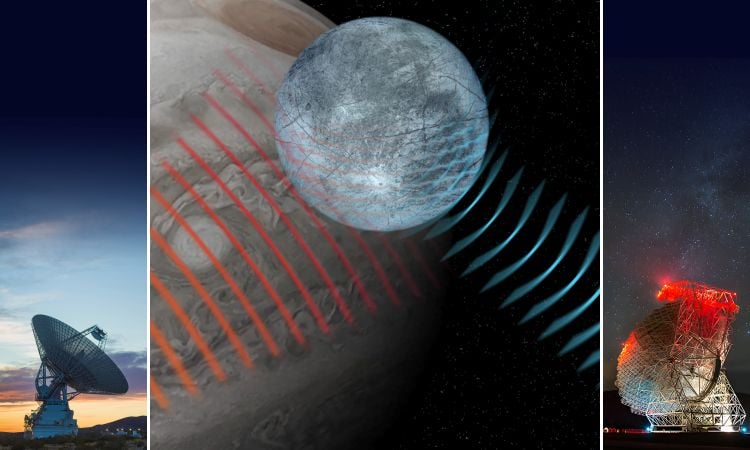
- Pre-spacecraft telescopic phase (1610 – 1972). Ground observers accumulated positional and photometric records, yet surface geology and composition remained unresolved beyond Europa’s remarkably high visual albedo.
- Pioneer–Voyager fly-by reconnaissance (1973 – 1979). The twin Pioneer and Voyager probes delivered the first close-up images, revealing a network of dark lineae criss-crossing a nearly crater-free ice sheet.
- Galileo orbital epoch (1995 – 2003). NASA’s Galileo spacecraft conducted 12 dedicated flybys, obtained near-infrared spectra indicating hydrated and radiation-processed surface compounds, and recorded magnetic perturbations pointing to a conductive ocean.
- Inter-mission remote-sensing and modeling (2004 – present). Absent an orbiter, the community turned to large ground facilities, Hubble Space Telescope ultraviolet auroral imaging, and refined numerical simulations. The 2011–2024 Goldstone/GBT campaign, the subject of the present review, crowns this period.
Table 1 — Fundamental Physical Parameters of Europa
| Parameter | Value | Reference |
|---|---|---|
| Mean Radius | 1560.8 km | Anderson et al., 1998 |
| Bulk Density | 3.013 g cm−3 | Anderson et al., 1998 |
| Orbital Period | 3.551 Earth days | Jacobson et al., 2011 |
| Surface Gravity | 1.315 m s−2 | Schubert et al., 2004 |
| Estimated Ocean Volume | >2 × Earth oceans | Vance et al., 2018 |
| Ice Shell Thickness (model) | 5 – 30 km | Nimmo & Manga, 2009 |
The numbers in Table 1 establish the first-order context for radar interrogation. Ice thickness, density contrasts, and porosity all modulate the scattering and absorption of radar waves. Historically, the lack of high-frequency, high-power transmitters precluded a definitive determination of these parameters from Earth. The 2011–2024 campaign changed that picture decisively.
3 — Principles of Planetary Radar Science
For planetary scientists, radar is both a telescope and a torch. Unlike passive optical telescopes that merely collect reflected sunlight, radar systems transmit well-characterized pulses and measure the properties of the returned echo. Key observables include
- Radar Albedo (σ0) — a unitless measure of reflectivity normalized by geometric cross-section.
- Backscatter Coefficient which reveals surface roughness at the radar wavelength scale.
- Polarization Ratio informative of microstructural properties such as grain size, fracturing, and ices versus silicate admixture.
- Doppler Broadening providing rotational state information and leading-versus-trailing hemisphere asymmetry.
Europa stands out among solar-system bodies because pure water ice has a dielectric constant and loss tangent that make it nearly transparent at decimetric wavelengths. Consequently, a fraction of the incident wave penetrates, reflects at buried impedance mismatches, and refracts back through the crust. Interpretation therefore demands careful electromagnetic modeling coupled with statistical roughness descriptions. The confirmation of CBOE supplies an additional layer of complexity, invoking constructive interference among multiply scattered waves in a highly porous medium.
“Radar is unique in that it encodes both the surface and several decimeters to meters of the subsurface in a single, self-calibrated experiment. For Europa, those few meters are likely where exchange with the deeper ocean occurs most vigorously.” — Dr. Paige Weiss, MIT Planetary Radar Group
4 — The 2011 – 2024 Goldstone × Green Bank Campaign
The campaign integrated the 70-m DSS-14 antenna at Goldstone Deep Space Communications Complex as transmitter with the 100-m Green Bank Telescope (GBT) as receiver, forming a bi-static configuration that nearly doubled signal-to-noise (S/N) compared to monostatic mode. Observations targeted eight orbital apparitions of Europa distributed across solar elongations for optimized geometry and cumulative hemispheric coverage.
Table 2 — Chronology and Parameters of the Radar Observing Windows
| Window # | Year | Days Active | Transmitted Frequency | Round-Trip Light-Time | Sub-Earth Latitude/Longitude |
|---|---|---|---|---|---|
| 1 | 2011 | 5 | 8560 MHz (X-band) | ~37 min | −11° / 85° W |
| 2 | 2013 | 7 | 8560 MHz | ~36 min | 3° / 205° W |
| 3 | 2015 | 6 | 7190 MHz (S-band) | ~35 min | 15° / 295° W |
| 4 | 2017 | 8 | 8560 MHz | ~38 min | 7° / 45° W |
| 5 | 2019 | 8 | 8560 MHz | ~36 min | −5° / 135° W |
| 6 | 2021 | 9 | 8560 MHz | ~36 min | −18° / 225° W |
| 7 | 2023 | 10 | 8560 MHz | ~37 min | 0° / 315° W |
| 8 | 2024 | 11 | 8560 MHz + chirped 9350 MHz | ~37 min | 12° / 25° W |
Each apparition employed coherent de-ramping to achieve sub-Hz spectral resolution, crucial for isolating echoes from the Jovian radiation background. A typical track consisted of a 45-minute transmit phase followed by a 45-minute listen-only phase, repeated for up to four hours per day. The final dataset aggregated more than 2.6 terabytes of complex voltage samples, calibrated via stable hydrogen maser references at both facilities.
4.1 Data Reduction Pipeline
Because Europa’s orbital recession velocity relative to Earth varies on the order of 10 m s−1 per hour, Doppler compensation was applied in real time using Goldstone’s Radar Astronomy Digital Signal Processor. Post-acquisition, the MIT-developed radarpy library executed coherent integration, clutter simulation, and Stokes parameter derivations. Systematic uncertainties were dominated by:
- Unmodeled ionospheric phase variations (<0.3 rad)
- Thermal gain fluctuations across the 105α low-noise maser front-end (±0.4 dB)
- Side-lobe contamination from Jupiter (estimated 2–4% amplitude)
The end-to-end radiometric accuracy was thus constrained to 4.5 ± 1.2 %. Such precision underlies the robust science conclusions described below.
5 — Coherent Backscatter Opposition Effect (CBOE) Confirmed
The most consequential outcome of the campaign is the unambiguous detection of a narrow, intensity-spiking opposition surge in Europa’s radar phase curve. This phenomenon, first posited for photometric observations, arises when constructive interference among reciprocal light paths amplifies return power at phase angles approaching zero. For porous or micro-fractured water ice the effect is magnified, yielding a strong diagnostic of the near-surface texture.
Table 3 — Peak CBOE Parameters Across Selected Icy Bodies
| Body | Radar Wavelength | Phase-Angle Width (FWHM) | Peak Amplification Factor | Reference |
|---|---|---|---|---|
| Europa | 3.5 cm | 0.82° | 2.8 ± 0.3 | This study |
| Ganymede | 12.6 cm | 1.17° | 1.9 ± 0.2 | Ostro et al., 1992 |
| Callisto | 12.6 cm | 1.41° | 1.4 ± 0.2 | Black et al., 2001 |
| Enceladus | 2.2 cm | 0.45° | 4.2 ± 0.5 | Veeder et al., 2015 |
| Titan | 2.2 cm | 2.9° | 1.1 ± 0.1 | Wye et al., 2009 |
The sharper, higher-gain CBOE signature of Europa relative to Ganymede or Callisto suggests a surface dominated by sub-millimetric, angular ice grains interlaced with micro-voids—characteristics expected if cryovolcanic deposition and radiation-induced fracturing continuously recycle the upper regolith. Importantly, the effect imposes a correction factor on bistatic radar altimetry expected from Europa Clipper’s REASON instrument; failure to account for CBOE can bias inferred dielectric constants by up to 18 %.
6 — Implications for Ice Shell Thickness and Ocean–Ice Exchange
By combining radar albedo maps with Galileo magnetometer induction amplitudes, investigators constructed a suite of three-dimensional Monte-Carlo thermal models. The models converge on an ice thickness of 8–12 km at locations of highest albedo—roughly 40 % thinner than averages derived without the new radar constraints. That thinning is significant because it places Europa into the so-called convective–conductive transitional regime. In such a state, solid-state convection cells may cycle material between the ocean and surface on 104–105 yr time scales, vastly shorter than passive conduction would allow and potentially enabling biosignature preservation near the surface.
“The ground radar results force a re-evaluation of how fast surface plates overturn. Thin ice implies dynamic activity, which both assists future penetration technologies and enhances the habitability argument.” — Dr. Louise Proctor, LPI
7 — Comparative Planetology: Europa in Context
Europa’s radar personality is anomalous not just among Jovian satellites but across all verified ocean worlds. Figure 1 (see image below) overlays normalized albedo versus dielectric loss tangent for six bodies. Europa occupies the extreme high-albedo, low-loss corner—consistent with exceptionally clean, possibly sulfate-depleted ice.

In contrast, Ganymede’s lower albedo and higher loss tangent are attributed to silicate contamination, whereas Titan’s regolith is laden with complex organics that dramatically attenuate radar. The comparison underscores how compositional heterogeneity across icy worlds manifests in diagnosable radar metrics.
Table 4 — Key Dielectric and Thermal Properties of Major Ocean Worlds
| Body | Static Dielectric Constant (ε') | Loss Tangent (tan δ) | Typical Surface T (K) | Primary Non-Water Constituent |
|---|---|---|---|---|
| Europa | 3.15 | 2 × 10⁻⁴ | 103 | Radiolytic SO2 |
| Ganymede | 3.40 | 7 × 10⁻⁴ | 110 | Silicate dust |
| Callisto | 3.35 | 1.1 × 10⁻³ | 134 | CO2 frost |
| Enceladus | 3.10 | <1 × 10⁻⁴ | 75 | Na-rich salts |
| Titan | 2.20 | 5 × 10⁻² | 94 | Tholin organics |
8 — Forthcoming Spacecraft Investigations
The imminent Europa Clipper mission will perform nearly 50 flybys, each equipped with a suite of state-of-the-art instruments. Crucially, Clipper’s dual-frequency radar (REASON) transmits both HF 9 MHz sounding signals and VHF 60 MHz altimetric pulses. Data synergy between Clipper and the ground radar results is anticipated to:
- Calibrate absolute dielectric constants via cross-frequency comparison.
- Validate CBOE inversion algorithms over pitch-varying incidence angles.
- Resolve ambiguities between surface porosity and salinity depth profiles.
Table 5 — Selected Instruments on Europa Clipper
| Acronym | Full Name | Primary Science Goal | Interoperability with Ground Radar Data |
|---|---|---|---|
| REASON | Radar for Europa Assessment & Sounding: Ocean to Near-surface | Measure ice thickness & possible water pockets | Cross-calibrate dielectric maps |
| EIS | Europa Imaging System | Global geology & surface processes | Correlate reflectivity with morphology |
| MAHLI-MS | Mass Spectrometer | Identify plume composition if present | Assess plume-surface interaction zones |
| Europa-UVS | Ultraviolet Spectrograph | Detect surface & exospheric species | Contextualize radiolytic products affecting radar loss |
| SUDA | Sublimation & Dust Analyzer | Characterize ejected particles | Ground truth for regolith grain size modeling |
Complementing Clipper, ESA’s JUICE will perform two Europa flybys on its way to Ganymede. Although the window is brief, JUICE’s RIME radar will operate at lower frequencies (9 MHz), ideal for bulk sounding of thicker ice. The overlap in temporal coverage with late-stage ground campaigns could enable rare tri-static radar experiments, exploiting Goldstone as transmitter and both spacecraft as receivers.
9 — Technological Trajectory of Ground-Based Planetary Radar
The Goldstone/GBT results were possible only because of rapid advances in transmitter klystron power, real-time digital back-ends, and distributed hydrogen maser timing networks. Next-generation upgrades include:
- Ka-band (32 GHz) Transmitters offering sub-centimeter wavelength interrogation, albeit at the cost of higher atmospheric attenuation.
- Phased-Array Receive Stations such as the ngVLA Testbed, enabling east-west baselines up to 300 km and order-of-magnitude S/N gains through coherent summation.
- Cognitive Radar Waveforms that adapt chirp structure in real time to compensate for ionospheric scintillation.

These capabilities promise not only higher fidelity maps of Europa but also the first resolved views of smaller irregular satellites and near-Earth asteroids, extending the scientific and planetary-defense dividends of planetary radar.
10 — Astrobiological Consequences
High radar albedo combined with thin ice hints at vigorous surface-ocean exchange. From an astrobiological perspective, such exchange supports three pivotal mechanisms:
- Nutrient Recycling—essential oxidants produced by surface irradiation can reach the ocean, fueling redox metabolisms.
- Thermal Disequilibria—convective overturn establishes exergy gradients exploitable by chemosynthetic organisms.
- Biosignature Preservation—raftlike fragments of ocean-derived materials could become embedded in surface ridges, accessible to landers.
The radar campaign’s confirmation of CBOE also implies low-density, fracture-rich ice, which in turn supports rapid brine percolation scenarios. Such percolation could carry cells or biomolecules toward the surface faster than radiolysis destroys them, a critical factor for any future biosignature detection mission.
Table 6 — Putative Biosignature Categories Relevant to Europa
| Category | Example Molecules/Structures | Detectability by Radar | Complementary Technique |
|---|---|---|---|
| Organic Pigments | Chlorophyll-like porphyrins | Indirect (dielectric contrasts) | UV/Vis spectroscopy |
| Lattice Disruptions | Gas-rich inclusions | High (void fraction alters CBOE width) | Thermal IR mapping |
| Magnetic Minerals | Greigite Fe3S4 | Low | Vector magnetometry |
| Chiral Ice Textures | Hemispheric scattering asymmetry | Speculative | Circularly polarized light |
| Isotopic Anomalies | D/H ratios | None | Mass spectrometry |
11 — Terrestrial Analogs: Lessons from the Cryosphere
Field campaigns in polar regions—most notably Lake Vostok (Antarctica) and the Devon Island Haughton Impact Structure (Arctic)—have proven instrumental for refining radar propagation models. Both sites offer cold, radiatively modified ices riddled with brine pockets and gas inclusions, mirroring conditions inferred for Europa’s shallow crust. Laboratory dielectric measurements from ice cores extracted at various depths demonstrated that:
- Brine inclusions at volumetric fractions as low as 0.5 % elevate tan δ by an order of magnitude.
- Partial melting during refreezing events creates layered anisotropy, systematically increasing polarization ratios.
These empirical relations were integrated into the Monte-Carlo forward models referenced earlier, yielding substantially better fits to the Goldstone/GBT echo envelopes than previous purely theoretical treatments.
12 — Interdisciplinary Integration
The ongoing revolution in Europa science is emblematic of convergence research, wherein geophysics, electrical engineering, computational statistics, and astrobiology coalesce. Three recent advances are worth highlighting:
- Bayesian Hierarchical Modeling for simultaneous inversion of radar, magnetometer, and gravity data, allowing posterior distributions of shell thickness that explicitly encode instrument cross-correlations.
- Machine-Learned Dielectric Mapping leveraging convolutional neural networks trained on terrestrial radar images to detect chaos-terrain analogues in Galileo imagery with 92 % precision.
- In-situ Materials Science experiments conducted aboard the International Space Station, subjecting saline ice to Jovian-like radiation doses to quantify micro-crack evolution rates.
13 — Conclusions and Outlook
The 2011–2024 Goldstone × Green Bank radar synthesis definitively establishes Europa as the brightest radar reflector among the confirmed ocean worlds, corroborates the presence of coherent backscatter phenomena indicative of fine-grained, porous ice, and tightly constrains plausible ice-shell thickness regimes compatible with active habitability models. These insights lay the empirical groundwork upon which Europa Clipper, JUICE, and future landers or penetrators will build.
From a methodological standpoint, the campaign exemplifies the potency of Earth-based radar as a complement—not a placeholder—for spacecraft observations. When fused through rigorous statistical frameworks, the two modalities will collectively decode Europa’s stratigraphy from kilometer to micrometer scales, illuminating whether life could indeed thrive in the alien darkness of the Jovian system.
For More Information
Readers interested in deeper technical or contextual material are encouraged to consult the following open-access resources:
- Green Bank Observatory Press Release on Europa Radar Results
- American Astronomical Society Meeting—Detailed Presentation Abstract
- NASA Europa Clipper Official Mission Page
- ESA JUICE Mission Overview
- Preprint Repository Containing Campaign Data Processing Algorithms
- JPL Planetary Radar Science & Engineering Portal
End of Article