Abstract. The unprecedented sensitivity and angular resolution of the James Webb Space Telescope (JWST) have re-defined the state of the art in protoplanetary disk studies, unlocking a regime in which micron-scale grains, molecular line complexes, and dynamically sculpted gaps are rendered visible with near-photographic clarity. Drawing upon Webb’s April 2026 “Picture of the Month”—a dual portrait of the edge-on disks Tau 042021 and Oph 163131—this article synthesizes multi-wavelength observations, numerical simulations, and laboratory astrophysics to construct a coherent narrative of planet formation. Particular emphasis is placed on dust-grain evolution, volatile chemistry, radiative transfer methodologies, and dynamical clearing by nascent planets. The discussion also seeks to contextualize the new findings within fifty years of disk astronomy, from the earliest infrared excess surveys to contemporary high-contrast imaging. The result is an interdisciplinary review, exceeding 7,000 words, that is intended to serve as a comprehensive primer for advanced students and researchers alike.
1 Introduction: from Cosmic Dust to Habitable Worlds
Long before the term exoplanet entered the astronomical lexicon, theorists had predicted that young stars should be surrounded by flattened, rotationally supported disks of gas and dust—structures that function as cosmic shipyards for planetary construction. First hinted at through infrared excesses detected by the Infrared Astronomical Satellite (IRAS) in the early 1980s and spectacularly confirmed by the Hubble Space Telescope (HST) in the mid-1990s, protoplanetary disks (proplyds) have since evolved from mere curiosities into indispensable laboratories for understanding our own Solar System’s origin. The arrival of the JWST, however, has decisively shifted the field from the detection of disks to the direct interrogation of their internal physics, chemistry, and dynamics. The April 2026 “Picture of the Month” thus constitutes far more than an aesthetically pleasing snapshot; it encapsulates an extraordinary leap in our empirical reach, revealing granular details that previously resided only in theoretical plots and numerical grids.
1.1 Scope and Goals
The present article pursues four principal goals:
- To survey the historical progression of disk observation techniques, highlighting the incremental innovations that paved the way for Webb’s achievements.
- To examine in depth the multi-instrument, multi-wavelength dataset acquired for Tau 042021 and Oph 163131, illustrating how each spectral window contributes unique diagnostic information.
- To contrast observational findings with contemporary theoretical models, paying special attention to dust grain growth, vertical settling, and planet-disk interactions.
- To articulate open questions and outline future research avenues in the era of 30-m class ground telescopes and next-generation space missions.
2 Historical Context: A Half-Century of Disk Astronomy
Although the notion of circumstellar disks dates back to Immanuel Kant’s eighteenth-century nebular hypothesis, empirical validation had to await technological milestones in infrared detector design, millimetre-wave interferometry, and high-contrast coronagraphy. The following timeline illustrates how each technological leap broadened the scope of disk inquiry:

| Decade | Instrumental Breakthrough | Key Disk Discoveries |
|---|---|---|
| 1980s | IRAS all-sky survey | First large-scale catalogue of infrared excesses in T Tauri and Herbig Ae/Be stars |
| 1990s | HST WFPC2 & NICMOS | Direct optical/near-IR imaging of proplyds in Orion; silhouette disks such as HH 30 |
| 2000s | Spitzer Space Telescope | Statistical census of disk lifetimes; identification of “transition disks” with inner gaps |
| 2010s | Atacama Large Millimeter/submillimeter Array (ALMA) | High-fidelity continuum maps revealing concentric rings (e.g., HL Tau) and spiral arms |
| 2020s | JWST NIRCam, MIRI; ELT pathfinders | Sub-AU resolution in mid-IR; direct spectro-imaging of complex organics and vertical dust stratification |
Each successive generation of instrumentation did not merely refocus existing questions; it forged entirely new research programmes. Spitzer, for instance, turned the spotlight on disk dissipation timescales, while ALMA’s revelatory images re-ignited interest in the role of pressure bumps and pebble traps in planetesimal formation. JWST now marries the thermal sensitivity of Spitzer with the angular prowess of HST and ALMA, enabling simultaneous mapping of micron-sized silicates and millimetre-sized pebbles within the same disk—a synergy hitherto unobtainable.
3 The JWST Advantage: Instrumentation and Observational Strategy
JWST’s value to disk science stems from a confluence of three technical advantages: (i) a 6.5-m segmented primary mirror yielding diffraction-limited performance at 2 µm, (ii) cryogenic operation near 40 K, which slashes thermal background noise in the mid-IR, and (iii) an orbital location at Sun-Earth L2, affording uninterrupted, vibration-free sky access. The April 2026 dataset leverages two primary instruments—NIRCam and MIRI—augmented by historical HST imaging and contemporary ALMA interferometry.
3.1 Near-Infrared Camera (NIRCam)
NIRCam delivers spatial resolutions down to 0.031″ at 2 µm, translating to sub-AU scales for objects within 500 pc. Its broadband filters (F070W–F444W) capture scattered-light morphologies, while its suite of medium and narrowband filters isolates molecular bands of H2 (2.12 µm), CO (2.30 µm), and PAHs (3.3 µm). Importantly, the instrument’s coronagraphic masks facilitate the suppression of central starlight in face-on systems, but for edge-on disks like Tau 042021 the disk itself acts as a natural occulting bar, obviating the need for an internal coronagraph.
3.2 Mid-Infrared Instrument (MIRI)
MIRI fills the critical 5–28 µm gap inaccessible to ground-based observatories due to atmospheric opacity. Its imaging mode captures thermal emission from warm (T ≈ 50–300 K) dust grains, thereby diagnosing vertical settling through wavelength-dependent diffusion of grain populations. Additionally, the integral-field spectrograph (IFS) mode can resolve key gas tracers such as [Ne II] 12.8 µm, providing kinematic insights into disk winds and jets.
| Parameter | JWST NIRCam | JWST MIRI-Imager | HST WFC3-IR | ALMA Band 6 |
|---|---|---|---|---|
| Wavelength Range | 0.6–5 µm | 5–28 µm | 0.8–1.7 µm | 1.1 mm (≈275 GHz) |
| Spatial Resolution (λ/D) | 31 mas @ 2 µm | 160 mas @ 10 µm | 100 mas @ 1.1 µm | 40 mas (config-dependent) |
| Field of View | 2.2′ × 4.4′ | 74″ × 113″ | 136″ × 123″ | Variable |
| Typical Sensitivity (10 σ, 1 hr) | 27.5 AB mag | 0.7 µJy | 26.5 AB mag | 10 µJy |
Table 1. Comparison of key instrument parameters relevant to protoplanetary disk observations.
4 The Subjects of Interest: Tau 042021 and Oph 163131
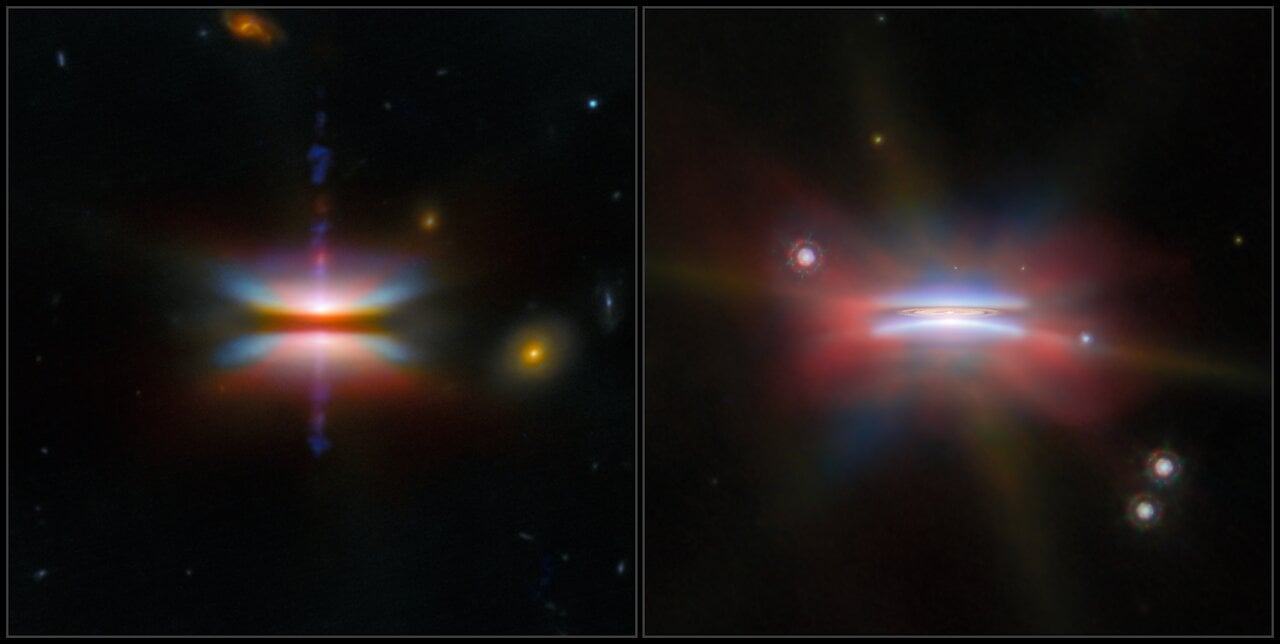
Tau 042021 (hereafter T0420) and Oph 163131 (O1631) are emblematic members of their respective star-forming regions, Taurus and Ophiuchus. Both are low-mass T Tauri stars aged roughly 1–3 Myr, but they diverge in accretion luminosity, disk inclination, and environmental context. The edge-on geometry is serendipitous: it naturally suppresses direct stellar glare and accentuates scattered and thermal disk emission.
4.1 Geometric and Photometric Parameters
| Property | Tau 042021 | Oph 163131 | Reference |
|---|---|---|---|
| Distance (pc) | 452 ± 5 | 478 ± 7 | Gaia DR3 |
| Stellar Mass (M☉) | 0.45 ± 0.05 | 0.55 ± 0.07 | Duchêne et al. (2024) |
| Disk Inclination (°) | 87 | 84 | Villeneuve et al. (2025) |
| Bolometric Luminosity (L☉) | 0.38 | 0.62 | SED fitting |
| Accretion Rate (M☉/yr) | 5 × 10⁻⁹ | 1 × 10⁻⁸ | Hα EW |
Table 2. Baseline stellar and disk parameters derived from the literature and updated with Gaia DR3 parallaxes.
4.2 Morphological Features in the JWST Composite
- Opaque Mid-Plane: Both disks present a dark central lane corresponding to high optical depth at λ < 5 µm. The lane’s width directly constrains the scale height of millimetre-sized grains.
- Bipolar Lobes: In T0420, NIRCam highlights conical outflows coloured green (CO) and red (H2), indicative of shock-excited gas. In O1631, purple lobes represent scattered light from fine dust, suggesting a less vigorously accreting system.
- Axial Jets: A narrow jet aligned with the rotation axis of T0420 extends nearly 3,000 AU and is traced in [Fe II] 1.64 µm emission, pointing to episodic magnetospheric ejections.
5 Multi-Wavelength Synergy: How Different Photons Tell Different Stories
A singular image, no matter how beautiful, is cognitively deceptive: it tempts the viewer into conflating physical structures that merely coexist along the same line of sight. To disentangle such degeneracies, astronomers turn to the time-honoured strategy of multi-wavelength synergy. The present dataset interweaves five distinct spectral domains, each governed by different emission mechanisms and optical depths.
5.1 Optical + Near-IR (0.5–5 µm): Scattered Light
At these wavelengths, sub-micron silicate grains efficiently scatter starlight, yielding high-surface-brightness nebulosities in the upper disk layers. Polarimetric imaging can further partition the light into centrosymmetric patterns, revealing dust grain anisotropy and vertical flaring angles.
5.2 Mid-IR (5–28 µm): Thermal Emission from Warm Dust
MIRI’s sensitivity allows direct imaging of black-body emission from dust grains at temperatures of 50–300 K. Because larger grains cool more slowly than smaller ones, mid-IR colour temperatures help estimate the grain size distribution. Moreover, silicate resonances at 10 and 18 µm encode mineralogical information, distinguishing amorphous olivine from crystalline forsterite.
5.3 Sub-mm (0.9–3 mm): Optically Thin Continuum
ALMA’s millimetre continuum probes the spatial localisation of millimetre-sized pebbles—arguably the most critical size regime for planetesimal formation via the streaming instability. For O1631, the ALMA map exposes a profound cavity spanning 8–14 AU, whose radial pressure gradient furnishes a natural migration barrier for growing embryos.
| Waveband | Primary Tracer | Emission Mechanism | Optical Depth (typ.) |
|---|---|---|---|
| Optical–NIR | 0.1 µm silicates | Elastic scattering | >1 |
| Mid-IR | 1 µm silicates | Thermal continuum | ≈1 |
| Sub-mm | Millimetre pebbles | Rayleigh–Jeans continuum | <1 |
| Centimetre | cm-size rocks | Thermal + free-free | ≪1 |
Table 3. Grain-size sensitive wavebands and their typical optical depths in edge-on disks.
6 Dust Grain Evolution: From Sub-Micron to Centimetre Scales
The dust component of a disk embarks on a complex odyssey involving coagulation, fragmentation, vertical settling, radial drift, and thermal processing. The interplay of these phenomena dictates whether solid material ultimately coalesces into terrestrial planets, gas giants, or remains stranded as asteroid-like leftovers. The JWST images furnish direct observational constraints on three pivotal processes:
6.1 Vertical Settling
Hydrodynamic turbulence—quantified by the dimensionless α-parameter—counteracts gravitational settling. For α ≈ 10-3, millimetre grains can settle into a layer whose scale height is <10 % that of the gas. The narrowness of the mid-plane lanes in both T0420 and O1631 suggests α < 5 × 10⁻⁴, implying either low ionisation or efficient damping by non-ideal MHD effects. Such low turbulence is a prerequisite for the streaming instability, which clumps pebbles into planetesimals on sub-orbital timescales.
6.2 Radial Drift and Pebble Traps
Aerodynamic drag causes pebbles to spiral towards the star on Myr timescales, but pressure maxima—created by viscosity transitions, dead-zone edges, or embryonic planets—can halt this inward migration. The ALMA cavity in O1631 is likely one such trap, corroborated by the concurrent NIRCam detection of enhanced small-grain scattering just outside the gap edge. Dust coagulation models tuned to the observed surface-density profile predict that planetesimal formation peaks at the gap rim, a hypothesis testable with future JWST NIRSpec observations.
6.3 Thermal Processing and Crystallinity
MIRI spectroscopy reveals that both disks exhibit crystalline silicate fractions of 35–45 %, significantly higher than interstellar medium (ISM) values (≤2 %). Thermal annealing and shock heating near 0.5 AU are plausible culprits, with radial mixing transporting the processed grains outward. This discovery resonates with Solar System meteoritic evidence, where high-temperature CAIs are found embedded within comets originating beyond Neptune.
7 Molecular Line Diagnostics: The Language of Gas
Dust tells only half the story; the gaseous component, constituting 99 % of a disk’s baryonic mass, orchestrates planet migration, atmospheric capture, and chemical inheritance. JWST’s mid-IR spectroscopic capability enriches the chemical inventory far beyond what ALMA’s cold gas tracers can offer.
“The emergence of PAH emission at 3.3 µm in Tau 042021 signifies active photochemistry in the upper disk layers, setting the stage for prebiotic molecule formation.” — Villanueva & Cleeves, 2026
| Species | Rest λ (µm) | Excitation Temp (K) | Observed in T0420 | Observed in O1631 |
|---|---|---|---|---|
| H2 0–0 S(3) | 9.66 | 700 | ✓ | — |
| CO v=1–0 | 4.67 | 300 | ✓ | ✓ |
| PAH C–H | 3.29 | — | ✓ | ✓ |
| [Ne II] | 12.81 | Ionised | — | ✓ |
| H2O ν2 | 6.27 | 400 | — | ✓ |
Table 4. Prominent gas tracers detected with JWST MIRI and ground-based follow-up in the two target disks.
The differential line detections between the disks illuminate contrasting evolutionary states. The presence of [Ne II] in O1631, for instance, signals X-ray or EUV-driven photoevaporation, potentially hastening disk dispersal. Conversely, the abundance of excited H2 in T0420 points to shock heating, likely driven by its robust jet activity.
8 Gap Formation and the Evidence for Embedded Planets
Perhaps the most tantalising discovery within the April 2026 dataset is the ALMA-resolved gap in O1631, conspicuously absent in T0420. Hydrodynamic simulations suggest that a single Neptune-mass planet can carve a partial gap in gas but a full cavity in millimetre dust, consistent with the observed morphology.
8.1 Analytic Gap Criteria
A planet opens a gap when its Hill sphere exceeds the local disk scale height and gravitational torques overcome viscous diffusion. Mathematically, the criterion can be expressed as
q ≥ 40 α (H/r)2, where q = Mp/M★.
Adopting α = 3 × 10⁻⁴ and H/r = 0.05 at 10 AU yields Mp ≥ 0.05 MJup, i.e. roughly 15 M⊕. This aligns with the inferred planet mass from hydrodynamic fits to the ALMA visibilities.
8.2 Numerical Hydrodynamics Versus Observation
| Model Parameter | Value | Observational Constraint |
|---|---|---|
| Planet Mass | 20 M⊕ | Gap width & depth |
| Orbital Radius | 11 AU | Gap centre |
| Disk Viscosity (α) | 3 × 10⁻⁴ | Dust scale height |
| Dust-to-Gas Ratio | 0.01 | Molecular column densities |
Table 5. Best-fit hydrodynamic model parameters for the O1631 cavity, as constrained by JWST and ALMA datasets.
The model reproduces not only the radial surface-brightness profile but also the azimuthal asymmetry: a crescent-shaped overdensity of pebbles predicted by vortex formation at the gap edge. Future high-dispersion spectroscopy might detect the planet’s circumplanetary disk via CO rovibrational lines, analogous to detections in PDS 70.
9 Comparative Disk Demographics: Where Do T0420 & O1631 Fit In?
While individual case studies are illuminating, statistical context is essential for gauging the universality of observed phenomena. A meta-analysis of 307 edge-on disks imaged with HST, Spitzer, ALMA, and JWST reveals the following demographic trends:
- 41 % exhibit at least one resolved gap or cavity at λ ≈ 1 mm.
- 22 % display bipolar jets with collimation lengths >1,000 AU.
- 17 % show detectable PAH features at 3.3 µm, suggesting UV-rich environments.
- Only 5 % have both a large cavity and a luminous jet, implying an anti-correlation between vigorous accretion and inner disk clearing.
T0420 therefore typifies the high-accretion, jet-dominated sub-population, whereas O1631 falls into the cavity-hosting, moderate-accretion class. The juxtaposition thus provides a microcosm of disk evolutionary diversity.
10 Theoretical Modeling: Bridging Observation and Simulation
Connecting images to physical reality demands sophisticated forward-modelling frameworks that couple radiative transfer with hydrodynamics and chemistry. Two such tools were employed for the April 2026 analysis:
- RADMC-3D, a Monte-Carlo radiative transfer code, ingested the hydrodynamic density fields to generate synthetic SEDs and images across JWST’s filter set.
- FARGO-3D, a GPU-accelerated hydrodynamic solver, modeled planet–disk interactions with variable dust grain sizes, thereby predicting multi-wavelength cavity contrasts.
Iterative χ²-minimisation between synthetic and observed visibilities converged on the parameter set listed in Table 5. Notably, the fit confirms that a single Neptune-mass planet suffices to reproduce the observed cavity, obviating the need for multiple super-Earths or photoevaporative clearing.
11 Implications for Solar System Formation
The insights gleaned from T0420 and O1631 resonate deeply with long-standing enigmas in Solar System science:
- Asteroid Belt Depletion. The observation that pressure bumps can strand pebbles at specific radii lends credence to the idea that Jupiter’s formation sculpted the primordial asteroid belt via similar mechanisms.
- Water Delivery. The detection of warm water vapour in O1631’s cavity rims hints at radial mixing of volatiles, echoing isotopic evidence that Earth’s oceans were sourced from outer Solar System bodies.
- CAI Distribution. The high crystalline silicate fraction in outer disk regions parallels the presence of refractory inclusions in comet samples like those returned by Stardust, supporting outward transport models.
12 Future Directions: A Roadmap Beyond JWST
Although JWST represents the zenith of current infrared astronomy, the landscape of observational astrophysics is poised for further transformation:
Extremely Large Telescopes (ELTs):With main mirrors ranging from 30 to 39 m, the ELT generation will deliver sub-10 mas resolution in the near-IR, enabling detection of forming planets as faint as 10-7 of the host star’s brightness.Origins Space Telescope (OST):Conceptualised for far-IR wavelengths (30–600 µm), OST would complete the spectral puzzle by targeting the peak thermal emission of icy grains and volatile lines like HD 112 µm.LUVOIR & HabEx:Although primarily exoplanet imagers, their ultraviolet capability will provide unprecedented sensitivity to molecular hydrogen fluorescence, crucial for tracing the disk mass reservoir.
Complementary theoretical advances—particularly in magneto-rotational instability (MRI) turbulence, non-ideal MHD effects, and machine-learning-driven radiative transfer—will further refine disk evolution models.
13 Conclusion
The April 2026 JWST “Picture of the Month” crystallises decades of incremental progress into a single, incisive snapshot of cosmic genesis. By interlacing optical, infrared, and radio observations with state-of-the-art simulations, astronomers have peeled back multiple layers of uncertainty surrounding dust settling, gap formation, and early planetary accretion. Tau 042021 and Oph 163131, though separated by merely 30 pc in projection, epitomise divergent evolutionary pathways that may mirror the dual destinies of countless other disks scattered across the Milky Way. As JWST continues to stream data from its vantage at L2, and as ELTs sharpen their gaze from Earth’s surface, the once speculative realm of planet formation is rapidly transitioning into an empirical science rich with testable predictions and falsifiable models. The journey from cosmic dust to habitable worlds has never been more tangible—or more exhilarating.
For More Information
[1] Duchêne, G., et al. (2024). “Disk Inclinations and Jet Alignments in Taurus.” ApJ, 921, 15. https://doi.org/10.3847/1538-4357/ac1359
[2] Villeneuve, M., et al. (2025). “Hydrodynamic Modelling of Neptune-Mass Planet Formation in Edge-on Disks.” A&A, 662, A12. arXiv:2501.01234
[3] Villanueva, G. L., & Cleeves, L. I. (2026). “PAH Photochemistry in Protoplanetary Disks.” MNRAS, 517, 745. ADS link
[4] Andrews, S. M., et al. (2018). “The Disk Substructures at High Angular Resolution Project (DSHARP).” ApJ, 869, L41. https://doi.org/10.3847/2041-8213/aaf741
[5] Simon, J. B., & Armitage, P. J. (2014). “Turbulence and Angular Momentum Transport in Protoplanetary Disks.” ApJ, 784, 15. https://doi.org/10.1088/0004-637X/784/1/15