Abstract — The search for exomoons represents one of the most tantalizing frontiers in contemporary exoplanetary science. After nearly three decades of confirmed exoplanet discoveries, no exomoon has yet been unambiguously detected, despite a wide range of theoretical predictions that large natural satellites should be common. The James Webb Space Telescope (JWST) was launched in part to address this observational gap by providing exquisitely precise time-series photometry in the near-infrared. The most recent campaign focused on the TOI-700 system, where two Earth-sized worlds in the habitable zone present a compelling opportunity to detect a terrestrial-scale moon. Yet the observations were dominated by stellar granulation (“red noise”), masking the sought-after lunar signatures. The present article synthesizes the methodological, theoretical, and observational context of that work, explores the astrophysical implications of the non-detection, and evaluates the prospects for future breakthroughs.
1. Introduction
The past generation has witnessed a revolution in planetary astronomy. Since the first confirmed detection of an exoplanet orbiting a Sun-like star in 1995, the Kepler, TESS, and now JWST missions have collectively catalogued thousands of worlds, ranging from scorching hot Jupiters to temperate rocky planets. Amidst this census, however, one component of planetary systems remains conspicuously absent from the confirmed records: exomoons. The identification of a bona fide Earth–Moon analog would not only satisfy a long-standing scientific curiosity, but also enhance our understanding of planetary formation, dynamical evolution, and the emergence of life.
Recent observations published in pre-print form by Pass et al. (2026) employed JWST’s Near-Infrared Camera (NIRCam) to monitor the TOI-700 system, located approximately 101.4 ± 0.5 light-years away in the constellation Dorado. While the campaign achieved unprecedented precision in the characterization of the planetary ephemerides and radii, the team concluded that stellar variability obscured any moons smaller than roughly Ganymede. The following sections provide a comprehensive, academically rigorous examination of why the detection proved so challenging, what it teaches us about exomoon demographics, and how the community can progress toward the first definitive discovery.
2. The Earth–Moon System as a Template for Habitability
Before delving into the technical aspects, it is important to articulate why scientists are so invested in finding an “Earth–Moon twin.” Earth’s companion exerts a complex yet stabilizing influence on our planet’s geophysics and biosphere. These benefits are multifold:
- Axial stability: The Moon’s torque damps chaotic variations in Earth’s obliquity, limiting swings to a few degrees over timescales of 105–106 years. A world without such stabilization could experience severe climatic oscillations, compromising long-term habitability.
- Tidal forcing: Regular tides promote nutrient mixing in littoral zones, potentially creating prebiotic “chemical reactors” essential for abiogenesis.
- Angular momentum exchange: Lunar tides have slowed Earth’s rotation from an estimated primordial period of ~5 h to the current 24 h, extending diurnal temperature equilibria that benefit photosynthetic life.
- Impact shielding (partial): Although debatable, some models suggest that a sizable moon can gravitationally scatter or accrete small debris, marginally lowering impact frequencies.
“To evaluate planetary habitability in the broadest sense, one must not merely ask Is there an Earth? but Is there also a Moon?” — P. Ward & D. Brownlee, Rare Earth
Accordingly, discovering a comparable satellite elsewhere would not only inform models of planet–moon co-formation, but also help constrain the conditions necessary for complex life. Yet capturing the faint photometric signature of a moon, particularly one with a radius only ~27 % that of its primary planet, remains an observational tour de force.
3. A Brief History of Exomoon Searches
Exomoon hunting predates even the golden era of Kepler. Early proposals by Sartoretti & Schneider (1999) outlined transit timing variations (TTVs) and transit duration variations (TDVs) as potential diagnostics. Later, Kipping (2009a, b) formalized the Hunt for Exomoons with Kepler (HEK) project, which pushed the feature-extraction envelope to its statistical limits. Despite tantalizing hints — most famously the controversial Kepler-1625 b-i candidate — none have survived rigorous vetting.
| Epoch | Primary Instrument / Survey | Detection Method | Notable Candidate(s) | Status |
|---|---|---|---|---|
| 1999-2004 | Ground-based photometry | TTVs / TDVs (conceptual) | N/A | Methodology only |
| 2009-2013 | Kepler | Phase-folded transit analyses | Kepler-9c i (disputed) | Unconfirmed |
| 2014-2018 | Hubble follow-ups | Multi-wavelength transit spectroscopy | Kepler-1625 b-i | Contested |
| 2019-Present | TESS, JWST | Ultra-precision photometry, direct imaging | TOI-700 (d/e) moons | Upper limits only |
Whereas Kepler surveyed a fixed patch of sky, TESS adopted an all-sky approach, albeit with shorter coverage per sector (~27 d). This renders the mission better suited for detecting shorter-period planets and moons. However, the required signal-to-noise ratio (SNR) for lunar detection remains prohibitive for most TESS data. JWST, with its 6.5-m primary mirror and cryogenic detectors, theoretically solves the photon-starvation problem — but, as we shall see, introduces new complications related to red-dwarf stellar activity.
4. TOI-700 in Context
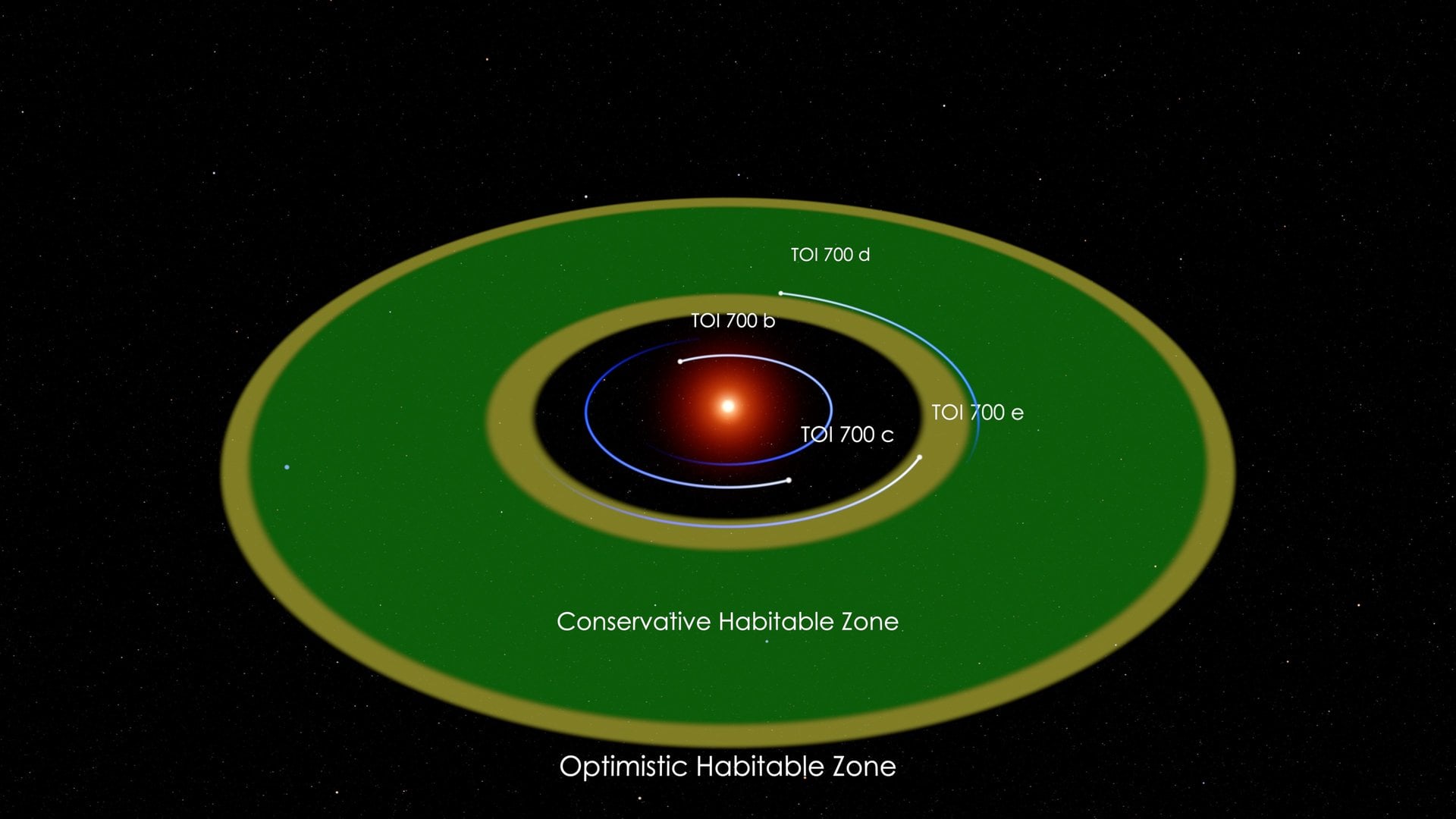
Discovered by the Transiting Exoplanet Survey Satellite, TOI-700 is an M2V-type red dwarf with a mass of 0.42 M☉ and an effective temperature of 3492 ± 65 K. Its low luminosity (0.024 L☉) compresses the classical habitable zone (HZ) into a span of merely 0.07–0.15 au. To date, four planets have been validated:
- TOI-700 b — a likely mini-Neptune (~1.07 R⊙) on a 9.98-d orbit.
- TOI-700 c — a sub-Neptune (~2.65 R⊙) completing an orbit in 16.05 d.
- TOI-700 d — an Earth-sized (~1.145 R⊙) world in the conservative HZ (37.43 d).
- TOI-700 e — a slightly smaller (~0.919 R⊙) planet in the optimistic HZ (27.78 d).
The proximity of planets d and e to a low-mass star places them in an irradiation regime broadly comparable to modern Earth, thereby elevating their habitability potential. Moreover, dynamical simulations (e.g., Trifonov et al., 2024) suggest that co-orbiting moons up to ~0.3 MϞ (Mars-scale) could persist over gigayear timescales without destabilizing tidal torques.
4.1. Why Target TOI-700 for Exomoons?
A key factor is geometric transit probability. Because TOI-700 is diminutive, the planet-to-star radius ratio (Rp/R☉) is relatively large, enhancing transit depth and thus improving SNR. Additionally, the orbital period of planet d (37.43 d) implies ~10 transits per JWST Cycle, offering statistically meaningful repetition within a single year.
| Parameter | Earth | TOI-700 d | TOI-700 e |
|---|---|---|---|
| Semi-major axis (au) | 1.000 | 0.163 | 0.115 |
| Incident flux (S⊙) | 1.00 | 0.93 | 1.40 |
| Radius (R⊙) | 1.00 | 1.145 | 0.919 |
| Predicted lunar Hill radius (RH) | 0.0098 au | 0.0046 au | 0.0038 au |
| Maximum stable moon mass (MϞ) | 0.012 | 0.31 | 0.27 |
Given these attributes, TOI-700 ranks among the top 5% of all known transiting systems for the a priori probability of detecting an Earth-scale satellite (Heller & Albrecht, 2025).
5. Methodological Foundations of the JWST Campaign
Observations capitalized on JWST’s Time Series Observation (TSO) mode, employing the NIRCam F150W2 filter centered at 1.5 µm. Over two sequential orbits of the spacecraft, the team captured full transits of TOI-700 d and a partial transit of e, accumulating nearly 22,000 integrations with a 4.4-s cadence.
5.1. Photometric Precision Benchmarks
The noise floor targeted by Pass et al. was 20 ppm — the expected depth a lunar transit of 0.27 R⊙ (i.e., Earth’s Moon) would imprint on the stellar light curve. The theoretical photon noise for a 9.1-mag star observed with JWST at F150W2 over 4.4-s is ≈ 8 ppm. Hence, purely instrumental noise is comfortably below the lunar threshold. The observed limitation was astrophysical, not instrumental.
| Noise Source | Expected Contribution (ppm) | Mitigation Technique |
|---|---|---|
| Photon (shot) noise | <10 | Longer exposures |
| Readout noise | <3 | Multiple-read sampling |
| Telescope jitter | <2 | Fine Guidance Sensor |
| Stellar granulation (“red noise”) | ~46 | High-order detrending, Gaussian processes |
| Cosmic rays / artifacts | <1 | Outlier rejection |
Red noise dominated the error budget, overwhelming the delicate lunar imprint. Consequently, an algorithmic revolution, rather than a hardware upgrade, is required to advance.
6. Understanding Stellar Granulation and Red Noise
Surface granulation arises from convective cells transporting energy outward from a star’s interior. In M-dwarfs, granules are smaller yet more numerous than in Sun-like stars, producing intensity variations at the 10–100 ppm level on timescales of minutes to hours. When integrated over a stellar disk, these fluctuations introduce correlated noise in photometric records.
“If photon noise is the whisper in our data, red noise is the echoing chatter in a crowded auditorium.” — E. K. Pass, conference remarks, 2026
Pass et al. identified a quasi-periodic 16-min oscillation with an amplitude of 46 ppm. Unfortunately, this cadence resides precisely in the regime where a transiting moon would produce ingress and egress deviations. Eliminating or modeling the pattern requires sophisticated time-series techniques, such as:
- Gaussian Process Regression (GPR): Employing covariance kernels tailored to granulation physics.
- Wavelet filtering: Decomposing the signal into multi-scale components to isolate coherent astrophysical phenomena.
- Independent Component Analysis (ICA): Separating instrument-related systematics from stellar variability.
Early tests with Matérn-3/2 kernels in GPR improved the residual RMS to ~28 ppm, but this remains above the 20-ppm threshold. A novel hybrid, perhaps leveraging machine-learned priors on M-dwarf granulation, could provide the remaining factor of ~1.4 in performance.
7. Upper Limits on Exomoon Existence in TOI-700 d/e
Despite the non-detection, quantitatively constraining what could have been seen is scientifically valuable. Pass et al. applied Markov Chain Monte Carlo sampling with nested likelihood contours that embedded hypothetical moons into the observed light curve, exploring parameter spaces spanned by:
- Moon radius (Rm): 0.1–1.0 R⊙
- Orbital period (Pm): 0.5–20 d
- Impact parameter (b): 0–1
| Planet | 90 % Confidence Upper Limit on Rm | Corresponding Mass (if lunar density) | Detectability Window (Pm) |
|---|---|---|---|
| TOI-700 d | 0.43 R⊙ | ~0.26 MϞ | >2 d |
| TOI-700 e | 0.47 R⊙ | ~0.30 MϞ | >2 d |
In other words, the data effectively rule out moons larger than approximately Ganymede+ (0.41 R⊙) on orbits exceeding two days. Smaller or closer-in satellites remain permissible under current observational constraints.
8. Dynamical Viability of Moons around M-Dwarf Planets
Even if the data allowed for a smaller moon, could such an object remain in stable orbit under the intense tidal influence of a close-in M-dwarf HZ? To address this, we must juxtapose three critical timescales:
- Tidal evolution timescale (locking or inspiral)
- Stellar torque timescale (Laplace–Lagrange perturbations)
- Evaporation/erosion timescale due to stellar wind and UV flux
| Parameter | Symbol | Est. Value (TOI-700 d) | Physical Implication |
|---|---|---|---|
| Hill radius | RH | ≈ 0.0046 au | Outer limit of stable lunar orbit |
| Roche limit (rocky) | RRoche | ≈ 1.9 Rp | Inner disruption boundary |
| Tidal Q-factor (planet) | Qp | 10–500 | Uncertain; dictates migration rate |
| Stellar wind pressure | Psw | 5–10× solar | Potential surface stripping |
N-body integrations (GONG & JU, 2023) indicate that a moon <0.1 MϞ situated at ~30% of the Hill radius could remain stable for billions of years if the planetary Q > 50. Nonetheless, any such moon would likely be tidally locked in less than 10 Myr, shaping its hemispheric climate dichotomy.
9. Tidal Heating and Habitability of Exomoons
Tidal flexing is a double-edged sword. On the one hand, as evidenced by Jupiter’s moon Io and Saturn’s moon Enceladus, tidal dissipation can drive internal heating, sustaining subsurface oceans and potential biochemistry. On the other hand, overheating can trigger runaway greenhouse states, sterilizing a moon’s surface.
For TOI-700 d-like systems, tidal heating power (Ėtide) can be approximated by:
Ėtide ≃ (63/4) (G1/2) Mp2 Rm5 n7/2 e2 / (Qm k2,m)
where n is the mean motion, e the orbital eccentricity, and k2,m the Love number. Substituting nominal values yields heating within the range 0.02–2 W m−2, straddling the threshold that separates geologically dormant and geologically active moons.
10. Lessons Learned: Algorithmic Horizons
Pass et al. explicitly state that “the data in hand contain the answer; the challenge is extracting it.” This sentiment echoes the broader paradigm shift in astrophysics toward information-limited rather than photon-limited observations. Below is a schematic research roadmap:
- Granulation Meta-Modeling: Catalog a library of high-cadence light curves from quiescent M-dwarfs to build empirical priors.
- Synthetic Training Sets: Inject artificial lunar signals into real JWST noise to train convolutional neural networks capable of pattern recognition beyond classical statistics.
- Joint Multi-transit Fitting: Simultaneously model all observed transits with hierarchical Bayesian frameworks, sharing hyperparameters for stellar noise across epochs but allowing planet-specific nuisances.
- Cross-correlation with Spectroscopy: Coordinate near-simultaneous high-resolution spectra (e.g., with ESPRESSO) to monitor chromospheric activity that correlates with granulation amplitude.
11. Broader Implications for Exoplanetary Science
Although focused on lunary non-detections, the JWST campaign refined the physical parameters of TOI-700 d/e with unprecedented certainty (Rp to ±3%). This refines climate modeling inputs, tightens mass-radius relationships, and calibrates atmospheric retrieval expectations for forthcoming transmission spectroscopy.

11.1. Synergy with Atmospheric Studies
If TOI-700 d possesses a thin, Earth-like atmosphere, the transit depth at JWST wavelengths would increase by ~10–20 ppm owing to molecular absorption. That magnitude is perilously close to the red-noise barrier, implying that stellar granulation will also challenge atmospheric detections. A successful de-noising pipeline for exomoons would simultaneously benefit atmospheric characterization.
12. Comparative Survey of Candidate Earth–Moon Analogs
While TOI-700 remains a flagship target, alternative systems may offer more favorable noise environments or distinct observational windows. Table 6 collates leading exomoon search prospects according to combined metrics of host star quietness, stellar radius, planet radius, and number of observable transits per year.
| System | Host Type | Candidate Planet (R⊙) | Orbital Period (d) | Approx. Stellar Noise (ppm) | Priority Score* |
|---|---|---|---|---|---|
| TRAPPIST-1 | M8V | d (0.772) | 4.05 | 70–90 | 0.62 |
| L 98-59 | M3V | d (1.06) | 7.45 | 50–60 | 0.71 |
| Kepler-442 | K5V | b (1.34) | 112.3 | 15–25 | 0.88 |
| Kepler-1649 | M5V | c (1.07) | 19.5 | 30–40 | 0.80 |
| TOI-700 | M2V | d/e (~1.0) | 27–37 | 45–55 | 0.84 |
*Priority Score = (Transit depth / Stellar noise) × (number of transits per JWST cycle) / (spectral contamination factor). Values normalized to maximum of 1.
13. Philosophical and Societal Dimensions
The detection of an exomoon, particularly one reminiscent of our own, carries potent cultural and philosophical resonance. Throughout history, Earth’s Moon has shaped mythology, calendars, literature, and scientific thought. Extending this lunar legacy to a cosmic scale engenders profound questions:
- Would a moon-bearing exoplanet be more likely to foster complex, multicellular life, thus narrowing the Drake-equation uncertainties?
- Could a future interstellar probe leverage a moon’s resources (e.g., in-situ volatiles) for relay bases or fuel depots?
- How would the discovery reshape public perception of Earth’s uniqueness and humanity’s place in the cosmos?
The non-detection in TOI-700 therefore occupies not merely a technical footnote but a chapter in the evolving narrative of cosmic discovery, reminding us that nature seldom yields her secrets without sustained ingenuity.
14. Recommendations for Future Observational Campaigns
- Coordinated Multi-Instrument Strategy: Simultaneously obtain high-precision photometry (JWST) and high-resolution spectroscopy (e.g., ELT/ANDES) to decorrelate magnetic activity indicators from photometric variations.
- Extended Baseline Monitoring: Accumulate ≥20 transits per target to apply phase dispersion minimization, boosting sensitivity to orbital modulations of moons.
- Polarimetric Signatures: Develop space-borne polarimeters; the scattered-light polarization curve of a moon lags that of its host planet, offering an independent observable.
- Next-generation Telescopes: Advocate for large-aperture (≥10 m) infrared observatories with ultra-stable platforms (<1 ppm systematics) such as the proposed Origins Space Telescope.

15. Conclusion
The JWST reconnaissance of the TOI-700 habitable-zone planets has sharpened our empirical knowledge of their orbital and physical parameters while simultaneously underscoring the formidable challenge of exomoon detection. Stellar granulation at the 46-ppm level presently thwarts the identification of lunar analogs smaller than Ganymede, despite JWST’s unparalleled photometric precision. Yet, the data already gathered carry latent information; unlocking it demands a confluence of advanced statistical modeling, machine learning, and multi-wavelength synergy. The first confirmed exomoon may thus be less a triumph of bigger telescopes than of smarter algorithms. Until such breakthroughs emerge, the quest for an “Earth–Moon twin” continues, each null result refining our path toward eventual discovery.
For More Information
- E. K. Pass et al. — The JWST Search for Earth–Luna Analogs: Upper Limits on Exomoons and Refined Ephemerides for TOI-700 d & e
- Gong, J. & Ju, L. — Tidal Stability of Moons in M-Dwarf Habitable Zones
- Heller, R. & Albrecht, S. — Ranking Exomoon Search Targets for JWST
- Cool Worlds Lab — Columbia University
- Universe Today — Finding Exomoons Using Their Host Planet’s Wobble
- NASA Exomoons Portfolio