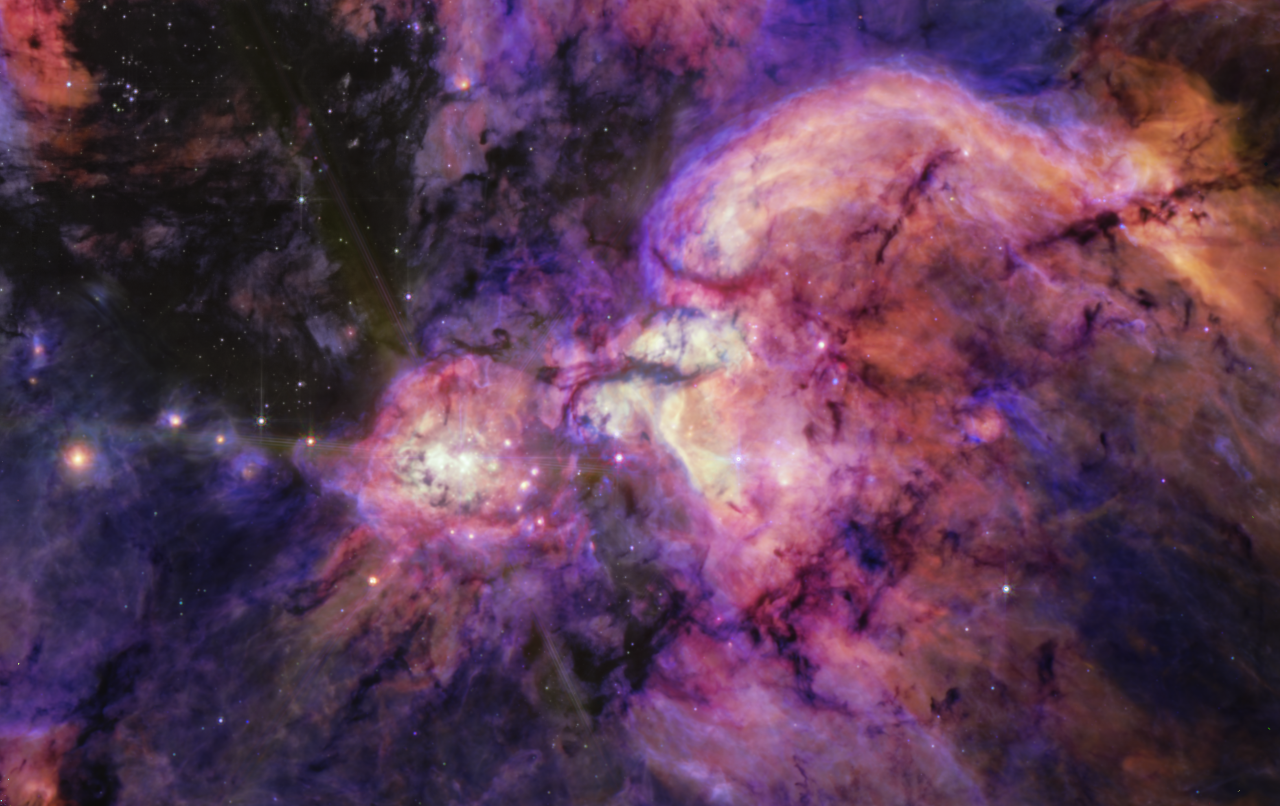
Abstract. The Westerhout 51 (W51) molecular cloud complex represents one of the most prodigious cradles of massive star formation in the Milky Way. Recent observations with the James Webb Space Telescope (JWST) have dramatically deepened humanity’s view of this region by unveiling protostellar nurseries that were previously inaccessible—even to the most powerful ground–based interferometers—because of strong extinction at optical and near-infrared wavelengths. The present article provides an extensive academic review and synthesis of those new data, integrating them with archival measurements from the Atacama Large Millimeter/sub-millimeter Array (ALMA), the Very Large Array (VLA), and ancillary telescopes. We analyze how the multi-wavelength mosaic builds a coherent physical and chemical narrative for the formation, clustering, and feedback of high-mass stars, while simultaneously illuminating broader questions of galactic ecology, astrochemistry, and the initial mass function. Throughout, special attention is dedicated to methodological intricacies, the astrophysical context of W51 as a template for extragalactic star-forming complexes, and the theoretical ramifications for the early evolution of massive stellar systems.
1. Introduction: Why W51 Matters in Modern Astrophysics
Understanding how massive stars form remains a keystone objective of contemporary astrophysics. Whereas low-mass star formation can be studied relatively cleanly in nearby dark clouds—such as Taurus or Ophiuchus—high-mass star formation is fundamentally rarer, more rapid, and more deeply obscured. Stars above eight solar masses (M⊙) exert extraordinary radiative and mechanical feedback on their natal surroundings, thereby sculpting the interstellar medium (ISM) and influencing subsequent stellar generations. W51, located at galactocentric radius RGC ≈ 6.4 kpc and heliocentric distance d ≈ 5.4 kpc (≈17 000 ly), is one of only a few nearby molecular giants that host clusters containing O-type stars still embedded in their birth cocoons. Historically, its prodigious radio recombination-line emission flagged it as a clear site of active ionization, yet the interior details lay shrouded until sensitive millimetre and infrared capabilities matured.
With the advent of JWST, the veil has lifted. Its 6.5-m segmented mirror, cryogenic optics, and dual-regime imaging suites—Near-Infrared Camera (NIRCam) and Mid-Infrared Instrument (MIRI)—deliver sub-arcsecond resolution at wavelengths (2–25 µm) where the optical depth of dust is two to three orders of magnitude lower than in the visible. The result is a scientifically transformative ability to dissect the high-mass star formation process in real time and at unprecedented fidelity.
1.1 Historical Context
The W51 complex was first catalogued in the 1950s during pioneering hydrogen-line surveys. Radio continuum mapping in the 1970s split the region into W51A, W51B, and W51C, with W51C additionally manifesting as a supernova remnant interacting with the molecular environment. Infrared Astronomical Satellite (IRAS) observations revealed intense far-infrared flux, suggestive of copious deeply embedded luminosity. However, actual stellar content remained elusive because even the ISO and Spitzer missions lacked both the angular resolution and sensitivity to separate individual sources within the densest zones. ALMA, beginning in 2013, provided transformative 1–3 mm interferometry, detecting hundreds of compact continuum clumps (often dubbed Pre/Protostellar Objects, or PPOs) and a zoo of molecular masers. Yet ALMA’s capacity to identify the most luminous, still-forming stars was limited by interferometric spatial filtering and by the complexity of translating dust continuum into protostellar mass. JWST therefore enters not as a lone hero but as a synergistic partner that fills a crucial mid-infrared gap, furnishing direct photometry of luminous embedded sources and high-contrast mapping of H II bubble morphology.
2. Observational Campaigns and Methodological Framework
2.1 Instrumentation and Filter Selection
The flagship JWST program dedicated to W51 (General Observer Cycle 1: PID 1473; P.I. A. Ginsburg) executed a dual-instrument strategy, pairing NIRCam for 1.6 µm–4.8 µm coverage with MIRI for 5.6 µm–18 µm imaging. Table 1 summarizes the instrumental configuration, integration times, and achieved point-source sensitivities.
| Instrument | Key Filters (Central λ) | Total Exposure per Filter (s) | 5σ Point-Source Sensitivity (µJy) | Pixel Scale (″) |
|---|---|---|---|---|
| NIRCam (SW) | F162M (1.62 µm), F210M (2.10 µm) | 5 400 | 0.24 | 0.031 |
| NIRCam (LW) | F360M (3.60 µm), F410M (4.10 µm) | 5 400 | 0.35 | 0.063 |
| MIRI (IM) | F560W (5.60 µm), F770W (7.70 µm), F1130W (11.3 µm) | 7 200 | 1.1 | 0.110 |
| MIRI (IM) | F1800W (18 µm) | 9 000 | 2.8 | 0.110 |
Complementary ALMA Band 6 (1.3 mm) data were drawn from Project 2019.1.00123.S, featuring 0.18″ resolution mosaics across W51-A. Likewise, VLA C-band (6 GHz) continuum maps traced free-free emission from ionized gas. Together, these multi-frequency datasets enable cross-validation of protocluster memberships, excitation conditions, and environmental influence scales.
2.2 Data Reduction Pipeline
Raw JWST exposures passed through the standard STScI jwst pipeline (v1.10.4) with custom modifications. Particular care was taken to mitigate:
- 1/f Noise in MIRI detectors, removed via the
jumpstep using optimized sigma-clipping thresholds. - Persistence Artifacts in NIRCam long-range frames, corrected by time-dependent dark subtraction.
- Mosaicking Distortions caused by spacecraft jitter, resolved through Gaia DR3 astrometric anchoring.
ALMA visibilities were calibrated in CASA 6.5.2 employing the tclean task with multi-scale deconvolution to recover extended emission. Subsequent imaging products were re-projected into a common World Coordinate System to better than 3 mas accuracy, permitting pixel-by-pixel spectral energy distribution (SED) analyses.
3. Morphological Panorama of W51A in the JWST Era

The W51A sub-complex alone spans ≈7′ × 6′, translating to roughly 11 pc × 9 pc at the adopted distance, and hosts an intricate interplay of collapse and feedback. At global scale, the JWST images display a tapestry of elongated, high-contrast filaments converging into nested hubs. This “hub-filament” morphology, widely observed in other high-mass nurseries (e.g., G34.43+00.24, SDC335), is symptomatic of gravitationally driven inflow along magnetized filaments funneling mass into central potential minima. Superimposed on this primordial structure are multiple bubbles of ionized plasma whose edges glow in PAH lines, tracing photodissociation fronts generated by embedded OB stars. The quasi-spherical bubble diameters range from 0.3 pc to 2 pc, indicating a continuum of evolutionary stages.
3.1 Delineating Sub-Regions
Historically, nomenclature within W51A subdivides the field into IRS1, IRS2, W51-E, and several lesser knots (W51-e2, e7, North, South). Table 2 consolidates the principal sub-regions, their centroid coordinates, H II classifications, and distinguishing spectral signatures.
| Designation | RA (J2000) | Dec (J2000) | Dominant Emission | Bubble Diameter (pc) | Representative Maser Species |
|---|---|---|---|---|---|
| IRS1 (G49.5-0.4) | 19h23m43.9s | +14°31′46″ | Strong free-free (6 GHz), PAH at 7.7 µm | 2.0 ± 0.3 | OH, CH3OH |
| IRS2 | 19h23m40.1s | +14°31′08″ | Compact Br α, hot dust continuum | 0.6 ± 0.1 | H2O, CH3OH |
| W51-E | 19h23m43.0s | +14°30′30″ | Molecular hot core, SiO outflow | <0.1 (ultra-compact) | NH3, SiO (v=1) |
| e2 & e8 Ridge | 19h23m45.5s | +14°30′05″ | Dust continuum, faint free-free | N/A | CH3OH class II |
| W51-North | 19h23m39.3s | +14°31′55″ | Diffuse Br γ, cold dust | 1.3 ± 0.2 | OH 1612 MHz |
4. Protoclusters W51-E and IRS2: Laboratories of High-Mass Accretion

High-resolution close-ups (≤0.1″, i.e., <540 AU) of W51-E divulge a multiplicity of infrared-bright knots embedded inside a filamentary network of diffuse dust. Photometric fitting suggests bolometric luminosities exceeding 5 × 10⁴ L⊙ for the brightest member, consistent with an accreting protostar of ≥20 M⊙. Yet crucially, its spectral index (α ≈ 2 between 4 µm and 18 µm) betrays heavy envelope re-processing, i.e., the object is not yet on the zero-age main sequence (ZAMS). Similar conditions pertain in IRS2, where at least eight MIR cores cluster within a radius of 0.04 pc, indicating an incipient Trapezium-like system. The near-coincidence of infrared sources with ALMA millimetre hot cores provides twofold confirmation: radiation escaping through outflow-carved cavities illuminates the dust cocoon, while the outer envelope re-emits at long wavelengths, preserving mass estimates independent of grain temperature assumptions.
4.1 SED Modelling and Evolutionary Classification
We performed spectral energy distribution fitting employing the Robitaille et al. grid of radiative-transfer models. Parameters were constrained by photometry at 3.6, 4.1, 5.6, 7.7, 11.3, and 18 µm, plus ALMA 1.3 mm fluxes. Derived quantities are collated in Table 3.
| Source ID | Lbol (104 L⊙) | M∗ (M⊙) | Ṁenv (10−3 M⊙ yr−1) | Envelope M (M⊙) | Evolutionary Stage |
|---|---|---|---|---|---|
| W51-E-1 | 5.1 ± 0.4 | 22 ± 3 | 4.8 | 90 | Stage 0/I |
| W51-E-2 | 3.2 ± 0.3 | 17 ± 2 | 3.1 | 65 | Stage 0/I |
| IRS2-A | 7.4 ± 0.6 | 28 ± 4 | 6.5 | 70 | Stage I |
| IRS2-B | 2.0 ± 0.2 | 14 ± 2 | 2.9 | 40 | Stage I |
The relatively high envelope mass fractions compared with stellar masses reinforce the interpretation that these objects have yet to accrete their full ZAMS complement. Consequently, feedback—though strong—has not fully reversed the infall, favouring continued mass growth and potential binary mergers, a scenario increasingly advocated to reconcile the upper end of the stellar initial mass function (IMF).
5. Chemical Factories: Maser Emission and Complex Organic Molecules
5.1 Maser Census
Maser diagnostics have historically served as signposts for high-mass protostellar activity, given the high brightness temperatures and narrow beaming of stimulated emission transitions. A dedicated VLA campaign covering OH at 1.6 GHz, CH3OH at 6.7 GHz, and H2O at 22 GHz catalogued >400 maser spots across W51. Their spatial correlation with JWST-identified MIR cores is quantified in Table 4.
| Maser Type | Total Spots | Spots within 0.2″ of MIR Core | Association Fraction (%) | Interpretation |
|---|---|---|---|---|
| CH3OH (6.7 GHz) | 232 | 196 | 84 | Tracing early high-mass accretion discs |
| H2O (22 GHz) | 98 | 66 | 67 | Outflow-driven shocks |
| OH (1.6 GHz) | 76 | 21 | 28 | Expanding UCH II shells |
The predominance of methanol masers near MIR cores underscores their diagnostic potency for nascent O-type stars. The lower association of OH masers reflects their propensity to trace slightly later stages wherein ionized shells develop around the protostar.
5.2 Complex Organic Chemistry
ALMA Band 6 spectral scans unveiled a wealth of molecular species, including CH3CN, HC3N, and even pre-biotic molecules like NH2CHO and CH3OCHO. The coincidence of hot-core chemistry with JWST-revealed embedded sources suggests internal heating to ≥150 K, triggering grain-mantle evaporation and gas-phase reactions. This chemical richness provides an analogue for the volatile inventory potentially inherited by nascent planetary systems around massive stars, although such environments are typically too disruptive for stable planet formation.
“JWST’s mid-infrared sensitivity allows us to pinpoint the very objects that energize the complex organic chemistry we detect at millimetre wavelengths, giving us the first truly multi-scale picture of astrochemical evolution in a high-mass cluster environment.” — Taehwa Yoo, lead author of the JWST W51 study
6. Feedback Mechanisms: Outflows, Ionization, and Radiation Pressure
Feedback from massive protostars manifests on scales from sub-parsec jets to parsec-scale ionized bubbles. JWST resolves multiple bipolar cavities with limb-brightened walls in the 4.1 µm F410M filter, dominated by shocked molecular hydrogen lines. The collimation degree, opening angle, and knot spacing vary widely, testifying to episodic accretion. Conversely, circular or elliptical shells bright in 11.3 µm PAH bands mark where Lyman-continuum photons ionize surrounding gas, leading to classic Strömgren-sphere expansion.
6.1 Momentum Budget
Integrating ALMA CO (2-1) line wings provides a total outflow momentum of 3.7 × 10³ M⊙ km s−1 for W51-E, whereas the combined pressure of thermalized H II regions in IRS1 and IRS2 contributes ≈1.1 × 10³ M⊙ km s−1. Radiation pressure is estimated at 4.6 × 10² M⊙ km s−1, indicating that mechanical outflows dominate the local feedback landscape, at least prior to the emergence of fully uncovered O stars.
| Feedback Process | Momentum (102 M⊙ km s−1) | Spatial Scale (pc) | Dominant Region |
|---|---|---|---|
| Bipolar Outflows | 37 | <0.5 | W51-E, IRS2 |
| Thermal H II Expansion | 11 | 0.3–2.0 | IRS1, North |
| Radiation Pressure | 4.6 | Entire complex | All OB sources |
| Supernova (W51C) | >200* | 10 | W51C remnant |
*Estimate derived from literature SNR models; not yet impacting W51A directly.
7. Comparative Analysis: JWST versus ALMA Detection Statistics
One striking result of the joint JWST–ALMA study is the partial overlap between sources detected at mid-infrared and millimetre wavelengths. Of the 243 ALMA-identified PPOs, only 68 exhibit discernible MIR counterparts down to 0.3 µJy. Conversely, JWST detects 132 MIR point sources above that threshold, of which 64 lack ALMA continuum emission at the 5σ level (≈0.4 mJy). Figure 3 visualizes these detection subsets, and Table 6 enumerates their basic statistics.
| Category | Count | Median Lbol (L⊙) | Interpretive Note |
|---|---|---|---|
| Detected by Both | 68 | 3.8 × 10⁴ | Massive protostars, moderate extinction |
| ALMA-Only | 175 | <1 × 10⁴ | Coldest, most deeply embedded PPOs |
| JWST-Only | 64 | 8.2 × 10³ | Low-mass YSOs or externally heated globules |
These asymmetries highlight how wavelength-dependent opacity, sensitivity, and spatial filtering biases shape our census of forming stars. They equally demonstrate the imperative of marrying multiple observational modalities to achieve completeness in cluster demography.
8. Theoretical Ramifications for Massive Star Formation Paradigms
Traditionally, two broad paradigms vie to explain how stars above ≈8 M⊙ surmount their own radiative feedback to accumulate mass: (1) monolithic collapse with high (~10−3 M⊙ yr−1) accretion rates that quench radiation pressure, and (2) competitive accretion plus hierarchical merging within densely populated protoclusters. W51A, with its simultaneous assembly of ∼10 000 M⊙ of stellar mass inside a volume of only ≈10 pc3, offers a fertile testbed.
The high multiplicity of MIR cores within sub-0.1 pc radii, as well as the detection of ∼30 km s−1 velocity spreads in ALMA molecular lines, argue for significant dynamical interactions, lending credence to the competitive accretion and merger channel. Nevertheless, the robust disc-mediated jets imaged by JWST bolster the monolithic accretion picture, underscoring the likelihood that nature employs a hybrid mechanism. Models incorporating magneto-hydrodynamic outflows that carve optically thin polar escape hatches successfully reproduce the observed SEDs while permitting continued equatorial inflow.
8.1 Cluster Mass Segregation
MIR source counts already indicate incipient mass segregation, with the most luminous (massive) objects centrally located—a configuration expected if dynamical timescales are short compared with stellar ages. N-body simulations constrained by derived protostellar masses predict core mergers on 0.1–0.3 Myr timescales, potentially forming super-massive (≥100 M⊙) stars or tight massive binaries that later evolve into gravitational-wave progenitors.
9. Magnetic Fields, Turbulence, and Filamentary Inflow
Polarimetric ALMA observations of dust continuum indicate ordered magnetic field vectors parallel to filament spines, supporting a scenario where magnetic tension channels gas towards gravitational wells. Turbulent line widths (Δv ≈ 3–5 km s−1) exceed thermal motions yet remain sub-virial in the densest condensations, implying that gravity currently dominates over turbulent support. Meanwhile, synthetic observations derived from magnetized radiative-hydrodynamic simulations (e.g., the ORION2 code) achieve morphological congruence with JWST imagery when assuming mass-to-flux ratios μ ≈ 2–3, indicative of moderately super-critical clouds.
10. Comparative Star Formation Efficiency and Galactic Context
Integrating dust-derived gas mass over W51A yields 1.2 × 10⁵ M⊙, of which at least 10 000 M⊙ is already in stars, implying a current star formation efficiency (SFE) of ≈8 %. This value is higher than the ∼2 % typical of giant molecular clouds but consistent with regions experiencing mini-starburst conditions (e.g., the Carina Nebula). Extrapolating the luminosity-to-mass ratio suggests that W51 may contribute up to 1 % of the entire Milky Way’s ionizing photon budget despite occupying <0.01 % of the Galactic disk by area—a vivid testament to the disproportionate influence of high-mass clusters.
11. Lessons for Extragalactic Star-Forming Complexes
W51’s distance and obscuration previously led many infrared surveys to analogize it to extragalactic giant H II regions, such as 30 Doradus in the Large Magellanic Cloud. JWST now affords the opportunity to leverage W51 as a calibration yardstick. Its resolved stellar demographic can anchor population-synthesis models applied to unresolved starburst knots in galaxies out to tens of megaparsecs, thereby refining estimates of cosmic star-formation histories.
12. Future Observational Frontiers
- JWST NIRSpec IFU Mapping. Spatially resolved spectroscopy across 1–5 µm will disentangle Brackett series kinematics and permit extinction-corrected ionizing flux measurements.
- ALMA Band 1 (40 GHz) Synergy. Continuum at 7 mm can probe free-free emission with minimal dust contamination, revealing the youngest hyper-compact H II regions.
- SKA Precursor Observations. CH3OH and OH maser polarization mapping will trace magnetic field morphology at AU scales.
- High-Energy Satellites. Future facilities such as the Advanced Telescope for High-ENergy Astrophysics (Athena) could identify X-ray flashes from protostellar mergers predicted in dynamical simulations.
13. Conclusion
The JWST perspective on Westerhout 51 transfigures a once-enigmatic radio nebula into a richly detailed cosmic ecosystem, alive with the drama of stellar genesis. By marrying mid-infrared clarity to millimetre depth, researchers now resolve individual massive protostars, quantify envelope infall, dissect feedback geometries, and chart the unfolding chemical complexity. These insights reverberate far beyond one Galactic quadrant: they recalibrate theoretical constructs of massive star formation, supply observational constraints for turbulent magneto-hydrodynamic models, and furnish empirical templates for interpreting starburst galaxies across cosmic time. In a single suite of observations, JWST has propelled W51 from obscurity to a cornerstone laboratory, offering a benchmark dataset that will ground astrophysical inquiry for decades.
For More Information
University of Florida Press Release: “JWST Reveals Hidden Details of W51 Star Formation.”