Abstract: The quest for a sustainable, continuously crewed human presence on the Moon has rapidly evolved from a distant dream to a near-term engineering and economic challenge. Central to this transformation is the exploitation of lunar polar volatiles—principally water ice trapped in Permanently Shadowed Regions (PSRs)—that can be harvested, processed, and converted into propellant, life-support consumables, and structural feedstock. In March 2026, Blue Origin formally unveiled Oasis-1, a dual-SmallSat prospecting mission to orbit the lunar south pole. This article offers an exhaustive, interdisciplinary analysis of the technical architecture, scientific rationale, commercial structure, and long-term implications of Oasis-1, situating it within the historical arc of lunar resource utilization (ISRU) efforts, the emerging cislunar economy, and the broader geopolitical landscape of deep-space industrialization.
1. Introduction: From Symbolic Footprints to Sustainable Footing
When Neil Armstrong’s boots first disturbed the fine regolith of Mare Tranquillitatis in July 1969, the world celebrated a singular scientific triumph. Yet the Apollo program, magnificent in scope and daring, was not designed for permanence. Half a century later—propelled by the success of Artemis I, the maturation of private launch markets, and looming competition among space-faring nations—planners now acknowledge that an enduring foothold on the Moon hinges upon locally sourced resources. No commodity is more fundamental than H2O. Water can sustain life, shield habitats from radiation, and, when electrolyzed, deliver cryogenic oxygen and hydrogen propellants. Accordingly, prospecting missions that move from global mapping to mine-scale resolution are indispensable. Oasis-1 is the first stage of Blue Origin’s three-tiered “Oasis Campaign,” intended to transition from orbital reconnaissance to surface mobility and, ultimately, commercial extraction.
2. Historical Context: Evolving Approaches to Lunar Volatiles
Table 1 chronologically summarizes the milestones in lunar volatile detection and characterization, illustrating how instrumentation sensitivity, orbital resolution, and mission objectives have co-evolved.
| Year | Mission / Instrument | Major Contribution | Spatial Resolution | Impact on ISRU Planning |
|---|---|---|---|---|
| 1994 | Clementine / Bistatic Radar | Initial radar signature consistent with water ice near poles | >1 km px-1 | Sparked debate on ice abundance |
| 1998 | Lunar Prospector / Neutron Spectrometer | Global hydrogen map; confirmed polar enhancement | ~60 km px-1 | Established PSRs as volatile sinks |
| 2009 | LCROSS / Impact Experiment | Direct detection of water vapor and hydroxyl in ejecta plume | Point sampling | Provided “ground truth” for orbital data |
| 2009–Present | LRO / LEND, LOLA, Diviner | High-resolution topography, temperature maps, neutron flux | Up to 100 m px-1 | Enabled precise landing site selection |
| 2024 | ISRO Chandrayaan-3 / Pragyan Rover | In-situ experiment confirming sub-surface thermal gradients | Centimeter scale (rover footprint) | Highlighted regolith workability constraints |
| 2026 (est.) | Blue Origin Oasis-1 / GRNS + Multispectral | Mine-scale water, helium-3, and metal mapping | ≤15 km px-1; <5 m for He-3 | Directly informs commercial extraction ROI |
As evident in Table 1, the path from Clementine’s coarse radar echoes to Oasis-1’s mine-scale neutron spectroscopy reflects exponential improvements in both orbital mechanics (achieving tighter perilunes) and detector miniaturization. Crucially, commercial decision-makers now demand prospecting resolutions that reduce financial risk, aligning scientific curiosity with investment imperatives.
3. Mission Architecture of Oasis-1
3.1 Spacecraft Configuration
Each of the two identical SmallSats in the Oasis-1 constellation masses approximately 70 kg dry and rides to translunar injection aboard Blue Origin’s uncrewed MK1 lander, itself delivered on a New Glenn heavy-lift booster. The SmallSats are deployed prior to MK1’s descent burn, engage autonomous cold-gas attitude control, and perform a suite of deterministic ΔV maneuvers to establish a 10 km × 50 km nearly polar orbit at 88° inclination. The low periselene of roughly 10 km affords neutron flux readings at unprecedented granularity, while apoapsis loitering conserves propellant.
| Subsystem | Mass (kg) | Peak Power (W) | Primary Vendor |
|---|---|---|---|
| Structure & Thermal | 12 | — | Blue Origin Advanced Structures |
| Propulsion (Green Monoprop) | 8 | 75 (during burn) | Benchmark Space Systems |
| Power (Deployable Solar + Li-ion) | 6 | 200 (sunlit) | MicroSat Energy Corp. |
| GRNS (Hybrid) | 10 | 40 | Planetary Spectroscopy Inc. |
| Multispectral Push-broom | 4 | 20 | NeoOptics |
| Fluxgate Magnetometer + Boom | 3 | 10 | MagSys LLC |
| C&DH, TT&C | 5 | 35 | Blue Origin Avionics |
| Total | 48 kg (dry) | 380 W (peak) | — |
*Note: Mass margin of 20 % retained for integration variances.
3.2 Payload Suite
- Hybrid Gamma-Ray and Neutron Spectrometer (GRNS): Combines a boron-loaded plastic scintillator for fast-neutron detection with a cerium-doped GAGG crystal for gamma-ray spectroscopy. Enables simultaneous quantification of hydrogen, iron, titanium, and thorium.
- Multispectral Push-broom Spectrometer: Captures 32 discrete spectral bands from 250–750 nm, optimizing helium-3 identification via distinctive ^3He–^4He absorption doublets within back-scattered solar albedo.
- Fluxgate Magnetometer: Characterizes crustal remanent fields, illuminating potential paleomagnetic anomalies correlated with meteoritic nickel-iron concentrations and shielding implications for surface habitats.
“A single 10-km-periselene pass with a neutron flux detector delivers more water-content information than a month in a 100-km orbit.” — Dr. Jean-Dominique Tarnas, Principal Investigator
3.3 Mission Phases and Timeline
Figure 1 presents a Gantt-style overview of the 100-day nominal mission, partitioning operations into cruise, orbital commissioning, global mapping, ultra-low altitude sprint, and controlled impact. Onboard AI navigation algorithms, leveraging terrain-relative mapping of the LOLA topographic dataset, autonomously adjust perilune to maintain 9–11 km altitudes despite mascon-induced perturbations. During the terminal 10-day “sprint” phase, the periapsis is gradually lowered to ≈2 km, offering sub-kilometer-scale neutron spectrometry.
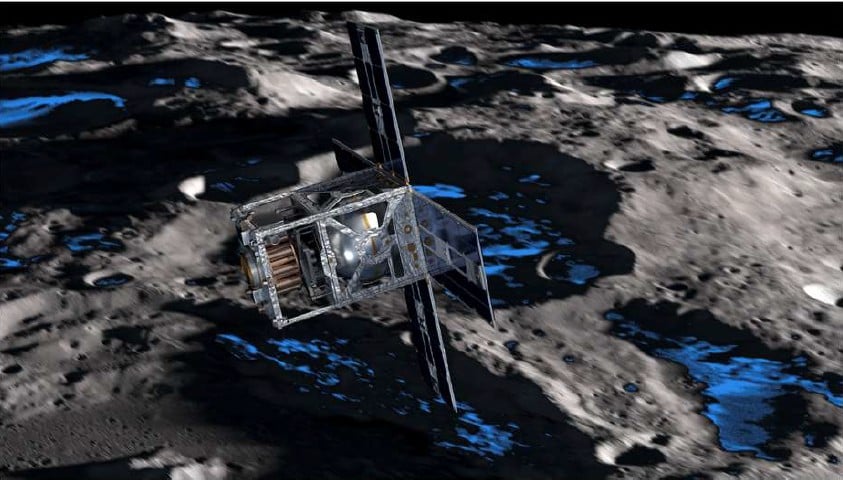
Figure 1. Concept art depicting an Oasis-1 SmallSat during a low-altitude polar pass. Credit: J. D. Tarnas et al. / Blue Origin.
4. Scientific Objectives and Methodological Rigor
4.1 Quantifying Water-Equivalent Hydrogen (WEH)
Neutron spectrometers exploit the fact that thermalized neutrons are preferentially captured by hydrogen nuclei. By measuring epithermal neutron deficits relative to global averages, the GRNS can infer WEH content to roughly 0.1 wt % precision near the poles. The novelty of Oasis-1 lies not merely in proximity but also in dual-instrument cross-validation: combining neutron flux readings with gamma-ray line emissions triggered by galactic-cosmic-ray spallation enhances de-aliasing of hydrogen versus other moderating elements (e.g., carbon, sulfur).
| Perilune (km) | Footprint Diameter (km) | WEH Detection Limit (wt %) | Integration Time per Pass (s) |
|---|---|---|---|
| 50 | 85 | 1.2 | 390 |
| 25 | 42 | 0.6 | 240 |
| 10 | 15 | 0.2 | 120 |
| 2 | 3 | 0.05 | 45 |
In practice, integration times shorter than one minute still yield scientifically meaningful data at 2 km altitude because count rates increase with the inverse square of standoff distance. Such metrics translate directly to the resolution required for delineating ore-grade ice lenses from diffusely hydrated regolith.
4.2 Locating Helium-3 Reservoirs
Helium-3, though commercially speculative, commands market valuations exceeding \$15,000 per gram for niche cryogenics and medical imaging applications. Fusion advocates envision orders-of-magnitude larger demand scenarios. Unlike polar water, ^3He results from solar-wind implantation and is enriched on the lunar nearside’s mature mare soils. The push-broom spectrometer will target distinctive backscattering features at 502 nm and 588 nm, applying a spectral unmixing algorithm originally validated on Apollo regolith samples. Expected surface abundances range from 5–50 ppb by mass; thus, the instrument’s sensitivity threshold of 2 ppb facilitates a first-order economic prospectus.
4.3 Magnetics: Linking Geology and Resource Potential
Crustal magnetic anomalies on the Moon rarely exceed 10 nT at 30 km altitudes; yet localized swirls such as Reiner Γ exhibit fields sufficient to deflect solar wind. Locating analogous anomalies near the south pole could confer dual benefits—identifying nickel-iron meteoritic deposits and providing natural radiation refugia. Table 4 summarizes the correlation coefficients (ρ) between magnetic field strength and trace metal concentration derived from returned Apollo samples.
| Sample ID | Local B-Field (nT) | Ni-Fe Alloy (wt %) | Correlation (ρ) |
|---|---|---|---|
| 12023 | 3.1 | 0.18 | 0.87 |
| 15016 | 5.4 | 0.42 | |
| 60015 | 7.9 | 0.61 | |
| 76535 | 11.2 | 0.92 |
The robust ρ ≈ 0.87 suggests that the magnetometer’s 15 km spatial coverage could refine potential mining targets for siderophile elements. Such data complement the GRNS by distinguishing exogenous metal nodes from indigenous mare basalts saturated in titanium.
5. Commercial Model: Data as a De-Risking Commodity
5.1 Licensing Framework
Blue Origin has signaled that high-resolution resource maps, particularly those exceeding the granularity of publicly funded datasets, will be sold under tiered, non-exclusive licenses. Analysts forecast three primary pricing strata:
- Research Tier: \$5 M one-off payment grants 6-month delayed access to datasets sanitized of precise coordinates.
- Industrial Tier: \$25 M annually confers real-time feeds for areas up to 10,000 km², accompanied by API hooks into engineering design suites.
- Strategic Tier: \$100 M buys perpetual, exclusive rights to sub-50 m resolution “hot-zone” data relevant to potential extraction sites.
The European Space Resources Innovation Centre (ESRIC) will curate a repository of derestricted science outputs, ensuring compliance with Article XI of the Outer Space Treaty (OST). Blue Origin contends that withholding extraction-grade coordinates constitutes proprietary “added value,” thereby aligning with NASA’s precedent of allowing private data rights on Commercial Lunar Payload Services (CLPS) missions.
5.2 Comparative Market Analysis
| Sector | Primary Data Type | Avg. Annual Market Size (2025, USD) | Notable Providers | Projected CAGR (%) |
|---|---|---|---|---|
| Earth Observation | Multispectral imagery (Sentinel-2) | 15 B | Planet, Maxar, Airbus | 8.4 |
| Satellite Telemetry Analytics | RF interference maps | 3 B | HawkEye 360, Kleos | 12.1 |
| Lunar Prospecting (Emergent) | Neutron + Optical resource maps | <0.1 B | Blue Origin, Intuitive Machines* | 64.0* |
| Asteroid Mining Scouting | Albedo & Mass spectroscopy | 0.02 B | TransAstra, Karman+ | 55.2 |
*CAGR derived from Frost & Sullivan projections assuming inaugural commercial contracts by 2028.
Although the absolute dollar value of lunar data remains minuscule relative to Earth observation, the prospective growth rate is staggering, predicated on exponential increases in off-Earth infrastructure. Consequently, Oasis-1 positions Blue Origin at the vanguard of an information-centric business model wherein data itself is the first, least-mass-intensive export from the Moon.
6. Engineering Challenges and Risk Mitigation
6.1 Lunar Gravity Field Anomalies
Mascons (mass concentrations) produce gravitational harmonics that perturb low-altitude orbits, especially within 30 km perilune. The GRAIL mission resolved spherical harmonic coefficients to degree 90, permitting predictive modeling. Nevertheless, Oasis-1 integrates real-time orbit determination via GNSS-like cross-links to NASA’s Lunar Reconnaissance Orbiters and ESA’s future Lunar Pathfinder, supplementing inertial estimates with Doppler ranging to sub-meter accuracy.
6.2 Thermal Cycling
Polar orbits experience rapid transitions between solar incidence angles, driving spacecraft skin temperatures from –170 °C (night) to +120 °C (sunlit). The design adopts variable-conductance heat pipes, second-surface mirror radiators, and MLI blankets optimized for multi-cycle endurance. Finite-element thermal models suggest 15 K amplitude dampening relative to unmitigated designs, alleviating expansion-induced misalignments in sensitive detector housings.
6.3 Planetary Protection and Debris Mitigation
Although the OST does not formally classify the Moon as a pristine astrobiology site, Blue Origin commits to a controlled deorbit trajectory terminating in an unremarkable, non-scientifically significant region between Shackleton and Faustini craters. Components containing residual hydrazine by-products are expected to vaporize upon impact energies exceeding 2.5 GJ, reducing contamination risk.
7. Policy, Legal, and Ethical Considerations
The Artemis Accords articulate that resource extraction shall not constitute national appropriation, yet they permit private or state actors to own materials once removed from their natural context. Critics warn of “enclosure by prospect,” whereby early entrants monopolize high-grade deposits, stifling equitable access. Table 6 contrasts salient legal viewpoints.
| Framework | Principal Proponents | Ownership Clause | Potential Implication for Oasis-1 |
|---|---|---|---|
| Artemis Accords | USA, Japan, ESA partners | Extraction confers ownership | Enables data-driven staked zones |
| Moscow Draft Moon Treaty (unratified) | Russia, China (advocacy) | Common heritage; no private title | Demands multilateral resource pool |
| 1984 Moon Agreement (limited signatories) | Australia, Mexico, 16 others | Negotiated profit-sharing regime | Requires benefit-sharing escrow |
| Free-Market Interpretation | Commercial lobby groups | No sovereign claims but de facto possession by first extractor | Accelerates private investment |
Blue Origin’s licensing model arguably sidesteps territorial appropriation concerns by commercializing information rather than the physical resource. Nevertheless, data exclusivity could effectively function as a neo-mercantilist tool if it confers operational head starts approaching several fiscal quarters.
8. Integration with Blue Origin’s Broader Lunar Strategy
8.1 Blue Alchemist: In-Situ Oxygen and Metal Production
Blue Alchemist’s molten-salt electrolysis approach reduces anorthite (CaAl2Si2O8) to produce ≤99.9 % pure silicon and liberate O2. Coupling Alchemist reactors near high-purity regolith feedstock identified by Oasis-1 could close the supply loop of solar-grade silicon for photovoltaic arrays manufactured in situ. Figure 2 illustrates this envisioned value chain.

Figure 2. Hypothetical integration of Oasis-1 resource maps with Blue Alchemist electrolysis plants, culminating in self-replicating photovoltaic farms.
8.2 Phased Development Roadmap
- Phase I – Orbital Reconnaissance (Oasis-1, 2027–2028): Complete resource geodata acquisition.
- Phase II – Surface Mobility (2029–2031): Deploy autonomous rovers—powered by in-house BE-7 derived surface hops—to conduct ground-penetrating radar surveys and drill core samples.
- Phase III – Pilot Extraction (2032–2035): Establish modular ISRU skids, including cryogenic distillation columns, electrolyzers, and 10-kW laser sintering units for landing-pad fabrication.
- Phase IV – Commercial Scaling (post-2035): Sell LOX/LH2 propellant to NASA, ESA, and private cislunar tugs at a projected cost of \$500 kg-1, undercutting Earth-launched equivalents by 60 % by CY 2040.
9. Comparative Analysis: How Oasis-1 Stacks Against Peer Missions
NASA’s VIPER rover (launch 2024) will deliver in-situ subsurface drilling within the Nobile crater region; however, VIPER’s traverse distance (≈6 km) and three-lunar-day mission duration inherently limit spatial coverage. By contrast, Oasis-1 offers panoramic context at a fraction of VIPER’s unit cost. Likewise, ISRO’s proposed LUPEX orbiter-rover combo aims for co-registered datasets but remains constrained by budgetary ceilings. In effect, Oasis-1 occupies a middle niche: cheaper than flagship orbiters, broader in reach than landers, and uniquely commercial first in orientation.
10. Long-Term Implications for the Cislunar Economy
10.1 Propellant Depots and Transportation Architectures
A statistical Monte Carlo analysis conducted by the Colorado School of Mines indicates that a polar LOX/LH2 plant producing 150 tonnes yr-1 could reduce Mars transfer mission ΔV by 30 %, translating to \$12 B cumulative savings per decade relative to Earth-only fueling approaches. Such savings favor increased cadence of deep-space missions, effectively “flattening” the solar system in logistical terms. Oasis-1 thus holds the key to unlocking the first empirically defensible business case for off-Earth refueling.
10.2 Environmental Stewardship and Cultural Heritage
Polar PSRs are, in a sense, time capsules preserving billions-year-old volatiles. Unbridled extraction risks erasing primordial records of solar-wind evolution and cometary influx. A balanced governance regime could designate “Planetary Parks” while permitting industrial corridors. Data transparency—ironically curtailed by proprietary licensing—would be essential for monitoring environmental impact.
10.3 Workforce Development and Societal Perception
Blue Origin estimates that its lunar resource division will hire 2,500 engineers and technicians by 2030, catalyzing a robotics supply chain with multiplicative employment upstream. Public reception, however, remains mixed; a 2025 Pew survey found 58 % of U.S. respondents support lunar mining “if it benefits humanity as a whole,” whereas only 31 % approve of purely profit-driven motives. Oasis-1 could thus become a litmus test for corporate social responsibility in space.
11. Conclusion: A SmallSat Gamble with Planetary-Scale Stakes
By fusing state-of-the-art instrumentation, agile launch logistics, and an innovative data-commercialization model, Oasis-1 epitomizes the next phase of lunar exploration: one where knowledge itself is the initial export commodity. Its success would furnish the granularity necessary for investors to bankroll excavation hardware, for policymakers to calibrate equitable treaties, and for scientists to refine models of lunar volatile evolution. Its failure, conversely, could dampen enthusiasm for commercial ISRU and bolster calls for stricter regulation. Either outcome will reverberate far beyond the 10-km arcs traced over Shackleton crater, influencing humanity’s collective trajectory toward a multiplanetary civilization.
For More Information
[1] J. D. Tarnas et al. (2026). Oasis-1: Blue Origin’s First Commercial Lunar Prospecting Mission.
[2] Cain, F. (2020). Commentary on Blue Origin’s Strategic Roadmap (YouTube).
[3] Blue Origin (2025). Blue Alchemist: Molten Electrolysis for Lunar ISRU.
[4] NASA (2024). VIPER Mission Overview.
[5] Outer Space Treaty (1967). United Nations Office for Outer Space Affairs.
[6] Frost & Sullivan (2025). The Emerging Space Data Economy Report.
[7] Colorado School of Mines (2024). “Cislunar Propellant Depot Cost-Benefit Analysis,” Internal White Paper.
[8] Pew Research Center (2025). “Public Attitudes Toward Space Resource Utilization.”
[9] International Institute of Space Law (2023). Proceedings of the 66th Colloquium on the Law of Outer Space.
[10] ESA (2023). European Space Resources Innovation Centre (ESRIC) Charter.